Best M.Ed. Programs in Nevada
Compare 32 accredited Education (M.Ed.) programs in Nevada at 3 schools, with graduate earnings, cost, debt, and completion data from IPEDS and the U.S. College Scorecard.

Choosing an M.Ed. in Nevada is mostly a tradeoff between price and format. The public universities in Reno and Las Vegas cost far less than a private hybrid program, though the cheaper seat may not fit a working teacher's schedule or licensure goal.
Annual tuition and fees at these schools run from $7,032 at the University of Nevada-Reno to $52,976 at Touro University Nevada, with UNLV at $7,413.
For teachers paying out of pocket, a master's that doesn't line up with a Nevada license or endorsement rarely recovers its cost, even when it is one of the M.Ed. programs with no GRE required.
Key Points
- UNR and UNLV charge $383.25 per graduate credit in 2026-2027.
- Nonresident M.Ed. students pay $18,142 more in tuition and fees.
- UNR reports $66,406 median earnings four years after finishing.
The Best M.Ed. Programs in Nevada for 2027, Ranked
Nevada's strongest master's in education options run through Reno, Las Vegas, and Henderson, with online and campus tracks for teachers, school counselors, and future administrators. The schools below were ranked from the available dataset, with attention to licensure pathways, cost, and the kinds of classroom and leadership roles each program supports.
Touro University Nevada
#1Henderson, NV · ~$53,000/yr (est.)
Best for: Aspiring K-12 school counselors in Nevada
Touro University Nevada is a private Henderson-based graduate educator preparation provider with a focused School of Education. Its M.Ed. options emphasize school counseling and curriculum and instruction, with online and on-campus night and weekend courses plus required fieldwork in Nevada schools. Touro lists tuition at roughly $480 per credit, with published estimates of $17,940 to $23,700 depending on required credits. The school is an approved educator preparation provider in Nevada.
- Online M.Ed. in school counseling with cohort-based structure
- Requires a 2.8 minimum GPA and a bachelor's degree
- $75 application fee and one cohort per year
- On-campus internship required for K-12 preparation
- Prepares for K-12 school counseling roles
- Hybrid curriculum and instruction track with school counseling emphasis
- Online and on-campus night and weekend classes
- One start date per year for the M.Ed.
- Certificates available in Spanish, autism, and special education
- Doctoral pathway in education administration and leadership
University of Nevada-Reno
#2Reno, NV · ~$7,000/yr (est.)
Best for: Licensed teachers moving into Nevada school leadership
The University of Nevada, Reno is a public research university with one of the state's broadest M.Ed. portfolios, spanning educational leadership, special education, elementary and secondary education, and reading and literacy. Many options are online, including a 36-credit educational leadership cohort for licensed teachers and an applied behavior analysis track with verified BCBA coursework. UNR lists graduate tuition at $9,578 in-state and $27,720 out-of-state, and the school graduates about 61% of students. Its educator preparation programs are CAEP-accredited.
- 36-credit cohort designed for current licensed teachers
- Synchronous online classes with embedded field internship
- Cohort of about 25 teachers, spring start
- Application deadline November 15 with three recommendations
- Guided by practicing principals and university faculty
- Online options for several emphasis areas
- BCBA coursework verified by ABAI
- Leads to Nevada licensure
- Applications accepted year-round
- 33-credit online track with six concentration options
- Praxis entrance exam required
- Rolling admissions with fall and spring starts
- Initial licensure or advanced preparation path
- 34-credit online track with BCBA verified course sequence
- Thesis or capstone option
- Praxis entrance exam required
- Faculty includes BCBA-D professors
- ABAI-accredited coursework
- Campus-based program designed for career changers
- Leads to K-8 teaching license
- Focus on high-impact education
- 48 total credit hours with entrance exam required
- First-time licensure program with full-semester student teaching
- Fast-track license available in two semesters
- Concurrent ESL graduate certificate option
- Teaching majors available in 19 subject areas
- Comprehensive exam required for degree
- 30-credit online program completed in about two years
- No entrance exam required
- Includes Nevada Reading Specialist certification
- Covers phonemic awareness, phonics, vocabulary, fluency, comprehension, writing
- Rolling admissions
- Fully online program for practicing educators
- Two-year completion path
- Designed for continuing educator improvement
University of Nevada-Las Vegas
#3Las Vegas, NV · ~$7,000/yr (est.)
Best for: Career changers earning conditional teaching licenses
The University of Nevada, Las Vegas offers a large set of master's-level educator preparation programs, including curriculum and instruction with 14 concentration options, school counseling, educational policy and leadership, special education, and early childhood and multilingual education. Several pathways are built for career changers, with conditional teaching licenses available after one semester in some MAT programs. UNLV lists graduate tuition at $9,748 in-state and $27,411 out-of-state, and the school graduates about 51% of students. The school's M.Ed. options align with Nevada licensure and endorsement requirements.
- Applied practice in early childhood and special education settings
- Aligned to Nevada licensure and endorsement requirements
- Campus-based master's in early childhood education
- 14 concentration options, including educational technology and career, technical and postsecondary education
- Culminating experience required
- Prepares for curriculum development, instructional coaching, and diversity specialist roles
- Campus-based with core plus concentration courses
- CACREP-accredited school counseling program
- 60 total credit hours with hybrid delivery
- Late afternoon and evening classes for working students
- Multicultural and social justice focus with field experience
- 36 total credit hours
- Meets Nevada administrator endorsement requirements
- Hybrid delivery with urban community and school focus
- Prepares for PK-12 school leadership
- 8 concentration options across arts, English, math, science, social studies, world languages
- Pathway for non-education bachelor's degree holders
- Conditional teaching license after one semester
- Covers Nevada standard licensing requirements
- 36 total credit hours with 24 credits in English Language Learning core
- 3 concentration options
- 2.8 GPA minimum and capstone required
- Designed for holders of a baccalaureate in education
- Three concentrations: student affairs, intercollegiate athletics, and higher education organization
- Prepares for entry-level leadership in higher education
- Careers include hall director, academic advisor, facilities management, and advancement
- Campus-based with learning outcomes in diversity and ethics
- Applied practice in educational settings
- Aligned to educational licensure and endorsement requirements
- Special education graduate certificate available
- MAT pathway for non-education bachelor's degree holders
- Earn conditional Nevada teaching license
- Complete Nevada standard licensing and master's requirements
Cost & outcomes by school
Federal data for the highest-earning Education (M.Ed.) programs, independent of the ranking above. Earnings are this field's master's graduates four years after completing, where the Scorecard reports them.
| School | Earnings | Tuition / yr | Debt | Grads/yr | Format |
|---|---|---|---|---|---|
| University of Nevada-Las Vegas NV | — | $7,413 | — | 2,582 | Campus |
| University of Nevada-Reno NV | — | $7,032 | — | 1,932 | Online |
| Touro University Nevada NV | — | $52,976 | — | 350 | Hybrid |
Sources: U.S. Department of Education. Tuition and graduates: IPEDS. Earnings and debt: College Scorecard, this field's master's graduates; a dash means no figure is reported.
Online and Hybrid Master's in Education Options in Nevada
Format by program
- UNR Educational Leadership: An online master's in education program with a 36-credit cohort that starts each spring and runs about two years. Nevada Leads selects 25 teachers.
- UNLV Educational Policy and Leadership: Campus-based, and the only format that comes close to hybrid. It is a 36-semester-hour cohort running 18 to 24 months.
- UNLV Curriculum and Instruction: Core and concentration coursework ending in a culminating experience. Confirm current delivery with the department, since a secondary source describes some UNLV specializations as mostly online.
Scheduling and field requirements
UNR's online delivery mixes synchronous Zoom sessions with asynchronous work, so expect some set meeting times. UNLV's leadership classes meet Tuesday or Wednesday evenings at Clark County School District sites, plus roughly one weekend a month at UNLV.
Both leadership programs, like other master's in education programs in Nevada, include school-based practice. UNR requires an internship aligned with Nevada administrative-endorsement requirements. UNLV ends with a capstone Field Experience under site administrators and a university supervisor. Ask each program whether you can complete placement in your home district. UNLV's Curriculum and Instruction track closes with CIG 697 (1 credit) or CIG 698 (3 credits).
Who each format suits
UNR's online cohort fits Washoe County teachers and rural educators who cannot commute. UNLV's evening cohort suits Clark County teachers who can reach district sites midweek. Career changers seeking licensure should look at UNLV's alternative route, which requires Praxis Core or CBEST, rather than a leadership degree.
Which Nevada M.Ed. Programs Waive or Make the GRE Optional?
GRE expectations differ by program and track. Several of the programs below waive the GRE entirely, while one makes score submission optional. In place of the GRE, admissions pages emphasize GPA minimums, teaching credentials, and sometimes other exams such as Praxis Core or CBEST.
| School | M.Ed. Track | GRE Policy | Waiver Conditions / Notes |
|---|---|---|---|
| University of Nevada, Las Vegas | Higher Education | Optional GRE submission | Strong GRE scores may help applicants with a lower GPA, but exceptional GRE scores may not overcome very low GPAs. Minimum GPA is 2.75 for all undergraduate work or 3.00 for the last two undergraduate years. |
| University of Nevada, Reno | Reading Curriculum and Instruction | No GRE required | Requires a bachelor's degree from an accredited institution and a minimum undergraduate GPA of 2.75. Satisfies the academic component for Nevada's Reading Specialist Endorsement; endorsement qualification requires a valid Nevada elementary or secondary teaching license and three years of licensed teaching in a K-12 setting. |
| University of Nevada, Reno | Elementary Education | GRE waived | Requires a valid elementary or secondary teaching license and a minimum 2.75 GPA. The admissions page does not state a separate GPA-based GRE waiver condition. |
| University of Nevada, Reno | Secondary Education | GRE waived | Requires a 3.0 overall GPA plus 2.5 in the teaching major. The program also mandates Praxis Core or CBEST scores. |
Related Articles
How Much a Master's in Education Costs in Nevada, and Which Tracks Lead to Licensure
In master's programs in Nevada, UNR and UNLV charge the same per-credit price for an M.Ed., so what you actually pay depends on fees, residency, and the track you choose.
What the Credits Cost
Both universities list a 2026-2027 graduate rate of $383.25 per credit. At UNR, that is a base rate that varies by residency, and mandatory fees are added based on your credit load.2 At UNLV, the rate is charged plus fees, and nonresidents pay more:1
- Nonresident, 1 to 6 credits: a $421.75 per-credit surcharge on top of tuition.
- Nonresident, 7 or more credits: a flat $10,094.50 charge.
- Online courses: a $34 per-credit distance education fee.
- Other charges: $7 per credit for graduate student services, plus $25 per semester.
For scale, UNR's Elementary Education M.Ed. runs 32 to 67 credits. That works out to roughly $12,264 to $25,678 at the base rate, before fees. Ask either school about graduate assistantships before you set a budget, and compare most affordable M.Ed. programs.
Do You Need a License to Enroll?
Not for every track. UNR's Elementary Education M.Ed. is built for career changers who hold a bachelor's degree outside education, and it pairs the degree with Nevada K-8 licensure. You'll need a Praxis 5019 score of 155 or higher, passed within five years before you apply.
Advanced tracks assume you already teach. UNR's fully online Literacy Studies M.Ed. supplies coursework toward the K-12 Nevada State Literacy Specialist Endorsement, which requires a master's degree and three years of teaching. Teachers who already hold a master's can enroll as graduate special students and take only the endorsement courses. At UNLV, confirm directly with the program which tracks lead to licensure or administrative credentials.
Nevada Administrator Licensure at a Glance
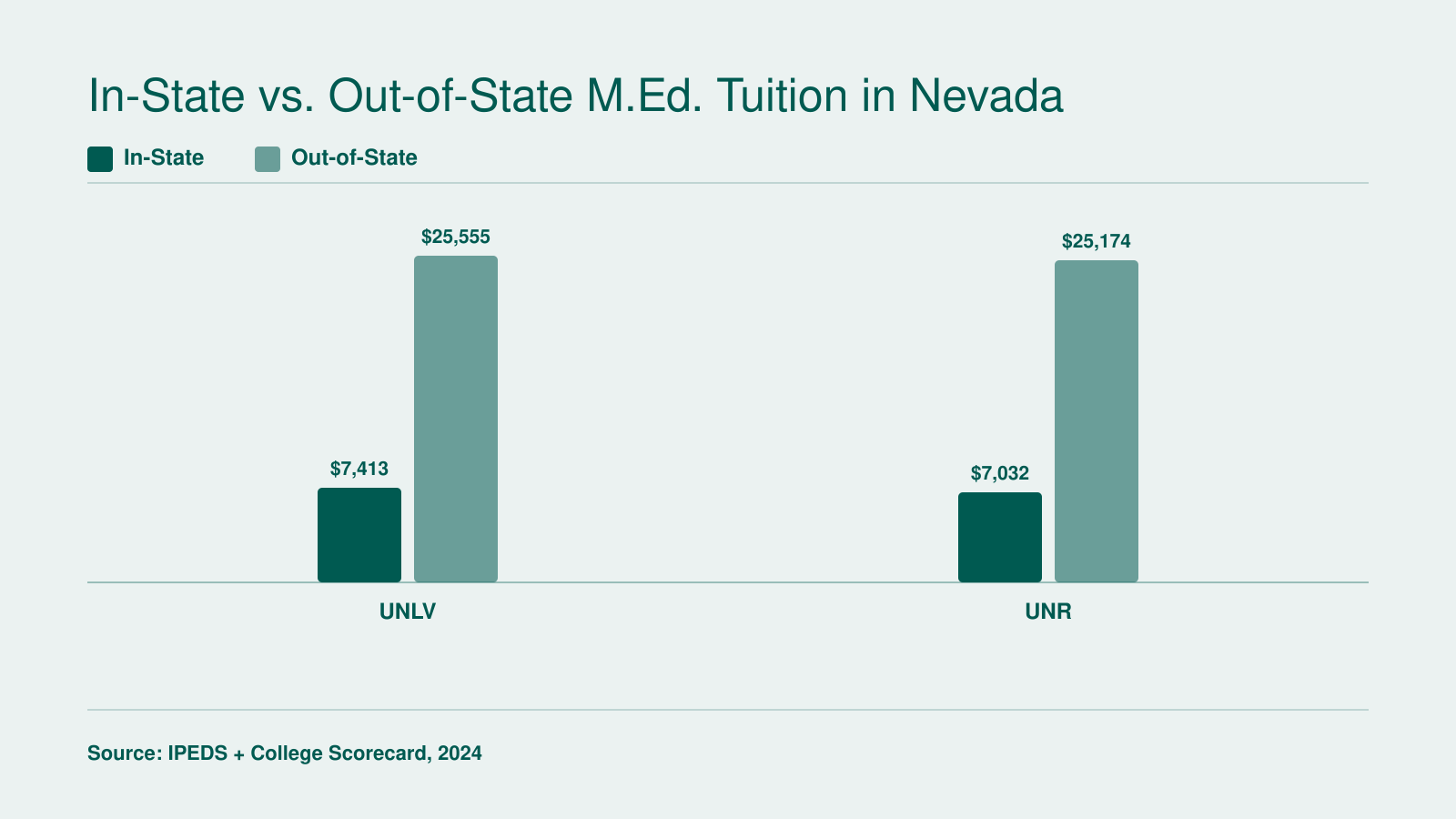
In-State vs. Out-of-State M.Ed. Tuition in Nevada
Non-resident M.Ed. students pay $18,142 more in graduate tuition and fees at UNLV and UNR. Net price is an institution-wide average, not a program-specific quote.
What Nevada M.Ed. Graduates Earn
Among the programs here, the highest reported program-level median earnings is $66,406 four years after finishing for University of Nevada-Reno's M.Ed. in Educational Leadership.
UNR vs. UNLV M.Ed. Programs: How They Compare
Should you pick UNR or UNLV among accredited M.Ed. programs in Nevada? The answer usually depends on the credential you need and which part of Nevada you plan to teach in.
- Concentrations: UNR's offerings center on elementary education, secondary education and educational leadership. UNLV lists curriculum and instruction (professional studies), English language learning with ELL and bilingual tracks, special education and educational leadership.
- Format: UNR runs its educational leadership M.Ed. online. UNLV admits leadership students in cohorts.
- Licensure tracks: UNR's elementary M.Ed. leads to first-time K-8 licensure for bachelor's holders without an education degree. UNLV special education accepts applicants with or without a license, with focus areas from autism to gifted and talented.1
- Deadlines: UNR elementary recommends March 15 (fall) and October 15 (spring); secondary uses April 15 and October 15; online leadership uses November 15 for spring. UNLV's Graduate Application Deadlines are May 1 and October 1, though education programs can set earlier ones. Its leadership cohorts close November 15 (fall) and April 15 (spring).
- Transfer credit: UNR elementary caps transfer and graduate special credit at 12 combined.
UNR suits northern Nevada career changers and working teachers who want online leadership coursework. UNLV fits southern Nevada educators who want the UNLV M.Ed. Educational Policy and Leadership cohort (three years of licensed teaching required) or a specialty in special education or bilingual instruction.
Compare Education (M.Ed.) programs on the data that matters
Explore more MEd specializations or browse every graduate field.
All MEd programs