Master's Programs in Alabama
Every master's program reported by a school in Alabama: 770+ programs at 30+ graduate schools, with the online options, costs and outcomes behind each one.

What does a master's degree in Alabama actually cost, and does the name on the diploma change what you earn? The options are broad. Research universities (the University of Alabama, UAB, and Auburn) sit alongside regional publics such as Troy, Jacksonville State, North Alabama, and West Alabama, plus private Samford. Many now run fully online tracks, including master's programs without GRE.
In-state graduate tuition here is often lower than at comparable schools in neighboring states, which makes price a real lever rather than a footnote.
The tension is that the cheapest route and the best-documented outcome are rarely the same program, and public earnings data at the graduate level remains thin.
Key Points
- The University of West Alabama lists graduate tuition at $429 per credit for 2026.
- UAB's MBA requires no GMAT or GRE score, but other programs vary.
- Alabama's Class A teaching certificate requires a master's from a State-approved program.
Popular degrees in Alabama
Master's programs in Alabama by field
Business & Management
- Accounting23 programs
- Management21 programs
- Finance19 programs
- Marketing18 programs
- Healthcare Administration18 programs
- Public Administration17 programs
- Healthcare Management15 programs
- General Business13 programs
Education & Teaching
- Secondary Education28 programs
- Elementary Education23 programs
- Special Education16 programs
- Music Education15 programs
- STEM Education or Science Education or Mathematics Education12 programs
- Educational Leadership11 programs
- Early Childhood Education9 programs
- Science Education8 programs
Nursing
- Family Nurse Practitioner (FNP)16 programs
- Nursing Education or Nurse Educator12 programs
- Nurse Administrator12 programs
- Psychiatric Mental Health Nurse Practitioner10 programs
- RN to MSN8 programs
- Health/Nursing Informatics5 programs
- Womens Health Nurse Practitioner4 programs
- MSN/MBA3 programs
Healthcare
- Health Administration13 programs
- Exercise Science10 programs
- Nutrition10 programs
- Public Health10 programs
- Speech Pathology9 programs
- Health Informatics4 programs
- Health Education4 programs
- Clinical Research Management1 program
Social Work & Social Sciences
- Social Work18 programs
- Social Work Advanced Standing9 programs
- Sociology4 programs
- Political Science, Government3 programs
- Human Services1 program
Communications & Media
- Speech Pathology10 programs
- Communication8 programs
- Communication Disorders6 programs
- Public Relations2 programs
- Communication Management2 programs
- Journalism1 program
- Media Communication1 program
- Technical Communication1 program
Computers & IT
- Cybersecurity12 programs
- Information Security & Assurance10 programs
- Data Analytics7 programs
Counseling
- School Counseling11 programs
- Clinical Mental Health Counseling10 programs
- Marriage and Family Therapy or Marriage and Family Counseling5 programs
- Christian Counseling2 programs
- Addiction Counseling1 program
Psychology
- General Psychology6 programs
- Counseling Psychology4 programs
- Industrial Organizational Psychology3 programs
- Applied Behavior Analysis3 programs
- Sports Psychology2 programs
- Clinical Psychology1 program
- Educational Psychology or School Psychology1 program
Religion & Theology
- Theology6 programs
- Christian Ministry5 programs
- Divinity4 programs
- Youth and Family Ministry2 programs
- Christian Leadership1 program
- Urban Ministry1 program
Science & Engineering
- Sustainability or Environmental Management8 programs
- Environmental Science5 programs
- Geography3 programs
Arts & Design
- Creative Writing12 programs
- Fine Arts2 programs
Criminal Justice & Law
- Fire Science or Fire Administration or Fire Leadership4 programs
- Homeland Security3 programs
- Public Policy3 programs
- Master of Laws2 programs
- Cybercrime1 program
Top Alabama Universities for Master's Degrees
Choosing where to pursue a master's in Alabama usually comes down to a tradeoff between research depth and practical flexibility. The state's larger research universities build out thesis tracks and specialized STEM labs, while regional and private campuses lean toward professional degrees you can finish while working. Both paths are legitimate; the right one depends on whether you want to produce original research or move efficiently into a career.
Research and Flagship Universities
The University of Alabama (Tuscaloosa) and the University of Alabama at Birmingham anchor the state's research tier. UA offers master's work across business, education, and engineering, and it has built out fully online and hybrid graduate options, including 100% online programs in fields like management, higher education administration, and several engineering and education disciplines.1 UAB in Birmingham is strong in areas tied to its health-sciences presence, with master's offerings spanning management information systems, criminal justice, and nursing, plus a large catalog of online graduate programs. Both are good fits if you want a thesis path or lab-based STEM work.
Regional Public Universities
Regional publics prioritize accessible, flexible professional degrees. The University of South Alabama (Mobile) offers master's in accounting programs, nursing, and education, and runs online MBA programs, organizational leadership, and public administration fully online. Its MPA is also available in traditional and HyFlex formats, with tracks in healthcare administration, criminal justice, environmental policy, and emergency management. Other regional campuses, including Auburn University at Montgomery, Troy University, the University of North Alabama, Jacksonville State University, and the University of West Alabama, offer online master's options in selected fields, though their full 2026 inventories aren't consistently documented.
HBCUs and Private Options
Alabama State University (Montgomery) and Alabama A&M (Huntsville) are public HBCUs with graduate programs; Alabama State offers master's work in education, online MSW programs, and counseling and promotes online graduate programming. Among private institutions, Samford University (Birmingham) offers master's degrees in selected professional fields. Confirm online availability directly with each school, since offerings shift year to year.
Matching School Type to Your Goals
If your plan involves a thesis, a research assistantship, or a STEM or health-sciences specialization, the research universities (UA, UAB, Auburn, and UAH) give you the depth and faculty infrastructure to support it. If affordability and schedule flexibility matter more, especially for teaching, business, or public-service credentials, the regional publics and HBCUs tend to deliver solid professional degrees at lower cost with more online and part-time formats.
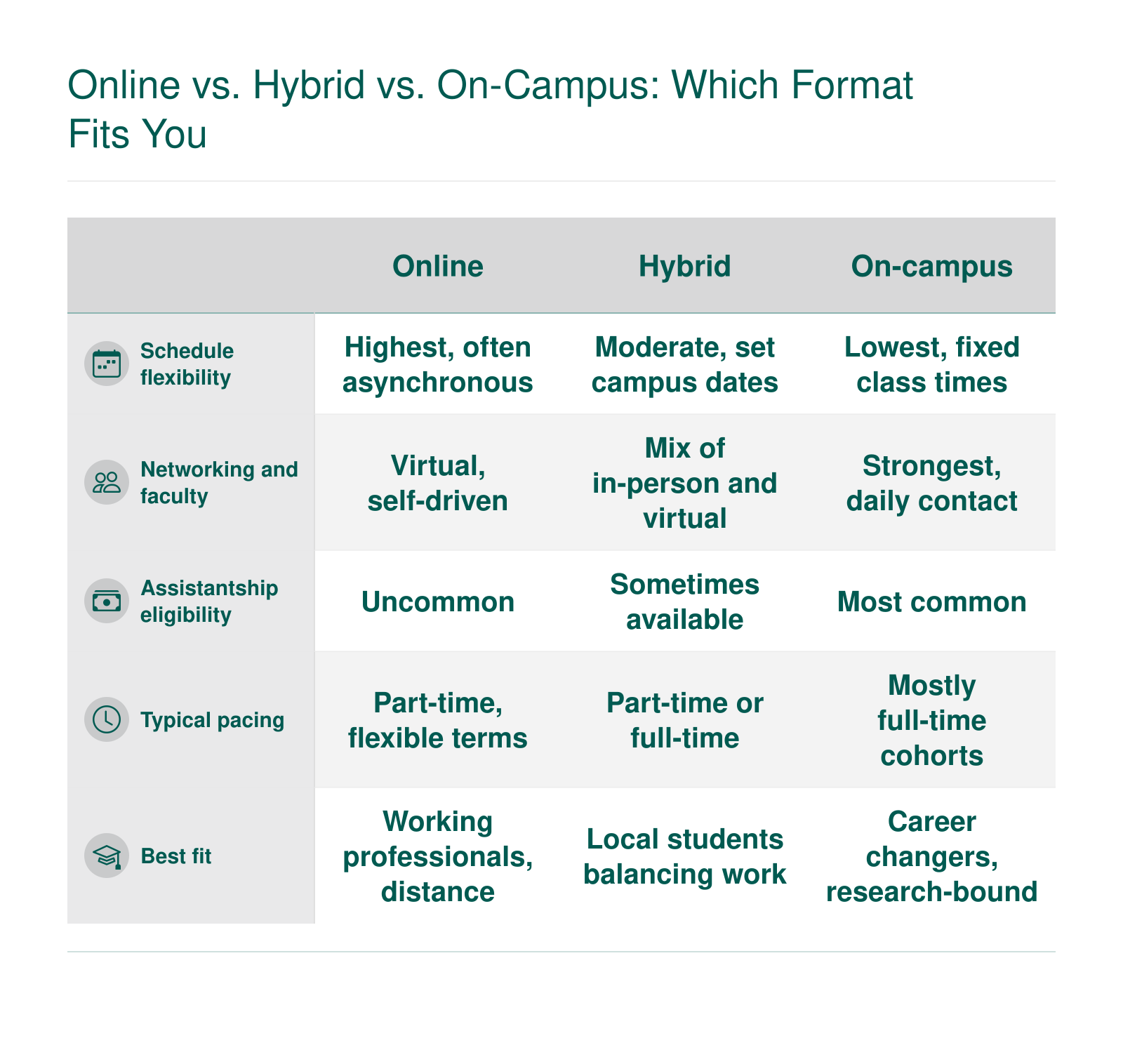
Online vs. Hybrid vs. On-Campus: Which Format Fits You
Format shapes your schedule, your access to faculty, and whether you can hold an assistantship. Use this comparison to match the delivery model to your life, then confirm details with each program, since policies vary by school.
Online Master's Programs in Alabama: Fields and Schools to Know
Several Alabama universities run sizable online graduate offerings: the University of Alabama (Bama By Distance), UAB Online, Auburn Online, and Troy Online, with the University of North Alabama, Jacksonville State, and the University of West Alabama also in the mix. Online fields commonly include education, nursing, business (including MBA programs and specialized degrees such as management information systems and accounting), engineering, counseling, social work, and public administration. Which fields each school offers changes often, so confirm against the current program page before you apply.
Accreditation: Same School, Same Standing
These are public universities accredited by SACSCOC, and an online master's is generally awarded by the same institution under the same institutional accreditation as the campus version. That is the core answer for anyone searching for accredited online master's programs in Alabama. Still, check the program level too. Social work (CSWE), nursing, and counseling programs carry separate programmatic accreditation, and that is what licensure boards look at.
Residencies, Practicums, and Clinical Placements
"Online" rarely means no in-person work in the licensed fields.
- Social work: UNA's online MSW programs are delivered online except for the field internship, which is arranged through a local, state, or regional agency. JSU's hybrid MSW Advanced Generalist (39 credits, for CSWE-accredited BSW holders) includes a 450-hour advanced internship.
- Health administration: UNA's online MHA (34 credits, about $20,400 total) requires a capstone. UAB's executive-format health administration option is reported as hybrid, mixing online work with campus sessions.
- Nursing and counseling: Expect supervised clinical hours or practicums, and ask whether you can complete them near home or must find in-state sites.
Do Out-of-State Students Pay More Online?
There is no single answer across Alabama. The University of Alabama charges online students the same distance-learning rate regardless of residency. For example, its online MA in Educational Psychology (Learning and Assessment) lists 30 credits at $480 per credit, roughly $14,700 in total for 2025-2026. UNA reports no out-of-state charge for its online programs in 2026.
Others are less clear-cut. Troy's published per-credit figures vary by source, with one 2026 schedule showing $424 in-state and $848 out-of-state, so verify the rate for your specific program. JSU, UAB, and Auburn have no institution-wide flat online rate that we could confirm, and UAB's blended or in-person programs are billed at standard tuition. Always get a program-specific cost sheet, including fees, before comparing offers.
The Cheapest Master's Programs in Alabama (And How to Pay Less)
The cheapest published master's tuition in Alabama is at the University of West Alabama, which lists graduate courses at $429 per credit for 2026. A third-party comparison lists Jacksonville State University at $410 per credit, which would be the lowest figure in the state if confirmed, but JSU's official 2026 pages do not establish that rate for all online master's students, so treat it as provisional.
Lowest published per-credit costs
- University of West Alabama: $429 per credit.
- Troy University: $475 per credit for TROY Online and support sites; the standard out-of-state rate is $950, but a waiver reduces it to $848. Active Duty Tuition Assistance service members pay $250 per credit after waivers.
- University of Alabama online: $480 per credit for Fall 2026 through Summer 2027, but course and test proctoring are extra. General graduate rates are $685 in state and $1,840 out of state.
- University of North Alabama: $495 per credit for online graduate programs, including the online MBA, online MHA, and MAcc.
- UAB: $588 to $744 per credit depending on the school or program.
Flat online rates can erase the out-of-state penalty
Several regional universities in Alabama publish online rates that are not raised for residency, which makes them especially cheap for out-of-state students. UNA's $495 online rate and UA's $480 online rate illustrate the pattern, while Troy charges $475 per credit for online and support-site students instead of the $950 out-of-state rate.
Ways to pay less
Assistantship tuition waivers and employer or dependent tuition benefits can lower the real cost at many Alabama universities, but these are institution-specific and not reflected in baseline per-credit prices. For military students, Troy publishes the clearest path: Active Duty Tuition Assistance service members pay $250 per credit after waivers. Other schools in this section do not consistently publish military or waiver rates, so ask the graduate school directly.
Compare total program cost, not just the sticker rate
A low per-credit price can hide a larger bill when a program requires 60 credits instead of 30. At UNA, the online MSW advanced standing track is an affordable MSW option, costing $14,850 before fees at 30 credits, while the traditional track costs $29,700 at 60 credits. At UA, the online MSW advanced standing track totals $20,160 before course and test proctoring at 42 credits, while the traditional track totals $28,800. Credit counts often range from roughly 30 to 60 or more, so always multiply the per-credit rate by the actual credit count and add technology, books, and graduation fees before comparing schools.
Admissions Requirements: GRE/GMAT Policies, GPA, and Deadlines
Do Alabama master's programs require the GRE? Not across the board. UAB's MBA requires no GMAT or GRE score, while the University of Alabama says some programs do require one, so you need to check the specific program. The table below covers the schools where we could verify current policies. Programs at South Alabama, Troy, UAH, and Jacksonville State are not shown because we could not confirm their current policies, so check those admissions pages directly. For the University of Alabama, the application fee is $65 for U.S. citizens and permanent residents and $80 for international students. Where a program posts no deadline, UA advises finishing your application at least six weeks before registration. Prerequisite coursework for fields like nursing, engineering, and the MBA varies by program, so confirm it on each program page before you apply.
| School | Minimum GPA | GRE/GMAT Policy | Common Waiver Criteria | Typical Fall Deadline |
|---|---|---|---|---|
| University of Alabama Graduate School | 3.0 overall, or 3.0 in a completed prior graduate program (4.0 scale) | Varies by program; some programs require a GRE or GMAT score, so check the Program Portal | No waiver when the program requires a score, or when applying with the 2026 Free Application Week code | Program-specific; if none is posted, complete your application at least six weeks before registration |
| UAB MBA | 3.0 cumulative undergraduate GPA | No GMAT or GRE required; a GMAT of 500 or higher may strengthen an application | Not needed, since no score is required | UAB Graduate School general deadline: August 1, 2026 for degree-seeking applicants; confirm the MBA date with the program |
| UAB MSN/MBA Dual Degree | 3.0 cumulative undergraduate GPA, or 3.0 in the last 60 semester hours | Required if GPA is below 3.2: 297 combined GRE verbal and quantitative, or 480 GMAT, taken within the past five years | Applicants with a graduate degree and at least a 3.0 GPA in that degree may receive a waiver | UAB Graduate School general deadline: August 1, 2026 for degree-seeking applicants; confirm the dual-degree date with the program |
| Auburn University, Curriculum and Teaching | 2.50 | N/A | N/A | June 15 |
Paying for Grad School: Assistantships, Fellowships, and Scholarships in Alabama
How Assistantships Work
Under University of Alabama graduate funding, a half-time (0.50 FTE) graduate assistantship includes a nine-month stipend, tuition, health insurance, and technology fees.1 A quarter-time appointment gets half that support. The tuition portion covers up to 15 credit hours or actual costs, whichever is less, and generally applies only to fall and spring.1 You must register for at least 6 hours, and Law and special-tuition programs such as the Executive MBA are excluded.
Stipends vary widely by department. UA's Biological Sciences reports a 12-month teaching assistant stipend of $34,992 for 2025-2026, with a full tuition waiver and health insurance, for most entering M.S. and Ph.D. students.2 American Studies lists $18,000.3 At Auburn, an appointment of 0.33 FTE or higher qualifies for a Graduate Tuition Fellowship covering resident or nonresident tuition up to 15 attempted hours, though you still owe student fees. UAB publishes no university-wide terms and sends students to individual programs, and some of its opportunities are open only to currently enrolled students.
Fellowships and Scholarships
- UA Graduate Council Fellowships: American Studies lists a $20,000 nonrenewable stipend.3 New master's students in two-year programs typically get one fellowship year and one assistantship year.
- SREB Doctoral Scholars: For new doctoral students planning to teach in higher education, with a stipend for up to three years and full tuition up to 15 hours per semester.1 Relevant if your master's leads to a Ph.D.
- UA Alumni Heritage Scholarship: A one-time $500 award for first-semester Alabama residents whose parent or grandparent is a UA graduate with an active Alumni Association membership.1
State-funded aid is limited. The Alabama Board of Nursing's Graduate Nursing Scholarship requires recipients to work in Alabama as nurses for two years.4 For K-12 teaching, no single state scholarship covers all graduate candidates; most awards come from universities and individual programs.
Employer Aid and Federal Loans
Because most graduate funding is institutional, ask your employer whether it reimburses tuition and what service commitment comes attached. Federal Direct Unsubsidized Loans remain the core federal option. Grad PLUS loans closed to new borrowers on July 1, 2026, under 2025 federal legislation, which also tightened borrowing limits, so confirm current caps with your financial aid office before relying on loans.
Contact the Department Directly
Many assistantships are filled by faculty and department chairs and never appear in a central portal. Email your program's graduate coordinator before applying, ask what openings exist and when decisions are made, and name faculty whose work matches your interests.
The Master's Degree Pay Premium
Master's degree holders earn a median of
Career Outcomes for Alabama Master's Graduates
What does a master's degree actually pay in Alabama? The honest answer is that the public data is thinner than most rankings pretend. A 2025 analysis of Alabama master's completers put the median salary at roughly $55,290 shortly after graduation1, with engineering, business, and health programs generally at the top and education and biology more often at the bottom. That ordering matches what you would expect, but it is a statewide average, not a promise attached to any one program.
Why program-level figures are hard to pin down
Federal College Scorecard earnings are reported only for graduates who received federal financial aid, who were working, and who were not enrolled in further study during the measurement year.1 Cash-paying students, people who went straight into a doctorate, and graduates who left the labor force are all invisible in those numbers. The University of Alabama, for example, shows a median of $116,062 for graduates after completion2, but that figure is not broken out by field or degree level, so it should not be read as an MBA salary. For most specific Alabama master's programs, clean field-level earnings simply are not published.
High-earning fields versus license-driven ones
Nurse Practitioner tracks, engineering, and computer science master's degrees tend to land at the upper end because the credential maps directly onto a higher-paid job title. Education and Counseling Psychology master's degrees usually pay less in raw dollars, but they function differently: the degree is the gateway to licensure, supervision hours, or a higher salary lane.
Alabama teachers see that lane explicitly. Under the FY 2026 state minimum salary schedule for a 187-day contract, a first-year Class A (master's) teacher starts at $54,818 versus $47,667 for Class B, a gap of about $7,151 that widens past $10,000 by the end of a career.3 Those are state-funded base figures before local supplements, and published versions differ slightly by step.
Where the jobs are
Three sectors absorb most Alabama master's graduates: healthcare, anchored by UAB Medicine in Birmingham; aerospace and defense contracting around Huntsville; and automotive manufacturing across the state's supplier network.
Accreditation and Licensure: Why It Matters for Your Alabama Degree
Institutional accreditation covers the whole university. Programmatic accreditation covers one degree. You need both, and they do different jobs.
Two Layers of Accreditation
SACSCOC accredits Alabama's major universities at the institutional level. That status underpins eligibility for federal financial aid, makes credits more likely to transfer, and satisfies the baseline many employers and licensing boards apply. Programmatic accreditation is narrower. Field-specific bodies review a single program's curriculum, faculty, and clinical or practical components, and licensing boards often key on it.
The main accreditors by field:
- Counseling: CACREP. Troy University lists CACREP accreditation for its MSCP in Clinical Mental Health Counseling (Dothan, Montgomery, and Troy campuses) and for its MSEd in School Counseling.1
- Education: CAEP and AAQEP. UAB and the University of Alabama both publish CAEP-accredited program lists, and Troy's school counseling degree also holds CAEP.
- Business: AACSB. The University of Alabama in Huntsville holds it for its business and accounting programs, though you should confirm that your specific master's is covered.
- Nursing and engineering: CCNE or ACEN for nursing, ABET for engineering. Check each school's accreditation page and the accreditor's own directory, because coverage varies by program.
Accreditation is campus-specific and program-specific. Troy also offers counseling at out-of-state sites, so match the accreditation listing to your location.
How Licensure Depends on It
For Alabama counselor licensure, the Board of Examiners in Counseling requires, for applicants since January 1, 2024, a single conferred counseling degree from a CACREP-accredited program.2 It must total at least 60 semester hours (or 90 quarter hours) at a regionally accredited institution.2 Licensure also requires 3,000 supervised hours.3 Older Board documents cite a 48-hour standard,4 and some materials mention content-equivalent programs, so confirm current wording with the Board before enrolling.
For advanced practice nursing, the Alabama Board of Nursing requires a program approved by a state board of nursing at an institution accredited by a U.S. Department of Education-recognized accreditor.5 It also requires national certification through a Board-recognized certifying agency.6 Ask the Board whether your specialty needs CCNE or ACEN specifically.
Teacher Class A certification runs through state-approved educator preparation programs, covered in the next section.
A Warning for Out-of-State Online Students
An Alabama degree does not guarantee licensure in your home state. Before applying, check your state board's rules on program accreditation, required hours, and supervised practice, and get the answer in writing.
Alabama Teacher Certification: The Class A Master's Path
How to Choose the Right Alabama Master's Program
The right Alabama master's program is the one whose accreditation, cost, format, and documented outcomes all line up with your specific goal, not the one with the most recognizable name. Run every option through the same four-part filter before you let prestige or marketing influence the decision.
The Four-Part Filter
- Confirm accreditation and licensure fit: Verify the institution holds regional accreditation and, if your field requires it, that the program carries the right programmatic accreditation (CACREP for counseling, CCNE or ACEN for nursing, including Family Nurse Practitioner (FNP) programs, and AACSB for business). A degree that does not satisfy Alabama licensure rules can cost you the career you enrolled for.
- Compare total program cost, not per-credit cost: A low per-credit rate means little until you multiply it by the full credit hour requirement and add fees. Ask each department for a complete cost sheet so you are comparing the real out-of-pocket total, whether you are weighing Affordable MBA programs or another field.
- Match format to your schedule: Online, hybrid, and on-campus each carry different time and travel demands. Be honest about how many hours you can give per week while working.
- Check outcomes data for your field: Look for earnings and employment figures tied to your specific program, not the university average, and treat missing data as a reason to ask the department directly.
Weight the Filter Toward Your Goal
Your priorities should shift with your plan. Career changers moving into a licensed field (teaching, counseling, nursing) should weight programmatic accreditation most heavily, since it is the gatekeeper to certification. Working professionals should prioritize online flexibility and confirm whether their employer offers tuition reimbursement, which can reshape the entire cost picture. Research-bound students aiming for a PhD or funded work should concentrate on assistantship funding at Alabama's R1 institutions, UA, UAB, and Auburn, where graduate research and teaching assistantships are most plentiful.
Your Next Step
Narrow your options to a shortlist of three programs that clear the four-part filter. Request a detailed cost sheet from each, then contact the department directly to ask two questions before you apply: what assistantships or fellowships are available to incoming students, and whether the program offers a GRE or GMAT waiver. The answers often separate a good fit from a great one, and they rarely appear on the program website.
Graduate schools in Alabama with the most master's programs
| School | City | Type | Master's programs | Online | Grad tuition / yr |
|---|---|---|---|---|---|
| University of South Alabama | Mobile | Public | 76 | 45 | $9,360 |
| The University of Alabama | Tuscaloosa | Public | 74 | 40 | $11,980 |
| University of Alabama at Birmingham | Birmingham | Public | 66 | 45 | $8,640 |
| Auburn University | Auburn | Public | 53 | 26 | $12,890 |
| Troy University | Troy | Public | 48 | 39 | $8,550 |
| Auburn University at Montgomery | Montgomery | Public | 40 | 24 | $9,136 |
| Jacksonville State University | Jacksonville | Public | 39 | 34 | $11,488 |
| University of West Alabama | Livingston | Public | 39 | 37 | $6,868 |
| University of North Alabama | Florence | Public | 38 | 29 | $10,350 |
| Samford University | Birmingham | Private nonprofit | 35 | 18 | $21,797 |
| Columbia Southern University | Orange Beach | Private for-profit | 32 | 32 | $3,936 |
| Strayer University-Alabama | Birmingham | Private for-profit | 28 | 28 | $15,135 |
| Herzing University-Birmingham | Birmingham | Private nonprofit | 26 | 26 | $9,370 |
| Faulkner University | Montgomery | Private nonprofit | 24 | 22 | $16,050 |
| Alabama A & M University | Normal | Public | 23 | 10 | $9,010 |
Program counts are the verified master's listings in our directory; tuition is the school-wide average for a full-time graduate student (IPEDS).
Alabama Master's Programs: Common Questions
These answers cover the questions prospective students ask most often about timelines, testing, tuition residency, and start dates. Policies vary by school and program, so confirm details with the graduate office before you apply.
How long does it take to complete a master's program in Alabama?
Do Alabama master's programs require the GRE?
Can out-of-state students pay in-state tuition for online master's programs in Alabama?
Can I start an Alabama master's program in spring or summer, or only fall?
Compare programs nationwide
Many Alabama residents study online. Every ranked list above has an online lens, or browse every field.
Online master's programs Browse all fields