Master's Programs in Arkansas
Every master's program reported by a school in Arkansas: 410+ programs at 21 graduate schools, with the online options, costs and outcomes behind each one.

Arkansas public universities charge some of the lower graduate tuition rates in the region. In-state students can pay roughly $300 to $475 per credit hour, and many master's programs run fully online. For a 30-credit degree, that can mean a total bill well under what comparable out-of-state programs charge.
The low rates raise practical questions. What does a degree actually cost once fees and credit requirements are counted? Do no-GRE options exist? How do assistantships and aid work? Which degrees lead to a state license, and which accreditor does the board require?
The answers vary by program, and a cheap per-credit rate does not guarantee a better outcome. In licensed fields such as counseling psychology and MSW programs, the right accreditation matters more than price.
Key Points
- University of Arkansas in-state tuition is about $473 per credit; Arkansas State's online rate is $300.
- Compare total program cost by multiplying credits by rate, then adding per-credit fees.
- Counseling licensure needs a 60-hour degree, and social work requires CSWE accreditation.
Popular degrees in Arkansas
Master's programs in Arkansas by field
Business & Management
- Analytics18 programs
- General Business15 programs
- Accounting13 programs
- Management12 programs
- Healthcare Administration11 programs
- Public Administration10 programs
- Project Management9 programs
- Healthcare Management8 programs
Education & Teaching
- Teaching23 programs
- Educational Leadership13 programs
- Special Education11 programs
- Curriculum & Instruction8 programs
- Educational Technology or Instructional Design5 programs
- Secondary Education5 programs
- Higher Education or Adult Education4 programs
- Elementary Education4 programs
Healthcare
- Public Health6 programs
- Exercise Science5 programs
- Health Administration5 programs
- Speech Pathology5 programs
- Nutrition4 programs
- Health Education4 programs
- Health Informatics1 program
Counseling
- Clinical Mental Health Counseling10 programs
- School Counseling9 programs
- Marriage and Family Therapy or Marriage and Family Counseling4 programs
- Addiction Counseling1 program
Communications & Media
- Communication6 programs
- Communication Disorders6 programs
- Journalism5 programs
- Speech Pathology5 programs
- Strategic Communication1 program
- Organizational Communication1 program
Nursing
- Nursing Education or Nurse Educator6 programs
- Family Nurse Practitioner (FNP)5 programs
- Nurse Administrator5 programs
- Psychiatric Mental Health Nurse Practitioner2 programs
- Public Health2 programs
- Adult Gerontology Acute Care Nurse Practitioner1 program
- Nurse Executive Leader1 program
- Direct Entry MSN (MENP) or (DEMSN)1 program
Computers & IT
- Cybersecurity7 programs
- Data Analytics6 programs
- Information Security & Assurance6 programs
- Machine Learning1 program
Social Work & Social Sciences
- Sociology4 programs
- Social Work Advanced Standing4 programs
- Social Work3 programs
- Political Science, Government2 programs
Arts & Design
- Creative Writing8 programs
- Fine Arts1 program
Science & Engineering
- Geography3 programs
- Environmental Science2 programs
- Sustainability or Environmental Management2 programs
Religion & Theology
- Divinity2 programs
- Theology2 programs
- Christian Leadership1 program
- Christian Ministry1 program
Psychology
- Applied Behavior Analysis2 programs
- Counseling Psychology2 programs
- Addiction Psychology1 program
Criminal Justice & Law
- Homeland Security1 program
How Much a Master's Degree Costs in Arkansas
Standard in-state graduate tuition at the University of Arkansas runs about $473 per credit hour for Fall 2026, while Arkansas State University prices its online graduate programs at $300 per credit for U.S. residents. That spread gives you a rough sense of the public-university range, with specialty colleges priced well above it and private schools such as Harding or John Brown University setting their own rates that published sources do not currently pin down for 2026.
Why the Per-Credit Rate Misleads
The sticker rate is only part of the bill. Mandatory university, technology, and online course fees stack on top of base tuition and can add a meaningful share per credit. At the University of Arkansas, online graduate mandatory fees total about $55 per credit, pushing the effective online rate near $529 in-state (excluding course-specific charges). At Arkansas State, required online fees of $60 per credit (a $40 online fee, $10 distance-education technology fee, and $10 identity-compliance fee) lift the base $300 rate to roughly $360 before any individual course fees, which can themselves range from a few dollars to over $250 depending on the class. The honest comparison is total program cost: credits multiplied by the rate, plus fees, across the whole degree.
Residency, Online Rates, and the Cheapest Option
Out-of-state students normally pay far more: standard graduate tuition at the University of Arkansas is roughly $1,288 per credit for non-residents. Online programs can erase that premium. A-State's online graduate tuition is a flat rate for U.S. residents regardless of state, and several of its program pages quote an all-in figure of $350 per credit.
The lowest complete online master's identified in current sources is Arkansas State's online M.S. in Educational Theory and Practice (General Education track), listed at $10,500 total for 30 credits with all fees included; its online M.S. in Media Management matches that figure. These are the lowest we found, not necessarily the cheapest statewide, so the right answer still depends on the specific program.
Premium tracks sit outside standard graduate tuition entirely. Walton College of Business MBA programs, for example, run about $652 per credit in-state, and engineering and MSN programs carry their own elevated rates. Compare the degree you actually want, not the general grad-school number.
Graduate Tuition and Fees at Arkansas Universities, Side by Side
Comparing graduate tuition in Arkansas is less about finding the lowest sticker price and more about identifying which rate structure actually applies to you: in-state, out-of-state, fully online, or program-specific. A low headline rate can become expensive after mandatory fees, while a higher per-credit rate may include everything.
These published per-credit figures are for the current academic year and exclude program-specific fees and differential tuition in fields such as general MBA programs and patient safety and quality MSN programs.
Current published rates
- University of Arkansas Fayetteville: $473.47 per credit hour for students studying completely online in fall 2026. Mandatory fees vary by enrollment category and course. Published per-credit fee items include library ($5.38), network and data systems ($18), off-campus ($30), online facilities ($2), student activity ($2.76), and student health and wellness ($9.21). On-campus in-state and out-of-state graduate per-credit rates were not available in the current figures.
- Arkansas State University: $754 per credit hour for out-of-state and international graduate students for 2026-27. In-state graduate per-credit tuition was not published in the current schedule. Required online fees total $60 per credit hour ($40 online fee, $10 distance-education technology fee, and $10 identity-compliance fee); a separate $50 online program fee and a $20 information technology fee also appear in published schedules. Additional course fees may range from $5 to $255 per course, and college support assessment fees vary by college.
For other Arkansas public universities, current-year graduate in-state, out-of-state, online, and mandatory per-credit fee figures were not available in a comparable form. Confirm those rates directly on each university's bursar or graduate admissions page before you compare total cost.
Reading the gaps
Because Arkansas State publishes an out-of-state rate of $754 per credit hour while UA Fayetteville lists a $473.47 online tuition rate before fees, the widest observable gap in this limited data is between campus out-of-state pricing and fully online tuition, not a classic in-state and out-of-state split. UA Fayetteville's fully online rate is the flat online tuition benchmark here, before mandatory fees. A-State also lists some online graduate programs at $350 per credit hour for all U.S. residents with fees included, but that is program-specific and should not be read as a university-wide online rate. Always total tuition plus mandatory fees and any course fees before comparing.
Online, Hybrid, and Campus Master's Formats in Arkansas
Fully asynchronous online courses let you fit study around a job; campus and hybrid formats trade that flexibility for direct access to labs, faculty, and cohorts. In Arkansas, the right choice often comes down to whether your field requires hands-on clinical or practicum work.
What Online Actually Means in Arkansas
Arkansas State University's ASU Online is the clearest example of a fully online model. Most of its master's courses run on accelerated 7-week terms in fall and spring, with some programs shortening summer terms to 5 weeks. That pacing produces advertised completion times as short as 12 months for programs such as the M.S. in Nutrition and Dietetics (non-RD track), the M.S. in Engineering Management, and the M.S. in Higher Education. Other ASU Online options take longer: the M.S.E. in Educational Theory and Practice advertises 18 months, and the M.S.E. in Educational Leadership advertises 20 months.
UA Little Rock, UCA, and the University of Arkansas also list online graduate offerings, but course length and pacing are program-specific. UCA's fully online post-master's certificate in Leadership Studies illustrates a hybrid synchronous/asynchronous design, combining scheduled live sessions with self-paced work, and can be completed in two to three semesters. For master's programs at these schools, verify the delivery format with the department rather than assuming all online courses are asynchronous.
Hybrid and Licensure-Driven Formats
Some fields rarely fit a fully online schedule. Counseling, nursing, and education programs often use hybrid designs that require campus intensives, skills labs, or in-state practicum and clinical placements. Even an online nursing or school counseling degree may require you to complete supervised hours at an approved Arkansas site, which matters for out-of-state students. State authorization through SARA covers many online programs, but licensure-track programs can still restrict out-of-state placements or require additional approval from your home state's licensing board. Confirm placement geography before enrolling.
Timeline Expectations
For working adults, full-time online study is intense: ASU Online's 7-week terms mean a 30-credit master's can finish in 12 to 20 months, but that assumes a steady two courses per term. Part-time enrollment stretches the same degree to two to three years or more, depending on how many credits you can carry alongside a job. Traditional campus master's programs in Arkansas commonly run about 18 to 24 months full-time, though thesis, clinical, or internship hours can extend that. Compare the total calendar time against your work and family obligations before choosing a format.
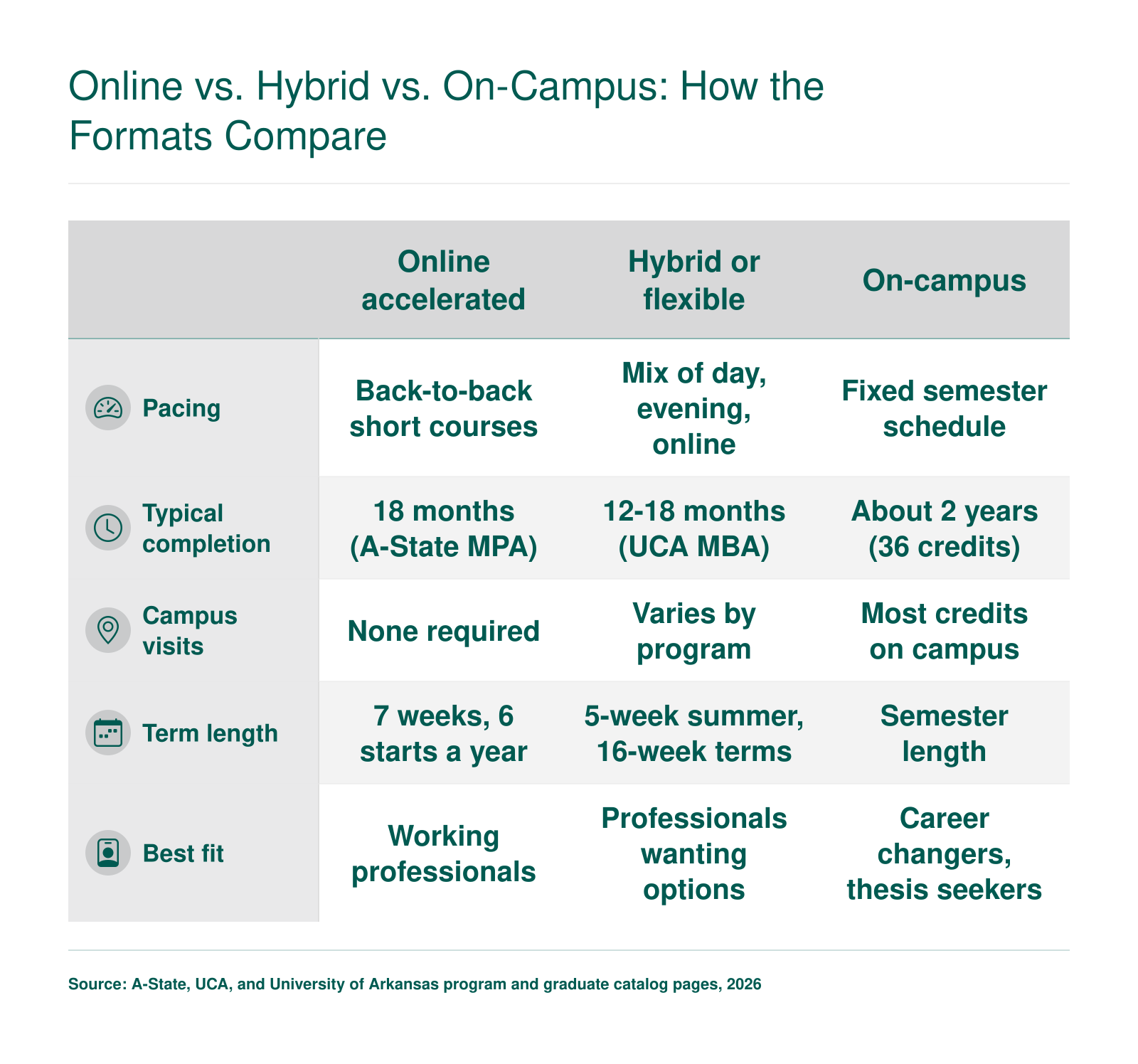
Online vs. Hybrid vs. On-Campus: How the Formats Compare
Completion time depends on credit load, thesis or capstone requirements, and summer enrollment, so treat these as typical ranges drawn from Arkansas public university programs, not guarantees. The online column reflects Arkansas State's accelerated online MPA, while the hybrid column reflects the University of Central Arkansas MBA.
Admission Requirements, GPA Minimums, and GRE Waivers in Arkansas
The question most Arkansas graduate applicants face is not just whether they can get in, but how much flexibility the admissions office will give them on tests, GPA, and deadlines.
Do You Need the GRE?
For University of Arkansas, the Graduate School does not require a standardized exam for university admission, but individual departments and the Walton College set their own rules. Walton's Online MBA and specialized master's policies are program-specific, so a university-wide test optional policy does not mean every Walton program is among the masters programs without gre. At Arkansas State University, many graduate programs add GMAT or GRE expectations but also offer waivers or conditional consideration based on GPA, work experience, or recommendations; there is no single all-program waiver. UA Little Rock handles tests at the program level as well. Some UA Little Rock programs require GRE, MAT, or GMAT scores, and scores older than five years are not accepted. For University of Central Arkansas, current published graduate admissions details are too limited in our sources to confirm a universal test requirement, so applicants should contact the program directly.
GPA Minimums and Conditional Admission
Arkansas State lists a general minimum GPA of 2.75 on a 4.0 scale for 2026-2027, but departmental requirements range from 2.5 to 3.0.1 UA Little Rock requires a 3.0 GPA on the last 60 undergraduate hours, including post-baccalaureate work, for most programs. UA Little Rock also uses conditional admission: a student who does not meet the standard can be admitted conditionally if they earn at least a 3.0 cumulative GPA during their first nine graded graduate hours. The University of Arkansas Graduate School does not publish a single universal master's GPA minimum; departments set their own thresholds.
Application Paths and Deadlines
University of Arkansas applicants use the Uark Graduate Application Portal, where they submit materials and track status; plan to have all materials in at least one month before the program's departmental deadline. University-wide deadlines are August 1 for fall, December 1 for spring, and April 15 for summer. Arkansas State lists general deadlines of June 1 for fall and November 1 for spring for 2026-2027, though many programs set earlier department dates.1 UA Little Rock domestic deadlines are June 1 for fall, October 15 for spring, March 15 for first summer, and May 1 for second summer; international deadlines are February 1 for fall and October 15 for spring. Deadlines vary by program and can change.
Transfer Credit
Graduate transfer credit is limited at the main public universities. University of Arkansas allows up to 6 semester hours toward a 30-hour master's or up to 12 toward a 60-hour master's, with program approval and other criteria. Arkansas State and UA Little Rock do not publish a single university-wide transfer limit in the current 2026 materials, so credit evaluation is handled at the program level.
Paying for Grad School in Arkansas: Assistantships, Scholarships, and Aid
Borrowing your way through a master's degree and working your way through it are different strategies, and Arkansas students can use either. Assistantships cut the bill most, but loans are the default fallback.
Federal Aid for Graduate Students
Yes, you can get financial aid for a master's in Arkansas. Graduate students can borrow through the Direct Unsubsidized Loan program, and Grad PLUS has been the second federal option. Graduate students do not qualify for Pell Grants. Federal borrowing caps and Grad PLUS access for new borrowers have been changing, so confirm current annual and aggregate limits on the federal student aid site and with your school's financial aid office before you plan around a number.
Graduate Assistantships
The University of Arkansas publishes the clearest figures, and they vary by department:
- Fully funded English master's programs: $17,723 over nine months in 2026-2027 (about $1,969 a month), with a full tuition waiver.1
- World Languages: $17,723 for a nine-month master's and $23,631 for a twelve-month appointment, with a 50% waiver covering in-state tuition up to 15 hours in fall and spring.2
- Kinesiology & Exercise Science (Health, Human Performance and Recreation): roughly $15,915 to $19,096.3
- Higher Education: about $800 to $1,100 a month.4
The fine print matters. Waivers generally cover tuition only, not mandatory fees or books. A 25% appointment earns in-state classification, and assistants at 50% or more receive 67% of their health insurance premium.1 Fall and spring enrollment minimums apply (6 hours at 50%, 9 at 25%).1 Waivers above $5,250 a year can be taxable for assistants whose duties are not teaching or research.1
Current stipend ranges and waiver rules for graduate assistants at Arkansas State, UCA, or UA Little Rock were not available in the published sources we reviewed. UA Little Rock's published waiver covers employees, their spouses, and dependent children, which is not the same as assistant eligibility. Ask each graduate office directly.
State and Institutional Awards
Current state-funded graduate scholarships for teachers or nurses were not verifiable in the sources reviewed, so do not assume amounts or service obligations. Your best leads are departmental scholarships and fellowships at the University of Arkansas, plus teacher-focused awards offered through individual programs. Ask each department what it funds and when deadlines fall.
Employer Tuition Reimbursement
For working professionals, especially in online programs, employer assistance can be the cheapest money available. Federal rules have long allowed up to $5,250 a year in employer education benefits to be excluded from taxable income. Check your employer's policy on grade requirements, payback clauses, and whether payment comes up front or after the course.
Licensure in Arkansas Starts With the Right Board
Which Arkansas Master's Degrees Lead to a License, and the Accreditation Each Needs
The table covers the licensure-track fields where we could confirm both the programmatic accreditor and the Arkansas licensing authority. Speech-language pathology, school administration, and healthcare administration also have their own accreditors and state agencies, but we could not verify those details here, so check the program and the relevant agency directly before you apply. Accreditation matters because licensing boards often tie eligibility to a degree from an accredited program, and employers use the same credentials as a quick signal of quality. Confirm that the specific concentration you want, not just the school, holds the accreditation.
| Field | Required Accreditation | Arkansas Licensing Authority | Arkansas Programs with Accreditation |
|---|---|---|---|
| Counseling | Council for Accreditation of Counseling and Related Educational Programs (CACREP) or equivalent standards | Arkansas Board of Examiners in Counseling | University of Arkansas: M.S. in School Counseling, M.S. in Clinical Mental Health Counseling, and M.S. in Rehabilitation Counseling (all CACREP-accredited) |
| Social Work | Council on Social Work Education (CSWE) | Arkansas Social Work Licensing Board | Not listed here; check the CSWE directory of accredited programs |
| Nursing (advanced practice) | Commission on Collegiate Nursing Education (CCNE) | Arkansas State Board of Nursing | University of Arkansas for Medical Sciences (UAMS): master's degree in nursing science, CCNE-accredited through 2035 |
The Earnings Premium of a Master's Degree in Arkansas
Arkansas-specific master's earnings aren't established here, so compare them yourself.
Career Outcomes and Salaries for Arkansas Master's Graduates
What the earnings data shows by field
Outcomes in Arkansas split sharply by field, and the gap is wide enough to change how much tuition you should be willing to carry. Third-party analyses of federal earnings data for Arkansas State University master's completers put registered nursing graduates around $118,704, educational administration and supervision graduates near $49,487, and teacher education graduates closer to $41,937.1 Treat those figures as directional rather than precise: different sources report different measurement windows (one year out versus four years out) and arrive at different numbers for the same programs, so the ordering is more reliable than the exact dollar amount.
At the institution level, College Scorecard reports median earnings for University of Arkansas graduates in the high $60,000s to high $70,000s,2 and roughly $56,631 for Arkansas State.3 Those are campus-wide medians mixing bachelor's and graduate completers, not an MBA or nursing figure, so they are a floor for context, not a program outcome.
Occupational wages across the state
Statewide wage data for 2025 gives a steadier read on where a master's actually pays. Nurse practitioner programs in Arkansas prepare graduates for roles earning a median of $125,660 a year ($60.41 an hour) across about 3,970 jobs, with the middle half between $105,450 and $137,550 and the top decile above $205,810. MHA programs prepare graduates for medical and health services manager roles earning a median of $94,3403 with roughly 6,440 jobs statewide, below the national median of $117,960 for the same occupation in 2024. K-12 education administrators earn a median of $86,330, with most falling between $68,090 and $107,410 across about 2,760 positions.
Who hires, and how to run the math
Three employer clusters absorb most Arkansas master's graduates: the Walmart ecosystem and its supplier network in Northwest Arkansas for business, data analytics and supply chain degrees; UAMS and the state's regional hospital systems for advanced nursing and health administration; and state agencies plus school districts for education, public administration and counseling credentials.
The ROI test is simple. Start with the total program cost from the tuition figures above, then divide it by your realistic annual earnings increase. A nurse practitioner degree priced near $25,000 against a six-figure clinical salary clears that hurdle fast. An education or counseling master's that lifts pay by a few thousand dollars a year only works if tuition stays low, which is exactly why in-state public pricing matters more in those fields than program prestige.
How to Choose the Right Arkansas Master's Program
A master's in social work only leads to an Arkansas license if the program holds CSWE accreditation, and that kind of requirement is where every good decision starts. Run each program you're considering through five filters, in this order, and drop it the moment it fails one.
The Five Filters, in Order
- Licensure and accreditation: For regulated careers such as teaching, counseling, nursing, and social work, this is non-negotiable. Confirm the program carries the accreditation your Arkansas board expects and that it is approved for licensure in the state where you plan to work. A cheaper degree that can't get you licensed has no value.
- Total cost: Compare the full program price (tuition, per-credit fees, and the number of credits required), not the advertised hourly rate. Then weigh what you'll likely borrow against what graduates in that field typically earn.
- Format fit: Decide whether you need asynchronous online courses, scheduled evening classes, or a campus program with in-person labs and cohorts. The right format is the one you can actually finish while working.
- Admission fit: Check GPA minimums, whether the GRE is required or waivable, and any prerequisite coursework or work experience.
- Career outcomes: Look at graduate earnings and employment data where it exists, and ask the department where recent graduates landed.
How the Filters Change the Answer
The same five filters point different people to very different programs. A working Arkansas teacher adding an M.Ed. for a pay-scale bump already holds a license, so the licensure filter is mostly cleared. For that student, cost and format dominate: a low-cost, asynchronous online program from an in-state public university is often the smartest buy, and paying more for a bigger name rarely changes the salary schedule.
A career changer moving into counseling faces the opposite situation. The licensure filter carries the most weight, which favors a CACREP-accredited Clinical Mental Health Counseling program, and the practicum and internship hours have to happen somewhere. A program with established placement sites near where you live can matter more than a lower tuition bill from a school that leaves you to find your own supervised hours.
Questions to Ask Before You Apply
Before committing an application fee, contact each graduate program directly and get answers in writing:
- Cost sheet: Request a program-specific cost sheet showing total credits, per-credit tuition, and every mandatory fee.
- Assistantships: Ask how many graduate assistantships the department funds, whether online students qualify, and whether they include a tuition waiver.
- GRE waivers: Confirm the exact GPA or experience threshold for a waiver with the department itself, since policies often differ from the graduate school's general page.
- Placements and outcomes: For licensure programs, ask how practicum sites are arranged and what share of graduates pass the licensing exam.
Shortlist two or three programs that clear the licensure filter, line them up on cost, format, admissions, and outcomes, and let the comparison make the decision rather than the brand name.
Graduate schools in Arkansas with the most master's programs
| School | City | Type | Master's programs | Online | Grad tuition / yr |
|---|---|---|---|---|---|
| University of Arkansas | Fayetteville | Public | 73 | 22 | $12,470 |
| Arkansas State University | Jonesboro | Public | 58 | 37 | $7,322 |
| University of Central Arkansas | Conway | Public | 38 | 21 | $7,446 |
| Southern Arkansas University | Magnolia | Public | 32 | 29 | $7,380 |
| Harding University | Searcy | Private nonprofit | 30 | 18 | $14,572 |
| University of Arkansas at Little Rock | Little Rock | Public | 28 | 20 | $7,915 |
| Strayer University-Arkansas | Little Rock | Private for-profit | 28 | 28 | $15,135 |
| Arkansas Tech University | Russellville | Public | 21 | 15 | $7,670 |
| Henderson State University | Arkadelphia | Public | 20 | 15 | $7,497 |
| University of Arkansas at Pine Bluff | Pine Bluff | Public | 17 | 1 | $9,076 |
| John Brown University | Siloam Springs | Private nonprofit | 16 | 12 | $14,880 |
| University of Arkansas for Medical Sciences | Little Rock | Public | 14 | 7 | $12,460 |
| University of Arkansas at Monticello | Monticello | Public | 11 | 11 | $9,834 |
| University of Arkansas Grantham | LIttle Rock | Public | 8 | 8 | $4,980 |
| Ouachita Baptist University | Arkadelphia | Private nonprofit | 6 | 6 | $17,188 |
Program counts are the verified master's listings in our directory; tuition is the school-wide average for a full-time graduate student (IPEDS).
Compare programs nationwide
Many Arkansas residents study online. Every ranked list above has an online lens, or browse every field.
Online master's programs Browse all fields