Master's Programs in Iowa
Every master's program reported by a school in Iowa: 360+ programs at 20+ graduate schools, with the online options, costs and outcomes behind each one.

The University of Iowa sets 2026-27 base graduate tuition at $12,360 for residents and $31,411 for nonresidents, before fees. That gap, plus the sizable online catalogs at Iowa State, Iowa, and Northern Iowa, makes cost and flexibility the central tension for most applicants.
For the 2027 application cycle, the decision runs in a fixed order: cost, format, admissions, funding, licensure and accreditation, then earnings against debt.
A bigger name rarely settles any of those. Net price and licensure fit usually do.
Key Points
- University of Iowa 2026-27 graduate tuition is $12,360 for residents, $31,411 for nonresidents.
- Funded assistantships cluster in on-campus research programs, while online students usually cover more of the bill.
- Counseling licensure in Iowa requires a 60-semester-hour master's from an accredited program.
Popular degrees in Iowa
Master's programs in Iowa by field
Business & Management
- General Business12 programs
- Management12 programs
- Accounting11 programs
- Healthcare Management10 programs
- Finance10 programs
- Organizational Leadership10 programs
- Analytics10 programs
- Healthcare Administration8 programs
Education & Teaching
- Teaching11 programs
- Special Education11 programs
- Reading & Literacy11 programs
- STEM Education or Science Education or Mathematics Education10 programs
- Educational Leadership5 programs
- Library Science or Library and Information Science or Library Media5 programs
- Music Education4 programs
- Art Education4 programs
Nursing
- Nursing Education7 programs
- Nurse Administrator5 programs
- Family Nurse Practitioner (FNP)3 programs
- Psychiatric Mental Health Nurse Practitioner3 programs
- Adult Gerontology Primary Care Nurse Practitioner2 programs
- Adult Gerontology Acute Care Nurse Practitioner2 programs
- Family Nurse Practitioner2 programs
- Clinical Nurse Leader1 program
Social Work & Social Sciences
- Social Work9 programs
- Sociology6 programs
- Social Work Advanced Standing6 programs
- Political Science, Government2 programs
Healthcare
- Health Administration6 programs
- Nutrition5 programs
- Health Informatics4 programs
- Speech Pathology3 programs
- Public Health2 programs
- Exercise Science1 program
Counseling
- Clinical Mental Health Counseling8 programs
- School Counseling7 programs
- Marriage and Family Therapy or Marriage and Family Counseling4 programs
Communications & Media
- Communication7 programs
- Media Communication3 programs
- Communication Disorders3 programs
- Speech Pathology3 programs
- Journalism1 program
- Strategic Communication1 program
- Communication Management1 program
Computers & IT
- Cybersecurity6 programs
- Data Analytics6 programs
- Machine Learning1 program
- Information Security & Assurance1 program
Arts & Design
- Creative Writing9 programs
- Fine Arts2 programs
- Interior Design1 program
Criminal Justice & Law
- Public Policy5 programs
- Fire Science or Fire Administration or Fire Leadership2 programs
- Master of Laws2 programs
- Legal Studies1 program
- Homeland Security1 program
Psychology
- Counseling Psychology4 programs
- Educational Psychology or School Psychology2 programs
- School Psychology1 program
- Applied Behavior Analysis1 program
- Social Psychology1 program
- Psychopharmacology1 program
- Applied Psychology1 program
Science & Engineering
- Geography4 programs
- Environmental Science2 programs
- Sustainability or Environmental Management1 program
Religion & Theology
- Divinity3 programs
- Theology3 programs
- Christian Ministry1 program
What a Master's Degree Costs in Iowa: Public vs. Private Tuition
What the public universities publish
The University of Iowa sets base graduate tuition for 2026-27 at $12,360 for residents and $31,411 for nonresidents, with $1,884 in mandatory fees on top, bringing the published annual totals to $14,244 and $33,295.1 Those rates rose modestly over 2025-26: $360 for residents, $464 for nonresidents, and $55 in fees.1 No single per-credit figure corresponds to that annual base. Per-credit rates vary by program and delivery mode, and the distance and online graduate rate sits at $687 per credit hour.
The University of Northern Iowa lists online graduate tuition at $604 per credit hour for 2026-27, with full-time graduate students billed at a nine-credit cap. Iowa State sets graduate tuition by program, residency, classification, and credit load, also with a nine-credit maximum, and separates tuition and mandatory fees from common and program-specific charges, so the sticker figure you first see is rarely the full bill.1
Private universities require a direct quote
For Iowa's private institutions, there is no verified, publicly posted 2026-27 graduate per-credit rate we can responsibly reprint. Private schools generally charge one rate regardless of residency, which can narrow the gap for out-of-state students, but you will need to pull the current number from each school's own tuition page rather than trust a third-party summary.
Price your program with this checklist
- Find the official rate: Go to the graduate college, bursar, or tuition-and-fees page for each school. Look specifically for resident versus nonresident rates and any flat online or distance-education rate, which often differs from the on-campus number.
- Build a total, not a per-credit figure: Multiply the per-credit rate by the full credit requirement of the degree, then add mandatory fees for every term you will be enrolled, plus any program-specific or course fees.
- Request a personalized estimate: Ask admissions and financial aid to model your actual credit load and residency status. Part-time enrollment and the nine-credit billing caps at the public universities change the math considerably.
- Ask what reduces the bill: Assistantships frequently carry a tuition scholarship alongside a stipend. Also ask about employer tuition benefits and the rules for establishing Iowa residency, which can take a year or more to qualify for.
Verify before you budget
Rates at the public universities are approved annually by the Iowa Board of Regents and change every year, so confirm current figures with the financial aid office before committing to a budget.1 Use NCES College Navigator for side-by-side cost comparisons, Iowa College Aid for state grant and loan programs, and BLS.gov plus professional association salary surveys to estimate what the degree is likely to return.
Online, Hybrid, and On-Campus Master's Programs in Iowa
Which Iowa master's programs are actually fully online, and which still require you to show up in person? The answer varies more by course schedule and licensure field than by university name, so the formats below are starting points to confirm with each program.
Fully online and hybrid examples
Iowa State's Higher Education M.Ed. is a 30-credit, 100% online program that typically takes two or more years, with rolling fall, spring, and summer entry. ISU also offers a 30-credit Digital Health master's that can be completed in as little as 12 months. Both are positioned for working professionals. The online Educational Administration M.Ed. is cohort-based and carries a principal licensure recommendation, while the Educational Technology M.Ed. is also online. University of Iowa's Distance and Online Education catalog describes online and hybrid graduate offerings; named examples include an online Educational Leadership M.A. and an online STEM Education M.S., though the published overview does not always specify synchronous meeting expectations. Drake's online programs include a Health Informatics and Analytics M.S. that is 100% online, 30 credits, and has six start dates per year. UNI's Science Education M.A. is available online and hybrid: required courses meet via interactive Zoom video conferencing on Wednesday evenings and in summer, while electives may be fully online or hybrid/in-person.
Synchronous, asynchronous, and campus time
Synchronous means live, scheduled class sessions; asynchronous means no required meeting time. UNI's Science Education M.A. is the clearest synchronous example in the source material: required courses use scheduled Wednesday-evening Zoom sessions. For many other named programs, the delivery mode is published as online, but the sync/async split, on-campus residencies, and local practicum or field hours are not consistently specified. That matters especially for licensure tracks such as ISU's Educational Administration cohort, which may add school-based field expectations even when the coursework is online.
Authorization and scheduling for working adults
Out-of-state online students should confirm the program's state authorization and NC-SARA status before enrolling, especially in licensure-track fields where each state sets its own requirements. Working professionals often benefit most from predictable evening sessions, rolling starts, or cohort pacing. UNI's Wednesday-evening science education schedule fits full-time teachers, and Drake's six annual starts offer flexibility for fitting coursework around a job. For other programs, ask for a sample weekly schedule rather than assuming "online" means self-paced.
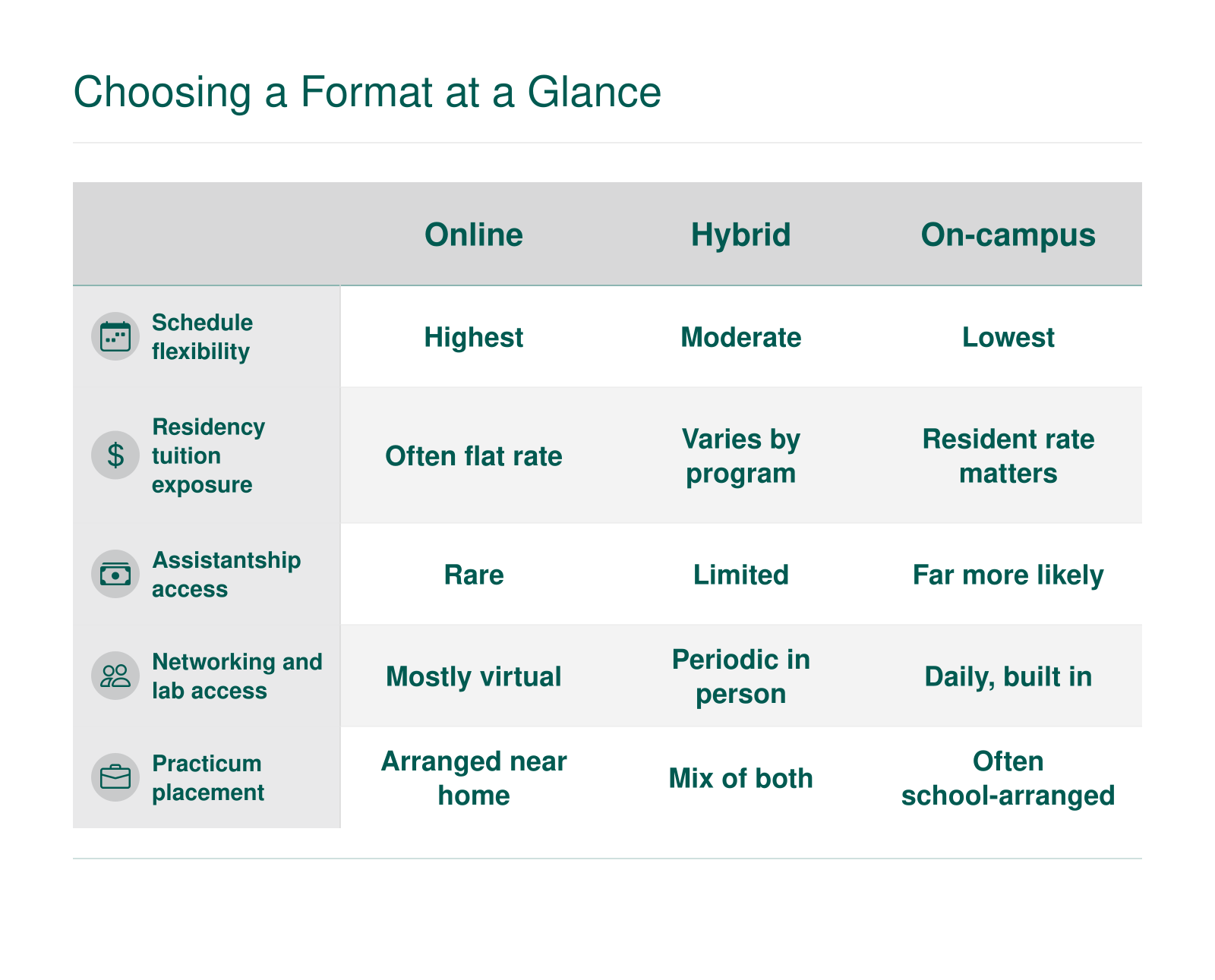
Choosing a Format at a Glance
Format shapes more than your weekly schedule. It affects what you pay, whether you can win funded assistantships, and how easily you reach labs and clinical sites. Ratings below are general tendencies, so confirm details with each program.
Iowa Graduate Admissions: GPA, GRE/GMAT, and Deadlines
Graduate admission in Iowa is a mix of university-level rules and department-level decisions, so the number that matters most is the one set by the program you are applying to. Treat the figures below as typical, not guaranteed, and confirm them with each program.
GPA Expectations
Iowa State University sets a minimum cumulative GPA of 3.0 on a 4.0 scale for graduate admission. At the University of Iowa, a 3.0 shows up in specific programs, including the Iowa MBA and industrial engineering, rather than as a single rule for every degree. Either way, a 3.0 is a floor, not a target. Competitive and funded programs often admit students well above it, and individual departments can set a higher bar.
GRE and GMAT Requirements
Standardized testing is loosening, but unevenly across No-GRE master's programs. The Iowa MBA does not require the GMAT or GRE, though submitting a score can strengthen your application and scholarship case. Industrial engineering at Iowa does not require the GRE for the master's. Iowa State's education program accepts the GRE but does not require it. Iowa State has no university-wide test rule, yet most of its graduate programs do ask for a score, so check your department before assuming a waiver.
Deadlines: Funded vs. Flexible
On-campus programs that offer assistantships tend to set early deadlines, because funding decisions come first. University of Iowa engineering departments list fall dates such as December 15 (electrical and computer), January 1 (biomedical), and January 15 (civil and environmental). Industrial engineering runs later, at April 1. The Iowa MBA lists an April 15 priority date and an August 1 final date for an August start. Iowa State's education applications for fall open September 1 of the prior year.
Online programs more often use rolling admission or several start dates, which gives working adults more room. Even so, applying early helps with scholarships and course availability. Fall 2027 dates were not fully published for every program at the time of writing, so verify before you plan around any of these.
International Applicants
English proficiency minimums vary by program. Iowa MBA applicants need a TOEFL of 100 iBT (600 on the paper test). University of Iowa industrial engineering asks for TOEFL 100 or IELTS 7. Drake's School of Education Admission requires TOEFL iBT 79 or IELTS 6.5. Some programs allow a waiver for applicants with a degree taught in English, but the conditions differ.
Your Iowa Graduate Application Checklist
Requirements vary by program and school, so confirm specifics on each program's admissions page. Most Iowa master's applications share the core items below.
- Accredited bachelor's degreeA completed undergraduate degree from a regionally accredited institution. Some programs also require a minimum GPA, and many ask for specific prerequisite coursework. Education, nursing, and counseling programs often want prior courses in areas such as psychology, statistics, or human development, or an existing license.
- Official transcriptsRequest them from every college you attended. Many schools accept electronic transcripts, and some allow unofficial copies for initial review.
- Statement of purposeA focused essay on your goals, relevant experience, and why this program fits. Tailor it to each school.
- Letters of recommendationPrograms typically ask for two to three recommenders, usually professors or supervisors. Ask early and give them your deadlines.
- Résumé or CVHighlight work, research, volunteer, and clinical or classroom experience relevant to the field.
- Test scores or waiver requestSome programs require the GRE or GMAT. Many have made scores optional or offer waivers based on GPA or work experience, so check before you register for a test.
- Application fee and background checksPay the fee or request a fee waiver if you qualify. Education, nursing, and counseling programs usually also require background checks, and sometimes fingerprinting, before placements in schools, clinics, or hospitals.
Funding Your Iowa Master's: Assistantships, Scholarships, and Aid
The cheapest way to earn a master's in Iowa is to get paid for part of the work, but funded seats cluster in on-campus, research-oriented programs, while the flexible online route usually leaves you covering more of the bill yourself. Knowing where each funding source applies keeps you from borrowing more than you need.
Graduate Assistantships at UI and ISU
Assistantships are the strongest package at both flagship universities. At the University of Iowa, an appointment of 25% or more earns a fall and spring tuition scholarship tied to the Board of Regents resident graduate rate, plus a fee scholarship. Iowa also pays 90% of the monthly single health premium, and 85% of the single dental premium for academic-year or fiscal-year appointments.
Iowa State works similarly. Assistants at quarter-time or above are assessed resident tuition, which means nonresidents pay the in-state rate, and those with a 3.0 GPA can receive a Graduate College Tuition Scholarship that offsets all or part of it. Students enrolled for at least one credit get self-only health coverage at no extra cost, though spouse, child, and dental coverage require premiums. One ISU biochemistry program, for example, advertises a stipend, tuition scholarship, and free single health insurance.
Stipends are the variable. Neither university publishes a single 2026 minimum. Pay depends on the department, degree, appointment percentage, and funding source, so ask each program for its current figure.
Scholarships and Fellowships
Departmental scholarships and fellowships exist at both universities, and ISU lists external fellowships as a category. Most of this money goes to thesis-based, on-campus students. Current award amounts and deadlines were not confirmed at the time of writing, so check each department directly.
Employer Tuition Assistance
Many working professionals choose online programs because their employer helps pay. Large employers often offer tuition benefits, but annual caps, grade requirements, and repayment clauses if you leave vary widely. Ask HR for the policy in writing before you enroll.
Federal Aid After July 1, 2026
Federal aid changed this summer. Grad PLUS loans are no longer available to new graduate students.1 A narrow legacy exception covers students who were enrolled by June 30, 2026, had borrowed a Direct Loan for that program, and stay continuously enrolled in it at the same school.1
The main federal option is the Direct Unsubsidized Loan, which for most graduate students is capped at $20,500 a year and $100,000 in total.2 Professional students have higher limits of $50,000 a year and $200,000 in total, and a lifetime federal cap of $257,500 applies.2 Because Grad PLUS once covered cost of attendance beyond other aid, a gap can now open at higher-priced programs. An assistantship, scholarship, or employer benefit is the cleanest way to close it.
Licensure and Accreditation for Iowa Master's Graduates
Which accreditation actually matters if you want a license in Iowa after your master's? Two kinds do, and they do different jobs.
Institutional Accreditation
Iowa's universities are accredited by the Higher Learning Commission (HLC). That status qualifies a school for federal student aid and is what other institutions check when deciding whether to accept your transfer credits or your degree for doctoral admission. If you are weighing an online or out-of-state provider, confirm it holds recognized institutional accreditation before you apply.
Programmatic Accreditation
Licensing boards often care about the program, not only the school.
- CACREP: counseling programs.
- CSWE: social work programs.
- CCNE or ACEN: nursing programs.
- CAEP: educator preparation.
- AACSB and ABET: quality markers for business and engineering. They are not licensing gates.
At the University of Iowa, the Clinical Mental Health Counseling, School Counseling, and Rehabilitation Counseling master's programs are CACREP-accredited (Clinical Mental Health Counseling through October 2027). Its MSW is CSWE-accredited, and its MSN programs are CCNE-accredited. For Iowa State, UNI, and Drake, check each program's own accreditation page rather than assuming.
Which Degrees Lead to Licensure
- Social work: The Iowa Board of Social Work, part of the Department of Inspections, Appeals, and Licensing (DIAL), requires a CSWE-accredited MSW.2 The LMSW requires the ASWB Masters exam, and the LISW requires the ASWB Clinical exam. The listed application fee is $123.2
- Counseling: A CACREP-accredited clinical mental health degree is the usual route toward LMHC licensure. Confirm supervised-experience and exam rules with the state board.
- Nursing: APRN practice requires Iowa licensure through DIAL.3 Ask each program about national certification and which accreditor covers its nurse practitioner track.
- School counselors and administrators: These go through the Iowa Board of Educational Examiners, not DIAL. The Initial Professional Service License requires a master's degree.5 A conditional Class G counseling license is available once you have completed 75% of a school-counseling master's.6 Converting to the full license generally takes two to three years of successful service, depending on the school setting.4
Check Before You Enroll
A program can be accredited and still not meet your state's licensing rules. Online and out-of-state students should read the program's professional licensure disclosure for the state where they plan to practice, and then confirm with that state's board. Do this before paying a deposit, not after graduation.
Iowa Licensing Snapshot: Mental Health Counselors
Career Outcomes and ROI for Iowa Master's Graduates
Iowa master's degrees split into two payoff stories: fields like business analytics where the earnings jump shows up quickly in federal data, and fields where the return comes through salary schedules the data does not capture. Both can be sound decisions, but they need different math.
What the Scorecard Shows
College Scorecard field-of-study data is patchy for Iowa master's programs. Many programs have suppressed earnings, debt, or both, and "not reported" does not mean zero. The usable examples still show the spread.
- Iowa State business administration: median earnings of $123,109 against median federal debt of $22,707.1 Debt is about 18% of one year's earnings. The table lists zero completers, so treat this figure cautiously.
- Iowa State electrical and communications engineering: earnings of $136,132 and debt of $30,724, a ratio of roughly 23%.1
- Iowa State master's programs overall: average earnings of $99,545 and average debt of $22,874, also near 23%.1
Outside engineering and business, figures are thinner. University of Iowa social work shows median earnings of $43,677, and no debt figure is available to pair with it.2 Drake's educational administration and curriculum and instruction master's programs report earnings of $59,587 and $57,020, also without debt.3 Without debt, no ratio can be calculated.
Be careful comparing across sources. The University of Iowa business master's shows $95,222 in one summary2 and $139,677 in another that measures a 2017-19 cohort at four years out.4 Those are different time windows, not a contradiction.
Cost of Living Helps
Federal regional price data from the Bureau of Economic Analysis has generally put Iowa's cost of living below the national average. A $60,000 salary in Des Moines or Cedar Falls typically stretches further than the same pay in a coastal metro, which makes a given debt load easier to repay.
Read the Numbers Carefully
Scorecard earnings and debt describe graduates who received federal aid, so students who paid without loans or relied on employer tuition benefits are not fully represented. They also do not capture teachers. Iowa school districts commonly publish salary schedules that add pay for graduate credits or a master's degree, so an education master's earning under $60,000 may still pay off steadily over a career. Check the schedule for the district you want to work in before judging that degree on first-year earnings alone.
In practice, compare debt to the earnings you can realistically expect in your field, not to a statewide average.
Median Earnings for Iowa Master's Graduates by Program
This chart compares business master's graduates one year after finishing, using College Scorecard figures for federally aided graduates only. The category is broader than the MBA alone and can include other business master's degrees. Program-level debt is not reported for these programs, so earnings are shown on their own, and cohort years were not stated in the source.
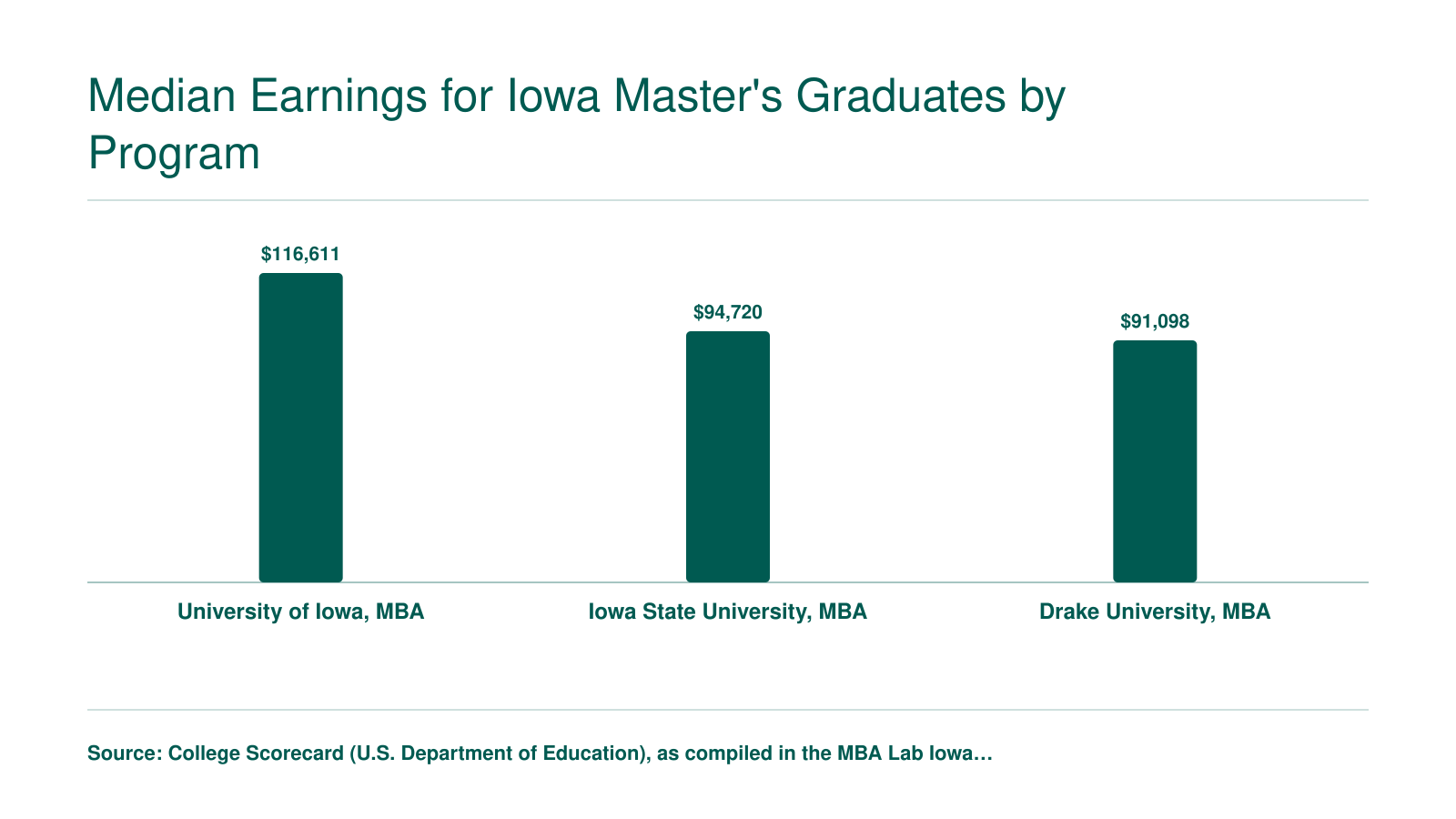
The real return on an Iowa master's depends less on the name on the diploma than on what you borrow: an assistantship that waives tuition, or a degree finished with little debt, often outweighs a bigger salary bump.
Graduate schools in Iowa with the most master's programs
| School | City | Type | Master's programs | Online | Grad tuition / yr |
|---|---|---|---|---|---|
| University of Iowa | Iowa City | Public | 64 | 12 | $13,425 |
| Iowa State University | Ames | Public | 41 | 9 | $12,967 |
| University of Northern Iowa | Cedar Falls | Public | 35 | 13 | $11,602 |
| Drake University | Des Moines | Private nonprofit | 24 | 17 | $12,825 |
| Upper Iowa University | Fayette | Private nonprofit | 23 | 23 | $20,185 |
| Morningside University | Sioux City | Private nonprofit | 19 | 19 | $11,516 |
| Waldorf University | Forest City | Private nonprofit | 18 | 18 | $5,340 |
| Mount Mercy University | Cedar Rapids | Private nonprofit | 18 | 15 | $12,148 |
| Dordt University | Sioux Center | Private nonprofit | 16 | 15 | $10,990 |
| Saint Ambrose University | Davenport | Private nonprofit | 16 | 6 | $17,209 |
| Northwestern College | Orange City | Private nonprofit | 15 | 15 | $6,790 |
| University of Dubuque | Dubuque | Private nonprofit | 13 | 9 | $9,530 |
| Graceland University-Lamoni | Lamoni | Private nonprofit | 12 | 11 | $11,991 |
| Briar Cliff University | Sioux City | Private nonprofit | 7 | 7 | $9,738 |
| Buena Vista University | Storm Lake | Private nonprofit | 7 | 6 | $9,061 |
Program counts are the verified master's listings in our directory; tuition is the school-wide average for a full-time graduate student (IPEDS).
Iowa Master's Programs: Common Questions
These answers cover the policy questions Iowa applicants ask most often. Tuition rules, credit limits, and assistantship terms change by year and by program, so confirm details with your department and the graduate college before you commit.
Can out-of-state students pay in-state tuition for online master's programs at Iowa State or the University of Iowa?
Do Iowa universities offer accelerated or combined bachelor's-to-master's (4+1) programs?
How long does a part-time master's take to complete in Iowa?
Can online students hold graduate assistantships at Iowa's regent universities?
Compare programs nationwide
Many Iowa residents study online. Every ranked list above has an online lens, or browse every field.
Online master's programs Browse all fields