Master's Programs in South Carolina
Every master's program reported by a school in South Carolina: 510+ programs at 30+ graduate schools, with the online options, costs and outcomes behind each one.

At South Carolina's public research universities, out-of-state graduate tuition runs roughly double the in-state rate. Prices for Online Master's Programs vary by more than $600 by tier. Choosing among master's in journalism programs means weighing cost, format, licensure, and salary payoff.
Popular degree and school lists answer which programs exist, not which are worth the money. Lower-priced online or hybrid tracks may serve working students better than residential name-brand degrees.
Assistantships, No-GRE master's programs, and deadlines differ more by department than by institution. Before comparing tuition, verify accreditation and board rules. A license-eligible program from a less prominent school can beat a brand-name degree that leaves you ineligible for the state board exam.
Key Points
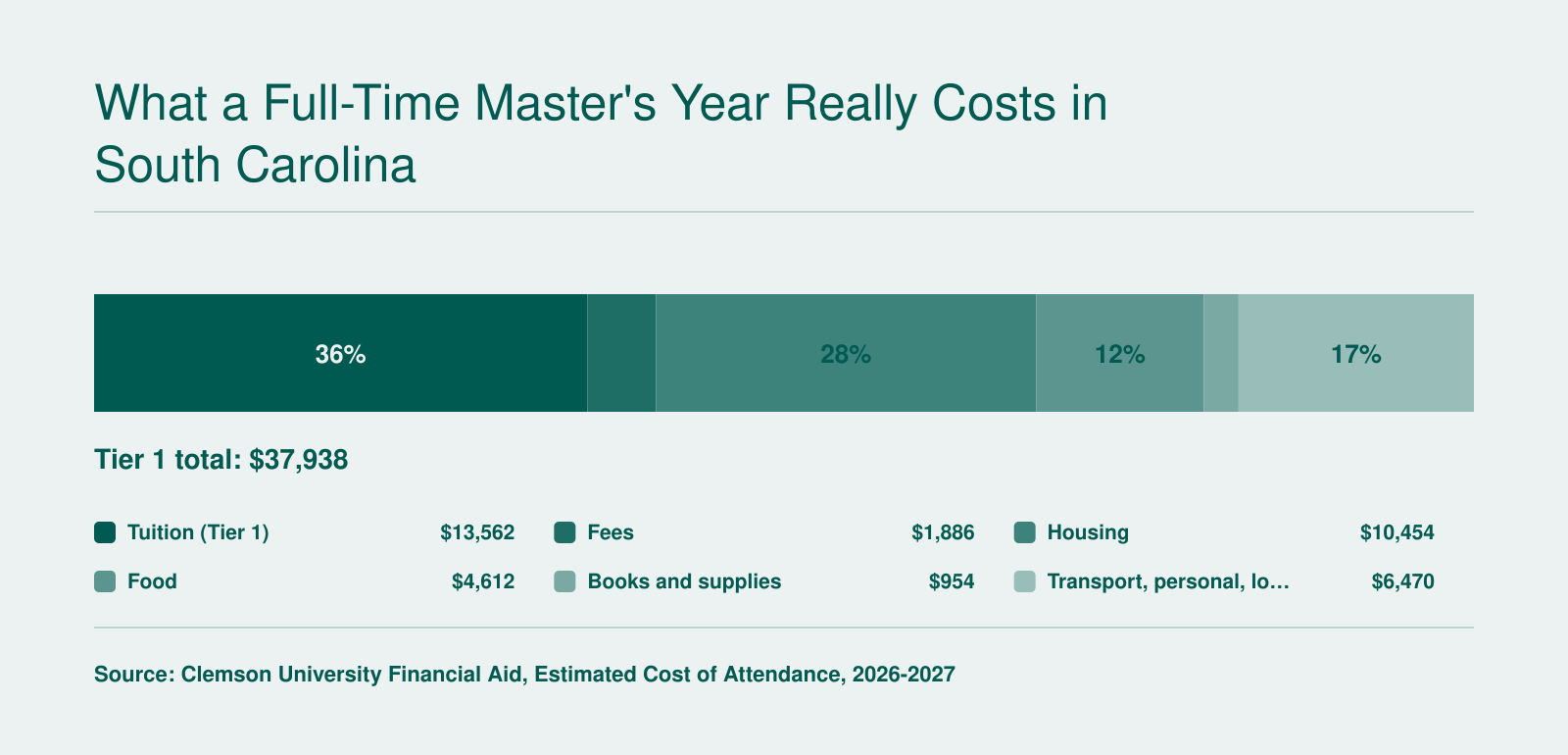
- Clemson's 2026-2027 in-state graduate budget tops out at $37,938 for a full-time year.
- Clemson charges online graduate students $673 to $1,356 per credit, with no residency surcharge.
- Admissions and funding are set by each department, so verify licensure and accreditation before applying.
Popular degrees in South Carolina
Master's programs in South Carolina by field
Business & Management
- Healthcare Administration21 programs
- Accounting15 programs
- Management14 programs
- General Business13 programs
- Finance13 programs
- Analytics13 programs
- Organizational Leadership12 programs
- Public Administration11 programs
Education & Teaching
- Teaching25 programs
- Special Education15 programs
- Educational Leadership12 programs
- Reading & Literacy12 programs
- School Counseling or Educational Counseling7 programs
- Early Childhood Education6 programs
- STEM Education or Science Education or Mathematics Education6 programs
- Higher Education or Adult Education5 programs
Nursing
- Nursing Education or Nurse Educator12 programs
- Nurse Administrator7 programs
- Family Nurse Practitioner (FNP)6 programs
- RN to MSN5 programs
- Psychiatric Mental Health Nurse Practitioner4 programs
- Nurse Executive Leader4 programs
- Clinical Nurse Leader3 programs
- Health/Nursing Informatics3 programs
Healthcare
- Health Administration11 programs
- Nutrition6 programs
- Speech Pathology6 programs
- Public Health5 programs
- Exercise Science2 programs
- Health Informatics2 programs
- Health Education1 program
Religion & Theology
- Divinity6 programs
- Christian Ministry6 programs
- Theology5 programs
- Christian Leadership2 programs
- Youth and Family Ministry2 programs
- Urban Ministry1 program
Psychology
- Counseling Psychology7 programs
- Applied Psychology5 programs
- School Psychology2 programs
- Clinical Psychology2 programs
- Educational Psychology or School Psychology2 programs
- Applied Behavior Analysis2 programs
- Industrial Organizational Psychology1 program
Communications & Media
- Speech Pathology5 programs
- Communication Disorders4 programs
- Journalism3 programs
- Communication3 programs
- Strategic Communication2 programs
Computers & IT
- Cybersecurity7 programs
- Data Analytics5 programs
- Information Security & Assurance3 programs
- Machine Learning1 program
Counseling
- School Counseling7 programs
- Clinical Mental Health Counseling4 programs
- Marriage and Family Therapy or Marriage and Family Counseling1 program
- Addiction Counseling1 program
- Christian Counseling1 program
Science & Engineering
- Environmental Science7 programs
- Sustainability or Environmental Management4 programs
- Geography3 programs
Arts & Design
- Creative Writing9 programs
- Fine Arts3 programs
Social Work & Social Sciences
- Social Work Advanced Standing4 programs
- Sociology3 programs
- Social Work2 programs
- Political Science, Government2 programs
- Human Services1 program
Criminal Justice & Law
- Master of Laws1 program
What to Weigh Before Choosing a Master's in South Carolina
The flashiest brochure and the most affordable degree are rarely the same program. Before you compare campuses or rankings, work through five factors in a deliberate order: total cost after funding, format fit for your schedule, licensure or accreditation requirements for your field, documented employment outcomes, and only then reputation. Reversing that order is how students end up paying a premium for prestige that their career never recovers.
Start With Net Cost, Not Sticker Price
Published tuition tells you almost nothing about what you will actually pay. In-state rates at South Carolina's public universities can run well below the posted out-of-state figure, and graduate assistantships, which pair a stipend with a tuition waiver, often cut the real cost further. Out-of-state applicants should look hardest here: an assistantship or a residency reclassification after your first year can turn an expensive program into an affordable one. Compare what you owe after aid, not what the website advertises.
Licensed Fields Narrow the List First
If you are headed into counseling, social work, nursing, education, or accounting, the board and accreditation rules come before program features; for social work, confirming CSWE-accredited MSW programs is the first step. A degree that is not properly accredited, or that omits required practicum hours, can leave you ineligible to sit for licensure no matter how good the curriculum looks. Confirm that a program meets South Carolina's board requirements, then weigh cost and format among the options that clear that bar.
Format Fit and the Finish-Time Trade-off
Format decides whether a degree is realistic alongside your life. A full-time, one-year master's, such as an Accelerated MBA, gets you back into the workforce fast but usually means stepping away from a paycheck. A part-time program stretches the timeline but lets you keep working, and employees often qualify for employer tuition assistance that an out-of-work full-time student cannot use. Weigh lost wages against tuition help before you assume the faster path is the cheaper one.
Graduate Tuition at South Carolina Public Universities
Residency shapes the price of a South Carolina master's more than any other factor. At both of the large research universities where we could confirm 2025-26 rates, the out-of-state per-credit charge is roughly double the in-state charge.
Published Per-Credit Rates
- Clemson University: $793 per credit hour in-state and $1,588 out-of-state, listed for Tier 2 programs at the part-time rate.1
- University of South Carolina Columbia: $572.25 per credit hour for residents and $1,240 for non-residents, as published by the Darla Moore School of Business doctoral programs and the College of Information and Communications.
These figures come from the 2025-26 tuition schedules, and USC's rate varies by college. Rates for College of Charleston, Winthrop, Coastal Carolina, The Citadel, Francis Marion, and South Carolina State were not confirmed in our research. Check each school's bursar or tuition-and-fees page for the current graduate schedule before budgeting.
What a 30-Credit Master's Looks Like
Multiplying the published rates by 30 credits gives a rough tuition-only estimate:
- Clemson: about $23,800 in-state and $47,600 out-of-state.
- USC Columbia: about $17,200 in-state and $37,200 out-of-state.
Treat these as starting points. Full-time students at some schools pay flat semester rates, which can change the math.
Fees and Differentials That Move the Total
Tuition is rarely the whole bill. USC lists a $17 per-credit technology fee (about $510 over 30 credits) and a one-time $80 matriculation fee. Clemson lists a $21 software license fee for full-time graduate students1, and its M.A. in Economics carries a $713 per-semester charge for full-time enrollment.2 Affordable MBA programs, MSN schools, and engineering tracks often add differential tuition or program fees on top of the base rate, and online courses may be billed at a separate rate. Ask the program office for a total-cost estimate, not just the per-credit figure.
Before You Rule a School Out
Out-of-state students should look at two things before dismissing a South Carolina school on price. First, read the university's residency rules, since the criteria for in-state classification are specific and rarely met by simply moving for school. Second, ask whether the program offers assistantships that include a tuition waiver, which can cut the out-of-state premium sharply or remove it.
What a Full-Time Master's Year Really Costs in South Carolina
Clemson University publishes its 2026-2027 in-state graduate budget in three tiers, and the chart below splits the highest tier ($37,938) into its parts. The lower tiers total $35,876 and $34,316, and the difference is almost entirely tuition. Clemson builds the budget on 5-8 enrolled hours, which its aid office treats as half-time, so a heavier course load would raise the tuition portion. Tuition is well under half of the total, and housing, food, and other living costs make up most of the rest. Those living figures are set for Clemson's Upstate location, and budgets at Columbia and Charleston schools are published separately, so check each school's own cost-of-attendance page.
Online, Hybrid, Part-Time, and One-Year Master's Options in SC
Clemson publishes online graduate tuition of $1,356 per credit at its highest listed tier and $673 per credit at its lowest, and the rate is the same for South Carolina residents and nonresidents. That is the clearest published answer in the state on what an online master's costs, and it shows how much the format matters.
How the Formats Differ
- Fully online: Coursework is delivered remotely. Clemson's College of Education says most of its master's and specialist programs are online2, and its online M.S. in Biological Sciences has no residency requirement3. Textbooks cost extra.
- Hybrid: Some sessions are on campus and the rest are online. Expect a regular commute, so this suits professionals who live near the university.
- Evening or weekend part-time: Classes meet on campus outside work hours. Ask each department how its schedule actually runs, because formats vary even within one school.
Fully online and part-time tracks fit working professionals best, since they let you keep a job while you study.
One-Year and Accelerated Options
Yes, at least one option among Accelerated Master's Programs exists. The University of South Carolina runs a one-year MBA at $30,750 for residents and $35,750 for nonresidents. Its MBA in International Business is $33,500 for residents and $53,600 for nonresidents, and its Professional MBA is $44,550 flat. Clemson lists eight-week online terms; whether USC or Clemson offers 4+1 bachelor's-to-master's tracks or 7-week online terms was not confirmed in our research. Ask admissions offices directly before assuming those formats exist. USC Palmetto College is an undergraduate unit, so its tuition table says nothing about graduate online pricing.
Check Accreditation and Residency Pricing
SACSCOC is the regional accreditor for South Carolina institutions. Confirm that the university appears in its directory of accredited institutions, not just that the program claims approval. For price, a flat online rate is not a statewide rule. Clemson states it for its published tiers, but we found no comparable policy for Winthrop, Coastal Carolina, The Citadel, or Charleston Southern, so verify each school's online graduate rate. Discounts exist too: Clemson's M.Ed. programs include Learning Sciences, which gives South Carolina K-12 teachers and leaders 10% off tuition.4
Licensed Fields Still Need Local Hours
An online label does not always mean zero in-person time. Programs that lead to a license, such as teaching, counseling, or nursing, typically require supervised practicum or clinical hours at an approved site. Ask the program whether you must complete those hours in South Carolina and whether it helps arrange placements, since that affects your schedule and your job.
Where SC Universities Deliver Online and Hybrid Graduate Programs
Program formats change every term, so treat any static list as a starting point, not a guarantee. The fastest way to verify a program is to check the university's own graduate school and online learning pages, then confirm the details with the program coordinator if anything is unclear.
Where to Verify Current Delivery
Start with the official source for each school. For example, use USC Distributed Learning and the USC Graduate School, Clemson Online and Clemson's graduate program pages, and the graduate or distance learning pages at Winthrop, Coastal Carolina, The Citadel, College of Charleston, and MUSC. Cross-check degree and career requirements at BLS.gov, confirm institutional accreditation through SACSCOC, and review programmatic accreditor and professional association sites for licensure or certification rules.
What to Confirm on Each Program Page
- Fully online vs. hybrid: Confirm whether every course is online or whether some credits require on-campus weekends or clinical placements.
- Synchronous vs. asynchronous: Ask if classes meet live at fixed times or if you can complete weekly work on your own schedule.
- Term length and start dates: Check the specific academic calendar. Clemson, for instance, currently lists eight-week terms with six-week summer terms1, while USC's Graduate School lists fall, spring, and summer starts but leaves session length to the program page.
- Residencies or campus visits: Look for any orientation, practicum, or capstone that must be completed in person.
- Accreditation: Verify the institution's SACSCOC status and any program-specific accreditation.
- State licensure: If the degree leads to a license, confirm the program meets South Carolina requirements and ask about reciprocity if you plan to work elsewhere.
Use one or two programs as examples, but apply this checklist to every program you are considering. Clemson's M.S. in Athletic Leadership and USC's M.Ed. in Language and Literacy are both described as fully online, the latter one of many online M.Ed. programs, yet their calendars and admissions steps differ, so the program page, not the university homepage, is the source to trust.
Admissions Requirements, GRE Waivers, and Deadlines
South Carolina has no statewide admissions standard for master's programs. Requirements and dates are set by each department, so use the figures below as examples and not as rules for every program.
- Bachelor's degree and minimum GPAEvery master's program expects an accredited bachelor's degree, or an equivalent for international applicants. Neither the University of South Carolina nor Clemson publishes a university-wide minimum GPA. USC Geography, for example, expects at least a 3.0 on a 4.0 scale, and 3.0 is a common floor elsewhere. Check your target program's own page.
- GRE, GMAT, and waiversMost USC graduate programs ask for the GRE, GMAT, or MAT, and scores stay valid for five years. Some have dropped the requirement: USC Geography no longer requires the GRE and ignores submitted scores, and Physics and Astronomy does not require it but lets you submit one. Clemson generally asks for the GRE or GMAT, and some programs waive it for all or some applicants based on work experience or other factors. Clemson also exempts approved bachelor's-to-graduate students. Published waiver criteria for College of Charleston and Winthrop were not available, so ask those programs directly.
- Priority vs. final deadlinesFunding dates are earlier than final dates. USC's general fall deadline is July 1, but fall financial-aid applicants should apply by March 1, and departments often set earlier dates. Physics and Astronomy asks for fall applications by January 15, with priority given to earlier ones. USC Geography's Fall 2027 deadline is December 1, 2026. Clemson admits on a rolling basis, though some programs set fixed deadlines or admit once a year. International applicants to Clemson typically finish by April 15 for fall, and visa timelines can push dates earlier.
- Letters, statement, résumé, and extrasExpect a statement of purpose, a résumé, transcripts, and usually two or three recommendation letters. Licensure-track programs in counseling, education, or social work may add interviews, background checks, or experience requirements. Confirm each with the program.
- Verify on the department pageDeadlines and test policies are program-specific and change from year to year. Before you plan an application timeline, confirm every date and requirement on the department's own admissions page.
Funding Your Master's: Assistantships, Scholarships, and Employer Support
A graduate assistantship is a paid campus appointment, usually teaching or research work, that comes with a stipend and some form of tuition relief in exchange for a set number of hours each week. For many South Carolina graduate students, assistantships are the single largest piece of funding, and the specifics vary sharply by department rather than following one university-wide rule.
How Assistantships Work at SC Public Universities
At the University of South Carolina, the Graduate School sets baseline eligibility (good standing in a degree program, with at least 6 graduate credits), but stipends and terms are set by departments. The Department of Languages, Literatures and Cultures, for example, lists a stipend around $16,000 for 2026-27 at 15 hours per week, with full tuition abatement toward the primary program at the in-state rate. The School of Music advertises stipends up to $21,000 across its areas for roughly 10 to 20 hours of work, plus a tuition supplement covering up to nine credits per semester.
Clemson structures assistantships as work for discounted tuition: appointments generally run 10 to 28 hours per week, the tuition discount scales with your service hours, and assistants are treated as university employees who must enroll full time.1 Amounts differ by department. The School of Architecture, for instance, attaches 50% tuition remission and in-state rates to a 10-hour appointment.2 Because these figures shift year to year and by funding source, confirm current terms directly with the hiring department.
Fellowships, Scholarships, and Loans
Fellowships and department scholarships often carry tuition benefits with no work obligation, but they are competitive and frequently require applying by the program's priority deadline. Missing that date can take you out of consideration entirely; consider it a hard cutoff, not a suggestion.
Federal aid fills remaining gaps, but the Most Affordable Master's Programs can lower the amount you need to borrow. Graduate students can borrow through Direct Unsubsidized loans and, for larger needs, Grad PLUS loans. Because these add debt that outlasts your degree, exhaust institutional funding, assistantships, fellowships, and scholarships before you borrow.
Employer and State Employee Support
If you work while studying, check for employer tuition assistance; many South Carolina employers reimburse part-time coursework tied to your role. State of South Carolina employees should also review agency education benefits, which can reduce out-of-pocket costs for part-time enrollment at public universities.
Master's Degrees That Lead to Professional Licensure in South Carolina
A master's degree only opens the door to a license if the program meets the state board's rules, and several of these careers also require supervised hours after you graduate. Before you apply, look up the program in the accreditor's own online directory instead of relying on a school's marketing page. Then check the program's licensure disclosure against the requirements on the SC board's website.
| Master's Degree | Accreditor to Verify | SC Licensing Board or Agency | Credential It Leads To | Post-Degree Requirements |
|---|---|---|---|---|
| Master of Social Work (MSW) | Council on Social Work Education (CSWE) | South Carolina Board of Social Work Examiners | LMSW, LISW-CP, and LISW-AP | 3,000 hours of social work practice under clinical supervision, including 100 face-to-face supervision hours |
| Clinical Mental Health Counseling | CACREP directory (one source for an SC program states only that it meets SC licensure requirements, so also read the program's licensure disclosure) | South Carolina Board of Examiners for Licensure of Professional Counselors | Licensed Professional Counselor (LPC) | 1,500 post-master's clinical hours over at least 2 years, including 1,380 direct client-contact hours and 120 supervision hours |
| Advanced Practice Nursing (MSN, APRN track) | CCNE or ACEN | South Carolina Board of Nursing | Advanced Practice Registered Nurse (APRN) | 2,000 clinical hours in advanced practice nursing after initial APRN licensure by the board |
| Education or Master of Arts in Teaching (MAT) | CAEP | South Carolina Department of Education | South Carolina educator certificate | Certification requirements are set by the Department, so confirm them before enrolling |
| Master of Accountancy | No programmatic accreditor specified here; confirm credit hours directly with the Board | South Carolina Board of Accountancy | Certified Public Accountant (CPA) | 150 semester hours of education required, which usually exceeds a bachelor's degree alone |
| Speech-Language Pathology (MS or MA) | ASHA CAA, plus a state-approved certification program meeting South Carolina State Board of Education requirements | South Carolina Board of Examiners in Speech-Language Pathology and Audiology; South Carolina Department of Education for school certification | Speech-Language Pathologist (SLP); South Carolina educator certificate for speech-language pathologists | Master's level or higher required |
| Physician Assistant Studies (MPAS or MSPA) | Accreditation Review Commission on Education for the Physician Assistant (ARC-PA) | South Carolina Board of Medical Examiners | Physician Assistant (PA) | N/A (confirm current requirements with the Board) |
South Carolina Licensing Authority
Master's Degree Salaries and Career Outcomes in South Carolina
A master's degree costs real money up front and pays back slowly, so the useful question is how much more you will earn in South Carolina, not nationally. The state-level answer is positive, but the size of the gain depends on which Census estimate you read.
What the Census Data Shows
Census ACS one-year estimates for 2024 put median earnings for South Carolina bachelor's degree holders at $70,470 and for graduate degree holders at $90,191.3 That is a gap of roughly $19,700, or about 28 percent. The 2020-2024 five-year estimates are lower across the board: $61,860 for bachelor's holders and $73,671 for graduate degree holders, a gap near $11,800, or about 19 percent.4 The two products cover different periods, so treat the premium as a range. Also note that graduate degree figures include doctorates and professional degrees, not only master's holders.
Occupation Wages
Nurse practitioner is the clearest case. BLS data for May 2025 put the South Carolina median at $123,290 a year ($59.28 an hour). The 10th percentile is $97,080, the 90th is $160,170, and a typical range runs from $107,930 to $132,220.1
For counselors (including those in marriage and family therapy master's programs), social workers (including those in online MSW programs), and school administrators, a South Carolina median was not available in the sources we reviewed. The national median for educational, guidance, and career counselors and advisors was $71,430 in 2025, which is a reference point rather than a South Carolina figure.2 For the others, look up the state estimates in the BLS Occupational Employment and Wage Statistics tables for South Carolina before you commit.1
Check the Program, Not Just the Field
College Scorecard reports earnings and debt for graduates of individual programs at the master's level. Search the school, select the specific field and credential, and compare median earnings after completion with median debt. Small programs are often suppressed for privacy, and recent cohorts may not appear yet. If a program has no data, ask the admissions office for placement rates and employer names.
Weighing Return on Investment
Take the full cost from the tuition section above: tuition, fees, living expenses, and any income you give up. Then compare it with the realistic raise in your target job, using the South Carolina wage and your likely starting point rather than a national average. A degree that lifts a $62,000 salary to $75,000 recovers its cost much faster at $20,000 than at $60,000. When the numbers look thin, a lower-cost public program, an employer tuition benefit, or a part-time format can change the math more than a better-known name.
The Master's Earnings Premium in South Carolina
Graduate degrees pay a measurable premium in the Palmetto State.
Thesis vs. Non-Thesis vs. Capstone: Choosing Your Track
The three tracks differ mainly in what you finish with: a research manuscript, a coursework-plus-exam record, or an applied project. Credit loads vary by school and field. Published examples show a thesis can run longer than a capstone (63 credits versus 50 in one University of Washington biostatistics example), while at Rochester Institute of Technology both options in applied statistics are built around six-credit blocks. Always check the specific South Carolina program handbook before you commit, since requirements are set department by department.
| Factor | Thesis | Non-Thesis (Coursework and Exam) | Capstone or Project |
|---|---|---|---|
| Typical credit load | Often similar to or higher than other tracks. Usually includes about 3 to 6 credits of dedicated thesis research (Rochester Institute of Technology requires 6; Pittsburgh biostatistics requires 3). | Replaces research credits with additional elective courses, so the total is usually comparable to the other tracks. | Usually includes a capstone course or sequence, or extra electives in place of research credits (Rochester Institute of Technology's project option uses 18 elective credits). |
| Time to finish | Often the longest, because research and writing are typically spread over the final two semesters or more. | Often the fastest, since progress depends on coursework and passing a comprehensive exam. | Generally on par with non-thesis, with the project completed in one or two terms. |
| Final requirement | Original research written up and defended before a faculty committee. | A comprehensive examination covering core coursework, with no major written product. | An applied project, often for a real client or employer, presented or defended at the end. |
| Best fit | PhD applicants and students heading into research or R&D roles. | Working professionals who want the credential quickly or need to meet a pay or licensure threshold. | Career advancers who want a portfolio piece to show employers. |
| Assistantship eligibility | Research assistantships often favor thesis students, since their work can tie into faculty projects. | Less commonly tied to funded research. Teaching or administrative assistantships may still be open, depending on the department. | Similar to non-thesis. Capstone and non-thesis tracks are common in online and part-time programs, where assistantships are less typical. |
| How common it is | Many programs offer it as an option rather than the default. One Southern Mississippi review found 3 of 4 students defended capstone projects rather than theses in 2022 to 2023, a very small sample. | Offered as a stand-alone option in some departments, and tracked separately in program reviews such as those at Wisconsin-Milwaukee. | Widespread in professional and online master's programs. Studies of engineering capstone graduates examine links to employment, but results should be read cautiously. |
Graduate schools in South Carolina with the most master's programs
| School | City | Type | Master's programs | Online | Grad tuition / yr |
|---|---|---|---|---|---|
| University of South Carolina | Columbia | Public | 82 | 34 | $14,134 |
| Winthrop University | Rock Hill | Public | 37 | 15 | $16,306 |
| Clemson University | Clemson | Public | 36 | 19 | $12,646 |
| Anderson University | Anderson | Private nonprofit | 33 | 31 | $13,759 |
| Strayer University-South Carolina | Greenville | Private for-profit | 26 | 26 | $15,135 |
| Charleston Southern University | Charleston | Private nonprofit | 25 | 24 | $20,250 |
| South Carolina State University | Orangeburg | Public | 24 | 8 | $11,460 |
| College of Charleston | Charleston | Public | 23 | 8 | $16,300 |
| Coastal Carolina University | Conway | Public | 22 | 4 | $10,764 |
| Francis Marion University | Florence | Public | 20 | 8 | $11,388 |
| Converse University | Spartanburg | Private nonprofit | 17 | 6 | $10,825 |
| University of South Carolina Aiken | Aiken | Public | 16 | 13 | $14,096 |
| Columbia International University | Columbia | Private nonprofit | 16 | 13 | $11,640 |
| Citadel Military College of South Carolina | Charleston | Public | 15 | 13 | $12,780 |
| University of South Carolina-Upstate | Spartanburg | Public | 13 | 12 | $14,114 |
Program counts are the verified master's listings in our directory; tuition is the school-wide average for a full-time graduate student (IPEDS).
Compare programs nationwide
Many South Carolina residents study online. Every ranked list above has an online lens, or browse every field.
Online master's programs Browse all fields