Best Master's in Journalism Programs
Compare 110+ accredited Journalism programs at 70+ schools, with graduate earnings, cost, debt, and completion data from IPEDS and the U.S. College Scorecard.
Tuition for a journalism master's now varies more than four-fold. The University of Florida's online program lists $17,926 in total tuition, while Northeastern's 18-month on-campus degree lists $74,124.
The practical question is which graduate programs lead to jobs that justify what they cost, not which carry the biggest names. The schools here include on-campus, online, and hybrid options, and their net prices and graduate earnings spread widely instead of clustering.
Newsroom hiring has contracted for years, so debt carries more weight in this field than in most. A famous brand does not shrink a loan balance.
Key Points
- Out-of-state students pay $17,393 more than residents at the University of Florida.
- Program-level federal earnings and debt data can't yet show whether a journalism master's pays off.
- Employers reportedly offer the same starting salary for online and in-person degrees, per a 2023 survey.
The 10 Best Master's in Journalism Programs, Ranked by Outcomes and Value
This ranking measures journalism master's programs by what matters after graduation: earnings, price, and the quality of reporting training. The programs below stand out for combining rigorous newsroom preparation with realistic value for both campus and online learners. Each card includes tuition, net price, and the format or concentration that shapes the student experience.
Columbia University in the City of New York
#1New York, NY · ~$58,000/yr (est.)
Best for: Data and investigative journalists seeking specialization
Columbia's journalism school offers intensive master's-level training in two specialized areas: data journalism and investigative reporting. The data track builds coding and visualization skills from scratch, while the investigative specialization pairs students with award-winning faculty and real deadlines. Both are campus-based, project-driven, and designed to move graduates into high-level newsroom roles.
- 3-semester program, no prior data background required
- Builds Python, R, SQL and visualization skills
- Culminates in a major data-driven Master's Project
- Emphasis on ethical, public-interest reporting
- Prepares for data journalist and investigative reporter roles
- Award-winning investigative training since 2006
- Directed by Sheila Coronel
- Stipends for post-graduation reporting
- Alumni at top news organizations
- Global reporting opportunities
- Pulitzer Prize-winning graduates
University of Florida
#2Gainesville, FL · ~$13,000/yr (est.)
Best for: Budget-conscious online learners
The University of Florida delivers an online master's in mass communication with a digital journalism and multimedia storytelling concentration. It is a 37-credit program with live online classes, multiple start dates, and an industry advisory board. The format suits working professionals who want to complete in about 16 months without relocating.
- 37-credit online program
- Can finish in as few as 16 months
- Live online classes with three start dates per year
- Advisory board of industry experts
- Capstone project required
- Includes reporting, multimedia editing, and data visualization coursework
University of Southern California
#3Los Angeles, CA · ~$72,000/yr (est.)
Best for: Aspiring multimedia reporters wanting L.A. newsroom access
USC Annenberg runs an intensive 11-month campus program in Los Angeles designed for the converged media landscape. Students work in the Media Center newsroom on web, broadcast, podcast, and documentary projects under award-winning faculty. Small cohorts of about 35 students support close editing and a strong alumni network at major outlets.
- 11-month campus program in Los Angeles
- Small cohorts of about 35 students
- Hands-on Media Center newsroom experience
- Covers coding and data storytelling
- Graduates have landed roles at Washington Post, NPR, BuzzFeed
- Scholarships available
University of Maryland-College Park
#4College Park, MD · ~$18,000/yr (est.)
Maryland offers both a research-oriented Master of Arts in Journalism and a professional Master of Journalism with multiplatform or broadcast tracks. Its proximity to Washington, D.C. gives students access to Capital News Service and the Howard Center for Investigative Journalism. Faculty include Pulitzer and Emmy award winners, and the program supports hands-on reporting across media.
- 30-credit research and thesis program
- Located near Washington, D.C. media market
- Access to Capital News Service and Howard Center
- Small classes with Pulitzer and Emmy award-winning faculty
- GRE optional
- Prepares for teaching or Ph.D. paths
- 30-credit professional track
- Cohort-based full-time enrollment
- Capstone through Capital News Service bureaus
- Optional fourth semester at Howard Center
- Career pathways in audience engagement, investigative, and data
- Flexible curriculum with many electives
- Capstone through Capital News Service
- Specializations in broadcast and multiplatform
- Prepares for broadcast reporting roles
The University of Texas at Austin
#5Austin, TX · ~$12,000/yr (est.)
UT Austin's journalism master's offers a professional track for career changers and a research and theory track for students aiming toward doctoral work. The professional track includes a required summer internship and places students at the Texas Tribune, Sports Illustrated, and NBC News. The program is campus-based in Austin with small cohorts and fall admission.
- 30-credit program for career changers
- Required summer internship
- Six required core courses and 12 elective credits
- Fall admission only; apply by December 1
- Placements at Texas Tribune, Sports Illustrated, NBC News
- Full-time, two-semester cohort experience
- Research-oriented track
- Fall application deadline December 1
- No spring admissions
- Dual degree programs available
- Faculty with distinguished research records
Northeastern University
#6Boston, MA · ~$29,000/yr (est.)
Northeastern's Master of Arts in Journalism combines core reporting and feature writing with digital skills in video, interaction, and data. Students can complete an optional six-month co-op at a media organization, gaining real reporting or editing experience. The campus program in Boston offers full-time and part-time enrollment and welcomes students without prior journalism experience.
- 18-month program with full-time or part-time options
- Optional six-month co-op at a media organization
- Intensive three-week skills course for newcomers
- No prior journalism experience required
- Publish work in local and national outlets
- Award-winning faculty mentors
New York University
#7New York, NY · ~$43,000/yr (est.)
NYU's journalism master's spans online and campus options, with tracks in American journalism, business and economic reporting, cultural reporting and criticism, and global and joint program studies. The American Journalism Online master's uses synchronous small cohorts, while the Global & Joint Program Studies track offers international reporting with regional studies. Students complete writing samples and build a professional portfolio across courses.
- Three writing samples required
- GRE not required
- Entrance exam required
- Tracks include business and economic reporting and cultural reporting and criticism
- Online study available
- 30-credit, 8-course online program
- Synchronous online classes with a cohort
- Full-time and part-time options
- Required course: Reporting the News
- Electives include Audio Storytelling
- Complete within three years
- Eight concentration options
- No entrance exam required
- Small cohorts of about 15 students
- Joint MA with regional studies
- Hands-on international reporting training
University of Oklahoma – Hudson College of Public Health
#8Norman, OK · ~$9,000/yr (est.)
The University of Oklahoma's master's in journalism and mass communication blends theory, research, and professional skills with concentration options in journalism, media management, and creative media production. Evening classes and flexible pacing accommodate working professionals, and students can finish through a thesis, professional project, or comprehensive exam. The program emphasizes hands-on learning in a collaborative environment.
- 33-credit program
- Thesis, professional project, or comprehensive exam routes
- Evening classes available
- Full-time students typically finish in four semesters
- Five-year completion limit
- 32-credit program
- Rolling admissions
- $0 application fee
- Graduate certificate in media management
- Evening classes for professionals
- 32-credit program
- 3.0 GPA minimum
- Thesis required
- State-of-the-art Gaylord Hall facility
- Evening classes for working professionals
Indiana University-Bloomington
#9Bloomington, IN · $12,000 – $33,000/yr (est.)
Indiana University Bloomington offers an M.S. in Media with concentrations in investigative journalism and data journalism. Investigative students work as fellows at the Michael I. Arnolt Center for Investigative Journalism, producing real stories with Pulitzer and Peabody award-winning faculty. The data track builds coding, visualization, and machine-learning skills through an internship and capstone portfolio.
- 36-credit two-year program
- Arnolt Center fellowship with financial support
- Hands-on investigative reporting practicum
- Faculty include Pulitzer and Peabody winners
- Curriculum includes data analysis and media law
- Master's capstone project required
- Five concentration options
- Internship required for graduation
- Arnolt Center capstone project
- Coding, data visualization and machine learning
- Observatory on Social Media training
- Graduate with a professional portfolio
Stony Brook University
#10Stony Brook, NY · ~$14,000/yr (est.)
Stony Brook's Master of Science in Journalism blends traditional reporting with a solutions journalism focus and hands-on work in newsroom, broadcast, and podcasting studios. The hybrid format includes synchronous online classes and evening sessions for working professionals. Students can enroll full time or part time, and no prior journalism background is required.
- 1.5-year hybrid program
- 33 credit hours
- Solutions journalism focus
- Evening classes for working professionals
- Newsroom, broadcast studio and podcasting studio
- No prior journalism background required
- GRE optional
Cost & outcomes by school
Federal data for the highest-earning Journalism programs, independent of the ranking above. Earnings are this field's master's graduates four years after completing, where the Scorecard reports them.
| School | Earnings | Tuition / yr | Debt | Grads/yr | Format |
|---|---|---|---|---|---|
| Georgetown University DC | $90,356 | $61,670 | — | 16 | Campus |
| Kent State University OH | $83,464 | $12,483 | $27,036 | 20 | Online |
| St Bonaventure University NY | $82,191 | $16,087 | $27,582 | 8 | Online |
| Columbia University in the City of New York NY | $78,880 | $57,973 | $69,000 | 230 | Campus |
| University of Missouri MO | $77,057 | $13,681 | $20,877 | 38 | Hybrid |
| Hofstra University NY | $74,266 | $31,120 | — | 8 | Campus |
| University of Nebraska-Lincoln NE | $73,130 | $8,434 | — | 13 | Hybrid |
| Arizona State University AZ | $72,390 | $13,587 | $35,778 | 43 | Campus |
| University of Georgia GA | $70,926 | $11,002 | $22,394 | 74 | Campus |
| University of South Florida FL | $69,612 | $10,428 | $36,404 | 11 | Hybrid |
| University of Nevada-Las Vegas NV | — | $7,413 | — | — | Campus |
| California State University-Northridge CA | — | $8,982 | — | — | Campus |
Sources: U.S. Department of Education. Tuition and graduates: IPEDS. Earnings and debt: College Scorecard, this field's master's graduates; a dash means no figure is reported.
Cost, debt & payoff
Median earnings of this field's master's graduates (4 yrs after completing) vs. their median federal loan debt · U.S. College Scorecard
Across these programs the median graduate earns about $71,658 and finishes with roughly $46,786 in debt — a ratio that clears a common rule of thumb (keep debt below first-year salary). Tuition and debt vary widely school to school, so check the per-school figures in the table above before you shortlist.
Why Outcomes Data Beats Prestige: The Logic Behind This List
A journalism master's can be judged by the reputation of the newsroom brand attached to it, or by what its graduates actually earn and owe. Prestige surveys reward the first. This list leans on the second, because a famous name on a diploma doesn't make a loan payment.
What the Numbers Come From
The figures draw on federal IPEDS data and College Scorecard outcomes, but program-level median earnings, median debt, and employment shares do not yet appear in the federal files for the programs on this list. Institution-level net price and graduation rates round out the cost and completion picture.
Program-level figures are tied to a specific journalism field of study and credential level. A university's overall earnings profile blends engineers, nurses in Direct Entry MSN programs, and MBA programs, which tells you little about a reporter's paycheck. Isolating the journalism master's is what separates this approach from reputation-based rankings.
Where the Data Falls Short
A few limits are worth keeping in mind:
- Graduation rate: It covers the whole institution, not the journalism program.
- Net price: It's an average across students, not a quote. Your residency, aid package, and program length will change what you pay.
- Small programs: Some enroll too few graduates for earnings to be published, so a missing figure doesn't necessarily signal poor results.
Treat the numbers as a starting point. Check them against each program's own cost sheet, and ask admissions offices directly about placement before you commit.
Does a Journalism Master's Pay Off? Earnings vs. Debt by Program
Does a journalism master's pay off? The honest answer depends less on the school's name than on what you owe when the first job starts, and right now the federal data cannot answer that question at the program level. The latest federal files do not yet publish program-specific median earnings after completion, first-year employment rates, or median 10-year loan payments for the journalism master's programs on this list, so any payoff calculation using those files alone would be incomplete.
What the University-Wide Context Shows
As context, not as journalism-program outcomes, median earnings 10 years after entry at these universities range from roughly $75,000 at UT Austin to $102,000 at Columbia. Those figures include every graduate, from engineers and nurses to MBAs, so they can overstate what an early-career reporter earns.
Median federal debt among all completers at the institution level is more useful as an affordability signal. UC Berkeley reports about $13,000 and the University of Florida about $15,000. Maryland and UT Austin sit closer to private levels at roughly $19,000 and $20,500, while private peers range from about $18,000 at USC to $24,250 at Northeastern. The share of completers employed one year out and the share above the poverty line are also missing at the program level, which means debt comparisons carry more weight than usual.
Where the Payoff Actually Comes From
Because program-level earnings are absent, the degree's payoff hinges on keeping debt low relative to a modest journalism salary. A $13,000 or $15,000 debt load is far easier to service on a junior reporter's pay than $21,000 or $24,000, even if the bigger-name school carries more prestige. That is why lower-cost public programs often look like the better ROI bet, but public status alone is not enough. Ask any program for verified first-year placement and salary data for its own graduates before assuming a high-tuition brand will outperform.
Online vs. Hybrid vs. On-Campus: Side-by-Side Trade-Offs
Format changes how you learn and who you meet, but employers do not appear to pay less for it. A 2023 employer survey found new hires received the same starting salary whether their degree was earned online or in person. Still, about two-thirds of employers believe in-person programs teach stronger technical skills, which matters for a hands-on field like journalism. These employer findings cover graduate hiring broadly, not journalism specifically.
| Factor | Online | Hybrid | On-Campus |
|---|---|---|---|
| Schedule flexibility | Highest; coursework often fits around a job | Moderate; remote work plus scheduled residencies | Lowest; fixed class and newsroom hours |
| Newsroom and studio access | Limited; reporting is done locally and remotely | Concentrated in on-site residencies | Full, regular access to campus newsrooms and studios |
| Networking and internship pipelines | Virtual events; you usually source internships yourself | Cohort bonds built during residencies, plus remote contact | Strongest; daily contact with faculty, peers, and local outlets |
| Ability to work full-time | Most practical | Usually workable with travel planning | Difficult |
| Typical pacing | Often part-time and spread out | Mixed; part-time or full-time tracks | Commonly full-time and cohort-based |
| Hands-on broadcast and multimedia training | Software-based; you produce with your own equipment | Intensive lab work during in-person sessions | Ongoing access to professional equipment and critique |
| Employer perception | Some employers doubt technical depth, though 56% of business leaders rate online learning as good as or better than on-campus | Seen as more credible than fully online in multiple studies | Widely viewed as stronger for technical skills |
| Best fit for | Career-changers working full-time | Mid-career reporters adding data skills | Recent grads seeking newsroom immersion |
Related Articles
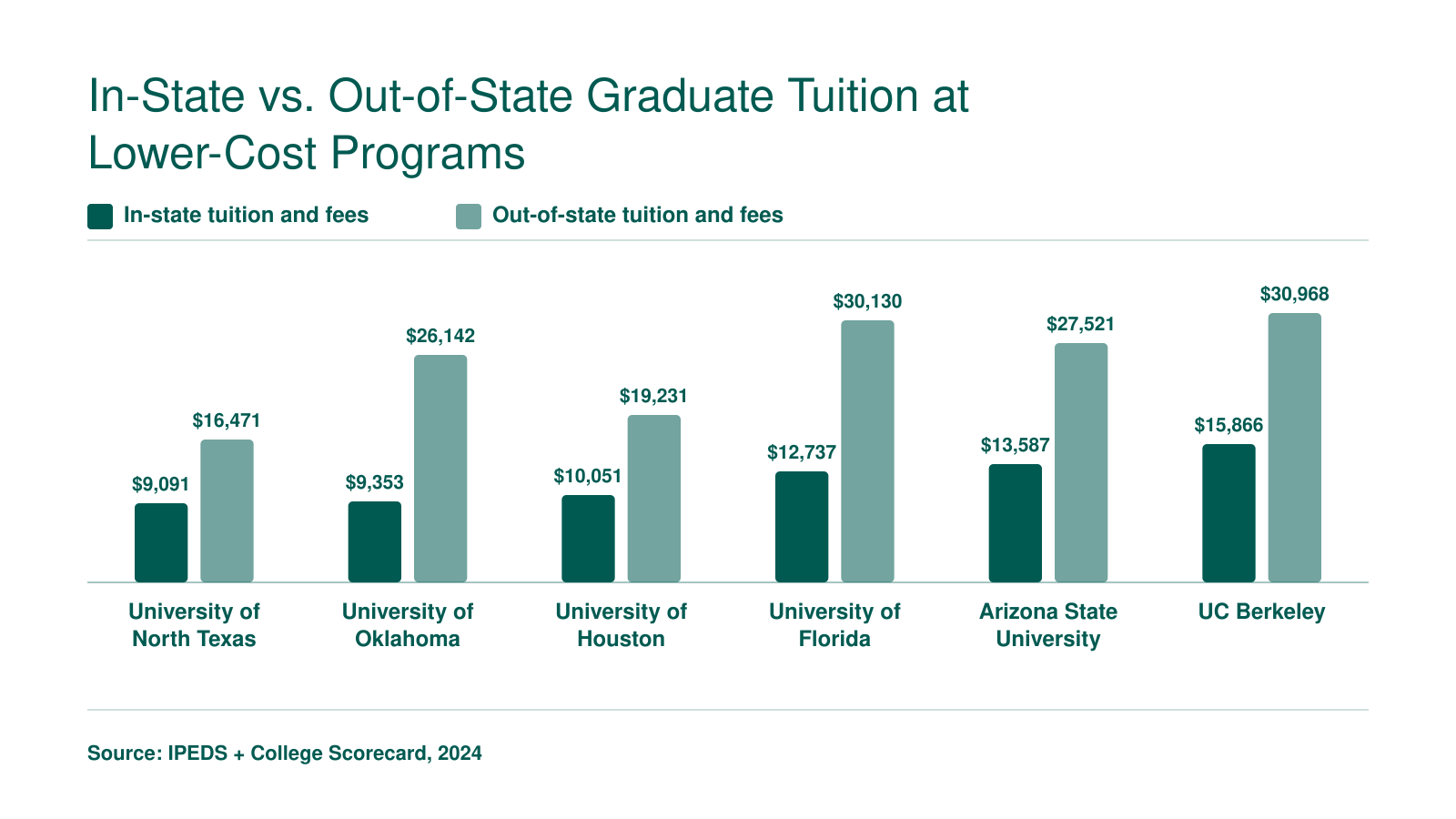
In-State vs. Out-of-State Graduate Tuition at Lower-Cost Programs
Residency status makes the biggest dollar difference at the University of Florida, where out-of-state students pay $17,393 more than in-state students, followed closely by the University of Oklahoma at $16,789. The gap is smallest at the University of North Texas, at $7,380. These are published graduate tuition and fees, not net price, so scholarships, assistantships, and other aid will change what you actually pay.
According to Pew Research Center, U.S. newspaper newsroom employment fell 57% between 2008 and 2020, from about 71,000 jobs to roughly 31,000. Across all newsroom types, including broadcast, radio, and cable, employment dropped 26% over the same period. Journalism careers look quite different than they did a generation ago.
What Journalism Grad Schools Ask for: Tests, Clips, and Deadlines
Requirements vary by school and change each cycle, so confirm details on each program's admissions page before you apply.
- Bachelor's degreeApplicants need a bachelor's degree from an accredited institution. A journalism major is generally not expected. Missouri, for example, does not require prior journalism education or experience.
- GRE policyMost programs here have dropped it. Columbia, UC Berkeley, and USC Annenberg do not require the GRE, and USC does not consider scores. Missouri's on-campus M.A. still asks for official scores, with suggested minimums of 153 Verbal and roughly 144–148 Quantitative.
- Writing samples and testsExpect original clips or a writing sample. USC's M.S. caps the collection at 10 pages. Applicants without conventional clips can submit alternatives. Columbia adds a one-hour writing test. Berkeley's documentary track expects hands-on video experience.
- Statement, recommendations, résuméA personal statement, a résumé, and recommendations are standard. Professional experience is usually not required, and Columbia defines it broadly.
- Deadlines and start termsBerkeley's priority deadline is December 1, 2026, with a final deadline of January 14, 2027. Applying by the priority date improves funding odds. CUNY's priority date is December 15, 2026. USC's M.S. deadline is January 8, 2027, for a summer 2027 start. Missouri's January 1 fall deadline is firm. Check Columbia's current deadline directly.
Journalism programs by state
Compare Journalism programs on the data that matters
Explore more Communications & Media specializations or browse every graduate field.
All Communications & Media programs