Best Master's in Media Communication Programs
Compare 90+ accredited Media Communication programs at 80+ schools, with graduate earnings, cost, debt, and completion data from IPEDS and the U.S. College Scorecard.

Graduates of the top-ranked media communication master's at UNC Chapel Hill earn a median of about $56,600 within a year of finishing, against a net price near $11,655. At George Washington University, the same degree runs roughly $36,500 a year after aid. Same job titles, very different math.
That spread is the real decision: which program pays back the cost and the twelve to twenty-four months it takes, not which carries the loudest name. The programs ranked here span online, on-campus, and hybrid formats, and they divide along concentrations like strategic communication, political communication, journalism, and media studies.
In a field where the Bureau of Labor Statistics expects most openings to come from turnover rather than growth, where you start matters more than the logo.
Key Points
- Rankings weigh graduate earnings, net price, and debt from federal data, not reputation.
- Public universities hold the lowest sticker prices, but out-of-state rates run far higher.
- Assistantships can pair tuition remission with a stipend, so ask each department.
10 Best Master's in Media Communication Schools Ranked
This list rewards programs that connect media training to real earnings and manageable costs, not the schools that simply look familiar on a name-brand survey. The top entries stand out for one-year completion, public-university pricing, or online flexibility that working professionals can actually use.
University of North Carolina at Chapel Hill
#1Chapel Hill, NC · ~$13,000/yr (est.)
Best for: Public media careerists needing concentration choices
Chapel Hill's Hussman School offers a one-year, 30-credit Master of Arts in Media and Communication with three concentration areas: journalism, strategic communication, and theory and research. Students begin with a summer bootcamp in reporting or video journalism and finish with a faculty-guided final project. The program enrolls about 45 students annually, and program-level data show a median $56,634 one year after finishing. The school's overall graduation rate is 91%.
- Three concentration options: Journalism, Strategic Communication, Theory and Research
- 30 total credit hours, one-year campus program
- Summer bootcamp and faculty-guided final project
- Annual enrollment of about 45 students
- Three journalism specializations: interactive design, public life reporting, video journalism
- Summer bootcamp in reporting or video journalism
- Courses in law, ethics, and journalism methods
- Culminating final project with faculty panel
- 33-credit sequence with eight courses
- Prepares for advertising, PR, and marketing roles
- Include a virtual evening summer course
- Internship or practicum experience
- Capstone project in summer
Florida State University
#2Tallahassee, FL · ~$11,000/yr (est.)
Best for: Theory-minded applicants wanting assistantship support
Florida State's campus-based Master's in Media and Communication Studies blends communication theory, research methods, and digital content creation. Students choose a thesis or creative project track, or a coursework-only path, with a cognate minor from more than 20 departments. The program requires 33 to 36 credits across four semesters, with no GRE and assistantships available each semester. The school's overall graduation rate is 86%.
- 33-credit, four-semester campus program
- Thesis or capstone option
- Cognate minor draws from 20+ university departments
- No GRE or entrance exam required
- Covers political communication, rhetoric, and persuasion
- 36-credit, four-semester campus sequence
- 4K video production skills
- Prepares for NGO and public interest careers
- Thesis or creative project capstone
- Scholarships and assistantships available
Rutgers University
#3New Brunswick, NJ · ~$23,000/yr (est.)
Best for: Working professionals balancing jobs and graduate study
Rutgers' Master of Communication and Media is built for working professionals, with on-campus, online, and hybrid options that include weeknight evening classes. The 36-credit degree can be finished in about 24 months, and a fully online option expanded in fall 2025 with tuition aligned closely to in-state costs for out-of-state learners. Students pick from six concentrations, including public relations and digital media, and the school's overall graduation rate is 84%.
- 36-credit program, about 24 months to complete
- On-campus, online, and hybrid formats
- Evening classes weeknights 6 to 9 p.m.
- Six concentration options with rolling fall admission
- Fully online option with synchronous and asynchronous formats
- Available on-campus, online, and hybrid
- No entrance exam required
- Alumni network of professionals
- Online Digital Media specialization
- Synchronous and asynchronous evening classes
- No entrance exam required
- Designed for working professionals
George Washington University
#4Washington, DC · ~$36,000/yr (est.)
George Washington's Master of Arts in Media and Strategic Communication sits in Washington, D.C., and emphasizes applied campaign skills, media effects, and public affairs. The 36-credit program offers full-time and part-time enrollment with thesis or project capstone options. Program-level data show median earnings of $90,873 five years after finishing. The school's overall graduation rate is 84%.
- No entrance exam required
- 36-credit curriculum in Washington, D.C.
- Capstone options: thesis or project
- Recent employers include Pew, Politico, and CNN
- Full-time and part-time enrollment
The University of Tennessee-Knoxville
#5Knoxville, TN · ~$16,000/yr (est.)
Tennessee's Master of Science in Communication and Information offers both a campus journalism and media concentration and an online strategic and digital communication track. The journalism path emphasizes hands-on storytelling and a career journalist alumni network, while the online option is a 30-credit asynchronous program drawing on four schools. The school's overall graduation rate is 74%.
- Full-time, hands-on journalism and media curriculum
- Mentorship from graduate coordinator
- Career journalist alumni network
- Small class sizes with real-world applications
- 30-credit, fully online asynchronous program
- Interdisciplinary curriculum from four schools
- No prerequisite courses required
- Flexible schedule for working professionals
Quinnipiac University
#6Hamden, CT · ~$19,000/yr (est.)
Quinnipiac's fully online Master of Science in Interactive Media and Communications is a portfolio-focused program covering social media, UX/UI, digital strategy, and audio/video production. Seven-week courses and live Zoom sessions support working students, with full-time completion in 16 months and part-time in 21. Program-level data show median earnings of $62,165 five years after finishing. The school's overall graduation rate is 76%.
- 30-credit, fully online program with 7-week courses
- Live Zoom sessions keep students connected
- Practice-based portfolio capstone
- No GRE; open to all undergraduate backgrounds
- Full-time finish in 16 months, part-time in 21
University of Iowa
#7Iowa City, IA · $13,000 – $32,000/yr (est.)
Iowa's Master of Arts in Communication Studies offers a media, history, and culture specialization grounded in qualitative, quantitative, and critical-cultural methods. The 36-credit program includes at least 30 graduate-level hours and professional training in teaching, grant writing, and digital scholarship. The school's overall graduation rate is 75%.
- 36 credit hours with 30 graduate-level hours
- Qualitative, quantitative, and critical-cultural methods
- Focused on media, history, and culture
- Professional training in teaching and grant writing
Calvin University
#8Grand Rapids, MI · ~$11,000/yr (est.)
Calvin's Master of Media and Strategic Communication combines media production with strategic communication from a Christian perspective. Students gain hands-on experience through the student-run Skylight agency, and evening classes suit working professionals. The program can be completed in one year full-time or two years part-time. The school's overall graduation rate is 74%.
- $23,000 total program tuition
- $693 per credit
- Student-run Skylight Media Agency for client work
- Evening classes for working professionals
- One-year full-time or two-year part-time path
University of Oregon
#9Eugene, OR · ~$19,000/yr (est.)
Oregon's Communication and Media Studies, MS is a research-oriented campus program covering media theory, ethics, and both qualitative and quantitative methods. Students choose between a thesis and a terminal project, with electives in political and international communication. The school's overall graduation rate is 72%.
- 46 credit hours with thesis or terminal project option
- Core courses in media theory and ethics
- Qualitative and quantitative research methods
- Electives in political and international communication
University of Arizona
#10Tucson, AZ · ~$15,000/yr (est.)
Arizona offers a campus Master of Arts in Communication with a media concentration and a fully online Master of Arts in Global Media. The campus path emphasizes theory, research, and hands-on application, while the online option focuses on comparative media systems and a capstone project. The school's overall graduation rate is 68%.
- Six concentration options with hands-on research and teaching
- Grounded in theory and research
- Accelerated bachelor's to master's path
- Tailored to specific career goals
- $650 per credit
- 31-credit online curriculum
- Focus on comparative media systems
- Capstone project or report
Cost & outcomes by school
Federal data for the highest-earning Media Communication programs, independent of the ranking above. Earnings are this field's master's graduates four years after completing, where the Scorecard reports them.
| School | Earnings | Tuition / yr | Debt | Grads/yr | Format |
|---|---|---|---|---|---|
| Johns Hopkins University MD | $107,409 | $64,730 | $39,737 | 262 | Online or campus |
| University of North Carolina at Chapel Hill NC | $88,174 | $12,751 | — | 18 | Campus |
| Lasell University MA | $80,449 | $12,150 | $30,634 | 7 | Online or campus |
| Stephen F. Austin State University TX | — | $7,829 | $34,558 | 8 | Online |
| University of West Georgia GA | — | $6,046 | — | — | Online |
| University of New Mexico NM | — | $9,860 | — | — | Campus |
| Florida State University FL | — | $10,553 | — | — | Campus |
| Calvin University MI | — | $11,113 | — | — | Campus |
| Tennessee Tech TN | — | $12,386 | — | — | Online |
| West Chester University of Pennsylvania PA | — | $12,652 | — | — | Online or campus |
| The University of Texas at Dallas TX | — | $15,168 | — | — | Campus |
| Point Park University PA | — | $16,704 | — | — | Online |
Sources: U.S. Department of Education. Tuition and graduates: IPEDS. Earnings and debt: College Scorecard, this field's master's graduates; a dash means no figure is reported.
Cost, debt & payoff
Median earnings of this field's master's graduates (4 yrs after completing) vs. their median federal loan debt · U.S. College Scorecard
Across these programs the median graduate earns about $72,252 and finishes with roughly $39,737 in debt — a ratio that clears a common rule of thumb (keep debt below first-year salary). Tuition and debt vary widely school to school, so check the per-school figures in the table above before you shortlist.
What Moves a Program up This List: Earnings, Net Price, and Debt
How do you tell a $90,000 master's in communication apart from a $23,000 one when both promise the same job title? You look at what graduates actually earn, what they borrow, and what they pay after aid, not at the name on the diploma.
What Carries the Most Weight
The programs that rise here do so on three measures that follow you after graduation: real earnings a few years out, the median federal debt students carry at completion, and net price. Prestige does not move a program up or down. A well-known school that leaves graduates with heavy debt and flat earnings ranks below a cheaper program that pays off faster.
One caution on net price: it is an institution-wide average after typical aid, grouped by sector. Treat it as a starting estimate, not a quote for your specific situation.
When Outcomes Aren't Published
Some programs here lack published earnings because their graduating cohorts are too small to report. Where that happens, any institution-wide figure is context only, never a stand-in for program results.
Use the list this way: shortlist by format and cost first, such as an online master's in communication, narrow to a handful you could realistically afford, then compare earnings and debt on those finalists.
Accreditation That Actually Matters for a Communications Master's
Accreditation is an outside review that confirms a school or program meets a published quality standard, and a communications master's can carry three separate kinds. Keep them apart, because one does not stand in for another.
Institutional Accreditation: The Baseline
A recognized regional or national accreditor must stand behind the university itself. That status affects federal aid eligibility, credit transfer, and how employers read your diploma. Treat it as the minimum.
ACEJMC and PRSA Signals
ACEJMC (the Accrediting Council on Education in Journalism and Mass Communications) is voluntary, open to four-year colleges and universities, and renewed every six years. It reviews units against eight standards, and at the graduate level it covers professional master's programs only. Those programs must make more than half of coursework professional and require a professionally oriented thesis, project, or comprehensive exam. Research-focused master's degrees fall outside its scope.
Format matters too. American University's on-campus MA in Strategic Communication is ACEJMC-accredited, while its online version is not currently. Among the schools ranked here, we could not confirm ACEJMC status for specific degrees, so check each one directly.
For public relations master's programs, PRSA's Certification in Education for Public Relations (CEPR) reviews programs across eight areas. It applies only when a program has a substantial PR focus. One 2025 secondary estimate counted just six certified programs at five institutions.
Verify in Two Steps
- Step 1: Search the school in the CHEA and US Department of Education accreditation databases.
- Step 2: Look up the exact degree and format in the ACEJMC accredited-programs list, and check PRSA if PR is your focus.
ACEJMC's fact sheet lists roughly 120 accredited journalism and mass communication programs worldwide, mostly in the U.S. That's a small slice of the field, since ACEJMC doesn't cover every communication-studies master's, and its list only includes degrees submitted for review. Check the accredited-programs list before assuming a program qualifies.
Three Lowest-Cost Routes to a Media Communication Master's
Each row below shows a public university route with its listed tuition and average net price. At Florida State and UNC Chapel Hill, out-of-state tuition is more than double the resident rate, so in-state status changes the cost sharply. The University of West Georgia's online program still lists separate in-state and out-of-state tuition, so non-residents should confirm the rate. Net price is an institution-wide average after grant aid, not a personal offer.
| School | In-State Tuition | Out-of-State Tuition | Average Net Price | Format |
|---|---|---|---|---|
| Florida State University | $10,553 | $26,707 | $11,297 | Campus |
| University of North Carolina at Chapel Hill | $12,751 | $31,408 | $11,655 | Campus |
| University of West Georgia | $6,046 | $19,600 | $12,786 | Online |
Graduate Assistantships, Employer Aid, and Other Ways to Cut the Bill
Can a communication master's come with a tuition waiver and a paycheck? At some schools, yes, through a graduate assistantship. Packages vary widely, so read each department's terms.
Assistantships
Most pair tuition remission with a stipend in exchange for teaching, research, or office work. Central Michigan University lists 20 credits of remission a year and an $11,000 stipend for 2026-2027.1 Nebraska's listing covers 12 credits per semester.2 American University cites a $10,000 stipend for about 10 hours a week.4 Sacred Heart University lists a $12,000 waiver and a $3,600 stipend, with weekly hours ranging from 12 to 35.3 Remission is often capped by credits and may not cover fees or health insurance.
Employer Tuition Assistance
Under IRS Section 127, an employer can provide up to $5,250 a year in education benefits tax-free for 2025-2026.5 That covers tuition, fees, books, supplies, and equipment, and it can also go toward student loan payments.6 Anything above the cap is generally taxable. Ask HR before enrolling, since this is an employer benefit, not a university rule.
Federal Loans and Scholarships
Graduate students have traditionally borrowed through Direct Unsubsidized and Grad PLUS loans, but graduate borrowing rules have been changing. Confirm the current limits on the federal student aid site before building a budget around them.
Professional groups also offer awards, though eligibility and 2026 availability need checking with each sponsor:
- Broadcast Education Association: $1,000 to $4,000, with an October deadline.
- ACES: The Society for Editing: $1,500 to $3,500, due in November.
- Overseas Press Club Foundation: $3,000 to $4,000, due in December.
- Alliance for Women in Media: $2,500 to $5,000, due in May.
Related Articles
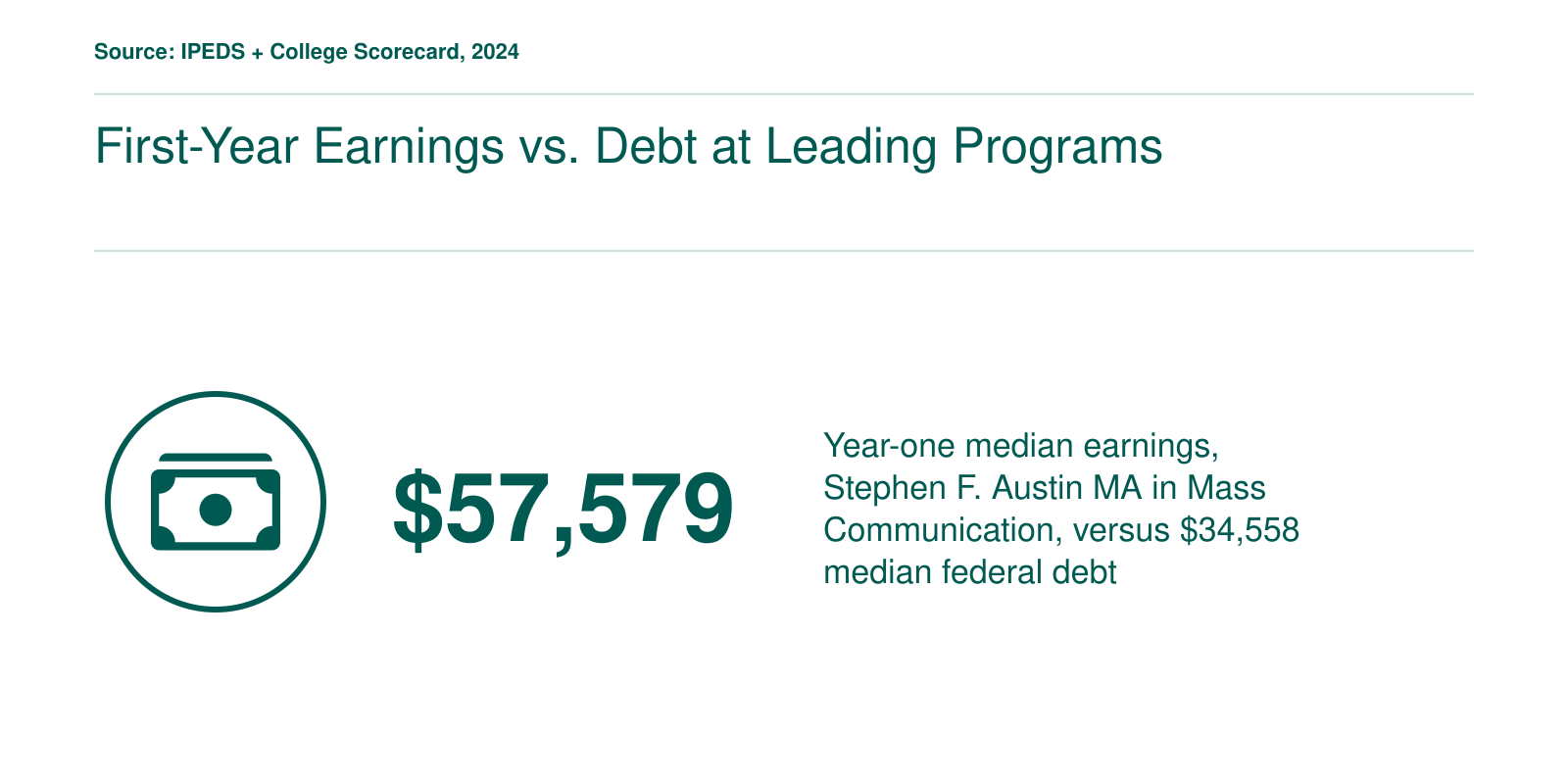
First-Year Earnings vs. Debt at Leading Programs
A fair earnings-versus-debt comparison needs program-level figures for both measures, and not every program publishes both. We left out schools that report only institution-wide debt rather than mix the two. The program below has both figures published.
The Bureau of Labor Statistics projects about 88,500 job openings per year in media and communication occupations from 2025 to 2035, mostly to replace workers who leave the field rather than from new growth. The BLS Occupational Outlook Handbook notes overall employment is projected to show little or no change during that period.
Media Communication programs by state
Quick Answers Before You Compare Programs
Degree names in this field overlap, and admissions rules change by school. These short answers cover the three questions applicants ask most before they start comparing programs.
What is the difference between media communication and mass communication?
Do media communication master's programs still require the GRE, and when are applications typically due?
Are there online master's in media communication programs that match campus degrees?
Compare Media Communication programs on the data that matters
Explore more Communications & Media specializations or browse every graduate field.
All Communications & Media programs