Master's Programs in Minnesota
Every master's program reported by a school in Minnesota: 630+ programs at 30+ graduate schools, with the online options, costs and outcomes behind each one.

Would you pay two to three times more per credit at a private Minnesota university than at a Minnesota State campus for the same license and job prospects? Graduate tuition runs from $536.82 per credit at St. Cloud State, a Minnesota State university, to over $1,200 at the University of St. Thomas, with the University of Minnesota system between them. Those gaps remain even when the credential feeds the same path: all counseling graduates face Minnesota's 4,000-hour LPCC requirement. Online Master's Programs remove relocation but not supervised practicum hours. The comparison here is price, format, admissions, funding, licensing, and earnings, not a school list. The real equation is which tradeoffs you can afford.
Key Points
- Compare total tuition across the full credit load, not per-credit rates alone.
- The LPCC counseling license requires 4,000 post-master's hours after at least 48 credits.
- Earnings depend more on field of study than on the school's name.
Popular degrees in Minnesota
Master's programs in Minnesota by field
Business & Management
- Finance21 programs
- Healthcare Administration21 programs
- Analytics18 programs
- Healthcare Management15 programs
- Management15 programs
- Accounting15 programs
- General Business12 programs
- Marketing11 programs
Education & Teaching
- Special Education14 programs
- Teaching13 programs
- Music Education9 programs
- Educational Technology or Instructional Design8 programs
- Reading & Literacy7 programs
- Educational Leadership5 programs
- Library Science or Library and Information Science or Library Media5 programs
- STEM Education or Science Education or Mathematics Education5 programs
Nursing
- Nursing Education or Nurse Educator12 programs
- RN to MSN10 programs
- Direct Entry MSN (MENP) or (DEMSN)6 programs
- Health/Nursing Informatics5 programs
- Family Nurse Practitioner (FNP)4 programs
- Nurse Administrator4 programs
- Adult Gerontology Primary Care Nurse Practitioner3 programs
- Pediatric Nurse Practitioner3 programs
Social Work & Social Sciences
- Social Work24 programs
- Social Work Advanced Standing14 programs
- Human Services5 programs
- Sociology3 programs
Psychology
- Educational Psychology or School Psychology6 programs
- Counseling Psychology6 programs
- Clinical Psychology5 programs
- Applied Behavior Analysis5 programs
- Industrial Organizational Psychology4 programs
- School Psychology4 programs
- General Psychology3 programs
- Forensic Psychology2 programs
Healthcare
- Health Administration12 programs
- Public Health8 programs
- Speech Pathology8 programs
- Health Informatics6 programs
- Nutrition3 programs
- Health Education3 programs
- Exercise Science2 programs
Religion & Theology
- Divinity11 programs
- Theology11 programs
- Christian Ministry7 programs
- Christian Leadership3 programs
- Youth and Family Ministry2 programs
- Urban Ministry2 programs
Counseling
- Clinical Mental Health Counseling13 programs
- Addiction Counseling8 programs
- School Counseling6 programs
- Marriage and Family Therapy or Marriage and Family Counseling6 programs
- Christian Counseling1 program
Communications & Media
- Communication7 programs
- Communication Disorders7 programs
- Speech Pathology6 programs
- Media Communication3 programs
- Technical Communication2 programs
- Strategic Communication2 programs
Computers & IT
- Cybersecurity11 programs
- Information Security & Assurance7 programs
- Data Analytics6 programs
- Machine Learning1 program
Arts & Design
- Creative Writing17 programs
- Fine Arts1 program
Science & Engineering
- Environmental Science6 programs
- Geography5 programs
- Sustainability or Environmental Management5 programs
Criminal Justice & Law
- Master of Laws3 programs
- Public Policy2 programs
- Business Law2 programs
- Legal Studies1 program
- Homeland Security1 program
What Does a Master's Degree Cost in Minnesota?
The cheapest per-credit rate is not always the cheapest degree, and the priciest school is not always the priciest once aid is counted. Start with sticker price, then adjust for credits, residency, and fees.
Public Universities: Total Tuition
Most master's programs run 30 to 36 credits. Counseling and social work often need 48 to 60. At the 2025-26 Minnesota State graduate rates, Minnesota State Mankato charges $572.95 per credit and St. Cloud State $536.82. Tuition alone for 30 to 36 credits works out to roughly $16,000 to $20,600 before fees.
The University of Minnesota Twin Cities lists professional graduate tuition at $913 per credit for residents.1 That puts a 30 to 36 credit degree near $27,400 to $32,900, again before fees. That rate covers professional graduate programs, so confirm your program's own schedule.
Private Universities
The University of St. Thomas sets graduate tuition by program, not one university-wide rate. Social work is $875 per credit and professional psychology $894.2 A 48 to 60 credit MSW program at $875 would run roughly $42,000 to $52,500 in tuition.2 Hamline and St. Catherine post their own schedules, so check them directly.
Residents, Nonresidents, and Flat Rates
At the University of Minnesota, the nonresident rate is $1,446 per credit versus $913 for residents, about 58 percent more.1 Mankato's cost-of-attendance estimates also show a gap, $15,178 for nonresidents against $10,732 for residents, based on nine credits per semester. Check whether your program applies a separate nonresident rate. Many private schools and online programs charge one flat rate to everyone, which can make them cheaper for out-of-state students.
What Sticker Prices Hide
- Mandatory fees: Twin Cities students pay a $385.93 student-services fee, plus athletics ($111), transportation ($19), and capital-improvement ($20) charges. Collegiate fees run $293 to $357 depending on the college, and there is a one-time $150 records fee.1
- Differential tuition: Mankato's Master of Accounting charges $889 per credit plus a $48.39 per-credit fee, well above its general graduate rate. St. Thomas prices its MSN programs at $11,033 per term and its LLM at $25,499 per semester.2
- Health coverage: The Twin Cities health-benefit plan is $1,795 when required.1
Published tuition is not what most students pay. Assistantships, waivers, and scholarships can change the math, which the funding section below covers.
Minnesota Master's Programs Tuition Comparison: Public vs. Private
The rates below are published 2025-26 graduate per-credit tuition. Rates and fees change each year and some programs charge their own rates, so confirm current figures on each school's bursar page before budgeting. Over a 30-credit degree, Minnesota State University, Mankato is the lowest here at about $17,100 for residents, while University of Minnesota Duluth at its published rate comes to about $53,205 for residents and $83,880 for nonresidents, a gap of more than $36,000 between residents at the two ends. Per-credit rates for University of Minnesota Twin Cities, Winona State, Hamline, and St. Catherine are not shown here, so check their bursar pages directly.
| Institution | Sector | Resident Per-Credit Tuition | Nonresident Per-Credit Tuition | Estimated 30-Credit Tuition |
|---|---|---|---|---|
| Minnesota State University, Mankato | Public | $570.00 | $826.00 | $17,100.00 resident; $24,780.00 nonresident |
| St. Cloud State University | Public | $685.08 | N/A | $20,552.40 |
| University of St. Thomas | Private | $727.00 | N/A | $21,810.00 |
| University of Minnesota Duluth | Public | $1,773.50 | $2,796.00 | $53,205.00 resident; $83,880.00 nonresident |
Online, Hybrid, and Part-Time Master's Options in Minnesota
What Can Be Done Online
Minnesota State, the University of Minnesota, and St. Thomas all offer online or hybrid master's programs. Fully online options cluster in education, business, nursing, online MHA programs, and IT, including St. Thomas's online MS in Emergency and Disaster Management. Fields built around supervised practice are different. Counseling practicums and social work field placements generally require in-person or clinical hours, so expect a hybrid structure or a placement near you even when coursework is remote. Minnesota State's online directory is the best starting point, though it does not list every participating university.
How Delivery Affects Price
Online does not automatically mean cheaper, and no single rule covers every school. Minnesota State's FY2026 schedule is labeled as resident master's rates, and Mankato lists 2026-2027 graduate tuition from a $552.39 per-credit baseline, with the rate set by the program. Examples include $558.26 for the MS in Cybersecurity, $683.84 for nursing, and $765.21 for MBA programs1. Mankato's 2026 cost chart shows $889.00 per credit for the MAcc and MBA, so confirm the figure for your exact program. Do not assume out-of-state online students get the resident rate until the school confirms it.
The University of Minnesota prices online programs one at a time. Its online MS in Child Life and Pediatric Psychosocial Care is $1,826 per credit for 2026-20272, and UMN Online says to check each program page for tuition and fees. St. Thomas also publishes program-specific rates: $700 per credit for the 30-credit online Emergency and Disaster Management degree3, or about $21,000 total, against $625 for its MBA and $500 for Online Educational Leadership4.
Part-Time Pacing
Most working adults take one or two courses a term, usually 3 to 6 credits. On a 30-credit program like St. Thomas's, one course per term means ten terms, and a degree that takes two years full-time often stretches to three or four. Total tuition stays roughly the same, but you pay it over a longer period, and fees may add up each term.
Aid and Assistantships
Part-time status can change your options. Federal aid generally requires at least half-time enrollment, and assistantships often expect full-time students. Ask each program about minimum credit loads before you plan around either.
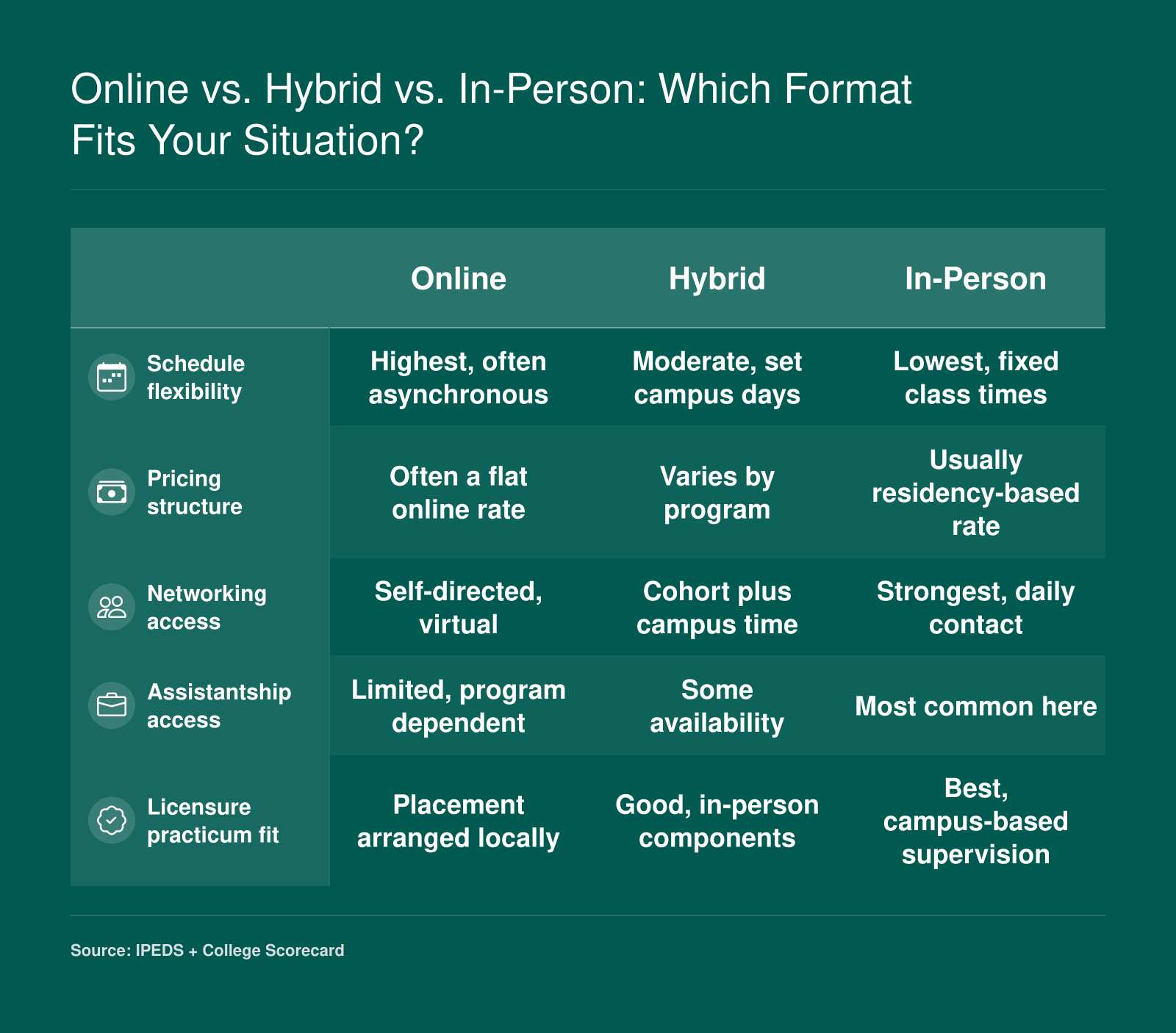
Online vs. Hybrid vs. In-Person: Which Format Fits Your Situation?
Format shapes your schedule, your bill, and your access to funding more than most applicants expect. Use this side-by-side to match a delivery style to your situation: working full time, relocating, or pursuing a license that requires supervised in-person practicum. Always confirm pricing and residency rules with each program, since policies differ by school.
Admissions: Deadlines, GRE/GMAT, and Work Experience
Do you need the GRE or GMAT?
The honest answer in Minnesota is: it depends entirely on the program, not the university. The University of Minnesota Twin Cities Graduate School sets no single testing policy, so one department may require the GRE General Test while another down the hall dropped it years ago. Applied Economics at the U, for example, requires the GRE General Test and will not accept the GMAT in its place. A U of M M.Ed. track, by contrast, is among the master's programs with no GRE required for fall 2026 entry. Minnesota State Mankato likewise leaves test policy to individual degree programs.
Business is where tests persist most stubbornly. The Carlson Full-Time MBA requires either the GMAT or GRE, though waivers are available based on GPA, prior graduate degrees, work history, or certain professional certifications. The Carlson Executive MBA is fully test-optional, with no GMAT, GRE, or Executive Assessment required. If you do test, sit for the exam several weeks ahead of your target deadline so scores arrive in time. GRE scores stay valid for five years; the U of M's score code is 6874, and Mankato's is 6677.
Deadline patterns worth planning around
Two rhythms dominate. Research-oriented and funded programs cluster their priority dates in December through February: Applied Economics uses a December 10 date for funding consideration, and the Carlson Full-Time MBA runs rounds that typically fall on October 1, December 1, February 1, and April 1. Professional and online programs run far later or on a rolling basis, with some U of M master's tracks accepting applications into late July for fall entry. Always confirm the specific program's date rather than assuming a campus-wide one exists.
Where work experience is expected
Management and executive programs treat experience as a real admissions requirement, not a nice-to-have. The Carlson Full-Time MBA expects work experience and strongly recommends at least two years full-time after the bachelor's. The Professional MBA requires two years. The Executive MBA sets the bar at six or more years of professional experience, including at least two in management, and expects you to be currently employed when you apply.
One practical move: submit by the priority deadline even if later applications are still accepted. Assistantships, tuition waivers, and fellowship nominations are usually decided from that first pool, and a late application can cost you funding you otherwise qualified for.
Your Minnesota Master's Application Checklist
Requirements vary by program, so treat this as a starting list and confirm details on each program's admissions page.
- Accredited bachelor's degreeYou need a bachelor's degree from a regionally accredited institution. Minnesota colleges and universities are accredited by the Higher Learning Commission, and that is the accreditor most Minnesota programs will expect to see on your transcript.
- Minimum GPAMany programs look for a GPA around 3.0. Some offer conditional or provisional admission to applicants below that line, often tied to strong work experience or a first-semester performance requirement.
- Core application documentsPlan on official transcripts from every institution you attended, a statement of purpose, a resume, and two to three recommendation letters. Ask recommenders early.
- Test scores, only if requiredMany programs no longer require the GRE or GMAT. Check whether your program does, and whether a waiver is available based on GPA or work experience.
- English proficiencyInternational applicants typically submit TOEFL, IELTS, or a comparable score unless they qualify for an exemption.
- Background checkLicensure-track programs, such as counseling, nursing, and teaching, commonly require a background check before clinical or field placements.
Funding Your Master's: Assistantships, Scholarships, and Tuition Waivers
Most Minnesota graduate students piece funding together from institutional aid, work-based support, and federal loans. State grant money is largely off the table. Minnesota State Grants are for undergraduates, and the University of St. Thomas notes that graduate students are not eligible for Pell Grants or Minnesota State Grants.3
How Graduate Assistantships Work
Assistantships come as teaching, research, or administrative roles, and the terms differ by campus.
- University of Minnesota: Tuition waiver coverage is set at twice the appointment percentage, so a 50% teaching or research appointment earns a 100% waiver. Assistants also receive a stipend and subsidized health coverage. Pay rates are set by the student's and adviser's home department, so figures vary.1
- Minnesota State Mankato: A full assistantship typically carries a stipend of at least $10,000 for the academic year, plus a waiver for up to nine graduate credits per semester. Assistants must enroll in at least six credits each semester.
- St. Cloud State: 2026-2027 stipends range from $5,280 to $10,560, depending on hours and appointment length. Full-time assistants receive remission for nine graduate credits per semester, and part-time assistants working about 10 hours a week receive six. Remission applies to fall and spring only, unused credits do not roll over, and fees are not covered. Assistants are not on the university's employee health plan, so they must buy coverage.2
Check the details before you count on a waiver. A stipend plus remission can still leave fees and credits beyond the cap on your bill.
Scholarships, Waivers, and Employer Help
St. Thomas points to scholarships, assistantships, and employer partnerships as ways to offset cost.3 Availability depends on field and need, and individual departments may offer awards that are not listed centrally. Assistantships there are program-specific, and at least one program, software, says it has none.4 The sources reviewed did not describe a general nonresident tuition waiver, so assume out-of-state students pay the rate their program charges unless a department tells you otherwise.
Employer tuition assistance matters in the Twin Cities, where large corporate and healthcare employers are common. Ask HR about annual caps and any requirement to stay after you finish.
Federal Direct Unsubsidized loans and Grad PLUS loans are the backstop for eligible students. Borrow only what remains after other sources, since graduate debt is the cost that follows you into your career.
Your Next Step
Contact the department you are applying to, not only the financial aid office. Assistantships are usually filled by faculty and program staff, and openings, stipends, and deadlines are often not posted in one place. Ask what share of admitted students receive appointments, what the waiver covers, and how health insurance works.
Licensure and Professional Pathways in Minnesota
Minnesota's professional counseling license (LPCC) requires 4,000 hours of post-master's practice1, and that is only one of several regulated pathways where the degree is the first step rather than the finish line. Requirements are set by separate boards, so check each one before you commit to a program.
Counseling and Marriage and Family Therapy
The Board of Behavioral Health and Therapy ties the 700-hour minimum to supervised field experience within a qualifying master's program.1 After the degree, general LPCC applicants document:
- Practice: 4,000 post-master's hours, including 1,800 hours of direct client contact.1
- Supervision: 200 hours, at a rate of 2 hours per 40 practice hours.1
- Format: at least half individual, at least 75% in person, with the remainder allowed by phone or audiovisual means.1
An LPC who already has 2,000 supervised hours documents only an additional 2,000 to convert.2 Look for CACREP accreditation for Clinical Mental Health Counseling and COAMFTE for Marriage & Family Therapy, then confirm with the board that a specific program qualifies. Exam requirements also apply, so verify the current ones.
Social Work
The Board of Social Work supervises in stages. Nonclinical LGSW supervision runs 4 hours per 160 practice hours for the first 4,000 hours.3 Clinical licensure (LICSW) requires 4,000 to 8,000 supervised clinical hours, 200 supervision hours, and at least 1,800 hours of direct client contact.3 A provisional license requires 2,000 practice hours and 37.5 supervision hours before the standard license.4 CSWE accreditation is the benchmark to look for, but the Board's materials we reviewed do not spell out degree or coursework requirements, so confirm directly.
Teaching, Nursing, and School Psychology
Teacher licensure runs through PELSB's tiered system, and APRN roles run through nursing board rules and national certification. School Psychology has its own licensing track. We could not confirm current 2026 pathway conditions for these, so check each agency's site before choosing a program.
Psychology Master's Programs
Independent practice as a licensed psychologist in Minnesota is a doctoral-level credential, so a master's alone is not a route to that title. We could not verify a current Board of Psychology rule for master's-level practice, including supervised-practice status or permitted titles. Many psychology master's graduates instead pursue counseling licensure or continue to a doctorate.
Verify Out-of-State Online Programs
An online program based outside Minnesota may not meet Minnesota's supervised-experience, accreditation, or coursework rules. Before enrolling, ask the program in writing whether it satisfies the relevant Minnesota board, and confirm with the board itself.
Minnesota Counselor Licensing at a Glance
Career Outcomes and Earnings for Minnesota Master's Graduates
Field of study shapes what a Minnesota master's degree pays far more than the name on the diploma.
What Graduates Actually Earn
College Scorecard reports median earnings only for master's completers who received federal financial aid. These figures describe that group, not every graduate, and small cohorts can shift from year to year. Even so, the Minnesota examples available show a wide spread:
- Nursing: Walden University (Minneapolis) reports a median of $109,614 one year after graduation and $122,823 four years out.1 Those figures come from different graduating cohorts, so treat them as two snapshots rather than one class's raise.
- Business: Bethel University's business administration master's (29 completers) shows medians between roughly $88,000 and $96,000 at two post-completion checkpoints.2 Walden's general MBA program median of $82,853 sits about 20 percent below the national comparison for the field.1
- Education leadership: Minnesota State University Moorhead's educational administration master's (65 completers) reports medians from about $62,000 to $72,000.3
- Social work: Walden's social work master's posts a median of $63,559, close to the national comparison of $65,123.1
Occupational Wages Are a Different Measure
Bureau of Labor Statistics wages cover everyone working in an occupation in the state, regardless of where or when they trained. They are not graduate earnings. Minnesota nurse practitioners earned a median of $133,260 a year ($64.07 an hour) in May 2025, with the 10th percentile at $98,950 and the 90th at $170,140, across about 7,780 jobs. The state's Department of Employment and Economic Development reports a slightly lower $62.69 hourly median for a different 2025 period.4 We could not confirm a reliable state median for education administrators, so check current BLS data before planning around one.
Weighing Payback Against Cost
Set these numbers against the tuition ranges listed above. Nursing and business tend to recover their cost fastest: the nurse practitioner pathway leads to six-figure wages, and a reasonably priced MBA can lift pay quickly. Walden's below-national business figure is a reminder that the specific program still matters. Education leadership degrees often pay off through district salary schedules that reward advanced credentials.
Counseling and social work involve harder math. Earnings in the low-to-mid $60,000s mean a high-priced private program can take many years to repay. Students usually pursue these degrees because licensure requires them, not because they promise a pay jump. In these fields, the most affordable accredited MSW program that meets Minnesota licensing requirements is usually the smartest choice.
National Context
Nationally, BLS data consistently show master's holders out-earning bachelor's holders, with median weekly earnings roughly 15 to 20 percent higher. That premium is an average across all fields. Your field and your program's price decide whether it actually shows up in your finances.
Nurse Practitioner Pay in Minnesota
Median annual wage for nurse practitioners in Minnesota
Graduate schools in Minnesota with the most master's programs
| School | City | Type | Master's programs | Online | Grad tuition / yr |
|---|---|---|---|---|---|
| University of Minnesota-Twin Cities | Minneapolis | Public | 64 | 12 | $22,017 |
| Walden University | Minneapolis | Private for-profit | 61 | 61 | $10,885 |
| Capella University | Minneapolis | Private for-profit | 60 | 60 | $15,092 |
| Minnesota State University-Mankato | Mankato | Public | 41 | 20 | $10,449 |
| Minnesota State University Moorhead | Moorhead | Public | 36 | 32 | $11,902 |
| Concordia University-Saint Paul | Saint Paul | Private nonprofit | 29 | 23 | $8,550 |
| Saint Mary's University of Minnesota | Winona | Private nonprofit | 28 | 28 | $12,474 |
| University of St Thomas | Saint Paul | Private nonprofit | 27 | 14 | $21,151 |
| Saint Cloud State University | Saint Cloud | Public | 27 | 20 | $10,924 |
| St Catherine University | Saint Paul | Private nonprofit | 26 | 14 | $18,570 |
| Bethel University | Saint Paul | Private nonprofit | 24 | 21 | $10,260 |
| University of Minnesota-Duluth | Duluth | Public | 24 | 6 | $21,630 |
| Southwest Minnesota State University | Marshall | Public | 22 | 21 | $10,360 |
| Herzing University-Minneapolis | St. Louis Park | Private nonprofit | 20 | 19 | $9,370 |
| Winona State University | Winona | Public | 18 | 16 | $10,886 |
Program counts are the verified master's listings in our directory; tuition is the school-wide average for a full-time graduate student (IPEDS).
Common Questions About Master's Programs in Minnesota
These answers cover the questions prospective students ask most often about cost, accreditation, licensure, and doctoral pathways. Policies change, so confirm details with the program or agency before you apply.
Which Minnesota universities offer the most affordable master's programs?
How do I confirm a Minnesota master's program is accredited?
Can I practice psychology in Minnesota with only a master's degree?
Do master's credits transfer into doctoral programs at Minnesota universities?
Compare programs nationwide
Many Minnesota residents study online. Every ranked list above has an online lens, or browse every field.
Online master's programs Browse all fields