Best Master's in Music Education Programs in Minnesota
Compare 9 accredited Music Education programs in Minnesota at 5 schools, with graduate earnings, cost, debt, and completion data from IPEDS and the U.S. College Scorecard.
For a working music teacher, a master's degree usually means a jump on the district salary schedule, but earning it without stepping away from the classroom or the podium is the real constraint. Most Minnesota programs answer that by building around summers and evenings.
The field here is small, and both campus and online formats sit on one list. Evening and synchronous online classes at the University of Minnesota-Twin Cities, summer residencies at Bemidji State University, and cohort hybrids at Concordia College at Moorhead all target teachers who keep teaching while enrolled, a model shared by many of the best online master's in music education programs.
Tuition spans a wide range, and reported graduate earnings a decade out run from roughly $54,000 to $74,000, a spread worth weighing against what each degree costs.
Key Points
- Bemidji State's 33-credit master's runs over three consecutive summer residencies.
- Concordia College at Moorhead offers a 34-credit, cohort-based hybrid format for working teachers.
- Total cost depends more on your district and license status than sticker tuition.
Top-Ranked Master's in Music Education Programs in Minnesota for 2027
Minnesota offers master's in music education options ranging from evening and summer programs for working teachers to hybrid and low-residency formats. Graduation rates below describe each school's institution-wide rate, not completion of the music education program. Where accreditation status could not be confirmed from our research, we say so and suggest checking with the school.
University of Minnesota-Twin Cities
#1Minneapolis, MN · ~$22,000/yr (est.)
Best for: Practicing teachers drawn to a research track
The University of Minnesota-Twin Cities, in Minneapolis, offers a Master of Music in Music Education built for practicing educators, with a Pedagogical track and a Research track. Evening courses, summer seminars, and a synchronous online option fit around a teaching schedule. The university is accredited by the Higher Learning Commission (HLC), with its next comprehensive review scheduled for 2026-2027, and NASM lists the degree. Its institution-wide graduation rate is about 85 percent.
- Two options: Pedagogical track or Research track
- Master's project and final oral exam required
- Synchronous online classes plus evening courses
- Summer week-long seminars for working teachers
- K-12 teaching experience preferred
- Minnesota teacher licensure pathways noted
- Emphasis on action research
University of St Thomas
#2Saint Paul, MN · ~$21,000/yr (est.)
Best for: Choral, Kodály, or Orff specialists
The University of St. Thomas, in Saint Paul, offers a 33-credit Master of Arts in Music Education aimed at working music teachers, with summer-term courses and several specialty concentrations. Its Kodály and Orff Schulwerk options are especially distinctive for elementary and general music educators. The university has been HLC accredited since 1916, reaffirmed in 2024, and NASM accredits the music department and lists the MA and its options. Its institution-wide graduation rate is about 76 percent.
- 33 credits, starting in summer
- Concentrations include Instrumental, Piano Pedagogy, and Diverse Perspectives
- Capstone and oral comprehensive exam required
- Up to 10 credits may transfer
- Non-degree option available
- Meets AOSA requirements
- Learning through movement, song, speech, and instruments
- Thesis or capstone option
- SONOR scholarship includes a special xylophone
- Focus on conducting, pedagogy, and repertoire
- Serves treble, adolescent, and mature voices
- Annual choral conducting concert
- Smithsonian Folkways certification available
- Sequential, active music-making approach
- Moveable do, hand signs, and rhythm syllables
- Offered through the Kodály Institute at St. Thomas
- Thesis or capstone option
Concordia College at Moorhead
#3Moorhead, MN · ~$12,000/yr (est.)
Best for: Working teachers wanting hybrid summer study
Concordia College at Moorhead offers a hybrid Master of Music in Music Education for working teachers, combining online coursework with an accelerated on-campus summer session in July. The cohort model and two-year format suit teachers who want a predictable path. Our research did not confirm HLC or NASM status for this program, so verify both with the college. This is a different institution from Concordia University, St. Paul. Its institution-wide graduation rate is about 61 percent.
- 34 credits over two years
- Published rate of $560 per credit
- Online learning plus July on-campus summer session
- Cohort-based with graduate faculty mentorship
- Flexible start options
- Covers elementary, band, choir, and orchestra contexts
Minnesota State University-Mankato
#4Mankato, MN · $10,000 – $20,000/yr (est.)
Minnesota State University, Mankato offers a campus-based Master of Music with a music education concentration, alongside choral conducting and wind band conducting options. It suits both recent graduates and practicing professionals who want to grow as performers, conductors, and teachers. The graduate catalog identifies NASM accreditation; we could not confirm institutional HLC status for this specific program from our sources. Its institution-wide graduation rate is about 54 percent.
- 34 credits per the 2024-2025 graduate catalog
- Three concentration options
- Professional degree for recent graduates and working professionals
- Connected to Minnesota teacher licensure with K-12 field experience
- Campus-based format
Bemidji State University
#5Bemidji, MN · ~$10,000/yr (est.)
Bemidji State University offers a low-residency Master of Music Education for K-12 teachers, completed over three consecutive summer residencies on Lake Bemidji. We could not confirm NASM status from our research, so check with the school. Its institution-wide graduation rate is about 48 percent.
- 33 credits over three summer residencies
- Cohort-based, summer-start format
- Awards national Kodály certification
- Bachelor's in music or education required
- 3.00 minimum GPA listed in the graduate catalog
- Capstone, thesis, or recital option
- Instrumental and general music specialization
- Topic courses in Orff-Schulwerk and special education
- Private lessons with a faculty adviser
- Hands-on courses in the Bangsberg Fine Arts Complex
Cost & outcomes by school
Federal data for the highest-earning Music Education programs, independent of the ranking above. Earnings are this field's master's graduates four years after completing, where the Scorecard reports them.
| School | Earnings | Tuition / yr | Debt | Grads/yr | Format |
|---|---|---|---|---|---|
| University of St Thomas MN | $62,671 | $21,151 | — | 15 | Campus |
| Minnesota State University-Mankato MN | $59,887 | $10,449 | — | 17 | Campus |
| University of Minnesota-Twin Cities MN | $52,392 | $22,017 | $27,470 | 33 | Campus |
| Concordia College at Moorhead MN | — | $11,557 | — | 18 | Hybrid |
| Bemidji State University MN | — | $10,099 | — | 1 | Hybrid |
Sources: U.S. Department of Education. Tuition and graduates: IPEDS. Earnings and debt: College Scorecard, this field's master's graduates; a dash means no figure is reported.
Online, Hybrid, and Summer Master's in Music Education Options in Minnesota
Summer-intensive and hybrid
Among the best master's in music education programs, Bemidji State's Master of Music Education is the clearest summer model: 33 credits completed over three consecutive summer residencies, with the cohort living on campus. Concordia College at Moorhead runs a 34-credit, cohort-based hybrid over two years, anchored by an accelerated on-campus summer session. The University of St. Thomas Master of Arts in Music Education (33 credits) is built for working teachers and lists summer-only, blended, and online routes among online master's programs in Minnesota. Its summer course GMUS 536 on world music pedagogy is offered every summer. St. Thomas has also paused new enrollment in some graduate music programs as of April 2026, so confirm your concentration is open before planning around it.
Campus with online access
The University of Minnesota's 30-credit program meets in the evenings during the school year, with synchronous online classes for distance students and week-long summer seminars. It suits part-time study, though the school's published materials don't spell out a fixed number of semesters. Minnesota State University-Mankato is a traditional campus Master of Music, and no online or summer format is published for it.
Does summer study fit full-time teaching?
Generally yes, since Bemidji's residencies fall in summer. Exact 2026 weeks vary, so check each school's calendar. Concordia's two-year length suggests some work outside summer, so ask admissions what continues during the school year.
Related Articles
Which Minnesota Master's in Music Education Programs Waive the GRE?
The table reflects the admissions pages for the University of Minnesota-Twin Cities and the University of St Thomas as last reviewed in October 2026. Minnesota's music education master's programs generally put more weight on your musicianship and teaching background than on test scores. Minnesota expects a music degree and prefers licensure and K-12 teaching experience, and requires a remote interview. St Thomas requires a music or music education bachelor's degree and a video performance assessment. We could not confirm current GRE, audition, or deadline details for Concordia College at Moorhead, Minnesota State University-Mankato, or Bemidji State University, so we left them out rather than guess. Check those schools' graduate admissions pages directly. Summer-start programs often set spring priority dates, so confirm every deadline with the program before you apply.
| School | GRE Policy | Teaching License or Experience | Audition/Interview | Application Deadline |
|---|---|---|---|---|
| University of Minnesota-Twin Cities (Master of Music in Music Education) | Test-optional | Bachelor's degree in music expected, generally with music education licensure; K-12 music teaching experience strongly preferred | Remote entrance interview required | December 1 for 2027 graduate admission |
| University of St Thomas (Master of Arts in Music Education) | No published policy | Bachelor's degree with a major in music or music education from an accredited institution; no teaching license requirement listed | Video performance assessment: two contrasting selections and a short unaccompanied melody | Summer: April 1; Fall: July 1; Spring: December 1 |
What a Master's in Music Education Costs in Minnesota
The full price of these degrees depends far more on your home district and your license status than on the sticker tuition any one school lists. Multiply a per-credit rate by the required credits, and the gap between schools narrows quickly, even among the most affordable master's in music education programs.
Public versus private
The public universities carry the lower published graduate tuition, while the private route runs higher. At St. Thomas, a secondary source lists School of Education graduate tuition near $727 per credit, which at 33 credits comes to roughly $23,991, though the university's current rate is not officially confirmed here. The University of Minnesota's M.M. in Music Education is a 30-credit degree, and its exact per-credit figure for this year is not established. For the remaining schools, published per-credit rates are not available, so estimate directly from each program page before you commit.
Be cautious reading the institution-wide net price figures: those are averages across all students after aid, not a quote for a graduate music educator.
Offsetting the cost
Most working teachers lean on two levers: district tuition reimbursement and the salary-lane raise a master's brings on a district pay scale. These degrees typically advance an existing license rather than grant an initial one. St. Thomas also offers a Kodaly concentration built around Kodaly and Orff Schulwerk coursework, worth weighing if method certification matters to you.
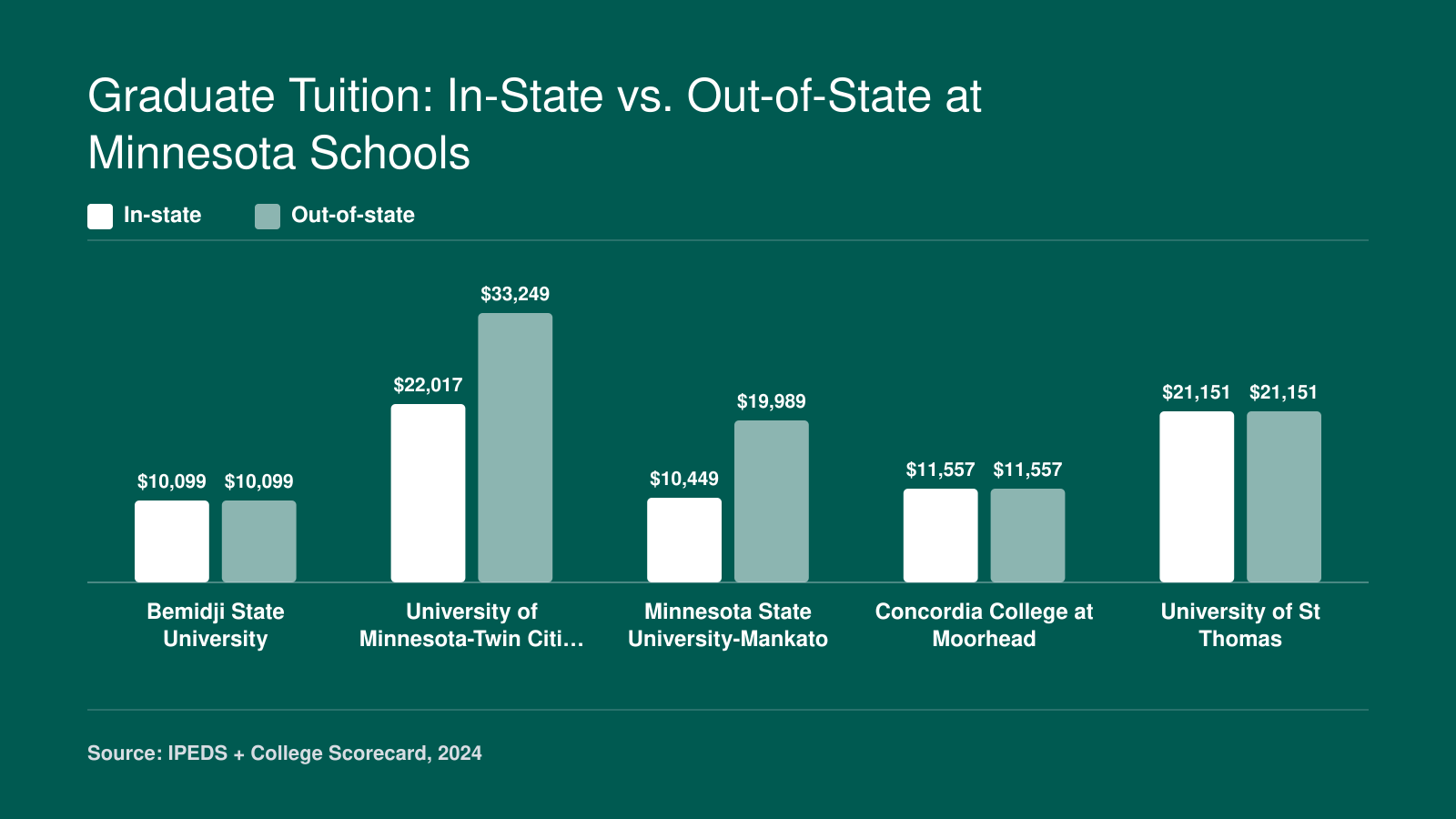
Graduate Tuition: In-State vs. Out-of-State at Minnesota Schools
The chart compares graduate-level tuition for residents and nonresidents at each school. Concordia College at Moorhead and the University of St Thomas charge every student the same rate, as private schools typically do. Bemidji State University also charges one rate. The University of Minnesota-Twin Cities has the widest gap, with out-of-state tuition $11,232 above the in-state figure, followed by Minnesota State University-Mankato at $9,540.
Minnesota Music Teaching Licensure at a Glance
Master's in Music Education in Minnesota: Common Questions
Do I need a teaching license to apply to a music education master's program in Minnesota?
Does the University of Minnesota-Twin Cities offer a master's in music education?
Are summer-intensive music education master's programs compatible with full-time teaching?
Can I earn Kodály or Orff certification as part of a Minnesota master's in music education?
Compare Music Education programs on the data that matters
Explore more Education & Teaching specializations or browse every graduate field.
All Education & Teaching programs