Most Affordable Master's in Music Education Programs
Compare 320+ accredited most affordable Music Education programs at 220+ schools, with graduate earnings, cost, debt, and completion data from IPEDS and the U.S. College Scorecard.

Working music teachers often pursue a master's for the salary-schedule bump, but the wrong tuition can erase that raise for years. In-state tuition across the ranked programs runs from roughly $6,600 to $12,700; average net price after aid lands between about $3,000 and $15,600. Identical credentials can carry very different payback times.
The decision turns on NASM accreditation, licensure fit, online scheduling, assistantships, and graduate earnings, not just the sticker price. A cheap program that forces unpaid summers or an extra year is rarely the better deal.
Key Points
- Southeastern Oklahoma State charges $5,220 in-state tuition for music education master's.
- University of Florida nonresident tuition tops $30,130, more than double resident rate.
- Teachers with a master's degree earned about $67,000 in 2020-2021 nationally.
Top 10 Most Affordable Master's in Music Education Schools
These ten schools combine relatively low graduate tuition with music education master's programs that span online, hybrid, and campus formats. The list prioritizes cost, but every entry also has a clear identity, whether that's a certification pathway, a thesis or capstone option, or a summer-friendly schedule for working teachers. Use the cards below to compare tuition, delivery format, and program focus before you apply.
The University of Texas Rio Grande Valley
#1Edinburg, TX · $5,000 – $10,000/yr (est.)
Best for: Texas educators seeking assistantship support
UT Rio Grande Valley's campus-based Master of Music in Music Education sits within a School of Music offering six concentrations, including conducting, performance, and theory-composition. The program prepares music educators for elementary, secondary, and college teaching roles, with faculty guidance and performance opportunities throughout. Graduate assistantships and music scholarships are available, and applicants seeking funding submit a separate assistantship application.
- One of six School of Music concentrations
- Prepares for elementary through university teaching
- Separate assistantship application required
CUNY Hunter College
#2New York, NY · ~$11,000/yr (est.)
Best for: NYC teachers pursuing PreK-12 music certification
CUNY Hunter College's hybrid Master of Arts in Music Education is run jointly by the Music Department and School of Education, combining musicianship with teaching methodology. Students complete 40 to 46 credits and fieldwork in New York City public schools, with a supervised teaching semester observed by clinical supervisors. The program prepares candidates for New York State certification through exams such as the EAS and CST in Music, and offers an internship certificate track for working teachers.
- Hybrid delivery with NYC public school fieldwork
- 40 to 46 credits required
- Leads to New York State music certification
- Internship certificate track for working teachers
- Transfer up to 12 graduate credits
- Fall and spring start sequences
CUNY Queens College
#3Queens, NY · ~$12,000/yr (est.)
Best for: Licensed teachers pursuing choral or instrumental focus
CUNY Queens College's campus-based Master of Science in Music Education is designed for teachers who already hold Initial Certification in Music Education and want to earn Professional Teacher Certification. Students may focus on choral, instrumental, general music, conducting, composition, pedagogy, or jazz, and finish with a thesis or summative project. An Advanced Certificate pathway is available for teachers with a bachelor's degree in music but no initial certification.
- New York State Education Department accredited
- Seven concentration options
- Thesis or summative project option
- Leads to Professional Teacher Certification
- Advanced Certificate pathway for uncertified teachers
- Based in Aaron Copland School of Music
CUNY Lehman College
#4Bronx, NY · ~$12,000/yr (est.)
CUNY Lehman College's campus-based Master of Arts in Teaching in Music Teacher: All Grades leads to New York State initial certification across every grade level, from early childhood through high school. The program combines advanced music study with teacher training, preparing graduates to teach general, instrumental, or vocal music in New York schools. It is part of Lehman's graduate educator preparation programs.
- Leads to New York State initial certification
- Covers all grade levels
- Prepares general, instrumental, and vocal music teachers
- Campus-based graduate educator preparation
California State University-Long Beach
#5Long Beach, CA · $9,000 – $19,000/yr (est.)
California State University, Long Beach offers a campus-based Master of Arts in Music with a concentration in Music Education. The curriculum combines research methods and musical analysis with foundations of music education, inquiry in music education, and emerging methods, plus electives in performance and conducting. Students finish with a thesis or project, and admission requires a bachelor's degree in music or equivalent coursework, a 3.0 GPA in upper-division music classes, and a placement exam.
- 30 total credit hours
- Thesis or project option
- 3.0 GPA in upper-division music classes
- Placement exam required
- Core curriculum of 13 to 15 units
University of Florida
#6Gainesville, FL · ~$13,000/yr (est.)
University of Florida's online Master of Music in Music Education is a 33-credit, asynchronous program built for practicing educators who want to continue teaching while earning a master's degree. The NASM- and CAEP-accredited program covers ensemble direction, general music, and collegiate teaching, with three annual start dates and no GRE requirement. Small classes and research funding opportunities support conference presentations and global performances.
- 100 percent online asynchronous classes
- 33 total credit hours
- NASM and CAEP accredited
- No entrance exam required
- Three start dates per year
- Scholarships and graduate research funding available
The University of Texas at El Paso
#7El Paso, TX · $5,000 – $10,000/yr (est.)
The University of Texas at El Paso offers a campus-based Master of Music with Concentration in Education, a 32-credit path that blends music education foundations, pedagogy for vocal or instrumental instruction, applied lessons, music history and theory, and educational research. Students choose a thesis or non-thesis track, and the program requires an interview with music education faculty, a written teaching philosophy, and two letters of recommendation.
- 32 total credit hours
- Thesis or non-thesis track
- Education electives cover classroom management and assessment
- Interview with music education faculty required
- All courses require a B or better
New Mexico State University
#8Las Cruces, NM · $7,000 – $19,000/yr (est.)
New Mexico State University's campus-based Master of Music in Music Education is a 31-credit program covering graduate theory review, music history and literature, and nine credits of specialized music education study. Students complete either a special research project or a master's thesis, and all coursework must earn a B or better. An accelerated pathway lets qualified undergraduates begin graduate work during junior and senior years.
- 31 total credit hours
- Thesis or special research project option
- All courses require a B or better
- Accelerated master's pathway for undergraduates
- Nine credits in music education
Brigham Young University
#9Provo, UT · $5,000 – $10,000/yr (est.)
Brigham Young University's School of Music offers a Master of Music or Master of Arts in music education, both at 32 credit hours with choral or instrumental emphasis. The program starts each summer and can be completed summers-only or full-time, usually over three to four summers. Students complete a comprehensive written exam and a final oral defense, and admission requires a bachelor's degree in music education, a music teaching license, and at least one year of public school teaching. A master's degree leading to teaching licensure is not offered.
- Choral or instrumental emphasis
- 32 total credit hours
- Summers-only or full-time study
- Starts summer term
- Comprehensive written exam and oral defense required
- Requires music teaching license and one year teaching experience
San Jose State University
#10San Jose, CA · ~$10,000/yr (est.)
San José State University's Master of Arts in Music Education is a hybrid, two-year, 30-unit program offered through Special Session, with a three-summer structure that combines online and in-residence weeks. Students pass Written Culminating Exams and complete a thesis (Plan A) or project (Plan B). Admission requires a bachelor's degree in Music, a 3.0 GPA in the last 60 units, a portfolio, an interview, and three letters of recommendation; the GRE is not required.
- Hybrid Special Session delivery
- 30 units over three summers
- Thesis (Plan A) or project (Plan B)
- Written Culminating Exams required
- No GRE required
- Portfolio, interview, and three letters required
Cost & outcomes by school
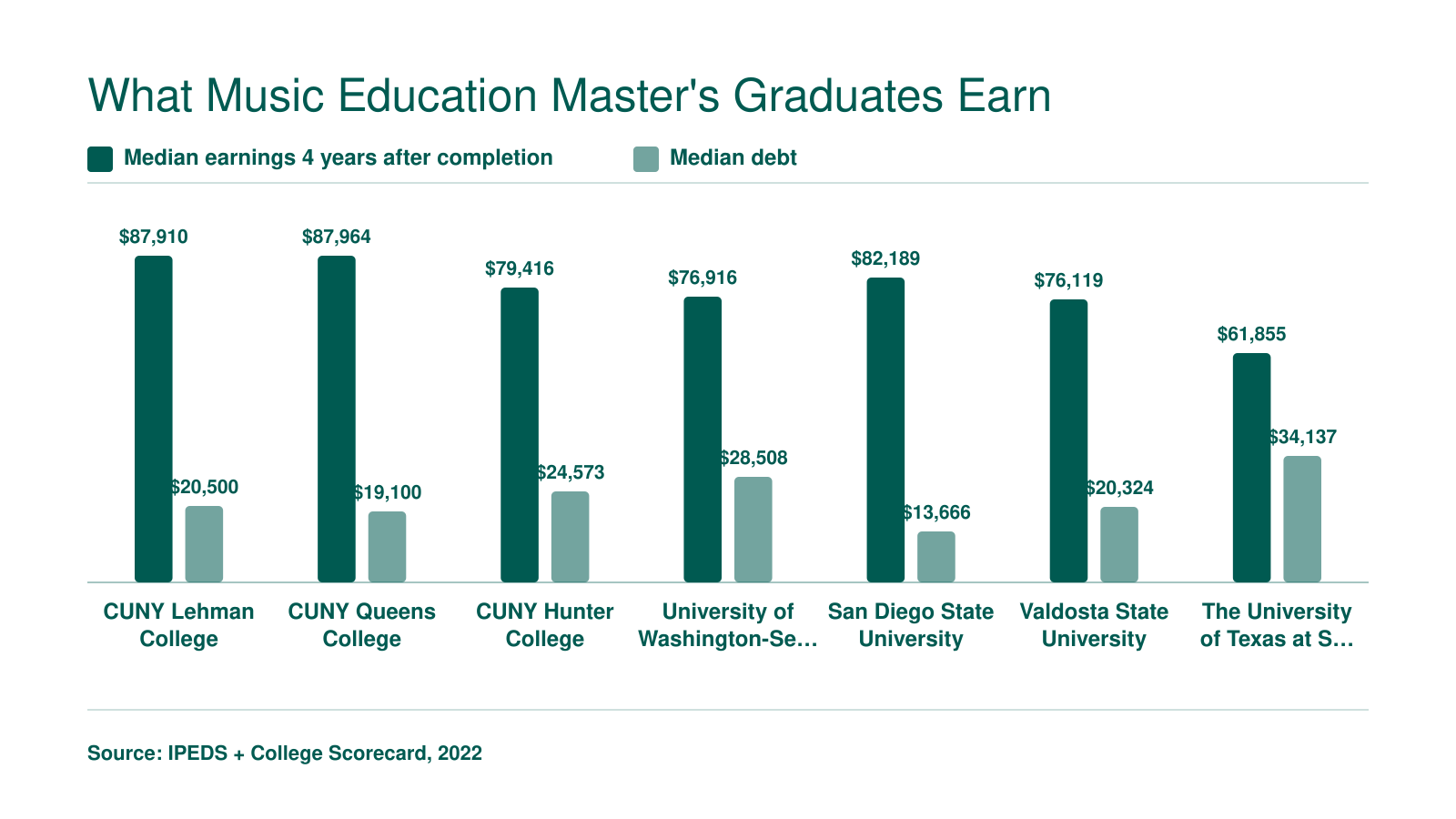
Federal data for the highest-earning Music Education programs, independent of the ranking above. Earnings are this field's master's graduates four years after completing, where the Scorecard reports them.
| School | Earnings | Tuition / yr | Debt | Grads/yr | Format |
|---|---|---|---|---|---|
| CUNY Queens College NY | $87,964 | $11,612 | $19,100 | 183 | Campus |
| CUNY Lehman College NY | $87,910 | $11,570 | $20,500 | 105 | Campus |
| Hofstra University NY | $83,127 | $31,120 | $39,214 | 89 | Campus |
| San Diego State University CA | $82,189 | $10,252 | $13,666 | — | Hybrid |
| Loyola University Maryland MD | $81,156 | $20,070 | $34,531 | 54 | Campus |
| CUNY Hunter College NY | $79,416 | $11,398 | $24,573 | 172 | Hybrid |
| Gordon College MA | $78,374 | $8,960 | — | 29 | Hybrid |
| University of Washington-Seattle Campus WA | $76,916 | $18,792 | $28,508 | 58 | Campus |
| Teachers College at Columbia University NY | $76,686 | $37,918 | $51,964 | 227 | Campus |
| Valdosta State University GA | $76,119 | $6,316 | $20,324 | 92 | Campus |
| Rowan University NJ | $72,436 | $18,607 | $19,619 | 13 | Hybrid |
| Bridgewater State University MA | $69,937 | $9,297 | $20,500 | 54 | Campus |
Sources: U.S. Department of Education. Tuition and graduates: IPEDS. Earnings and debt: College Scorecard, this field's master's graduates; a dash means no figure is reported.
Cost, debt & payoff
Median earnings of this field's master's graduates (4 yrs after completing) vs. their median federal loan debt · U.S. College Scorecard
Across these programs the median graduate earns about $61,242 and finishes with roughly $27,702 in debt — a ratio that clears a common rule of thumb (keep debt below first-year salary). Tuition and debt vary widely school to school, so check the per-school figures in the table above before you shortlist.
In-State vs. Out-of-State and Online Tuition: What You'll Actually Pay
Residency can nearly double what you pay for the same degree. Among the lowest-cost Music Education programs here, listed in-state tuition at the University of Florida is $12,737 against $30,130 for nonresidents. Southeastern Oklahoma State's $5,220 in-state figure climbs to $11,772 out of state, and CUNY Hunter College jumps from $11,398 to $20,828.
Online Doesn't Always Mean One Rate
Eastern Washington University's Online Master's in Music Education charges the same pay-by-course rate for in-state and out-of-state students.1 Don't assume every online program works that way. The University of Nebraska at Kearney's 2026-27 estimates run $369 per credit in state and $591 out of state, with the same $1,934.25 in program fees on top of both.
Fees Most Rankings Skip
- Distance-ed fees: The University of Georgia charges exclusively online students $431 per semester and flags possible textbook, proctoring, and technology costs.2
- Technology and studio fees: Longy School of Music lists a $450 yearly technology fee, a $200 per-semester accompanying fee for certain studios, and a $150 graduation fee.3
- Registration: The University of Hartford adds a $30 nonrefundable fee each semester.4
Estimate Your Real Total
Multiply required credits by your residency's per-credit rate. Then add each recurring fee times your number of semesters, plus application, graduation, and book costs.
Related Articles
NASM Accreditation and Teacher Licensure: Check Before You Enroll
The University of South Dakota has held NASM accreditation since 1956, which is the kind of signal worth looking for. NASM, the National Association of Schools of Music, evaluates the music unit and its curriculum. That differs from regional accreditation, which covers the whole institution, and from CAEP, which reviews educator-preparation units. Southeastern Oklahoma State lists both CAEP and NASM for its online M.Ed. in Curriculum & Instruction with a music focus. For most others here, current CAEP status is not clearly established, so verify it directly.
Most master's degrees in music education, including Accelerated Master's in Music Education programs, are built for teachers who already hold a license. Initial-licensure master's tracks are a separate path. Georgia's online M.M.Ed. is a license-upgrade program. Eastern Washington's M.M. is an endorsement-only route for Washington certificate holders. Campbellsville's M.M. is aimed at certified music educators with Rank III. New Mexico State expects current licensure at admission. Boston University is a notable exception, since it offers an Initial Licensure Track alongside its professional track, though tuition there was not verified.
Before paying a deposit, call your state education department. Ask whether this specific degree triggers a salary-schedule raise or a license advancement, and whether it counts if the school is out of state.
Online Master of Music Education: Schedules, Summer Residencies, and Completion Time
Online delivery solves the commute, but it does not guarantee a schedule that fits a teaching day, so check the format before you apply. Most program pages say only "online," not whether classes meet live. New Mexico State's program, built for practicing educators, states that it uses both synchronous and asynchronous sessions.1 Ask admissions for meeting times if you teach until late afternoon.
Campus residency is rarely mandatory in what we found. George Mason offers optional one- to three-week summer intensives in Fairfax, worth up to 9 elective credits.2 Georgia's two summer sessions are part of its online program.3
Most degrees run 30 to 33 credits (Georgia 33,3 New Mexico State 31,1 Campbellsville 32,4 Mason 30,2 Youngstown State 30,5 and Lamar 307). Expect roughly two years, though Georgia lists 14 to 24 months3 and Youngstown State cites as little as 12.5 Transfer limits are clearest at Georgia (6 credit hours)3 and Liberty (up to 50% of the degree)6, so confirm others in writing.
What Music Education Master's Graduates Earn
A master's degree can raise pay on district salary schedules, but the amount varies by district and experience. Nationally, teachers with a master's degree earned average base salaries of about $67,000 in 2020-2021, compared with $52,500 for teachers with a bachelor's, and in 2023-2024 master's-prepared teachers had starting salaries 8% higher and top salaries 16% higher. Music teachers are counted within broader elementary, middle, and high school teacher occupations, which reported national annual mean wages of $72,030 to $76,320 in May 2025.
Scholarships, Graduate Assistantships, and Other Ways to Cut Costs
A graduate assistantship is a paid campus job, often conducting an ensemble, teaching a section, or assisting a band director, that comes bundled with a tuition waiver and a stipend. These are campus-based by nature, so they rarely attach to fully online tracks. Missouri State's trombone assistantship, for example, waives up to 18 credits a year and pays a $12,291 stipend, but requires an undergraduate music degree and a 3.0 GPA. The University of Tennessee's graduate assistantships include a music education instrumental assistantship paying $14,067 with full tuition, fees, and medical coverage, while its Strings in Schools award pays $22,507 and requires public school licensure. Texas Tech master's assistants receive $10,500 for the academic year plus resident tuition status, subject to annual funding. Colorado Boulder covers six credits per semester plus a stipend.1
Outside the school, NAfME administers scholarships such as the Shannon Kelly Kane award for graduating seniors who are Collegiate members, and state music educator associations run their own programs. Ask your district about tuition reimbursement, check TEACH Grant eligibility, and file the FAFSA: Direct Unsubsidized and Grad PLUS loans both apply at the graduate level.
Music Education programs by state
Frequently Asked Questions About Affordable Music Education Master's Programs
These are the questions prospective students ask most when comparing affordable music education master's programs. The answers below are based on program data included in this guide. Always verify current tuition, accreditation, and licensure details directly with each university.
What is the cheapest online master's in music education?
Are online music education master's programs accredited?
Which affordable master's in music education leads to teacher licensure?
How long does an affordable music education master's take?
Can I get financial aid for a music education master's?
Compare Music Education programs on the data that matters
Explore more Education & Teaching specializations or browse every graduate field.
All Education & Teaching programs