Best Master's in Music Education Programs in Arkansas
Compare 4 accredited Music Education programs in Arkansas, with graduate earnings, cost, debt, and completion data from IPEDS and the U.S. College Scorecard.
Arkansas band, choir, and general music teachers usually want a master's that fits around a full teaching load and moves them up the district salary schedule, which makes flexibility and cost the real tradeoff. Campus and online programs share one list here, from the University of Arkansas to Arkansas State University, the University of Central Arkansas, and Arkansas Tech University.
Format, entrance requirements such as GRE waivers and recorded auditions, and the cost of a degree tied to Arkansas licensure all vary by school. Most applicants already hold a teaching license, so the degree is mainly a pay and skills credential.
Key Points
- University of Arkansas leads the 2027 Arkansas music education master's ranking.
- Arkansas State offers a fully online 2027 master's in music education.
- In-state tuition runs $7,322 to $12,470 and out-of-state reaches $30,892.
Best Master's in Music Education Programs in Arkansas, Ranked
The University of Arkansas's Master of Music in Music Education leads this ranking for prospective Arkansas music educators, followed by Arkansas State University's fully online Master of Music Education and the University of Central Arkansas's campus-based Master of Music in Music Education. These programs span campus and online formats to support working teachers.
University of Arkansas
#1Fayetteville, AR · ~$12,000/yr (est.)
Best for: Licensed music teachers seeking research-focused campus study
As Arkansas' flagship public university, the University of Arkansas houses a NASM-accredited Master of Music with a music education concentration. The program exempts candidates from the diagnostic entrance exam and ensemble participation, offers seven concentration options, and culminates in comprehensive written and oral exams. Campus-based in Fayetteville, it can be completed full time or part time while teaching, with competitive graduate assistantships for full-time students.
- Seven concentration options in the Master of Music degree
- No diagnostic entrance exam in aural and written theory or musicology
- Exempt from ensemble participation requirement
- Comprehensive written and oral exams required at completion
- Campus-based in Fayetteville
Arkansas State University
#2Jonesboro, AR · $7,000 – $13,000/yr (est.)
Best for: Working educators pursuing fully online graduate study
Arkansas State offers a fully online Master of Music Education with NASM accreditation and emphases in general, choral, or instrumental music. The 30-credit curriculum blends performance training, conducting, and music education research, with hands-on ensemble opportunities such as performing with the Howlers Pep Band or A-State choirs. Admission requires a bachelor's degree from an accredited institution with a minimum 2.8 GPA.
- Fully online delivery
- NASM accredited according to program materials
- Three concentrations: General, Choral, Instrumental
- 30 total credit hours
- Minimum 2.8 GPA for admission
- Hands-on instruction and guest artist masterclasses
University of Central Arkansas
#3Conway, AR · $5,000 – $10,000/yr (est.)
Best for: Already-certified teachers targeting K-12 music leadership
The University of Central Arkansas prepares already-certified teachers for advanced elementary and secondary music roles through its NASM-accredited Master of Music in Music Education. Admission requires a taped performance of your ensemble, and merit-based graduate assistantships can help offset costs. The campus-based program emphasizes refined teaching techniques, deeper musical knowledge, and leadership skills within UCA's graduate music division.
- Campus-based program for already-certified teachers
- Taped performance of your ensemble required for admission
- Merit-based graduate assistantships available
- Advanced study of elementary and secondary music teaching
- Financial aid and scholarships available
Arkansas Tech University
#4Russellville, AR · $5,000 – $10,000/yr (est.)
Arkansas Tech University's Master of Music in Music Education is a fully online, distance-learning degree built for working teachers who want to continue teaching while studying. The program covers leadership, curriculum design, assessment, and action research, with personalized faculty feedback and the option to stack a Certificate of Proficiency in Performance. NASM accreditation is not confirmed in the available directory listings for this program.
- Fully online distance-learning degree
- Built for working teachers who continue teaching while studying
- Same tuition rate for all students
- Covers leadership, curriculum design, assessment, and action research
- Tuition reimbursement grants for Arkansas teachers
- Stackable Certificate of Proficiency in Performance available
Cost & outcomes by school
Federal data for the highest-earning Music Education programs, independent of the ranking above. Earnings are this field's master's graduates four years after completing, where the Scorecard reports them.
| School | Earnings | Tuition / yr | Debt | Grads/yr | Format |
|---|---|---|---|---|---|
| University of Arkansas AR | $62,654 | $12,470 | $28,787 | 48 | Campus |
| Arkansas State University AR | $53,287 | $7,322 | $15,416 | 129 | Online |
| University of Central Arkansas AR | $50,549 | $7,446 | — | 38 | Campus |
| Arkansas Tech University AR | — | $7,670 | — | 2 | Online |
Sources: U.S. Department of Education. Tuition and graduates: IPEDS. Earnings and debt: College Scorecard, this field's master's graduates; a dash means no figure is reported.
Online and Hybrid Master's in Music Education Options in Arkansas
University of Arkansas requires graduate music education students to participate in at least one ensemble each semester, a campus-linked expectation that matters for working educators.
Where the programs sit on the online-to-campus spectrum
Arkansas State University lists its Master of Music Education as an online master's in music education with spring, summer, and fall entry points; the published pages do not specify whether classes meet synchronously or asynchronously. Arkansas Tech University describes a distance-learning M.M.E. with flexible, individualized course design and one-on-one faculty interaction, but does not list summer-hybrid residencies or a fixed transfer-credit maximum. University of Arkansas and University of Central Arkansas list campus delivery. None of the available pages describe a summer-only hybrid residency, so teachers should verify session format directly. Teachers who need asynchronous pacing should ask about live class times before enrolling.
Can a full-time teacher finish while teaching?
Yes, at Arkansas the university explicitly supports part-time study while teaching school, with full-time on-campus enrollment also available. Arkansas Tech's M.M.E. is structured for teachers to continue working, and its same-tuition rate for in-state and out-of-state graduate students can simplify budgeting. For campus-listed programs, plan for periodic travel to Fayetteville or Conway, including ensemble participation for students in master's programs in Arkansas. No published completion timeline or transfer-credit limit appears in the available materials for these programs, so confirm those details with the music education coordinator before applying.
Related Articles
Which Arkansas Master's in Music Education Programs Make the GRE Optional
GRE requirements lean permissive across the no-GRE master's programs in music education reviewed here, but the teaching evidence is decisive. The published policies carry several caveats.
- University of Arkansas: GRE not required, except Music Theory; a standardized test may be required if GPA is below 3.0. A classroom teaching video is required, with possible audition or interview. Prerequisite: music education degree; one or more years of teaching preferred, license not stated mandatory. February 1 is a funding-priority deadline.
- Arkansas State University: No published GRE policy for this program. Audition plus 5-10 minute teaching video required. Transcripts verify music education coursework or equivalent, not active license. Unconditional admission: 3.00 cumulative or 3.25 last 60; conditional: 2.75 cumulative or 3.00 last 60. April 1 priority deadline.
- University of Central Arkansas: GRE not required. Teaching demonstration via video link; in-person audition or unedited performance link, with taped ensemble performance for conducting/education. Transcripts show music education degree/certification, wording unclear if certification absolute. No published minimum GPA or 2026 deadline.
- Arkansas Tech University: Distance-learning Master of Music in Music Education publishes no GRE, audition, teaching-video, licensure prerequisite, or deadline details.
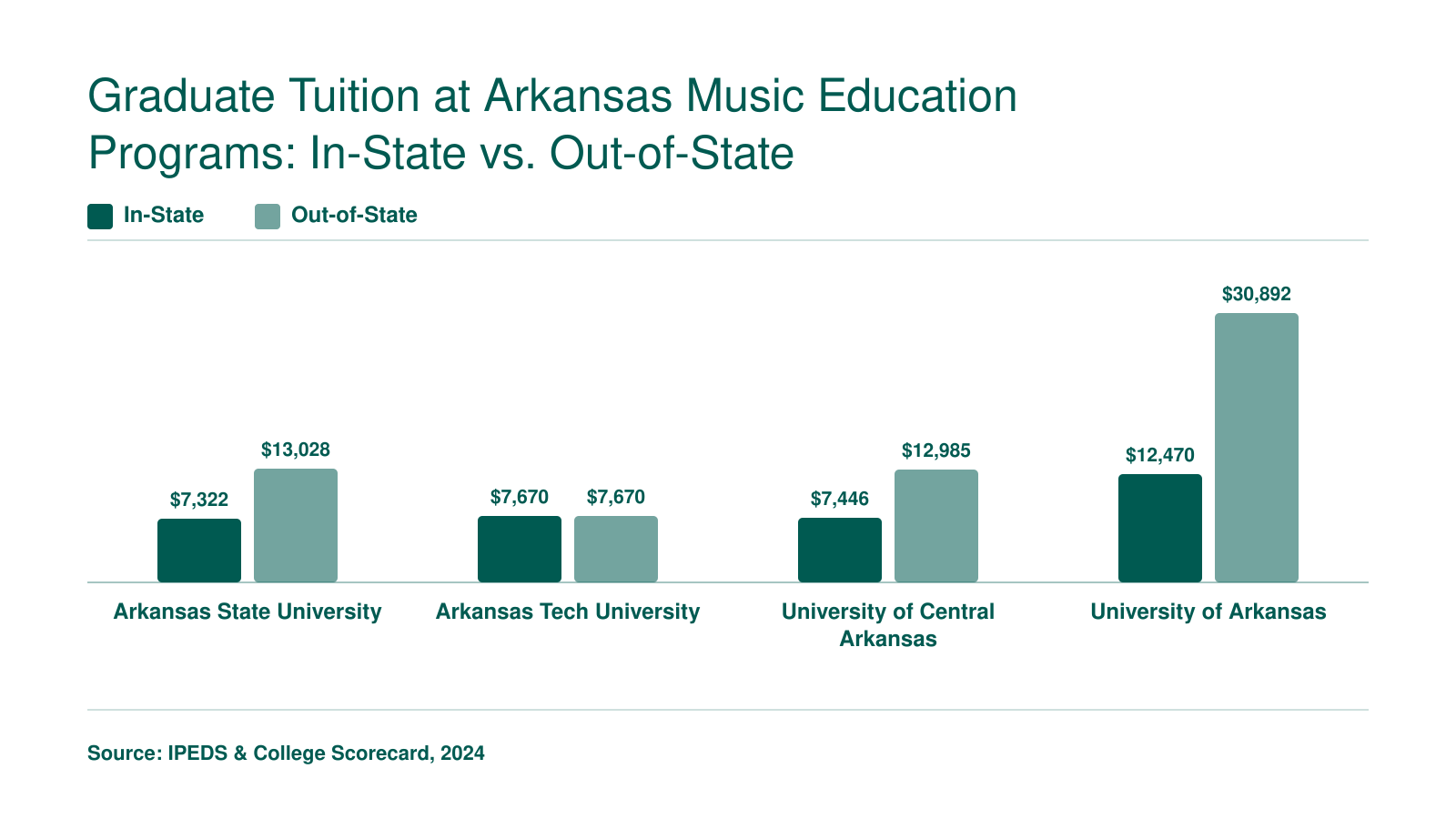
Graduate Tuition at Arkansas Music Education Programs: In-State vs. Out-of-State
Graduate tuition varies widely across Arkansas music education programs. In-state rates range from $7,322 to $12,470, while out-of-state rates run from $7,670 to $30,892. Arkansas Tech University's online program charges the same $7,670 rate for all students, regardless of residency.
Cost, Financial Aid, and Arkansas Licensure for Master's Students
Tuition and Total Cost
Published graduate costs vary by residency and program. The University of Arkansas lists in-state graduate tuition at $472.22 per credit for 2026-2027, with the 36-credit M.M.; out-of-state tuition is $1,287.74 per credit. Arkansas Tech University advertises the same tuition rate for all students, and Arkansas State University and the University of Central Arkansas publish lower in-state tuition than Fayetteville, but mandatory fees and total required credits are not consistently itemized. For in-state students, A-State's published in-state tuition is slightly lower; for out-of-state students, Arkansas Tech's flat rate makes it the most affordable choice among affordable master's in music education programs. Treat the federal institution-wide net price figures as rough affordability benchmarks only: about $12,366 at A-State, $12,970 at Arkansas Tech, $16,511 at UCA, and $18,209 at Arkansas. For an exact program total, ask each college's student accounts office to quote tuition, fees, and any summer travel or ensemble requirements.
Licensure and Salary Schedules
This master's is primarily an advancement degree for people who already hold an Arkansas teaching license, rather than an initial-licensure track among M.Ed. programs in Arkansas. The University of Arkansas describes its M.M. as designed for licensed music educators. UCA prepares already-certified teachers, and Arkansas Tech serves practicing K-12 educators. A-State does not clearly state whether its M.M. adds an initial license. For initial or added licensure, go through the Arkansas Division of Elementary and Secondary Education (DESE). The K-12 Music Education credential covers areas 265 and 262; current standard license holders may qualify for an Additional Licensure Plan. Districts typically move a teacher up the salary schedule for a master's, but amounts vary by district.
Arkansas Music Education Master's Programs: Common Questions
Prospective students often ask about accreditation, licensure, funding, and assistantships before choosing a music education master's in Arkansas. Here are direct answers based on published program and state information.
Are there NASM-accredited master's in music education programs in Arkansas?
Do I need a teaching license to apply to an Arkansas music education master's program?
Are graduate assistantships available for music education master's students in Arkansas, and what do they pay?
Can Arkansas teachers use district or state funding to help pay for a master's in music education?
Compare Music Education programs on the data that matters
Explore more Education & Teaching specializations or browse every graduate field.
All Education & Teaching programs