Best Master's in Reading & Literacy Programs
Compare 430+ accredited Reading & Literacy programs at 360+ schools, with graduate earnings, cost, debt, and completion data from IPEDS and the U.S. College Scorecard.

A master's in reading and literacy is the standard route to reading specialist certification, which usually requires a supervised practicum and a state exam. As districts adopt structured literacy reforms, they need specialists who can coach teachers in Elementary Education or Secondary Education and lead intervention.
Costs vary sharply across the ranked programs. Published in-state graduate tuition runs from $6,381 at the University of Florida to $68,102 at Boston University.
The practical decision is less about prestige than licensure fit: most programs require a current teaching license and a supervised practicum, and state reading specialist requirements vary. A program's clinical placement network often determines where graduates can sit for certification.
Key Points
- TEACH Grants cover up to $4,000 yearly, capped at $8,000 for master's.
- Clemson and Morningside offer fully asynchronous online routes.
- In 2024, 40% of fourth graders read below NAEP Basic.
10 Master's in Reading & Literacy Programs for 2027
The strongest reading and literacy master's programs on this list combine flexible delivery, strong institutional graduation rates, and cost structures that make sense for working teachers. Several leading choices are available fully online or in hybrid form, so you can keep teaching while earning a reading specialist credential.
University of Maryland-College Park
#1College Park, MD · ~$18,000/yr (est.)
Best for: Certified teachers needing clinical literacy practice
The University of Maryland's hybrid M.Ed. in Curriculum and Instruction with a Reading Specialist Specialization is designed for certified teachers who want to advance literacy instruction and equity. Students complete a 30-credit curriculum with online and on-campus sessions, including a supervised Summer Reading Clinic that pairs candidates with local PK-12 struggling readers. Graduates can pursue MSDE reading specialist certification after three years of teaching.
- 30 credit, part-time hybrid program
- Includes supervised Summer Reading Clinic
- Prepares for MSDE reading specialist certification
- Emphasizes equity, diversity, and multilingual learners
- AAQEP accredited and U.S. News ranked top 15 for curriculum
The University of Texas at Austin
#2Austin, TX · ~$12,000/yr (est.)
Best for: Texas teachers wanting research-based literacy leadership
UT Austin's campus-based M.Ed. in Language and Literacy Studies combines research and practice for certified teachers. The 36-credit program covers sociolinguistics, literacy leadership, children's literature, and writing pedagogy, with a partnership through the Heart of Texas Writing Project. No GRE is required.
- 36 credit campus-based master's
- No GRE or entrance exam required
- Partnership with Heart of Texas Writing Project
- Focus on sociolinguistics and literacy leadership
- Requires current teaching certification
Vanderbilt University
#3Nashville, TN · ~$58,000/yr (est.)
Best for: Licensed teachers pursuing dual ELL endorsement
Vanderbilt Peabody's M.Ed. in Reading Education is a three-semester, 30-credit program for licensed teachers or those with equivalent experience. It leads to reading specialist endorsement and offers an optional dual ELL endorsement. Graduates report strong placement, and the Teacher Pathway scholarship reduces tuition by at least 30%.
- 30 credit, three-semester program
- Leads to reading specialist endorsement
- Optional dual ELL endorsement
- 97% employed or in graduate school within 4 months
- Teacher Pathway scholarship reduces tuition at least 30%
Grove City College
#4Grove City, PA · ~$9,000/yr (est.)
Grove City College's online M.S. in Education with a Reading Specialist concentration is built around the science of reading and asynchronous coursework. The 30-credit program prepares certified educators for Pennsylvania Reading Specialist Certification and roles like literacy coach or interventionist.
- 30 credit fully online program
- Asynchronous coursework for working teachers
- Prepares for Pennsylvania Reading Specialist certification
- Strong emphasis on the science of reading
- Covers one-on-one intervention and small-group instruction
University of Florida
#5Gainesville, FL · ~$13,000/yr (est.)
The University of Florida's M.Ed. in Reading Education is a 36-credit, non-thesis program delivered online or on campus. It covers six literacy areas, including ESOL, classroom assessment, and educational technology, and can be completed in four to six semesters.
- 36 credit non-thesis master's
- Available fully online or on campus
- Covers ESOL, language arts, and literacy assessment
- Can complete in four to six semesters
- Focus on educational technology and digital storytelling
Texas A&M University-College Station
#6College Station, TX · ~$12,000/yr (est.)
Texas A&M's M.Ed. in Curriculum and Instruction with a Reading and Literacy emphasis is available online or on campus. The 36-credit program offers a Reading Specialist Certification option and an Early Start path for seniors, with synchronous and asynchronous online coursework.
- 36 credit non-thesis program
- Online with synchronous and asynchronous options
- Offers Reading Specialist certification option
- Early Start lets undergraduates begin early
North Carolina State University at Raleigh
#7Raleigh, NC · $12,000 – $33,000/yr (est.)
NC State's fully online, cohort-based M.Ed. in Curriculum and Instruction with a K-12 Reading concentration is designed for working educators. The two-year program uses evening courses focused on the science of reading and evidence-based literacy strategies, and graduates can add a K-12 Reading Specialist license by passing the Praxis.
- Fully online, cohort-based format
- Two-year program with evening courses
- Prepares for K-12 Reading Specialist licensure via Praxis
- Emphasizes science of reading and evidence-based strategies
University of Minnesota-Twin Cities
#8Minneapolis, MN · ~$22,000/yr (est.)
The University of Minnesota's Literacy Education M.Ed. is a flexible 30-credit program for licensed Tier 3 teachers. Evening and summer courses allow completion in one year full time or two years part time, with no prerequisites or cohort requirements.
- 30 credit degree, one or two-year options
- Evening and summer courses
- No prerequisites or cohort requirements
- Transfer up to 10 graduate credits
- CEHD fellowships and scholarships available
University of Delaware
#9Newark, DE · $20,000 – $25,000/yr (est.)
The University of Delaware's M.Ed. in Literacy is a fully online, part-time program that can be completed in two years through 7-week courses. The 30-credit curriculum prepares teachers for Reading/Literacy Specialist certification, including the Praxis II exam.
- 30 credit fully online program
- 10 courses over two years, 7-week terms
- No electives required
- Prepares for Reading Specialist certification and Praxis II
- U.S. News ranked online education
Boston University
#10Boston, MA · $65,000 – $70,000/yr (est.)
Boston University's Ed.M. in Reading Education is a one-year, in-person program for licensed K-12 teachers. It includes a literacy tutoring practicum and specialist shadowing, prepares students for Massachusetts Specialist Teacher of Reading licensure, and offers merit-based scholarships.
- 36 credit in-person program
- Can be completed in one year
- Includes literacy tutoring and specialist shadowing
- Prepares for MA Specialist Teacher of Reading license
- SEI endorsement pathway
- Merit-based scholarships available
Cost & outcomes by school
Federal data for the highest-earning Reading & Literacy programs, independent of the ranking above. Earnings are this field's master's graduates four years after completing, where the Scorecard reports them.
| School | Earnings | Tuition / yr | Debt | Grads/yr | Format |
|---|---|---|---|---|---|
| University of Wisconsin-Whitewater WI | $104,601 | $10,543 | $31,000 | 6 | Online |
| Capella University MN | $94,795 | $15,092 | $24,938 | 7 | Online |
| California State University-Fullerton CA | $91,226 | $8,994 | $27,925 | 43 | Online |
| CUNY Queens College NY | $87,964 | $11,612 | $19,100 | 183 | Hybrid |
| CUNY Lehman College NY | $87,910 | $11,570 | $20,500 | 105 | Hybrid |
| Touro University NY | $86,765 | $14,979 | $20,500 | 32 | Hybrid |
| CUNY Hunter College NY | $79,416 | $11,398 | $24,573 | 172 | Hybrid |
| Utah State University UT | $78,061 | $7,828 | $12,000 | 20 | Campus |
| Salem State University MA | $72,560 | $9,360 | $16,500 | 46 | Campus |
| Grand Canyon University AZ | $63,874 | $10,015 | $21,180 | 1,009 | Online |
| American College of Education IN | — | $6,600 | — | 966 | Online |
| Middle Georgia State University GA | — | $4,534 | — | — | Online |
Sources: U.S. Department of Education. Tuition and graduates: IPEDS. Earnings and debt: College Scorecard, this field's master's graduates; a dash means no figure is reported.
Cost, debt & payoff
Median earnings of this field's master's graduates (4 yrs after completing) vs. their median federal loan debt · U.S. College Scorecard
Across these programs the median graduate earns about $60,742 and finishes with roughly $24,737 in debt — a ratio that clears a common rule of thumb (keep debt below first-year salary). Tuition and debt vary widely school to school, so check the per-school figures in the table above before you shortlist.
How We Rank Reading & Literacy Master's Programs
Our reading and literacy rankings are built on federal outcomes, not reputation. We compare each eligible master's program using the same public data from IPEDS and College Scorecard: graduate tuition, average net price, institution-wide graduation rate, median debt, and program-level earnings when cohorts are large enough to report.
What We Count
Only programs that award a master's in reading, literacy, or reading specialist education are eligible. Online, hybrid, and campus formats all compete on the same financial and outcome measures, so no delivery method gets a structural advantage. Because reading specialist credentials often hinge on state rules, we treat licensure and placement as separate verification steps rather than scored ranking factors.
Where the Data Has Limits
Those two figures describe the entire institution, not just this department. Program-level earnings are published only when enough graduates are in the data, so a blank earnings figure does not necessarily mean low pay; it may simply reflect a cohort too small to report.
What This Ranking Does Not Measure
This list does not evaluate licensure pass rates, faculty quality, or practicum quality. Those factors matter for reading specialists, and you should verify them directly with each program, especially if you need state certification or a specific supervised clinical placement.
What a Reading & Literacy Master's Costs: Tuition and Net Price Compared
The table below compares published in-state and out-of-state tuition, institution-wide net price after aid, and program format for the programs with the lowest net prices in this comparison. Public schools often show a wide gap between in-state and out-of-state rates, while several online programs charge one flat rate regardless of residency. Per-credit rates and total required credits are included where available to help estimate full sticker cost. Net price is an average for all students at the institution, not a quote for a reading and literacy master's degree.
| School | Program | Format | In-State Tuition | Out-of-State Tuition | Net Price | Per-Credit Rate | Total Credits |
|---|---|---|---|---|---|---|---|
| University of Florida | Master of Education in Reading Education | online | 6,381 | 28,659 | 6,541 | 549 | 36 |
| University of Central Florida | Reading Education, MEd | online | 6,368 | 22,467 | 10,411 | 327 | 30 |
| University of Maryland-College Park | Curriculum and Instruction - Reading Specialist Specialization | hybrid | 11,809 | 41,186 | 15,678 | N/A | 30 |
| Vanderbilt University | Reading Education | campus | 67,498 | 67,498 | 15,846 | N/A | 30 |
| University of Minnesota-Twin Cities | Literacy Education MEd | campus | 17,214 | 38,362 | 16,778 | N/A | 30 |
| North Carolina State University at Raleigh | Master of Education in Curriculum and Instruction, K-12 Reading | online | 8,799 | 32,847 | 17,303 | N/A | N/A |
| University of Delaware | M.Ed. in Literacy | online | 16,810 | 41,400 | 17,799 | N/A | 30 |
| SUNY College at Geneseo | Reading and Literacy B-12 | campus | 8,999 | 19,569 | 18,211 | N/A | N/A |
| SUNY Oneonta | Literacy Education - All Grades (online), M.S. Ed. | online | 8,831 | 19,781 | 19,158 | N/A | 30 |
| The University of Texas at Austin | Master of Education in Language and Literacy Studies | campus | 11,688 | 44,908 | 19,857 | N/A | 36 |
Cutting the Bill: TEACH Grants, Scholarships, and Transfer Credits
The federal TEACH Grant offers up to $4,000 a year in 2026-27,1 with an $8,000 cap for a master's degree.2 Awards first disbursed between October 2020 and October 2026 carried a 5.7% reduction,1 so the amount you actually receive can fall below the maximum. The grant is not need-based,3 but you must file the FAFSA, attend a participating school, and enroll in a TEACH-eligible program. You also need a GPA of at least 3.25 or a score above the 75th percentile on an admissions test.4
The Service Obligation
The catch is the commitment. You must teach four years full-time2 in a high-need field, such as Special Education, at a low-income school within eight years5 of leaving the program. If you don't, the grant converts to a Direct Unsubsidized Loan with interest charged retroactively.1
A reading and literacy master's is not automatically TEACH-eligible.4 The school must designate the program, and it must align with a high-need field. Confirm with the financial aid office before you count on the money.
Other Funding Sources
- District reimbursement: Ask human resources what your district covers, since terms differ widely.
- Literacy scholarships: The International Literacy Association and state reading associations are the best places to look.8 Eligibility, amounts, and deadlines vary by affiliate, and some require membership, residency, or a specific credential. Separate conference awards and classroom grants don't pay tuition.
- Assistantships: Campus programs sometimes pair literacy clinic or tutoring work with tuition remission or a stipend. Many require full-time enrollment and a separate application.
Transfer Credits and Prior Learning
Most reading specialist programs accept roughly 6 to 18 transfer credits.7 Hood College's Reading Specialization M.S. allows 6,6 while Liberty University's Reading Specialist M.Ed. allows up to 18.7 Schools often require an accredited source, a grade of B or better, and recent coursework.
Credit for prior learning is a separate matter. Many graduate education programs do not turn a teaching license or classroom experience into master's credit automatically, and any exception needs documented equivalence and prior approval.
Before you enroll, ask admissions for a formal credit evaluation. It tells you how many credits transfer, whether they count toward core or elective requirements, and what your real time and cost will be.
Online vs. Campus Reading & Literacy Programs: Format, Schedule, and Placements
Every program with delivery details in our research offers an online route, so the real choice is how much live interaction you want and where you will log practicum hours. Online options range from fully asynchronous (Clemson, Morningside) to scheduled Zoom meetings (The Citadel, Bay Path). For working teachers, the biggest practical advantage is that many online programs let you complete practicum hours in your own school or district. Campus details below are general patterns, so confirm specifics with each school.
| Factor | Online | Campus |
|---|---|---|
| Class format | Asynchronous at Clemson, SUNY Oneonta, and Morningside, with no required live sessions at Clemson. Hybrid sync/async at Bay Path, University at Buffalo, and West Virginia University. The Citadel meets every other week on Zoom. | Scheduled in-person class meetings; times vary by school, so confirm the schedule before applying. |
| Part-time pacing and completion time | Built for working educators. Morningside can be finished in as little as 18 months, and West Virginia lists 18 to 24 months. | Part-time tracks are common, but completion time depends on how many courses the school offers each term. |
| Practicum arrangement | Often completed locally. Clemson and West Virginia use your own school district, Southern Maine pairs you with a principal or literacy coach on your campus, and UNC Charlotte allows your own classroom. | Placements are usually arranged through the university's partner schools, which may mean travel or time away from your job. |
| Start dates | Frequent entry points. Bay Path starts in May and September, Southern Maine runs six seven-week sessions a year, and Oneonta starts in spring, summer, or fall. | Typically fewer start points tied to the traditional academic calendar. |
| Networking and cohorts | Cohort models at The Citadel (at least 15 educators), Bay Path, and UNC Charlotte build a peer group remotely. | Face-to-face contact with faculty and classmates, and easier access to local school contacts. |
| Tuition structure | Check whether the online per-credit rate differs from the campus rate, and what fees apply. | Check per-credit rates and campus fees; commuting adds costs outside tuition. |
Related Articles
On the most recent Nation's Report Card, 40% of fourth graders and 33% of eighth graders scored below NAEP Basic in reading in 2024. That gap fuels steady demand for reading specialists who can intervene early. Schools need trained literacy teachers at every grade level, not just the early grades.
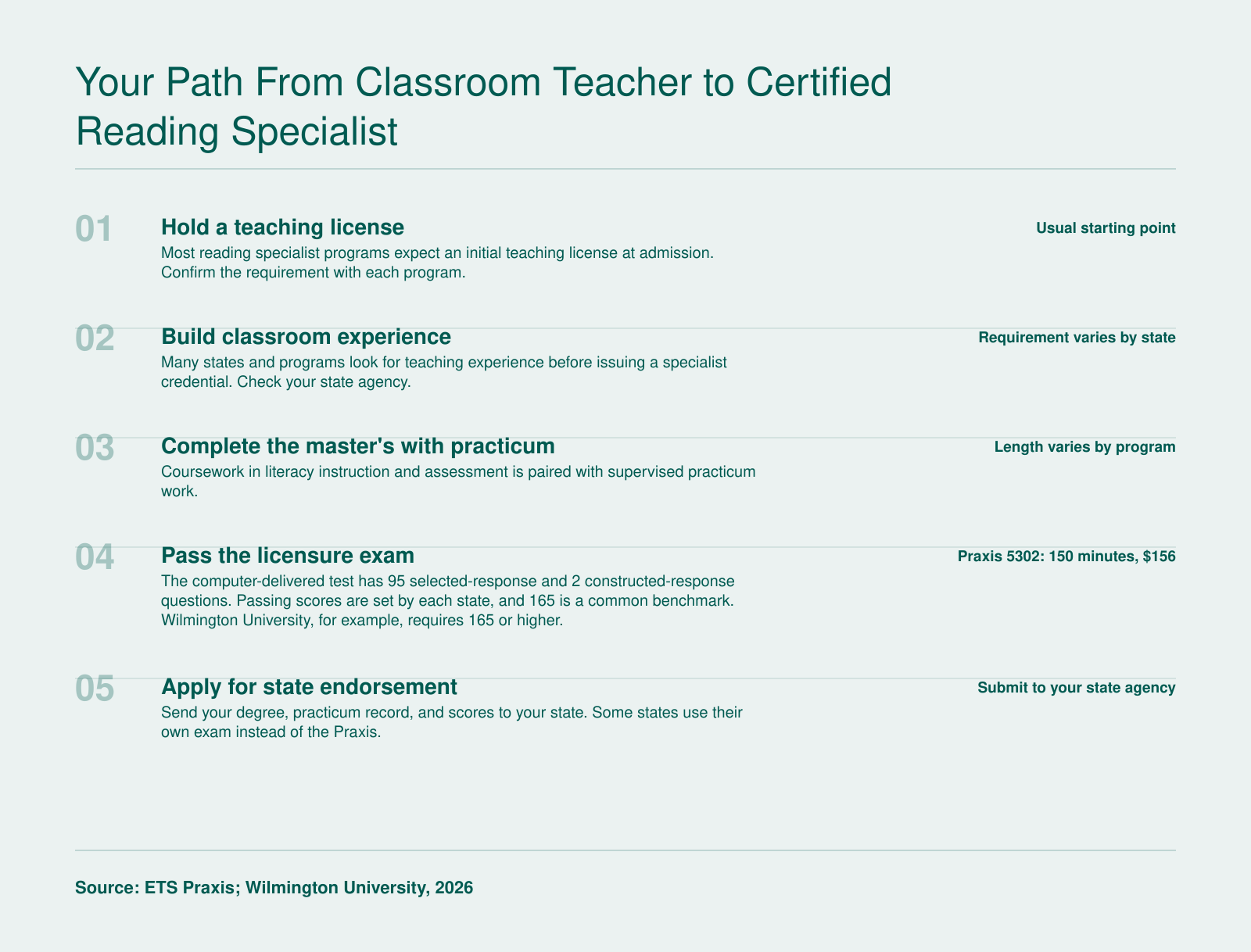
Your Path From Classroom Teacher to Certified Reading Specialist
Most reading specialist credentials follow the same sequence, and the exam comes after the degree. We could not confirm whether these master's programs build in exam prep or publish pass rates, so ask each program for its Praxis pass rate and whether coursework is aligned to the test.
Reading & Literacy programs by state
Frequently Asked Questions About Reading & Literacy Master's Degrees
Degree titles and admission rules vary a lot in this field, so the label on a program matters less than its curriculum, practicum, and licensure pathway. These answers cover the questions applicants ask most. Always confirm details with each program and your state's education agency.
What is the difference between an M.Ed. and M.A. in reading and literacy?
Do I need a teaching license to enroll in a reading specialist master's?
How long does a master's in reading and literacy take?
Is a master's in early literacy the same as a reading specialist degree?
Compare Reading & Literacy programs on the data that matters
Explore more Education & Teaching specializations or browse every graduate field.
All Education & Teaching programs