Best Master's in Reading and Literacy Programs in Michigan
Compare 4 accredited Reading & Literacy programs in Michigan, with graduate earnings, cost, debt, and completion data from IPEDS and the U.S. College Scorecard.

Michigan's Reading Specialist (BR) endorsement requires an approved graduate preparation program with school-based clinical experience, and it is added to a teaching certificate you already hold. For a classroom teacher aiming to become a reading specialist or literacy coach, the master's is the practical route, more specialized than a broad master's in curriculum and instruction in Michigan.
The programs ranked here mix campus and online formats, and prices differ: Eastern Michigan University lists $512 per credit, Calvin University $640.
Not every literacy master's leads to the endorsement, so the degree title alone tells you little.
Key Points
- Eastern Michigan reading graduates earned $60,347 four years out, up from $51,090.
- Michigan's Reading Specialist (BR) endorsement requires an existing teaching certificate.
- Expect about two years part-time, including a supervised clinical practicum.
Top Master's in Reading and Literacy Programs in Michigan, Ranked
This list includes both campus and online master's programs in reading and literacy in Michigan. Four of the five are fully online, and one is on campus at Northern Michigan University. Most lead toward a reading specialist or reading endorsement, so check each program's endorsement path against your certification goals.
Calvin University
#1Grand Rapids, MI · ~$11,000/yr (est.)
Best for: Part-time working teachers
Calvin University in Grand Rapids offers a Master of Education with a Literacy concentration delivered online, with coursework in reading and writing instruction, early literacy, instructional design, and assessment. Michigan-certified teachers who finish and pass the Reading Specialist MTTC qualify for the K-12 Reading Specialist endorsement. The university graduates about 74% of its students, the highest institution-wide rate on this list. The program requires no GRE and is built for teachers studying part-time.
- Literacy concentration, one of four M.Ed. concentrations offered
- 30 to 33 credit hours, completed in 20+ months
- $640 per credit, with no hidden costs
- No GRE or entrance exam required
- Admission: 2.8 GPA minimum, two recommendations, resume, goals essay
- Prepares for the Reading Specialist MTTC and K-12 endorsement eligibility
- Teaching certification not required to enroll
- Faith-shaped view of education; named MEd scholarships available
Grand Valley State University
#2Allendale, MI · $20,000 – $25,000/yr (est.)
Best for: Aspiring K-12 reading specialists
Grand Valley State University in Allendale offers a fully online Master of Education in Literacy Studies with four tracks: general literacy studies, elementary reading, secondary reading, and K-12 reading specialist. The specialist track includes three practicum experiences, and coursework covers literacy coaching and assessment. The university graduates about 67% of its students. It suits educators aiming at specialist or coaching roles, with merit scholarships available.
- Four tracks: general, elementary reading, secondary reading, K-12 specialist
- 33 to 36 credits, fully online
- Specialist track is 36 credits with three practicum experiences
- Coursework in literacy coaching, assessment, and teaching English learners
- Recognized by the International Literacy Association
- Accredited by the Higher Learning Commission
- Elementary reading endorsement requires an elementary teaching certificate
- $30 application fee; fall deadline July 15; merit scholarships
Spring Arbor University
#3Spring Arbor, MI · ~$8,000/yr (est.)
Best for: Teachers focused on struggling readers
Spring Arbor University offers a Reading M.Ed. delivered 100% online for K-12 educators. It trains teachers to diagnose reading difficulties, plan strategies for struggling readers, and support English language learners. Coursework is taught from a Christian perspective. The university graduates about 64% of its students.
- 100% online, designed for working professionals
- $569 per credit hour
- Trains teachers to diagnose reading problems
- Strategies for struggling readers and English language learners
- Reading and writing instruction across content areas
- Christian perspective with faith integration
Northern Michigan University
#4Marquette, MI · $12,000 – $16,000/yr (est.)
Northern Michigan University in Marquette is the only on-campus program on this list. Its Master of Arts in Education in Reading is approved by the Michigan Department of Education and offers a Reading K-8 track and a Reading Specialist K-12 track. Graduates are prepared for roles as reading teachers, literacy coaches, or reading specialists. The university graduates about 52% of its students.
- On-campus program for certified teachers
- Two tracks: Reading K-8 (Code BT) and Reading Specialist K-12 (Code BR)
- Endorsements follow a passing MTTC score
- Endorsement-only option of 18 credits
- Approved by the Michigan Department of Education
- Covers literacy foundations, assessment, and instructional strategies
Eastern Michigan University
#5Ypsilanti, MI · $15,000 – $20,000/yr (est.)
Eastern Michigan University in Ypsilanti offers a 100% online Master of Arts in Reading built for working teachers, with coursework in literacy intervention, coaching, assessment, and digital literacy. Graduates earn the Reading Specialist (BR) endorsement. All students pay the same in-state rate, and the program can be finished in as few as 12 months. The university graduates about 46% of its students.
- 100% online, with synchronous and asynchronous options
- 33 credits, 11 courses, as few as 12 months
- $512 per credit; in-state rate for all students
- Six start dates per year
- 2.7 GPA minimum; $45 application fee
- Leads to the Reading Specialist (BR) endorsement
- Prepares for the Michigan endorsement test (#092)
- TEACH-grant eligible
Cost & outcomes by school
Federal data for the highest-earning Reading & Literacy programs, independent of the ranking above. Earnings are this field's master's graduates four years after completing, where the Scorecard reports them.
| School | Earnings | Tuition / yr | Debt | Grads/yr | Format |
|---|---|---|---|---|---|
| Northern Michigan University MI | $62,230 | $12,196 | — | 6 | Campus |
| Spring Arbor University MI | — | $8,364 | — | 1 | Online |
| Calvin University MI | — | $11,113 | — | 1 | Online |
| Grand Valley State University MI | — | $20,030 | — | — | Online |
Sources: U.S. Department of Education. Tuition and graduates: IPEDS. Earnings and debt: College Scorecard, this field's master's graduates; a dash means no figure is reported.
How We Ranked Michigan's Reading and Literacy Master's Programs
We ranked Michigan's master's in reading and literacy programs on verifiable numbers drawn from the same data set we use for Master's Programs in Michigan, not reputation.
For every program below we pulled together:
- Graduate tuition and the average net price after aid
- Institution-wide graduation rate
- Program-level earnings and debt from College Scorecard
- Completions, so you can see which programs actually produce graduates
A note on two figures. Net price is an institution-wide average after aid, so treat it as a starting estimate rather than a personal quote; your own cost depends on your package. And earnings figures appear only where College Scorecard publishes them, so a program without a number simply means that data was not released, not that graduates earn less.
Online and Hybrid Master's in Reading Options in Michigan
The core tradeoff here is flexibility versus structure. Self-paced coursework bends around a teaching day, while live sessions add accountability but lock you into a fixed time slot. Most of the programs below lean online, a pattern reflected in the Best Online Master's in Reading and Literacy Programs. Northern Michigan University is the campus-based exception.
- Eastern Michigan University: 100% online, with both synchronous and asynchronous options. EMU lists the program as CAEP accredited and says it is designed for working teachers.
- Grand Valley State University: Fully online, mixing live and self-paced methods; it is one of the Michigan master of education programs. GVSU highlights International Literacy Association recognition and Higher Learning Commission accreditation rather than a CAEP listing.
- Calvin University: Offers online and hybrid formats, including a fully online option. Its page does not say which sections meet on campus or whether sessions are live.1
- Spring Arbor University: A fully online option aimed at working professionals. The school does not spell out its live-session requirements.
- Northern Michigan University: Campus-based in Marquette.
For schools that do not publish their CAEP status, check CAEP's directory for the current listing before you apply.
If you teach full time, ask each program when its synchronous sessions meet and whether practicum hours can fall in summer. That way the schedule fits the school year.
Related Articles
Which Michigan Reading Master's Programs Waive or Make the GRE Optional
Reading and literacy master's programs in Michigan generally ask for a bachelor's degree, a minimum undergraduate GPA, official transcripts, and often recommendations, a statement of purpose, and classroom teaching experience. A teaching certificate is usually tied to the endorsement you want rather than to the degree itself. Where a school's admissions page says nothing about the GRE, the table says so plainly instead of guessing. Details for Calvin University, Spring Arbor University, and Northern Michigan University are not shown because we did not confirm their admissions terms, so check each program page before applying.
| School | GRE Policy | Teaching Certificate Required | Minimum GPA | Key Application Materials |
|---|---|---|---|---|
| Eastern Michigan University (Reading M.A.) | No published policy on the program admissions page, which lists no criteria beyond minimum graduate school requirements | No for admission; a current Michigan teaching certificate is mentioned for candidates pursuing the Reading Specialist endorsement | 2.7 cumulative undergraduate GPA, or 3.0 in the last half of the undergraduate program (4.0 scale) | Four-year bachelor's degree from a regionally accredited U.S. institution (or equivalent non-U.S. degree); transcript requirements vary by GPA and credit hours; no additional documents required |
| Grand Valley State University (M.Ed. in Literacy Studies, Reading/Language Arts emphasis) | No published policy on the program page | Not stated on the program page | No admission minimum stated; a 3.0 GPA must be maintained by candidates adding a new endorsement | Not stated on the program page |
What Does a Michigan Reading and Literacy Master's Cost, and Does It Lead to Certification?
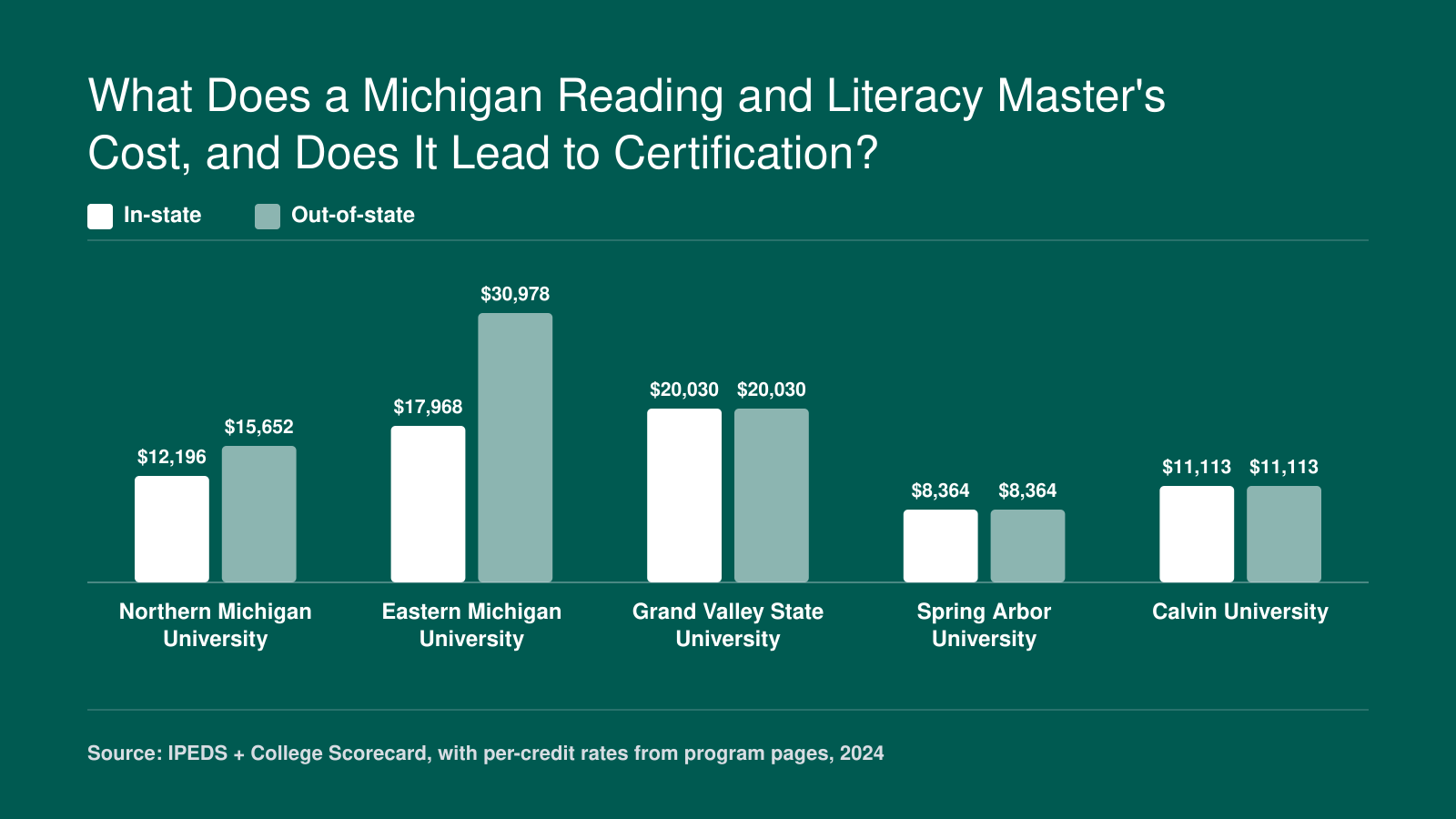
Program tuition varies widely across the schools here, and Eastern Michigan University is the only one where out-of-state tuition runs far above in-state. Published per-credit rates from program pages: Eastern Michigan's online program lists $512 per credit with in-state tuition for all students, Spring Arbor University lists $569, and Calvin University lists $640. Grand Valley State University and Northern Michigan University do not publish a per-credit rate on the pages we reviewed, and none of these schools lists a separate online rate that differs from its campus pricing. Average net price after aid is typically lower than sticker tuition, but it is an approximate institution-level figure, so confirm your own cost with the program. Finishing a degree does not by itself grant the Michigan reading specialist (BR) endorsement. The next section covers what does.
Michigan Reading Specialist (BR) Endorsement
How Long a Reading Specialist Master's Takes in Michigan, Including the Practicum
Expect roughly two years of part-time study: a Michigan reading specialist master's is a block of literacy coursework plus a supervised clinical practicum, taken one or two courses at a time while you keep teaching. Credit totals are published more consistently than timelines. Grand Valley State's online M.Ed. in Literacy Studies K-12 pathway is listed at 36 to 39 credits, 9 of them practicum. Eastern Michigan expects at least 24 credits earned at EMU for master's programs of 36 hours or fewer, which limits how much you can transfer in to finish faster.
The practicum
The practicum is supervised diagnostic and intervention work with real readers. Michigan programs do not publish a single clock-hour standard, and policies on using students in your own building vary, so ask the program coordinator directly before assuming your current classroom counts as a placement.
If you teach outside Michigan
These programs lead to the Michigan Reading Specialist (BR) endorsement, and Eastern Michigan's route also requires a current Michigan teaching certificate plus Michigan State Endorsement Test #092. None of that crosses state lines automatically. Confirm with your own state's licensing board before you enroll.
What Reading and Literacy Master's Graduates Earn and Owe
Earnings one year after graduation and earnings four years out tell different stories, and the gap matters most when you borrow.
At Eastern Michigan University, reading master's graduates earned a median $51,090 one year after finishing and $60,347 four years after finishing. Their median debt was $42,735. On a 10-year repayment plan, that comes to about $486 a month, or roughly 11 percent of first-year median earnings.
Northern Michigan University graduates posted a median $54,091 one year after finishing and $62,230 four years out. Spring Arbor University graduates earned a median $54,459 one year after finishing. Calvin University and Grand Valley State University have no program-specific earnings reported, so weigh them on tuition, format and fit, comparing the Most Affordable Master's in Reading and Literacy Programs and the Accelerated Master's in Reading and Literacy Programs.
The degree also opens roles beyond the classroom: reading specialist, literacy coach, reading interventionist and curriculum coordinator. Each of these builds on the assessment and instruction skills these programs teach.
Compare Reading & Literacy programs on the data that matters
Explore more Education & Teaching specializations or browse every graduate field.
All Education & Teaching programs