Master's Programs in Florida
Every master's program reported by a school in Florida: 1,500+ programs at 60+ graduate schools, with the online options, costs and outcomes behind each one.

Florida graduate students are choosing among 12 State University System campuses and a large private sector, and the price gap between them can exceed the price of the degree itself. A nonresident may pay roughly 1.5 to 4 times the in-state rate, and a program's required fees and format can shift the total further.
The comparison covers cost, online options, admissions and GRE policies, top programs by field, and career outcomes as of October 2026. It sticks to practical comparisons rather than prestige talk.
A recognizable name rarely changes what a license or a first salary requires. Accreditation, residency status, and total cost usually do.
Key Points
- Nonresidents pay about 1.5 times in-state tuition at FSU, but nearly 4 times at FGCU.
- Residency and program fees shape real cost more than the published per-credit rate.
- LMHC and LCSW licenses need about two years and 1,500 supervised post-master's hours.
Popular degrees in Florida
Master's programs in Florida by field
Business & Management
- Accounting69 programs
- Finance55 programs
- Healthcare Administration54 programs
- Management52 programs
- Marketing48 programs
- Analytics42 programs
- General Business32 programs
- Human Resource Management or HR Management27 programs
Education & Teaching
- Educational Leadership25 programs
- Special Education23 programs
- Elementary Education20 programs
- Curriculum & Instruction19 programs
- Teaching12 programs
- STEM Education or Science Education or Mathematics Education12 programs
- Reading & Literacy11 programs
- Secondary Education10 programs
Nursing
- Family Nurse Practitioner (FNP)22 programs
- Nursing Education or Nurse Educator17 programs
- Nurse Administrator13 programs
- Adult Gerontology Primary Care Nurse Practitioner13 programs
- Psychiatric Mental Health Nurse Practitioner13 programs
- Public Health9 programs
- Adult Gerontology Acute Care Nurse Practitioner9 programs
- Womens Health Nurse Practitioner7 programs
Communications & Media
- Communication23 programs
- Strategic Communication15 programs
- Speech Pathology13 programs
- Communication Disorders12 programs
- Journalism7 programs
- Public Relations7 programs
- Communication Management5 programs
- Social Media4 programs
Healthcare
- Health Administration31 programs
- Public Health14 programs
- Speech Pathology14 programs
- Health Education11 programs
- Exercise Science9 programs
- Health Informatics8 programs
- Nutrition6 programs
- Clinical Research Management1 program
Psychology
- Applied Behavior Analysis14 programs
- Industrial Organizational Psychology10 programs
- General Psychology8 programs
- Counseling Psychology8 programs
- Sports Psychology6 programs
- Clinical Psychology4 programs
- Educational Psychology or School Psychology4 programs
- Forensic Psychology3 programs
Science & Engineering
- Environmental Science27 programs
- Sustainability or Environmental Management24 programs
- Geography11 programs
Social Work & Social Sciences
- Social Work23 programs
- Sociology14 programs
- Social Work Advanced Standing12 programs
- Political Science, Government6 programs
- Human Services3 programs
Counseling
- Clinical Mental Health Counseling33 programs
- School Counseling10 programs
- Marriage and Family Therapy or Marriage and Family Counseling9 programs
- Christian Counseling2 programs
Computers & IT
- Cybersecurity21 programs
- Data Analytics13 programs
- Information Security & Assurance13 programs
- Machine Learning3 programs
Arts & Design
- Creative Writing32 programs
- Fine Arts5 programs
- Interior Design4 programs
Religion & Theology
- Theology12 programs
- Divinity10 programs
- Christian Ministry6 programs
- Christian Leadership1 program
- Urban Ministry1 program
Criminal Justice & Law
- Master of Laws7 programs
- Legal Studies4 programs
- Public Policy4 programs
- Fire Science or Fire Administration or Fire Leadership3 programs
- Homeland Security2 programs
- Cybercrime2 programs
- Business Law1 program
Florida Graduate Schools at a Glance
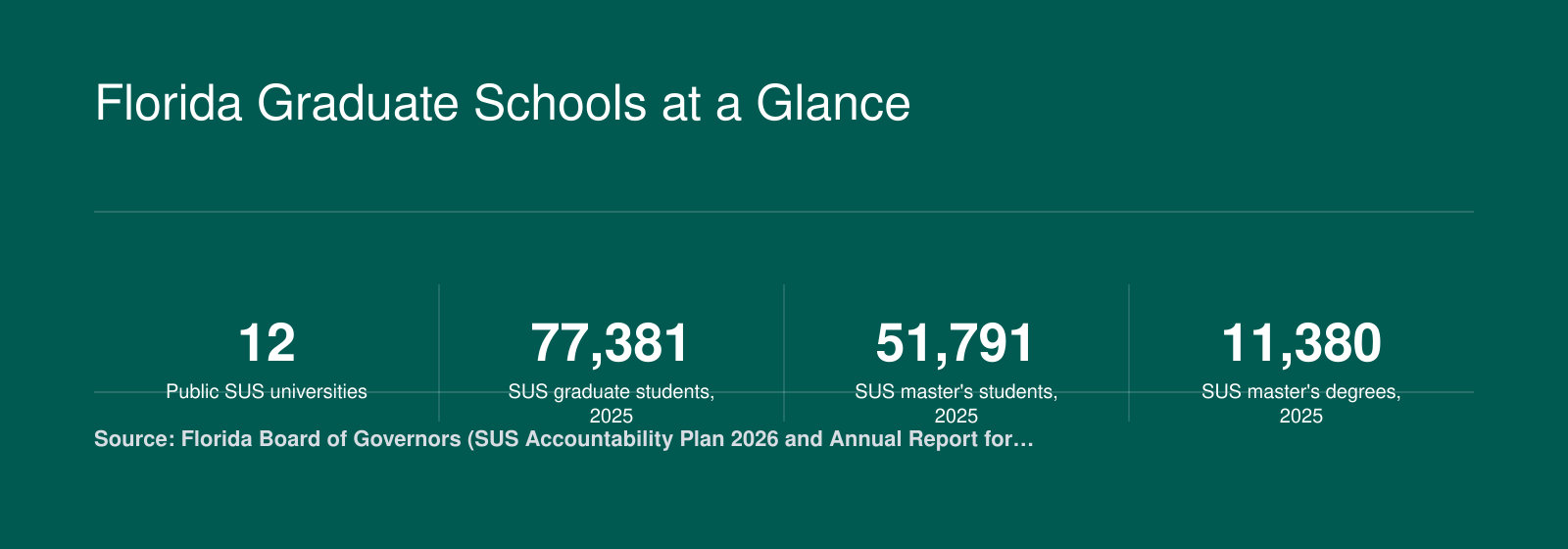
The figures below describe the 12 public State University System (SUS) institutions, including UF, FSU, USF, UCF, and FIU. Major private universities such as the University of Miami and Nova Southeastern sit outside that system. The 30 private nonprofit members of the Independent Colleges and Universities of Florida together enroll 49,369 graduate students and award about 12,000 master's degrees a year. The Board of Governors does not publish a single share of graduate instruction delivered online, so the online tile shows headcount instead.
Graduate Tuition at Florida Universities: In-State vs. Out-of-State
Florida graduate tuition varies widely by school, and nonresidents often pay far more: about 1.5 times the in-state rate at Florida State, roughly 2 times at the University of Florida, and nearly 4 times at Florida Gulf Coast University, based on the published per-credit rates below. Estimated totals multiply the per-credit rate by 30 credits and exclude most mandatory fees, so treat them as a floor rather than a final bill. MBA, nursing, engineering, and online programs frequently charge differential or market-rate tuition well above these base figures. We list only schools whose current per-credit rates we could confirm, so check the bursar page for USF, UCF, FIU, FAU, the University of Miami, and Rollins before budgeting.
| University | Type | In-State Tuition per Credit | Out-of-State Tuition per Credit | Est. Total for 30-Credit Program |
|---|---|---|---|---|
| University of Florida | Public (State University System) | $817.64 | $1,690.75 | In-state $24,529; out-of-state $50,723 |
| Florida State University | Public (State University System) | $771.66 | $1,173.86 | In-state $23,150; out-of-state $35,216 |
| Florida Gulf Coast University | Public (State University System) | $373.38 | $1,439.75 | In-state $11,201; out-of-state $43,193 |
| University of West Florida | Public (State University System) | $378.85 | N/A | In-state $11,366; out-of-state N/A |
| Nova Southeastern University | Private | $1,315.00 | Not listed separately | $39,450 (single published rate) |
How Much Do Master's Programs Cost in Florida? Finding the Cheapest Options
Published per-credit tuition is the number most students compare first, but the real cost of a Florida master's depends far more on your residency status and the fees your specific program tacks on. The gap between those two figures can run into tens of thousands of dollars.
The Lowest Public Rates
Among Florida's public universities, the University of West Florida lists one of the lowest graduate rates at roughly $379 per credit for 2026-27, though that excludes its market-rate and self-supporting programs.1 The University of Florida lists about $488 per credit for one 2026-27 graduate category,2 and the University of North Florida posts resident totals near $494 (with some program-specific categories lower). For a typical 30 to 45-credit master's, residents often land somewhere in the $12,000 to $22,000 range in base tuition. Nonresidents pay far more: UNF's nonresident total runs about $1,127 per credit, which can push a program past $40,000 before fees.
Rates vary by program, course level, campus, and term, so treat any single figure as a starting point, not a quote. Always verify on the university's own tuition page for your exact program.
What Sticker Price Misses
Per-credit tuition rarely captures the full bill. Watch for:
- Mandatory university fees: Activity, health, technology, and transportation fees stack on top of tuition.
- Differential or program tuition: Business (including MBA programs), engineering, and some health programs charge premium rates.
- Books and materials: Budget several hundred dollars per term.
- Living costs: Rent in Miami and Orlando runs well above Pensacola, Gainesville, or Tallahassee, which can matter more than tuition itself.
Residency Rules and Online Flat Rates
Florida bases resident tuition on Statute 1009.21.3 To qualify, you (or, for a dependent, your parent) must establish and maintain legal Florida residence for at least 12 consecutive months before your initial enrollment. Classification is generally set at that first term, and simply living in Florida afterward does not reclassify you. That is why out-of-state students rarely drop to resident rates mid-program; reclassification requires documented proof of a bona fide, permanent domicile.
Some online programs, including online MBA programs, narrow the gap. UNF, for example, shows base-tuition parity in certain online categories, though nonresident fees can still run higher. Confirm whether a given online master's truly charges a flat or reduced out-of-state rate, and whether that rate includes fees, before assuming it is the cheaper path.
Paying for It: Assistantships, Fellowships, and Tuition Waivers
Does a graduate assistantship at a Florida university actually cover tuition? Usually it covers some or all of it, but the terms differ by school and by program, so read the offer letter closely.
How Assistantships Work
An assistantship pairs a stipend with a tuition waiver in exchange for teaching or research hours. The fine print varies:
- FSU: Stipends must be based on at least $24.45 an hour. Out-of-state tuition waivers, when available, go to full-time, degree-seeking assistants and fellows. Stipends are normally federally taxable.
- USF: You need at least a 0.25 FTE appointment (about 10 hours a week) and 150 worked hours in fall or spring. Waivers cover only credits that count toward your degree and need home-college approval. Expect a 3.00 GPA and full-time enrollment requirements.
- UCF: Full support requires one 0.50 assistantship or two 0.25 assistantships. The published 2026 stipend schedule is labeled for doctoral students and lists $18,000 a year, so confirm master's amounts with your department.
UF's 2026 waiver rules and stipend ranges were not confirmed, so ask the department directly.
Fellowships
Master's fellowships are scarcer than assistantships. The NSF Graduate Research Fellowship Program supports research-based STEM students, and UF reported 15 recipients in 2026.1 UCF offers the MFA Provost's Fellowship to newly enrolling MFA students. Neither is a statewide program open to every field, so check eligibility before planning around one.
Underused Options
Florida law lets university boards allow full-time university employees to take up to six tuition-free credit hours per term, on a space-available basis.2 That covers university employees, not every state worker, and each school sets its own conditions. Ask HR whether your institution uses it. Employer tuition assistance is also worth a direct question, since many students never ask.
Federal Loans
Beyond assistantships, most master's aid comes as federal Direct Unsubsidized loans and Grad PLUS loans. Federal graduate borrowing rules have changed recently, so confirm current limits on studentaid.gov before you borrow. Weigh any loan against the earnings data before you borrow.
Online and Hybrid Master's Programs in Florida
Asynchronous and synchronous online programs can look identical on a university website, but they place very different demands on your calendar. In an asynchronous course, lectures and assignments are posted for you to complete on your own schedule within weekly deadlines. A synchronous course meets live, online, at set times. Hybrid programs combine online coursework with some scheduled or in-person components.
Who Each Format Suits
Asynchronous delivery usually fits working professionals best: nurses on rotating shifts, teachers who do coursework after grading, and anyone whose job can't bend around a fixed evening class. Synchronous sessions suit students who want real-time discussion and built-in accountability. That can matter for career changers who are trying to build relationships in a new field.
Most Florida programs lean asynchronous, but verify course by course. Florida State's distance learning office notes that most of its online courses are asynchronous, though some are synchronous or mixed.5 UCF says its fully online courses may be synchronous, asynchronous, or experiential.
Sample Online Master's Programs at Florida Universities
- University of Florida: The online M.Ed. in Higher Education Administration is mostly asynchronous and built for part-time study. Summer terms are required, and the typical timeline is two years.
- University of Central Florida: The online MSN Nurse Educator track uses asynchronous instruction, offers a part-time option, and typically takes seven semesters.
- Florida State University: The online M.S. in Curriculum and Instruction is mostly asynchronous, offers a part-time option, and takes approximately two years.
- Florida State University College of Law: The Juris Master in Legal Studies is 100% online and asynchronous, with part-time enrollment available. Keep in mind that a Juris Master is not a J.D.
- FSU School of Information: The school's online master's programs in information can be taken full-time or part-time.
Other Florida institutions, including USF, FIU, FAU, UWF, and Nova Southeastern, also offer online graduate study. Format and pacing vary by department, so confirm the details directly with each program before you apply.
How Long Online Programs Take
Your enrollment pace affects completion time more than the delivery format does. UCF says a 30-credit-hour master's can be finished in as little as four semesters, or about a year and a half, at full-time enrollment. Accelerated, full-time study generally falls in the 12 to 18 month range. Part-time study usually takes two to three years. The two-year estimates from UF and FSU fall within that range; UCF's seven-semester nurse educator track runs beyond it.
Before you commit, check three things: whether summer terms are mandatory, whether any courses require live attendance at fixed times, and how many credits per term you need to stay eligible for financial aid. A program marketed as "flexible" can still have rigid requirements in any of these areas.
Admissions Requirements, GRE Waivers, and Deadlines
Requirements vary by program, not just by university, so treat the figures below as typical starting points and confirm them with the program you are targeting.
- Bachelor's degreeApplicants generally need a bachelor's degree from a regionally accredited institution. Many programs accept any major, though some require specific prerequisite coursework.
- Minimum GPAState University System schools commonly look for at least a 3.0 on a 4.0 scale in upper-division undergraduate work (roughly the last 60 credits), as stated in the FSU graduate catalog. This is a system-level floor, not a guarantee of admission, and competitive programs often expect more. For example, USF's M.S. in Management cites a 3.5 GPA for its test waiver.
- GRE/GMATThere is no single statewide policy, so check each program. FSU's educational leadership programs automatically waive the GRE for master's applicants through 2026. UCF's Master of Arts in Teaching does not require it. USF's M.S. in Management and M.S. in Financial Analytics allow waiver requests, typically for applicants with a strong prior GPA (3.5 or higher) or about three years of relevant work experience. Waiver requests are usually reviewed only after the rest of the application is complete.
- Supporting materialsExpect letters of recommendation, a statement of purpose, and a résumé. International applicants whose prior education was not in English usually must submit TOEFL or IELTS scores, and some programs also ask for credential evaluations.
- DeadlinesFall deadlines for Florida master's programs in 2026 ranged from early January to mid-March for many competitive programs. Examples include UF engineering's January 5 priority date, UF's Master of Public Health on February 15, and UF Biostatistics on March 15. USF and FIU list June 1 for fall entry for domestic applicants. International applicants often face earlier dates, such as UCF's January 15 for fall 2026. Online programs may admit on a rolling basis or set later dates, such as July 15 for UF's online biostatistics program. Funding consideration often has earlier cutoffs, so apply early if you want an assistantship.
Best Master's Programs in Florida by Field
We judge programs on programmatic accreditation, licensure pass rates where they are published, graduate outcomes, and format flexibility, not prestige alone. The table below lists only programs where we could verify accreditation through the accrediting body or the school. Verified listings were not available for nursing, counseling, education, or data science, so those fields are left out rather than guessed at. Check each program's own site for current licensure pass rates and outcomes before you apply.
| Field | Standout Florida Programs | Programmatic Accreditation | Format Options | Why It Stands Out |
|---|---|---|---|---|
| Business administration (MBA) | University of Florida MBA (Warrington College of Business) | AACSB | Fully face-to-face; full-time and part-time | The AACSB listing covers an MBA plus specialized master's degrees in accounting, business analytics, entrepreneurship, finance, international business, information systems and operations management, management, marketing, and real estate. |
| Business administration (MBA) | University of South Florida MBA, General Business | AACSB | Fully face-to-face; full-time and part-time; fully online part-time | The Muma College of Business and the Lynn Pippenger School of Accountancy are separately AACSB accredited, and the program offers an online part-time option. |
| Business administration (MBA) | University of Central Florida MBA, General Business | AACSB | N/A | AACSB accredited general business MBA at a large public university. |
| Business administration (healthcare management) | Florida Southern College MBA: Healthcare Management | AACSB | N/A | A healthcare-focused MBA. The college notes that only about 6% of business schools worldwide hold AACSB accreditation. |
| Engineering and computer engineering | University of Florida computer engineering (Herbert Wertheim College of Engineering) | ABET (Engineering Accreditation Commission) | N/A | The verified listing is for the BS program. It is accredited under ABET engineering criteria and the electrical, computer, and communications program criteria. Confirm graduate options separately. |
| Public health (MPH) | University of Florida College of Public Health and Health Professions | CEPH | N/A | Listed in the Council on Education for Public Health's accredited schools and programs. |
| Public health (MPH) | University of South Florida public health program | CEPH | N/A | Listed in CEPH's accredited schools and programs. |
| Public health (MPH) | Florida State University MPH | CEPH | N/A | Listed in CEPH's accredited schools and programs. |
| Public health (MPH) | University of North Florida MPH | CEPH | N/A | Listed in CEPH's accredited schools and programs. |
| Social work (MSW) | Florida master's programs listed in the CSWE Accreditation Directory | CSWE (accredited or in candidacy status) | N/A | The directory lets you confirm a program's current status. Check it before applying, since candidacy is not the same as full accreditation. |
Florida Licensure After a Master's Degree
Career Outcomes and ROI: Which Florida Master's Degrees Pay Off
Some Florida master's degrees pay for themselves within a few years. Others are worth it mainly because the license they qualify you for is required for the job. Telling the two apart before you borrow is the most useful financial step you can take.
What the Data Shows
College Scorecard publishes field-of-study median earnings and median debt for master's completers, and you should pull those figures for each program you are considering. Program-level numbers for UF, USF, UCF, and FIU were not available to us when we wrote this, so we are not quoting them. Check each school's Scorecard page directly.
What we can say comes from broader Florida reports. Florida master's graduates earned a median of roughly $49,000 in their first year (2025). Payoff varies sharply by field. Nursing and two types of business master's programs show earnings gains above $25,000, while a master's in elementary education shows a gain closer to $5,000. One Florida dataset puts first-year earnings for MSN programs at $77,902. Treat these as directional, since they come from different sources and are not Scorecard field-of-study medians.
A Simple ROI Check
Compare a program's median debt to its first-year earnings. Aim for debt below one year's expected salary. Debt of $40,000 against $75,000 in earnings is comfortable. The same debt against $45,000 is tighter, and monthly payments will take a larger share of take-home pay.
High Earners vs. Licensure-Driven Fields
- Nursing, computer science, business analytics: These fields tend to show the strongest earnings gains, so moderate borrowing is usually easier to justify. Confirm that the specific program, not just the field, delivers those outcomes.
- Counseling, social work master's programs, and education: Starting pay is typically lower, but the master's is often the gateway to licensure or a required credential. These degrees can still make sense if you keep debt low, favor in-state public tuition, and pursue assistantships or employer support.
Florida Factors
Florida has no state income tax, so more of your paycheck stays with you than in many other states. Teachers may also see pay increases for advanced degrees, but supplements are set by individual districts. Look up the salary schedule of the district where you plan to work before assuming a master's will raise your pay.
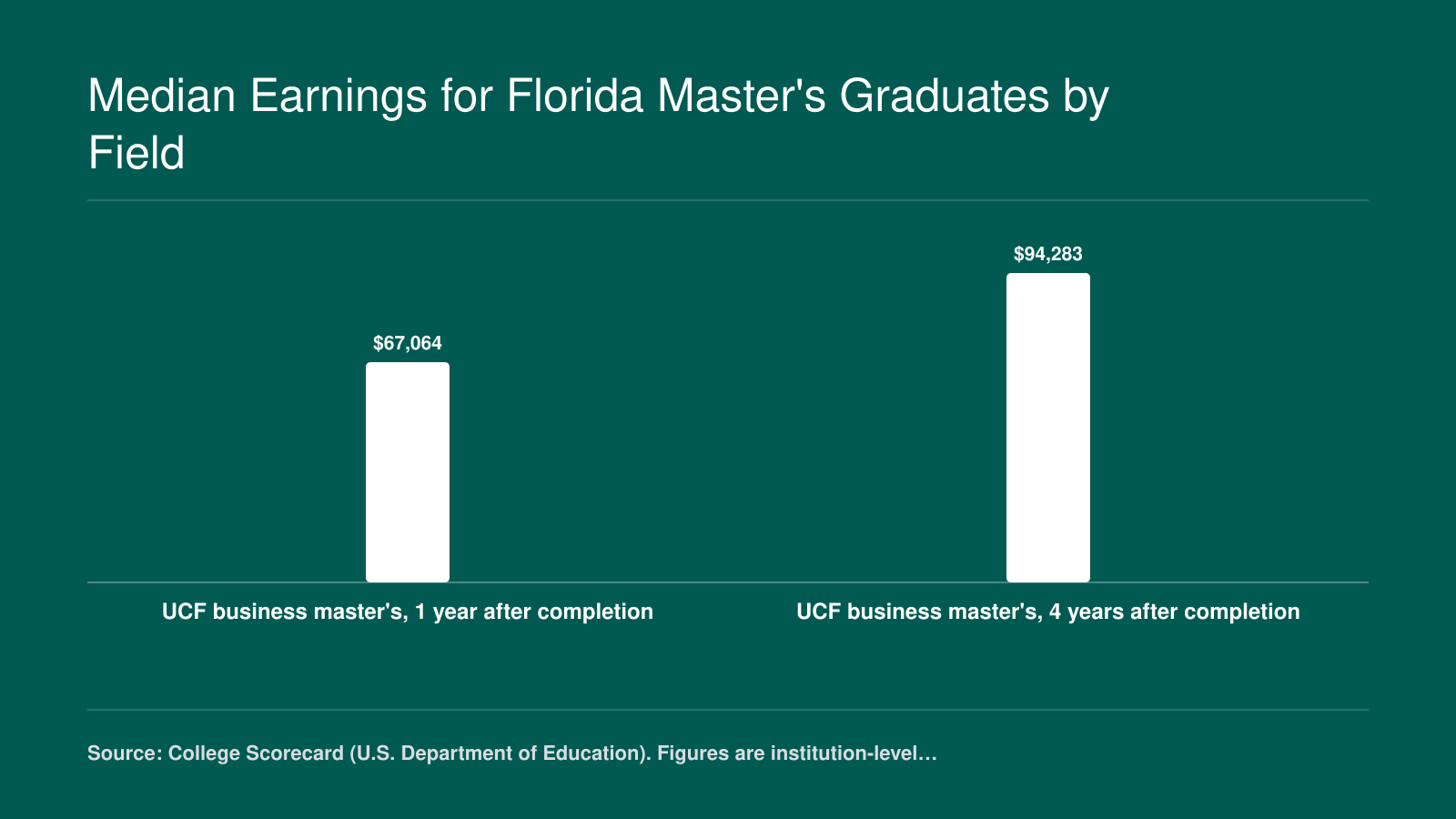
Median Earnings for Florida Master's Graduates by Field
College Scorecard does not publish usable earnings for every master's field at every Florida public university, so a full field-by-field chart would require guesswork. The clearest figures available are for business master's graduates at the University of Central Florida, shown below at two points after completion. Treat them as one data point, not a statewide average.
The Master's Degree Earnings Premium
Nationally, a master's degree comes with a measurable pay advantage over a bachelor's.
How to Choose a Florida Master's Program
The right Florida master's program is the one that clears your licensure or career requirement at the lowest total cost, not the one with the best-known name. Work the decision in a fixed order and the list narrows itself fast.
A five-step filter
- Define the end goal first. Name the job title or license you want. "Licensed mental health counselor in Orlando" produces a very different shortlist than "data analyst anywhere," which often points to a master's in data analytics rather than a licensure track. Everything downstream depends on this.
- Filter by required accreditation. For counseling, social work, nursing, teaching, engineering, accounting, and public health, specialized accreditation is often non-negotiable for licensure or employer recognition; for public health, that generally points toward ceph accredited mph programs. Cut any program that lacks it before you look at anything else.
- Set a total-cost ceiling. Add tuition, per-credit fees, and the in-state versus out-of-state differential, then subtract any assistantship or employer support you can realistically count on. Decide the number you will not cross, and hold it.
- Pick a format you can actually sustain. A part-time online program you finish beats a full-time on-campus program you abandon in year two. Be honest about work hours, commute distance, and clinical or practicum requirements that demand daytime availability.
- Compare outcomes last. Among the programs that survive the first four filters, rank by graduate earnings and debt load rather than reputation.
Verify licensure alignment before you apply
If your career requires a Florida license, confirm in writing that the specific program meets the relevant Florida board's coursework and supervised-hours requirements. Online programs based in other states are the common trap here: national accreditation does not guarantee a state-level match. Ask the program coordinator directly, and ask what happens if board rules change mid-enrollment.
Questions to ask before you commit
Request three numbers from every program on your list: the completion rate for the most recent cohorts, where graduates landed within a year, and how many students receive assistantships or tuition waivers. Programs confident in their results will share these. Vague answers are an answer.
Your next step
Shortlist three programs. For each, write down the total cost to degree and the realistic first-year salary in your target field. If a program costs more than roughly one year of expected earnings, it needs a specific justification: a required license, a clinical placement pipeline, a funded assistantship. Absent that, pick the cheaper option that clears the same bar.
Graduate schools in Florida with the most master's programs
| School | City | Type | Master's programs | Online | Grad tuition / yr |
|---|---|---|---|---|---|
| University of Florida | Gainesville | Public | 98 | 38 | $12,737 |
| Florida International University | Miami | Public | 89 | 46 | $11,334 |
| University of South Florida | Tampa | Public | 86 | 25 | $10,428 |
| Florida State University | Tallahassee | Public | 78 | 36 | $10,553 |
| Florida Atlantic University | Boca Raton | Public | 74 | 37 | $6,693 |
| University of Central Florida | Orlando | Public | 68 | 23 | $8,872 |
| University of West Florida | Pensacola | Public | 68 | 55 | $9,062 |
| University of Miami | Coral Gables | Private nonprofit | 63 | 11 | $46,870 |
| Nova Southeastern University | Fort Lauderdale | Private nonprofit | 60 | 55 | $24,830 |
| University of North Florida | Jacksonville | Public | 51 | 15 | $10,364 |
| Barry University | Miami | Private nonprofit | 44 | 19 | $19,650 |
| Florida Institute of Technology | Melbourne | Private nonprofit | 41 | 25 | $24,320 |
| Jacksonville University | Jacksonville | Private nonprofit | 34 | 26 | $21,818 |
| Saint Leo University | Saint Leo | Private nonprofit | 34 | 33 | $12,870 |
| Herzing University-Orlando | Winter Park | Private nonprofit | 33 | 33 | $9,370 |
Program counts are the verified master's listings in our directory; tuition is the school-wide average for a full-time graduate student (IPEDS).
Compare programs nationwide
Many Florida residents study online. Every ranked list above has an online lens, or browse every field.
Online master's programs Browse all fields