Best Master's in Information Security and Assurance Programs in Florida
Compare 13 accredited Information Security & Assurance programs in Florida, with graduate earnings, cost, debt, and completion data from IPEDS and the U.S. College Scorecard.

Campus or online is the first fork for Florida security students, and the answer depends on who is hiring. Banks, defense contractors, hospital systems, and state agencies all compete for the same shrinking pool of analysts and managers, and many of them let employees study while working.
The ranked schools reflect that split: campus programs at public research universities, fully online options from career-focused institutions, and at least one hybrid. Tuition gaps are wide, with public in-state rates far below private ones.
Most employers still weigh a credential like CISSP alongside the degree, so the program's certification alignment matters as much as its name.
Key Points
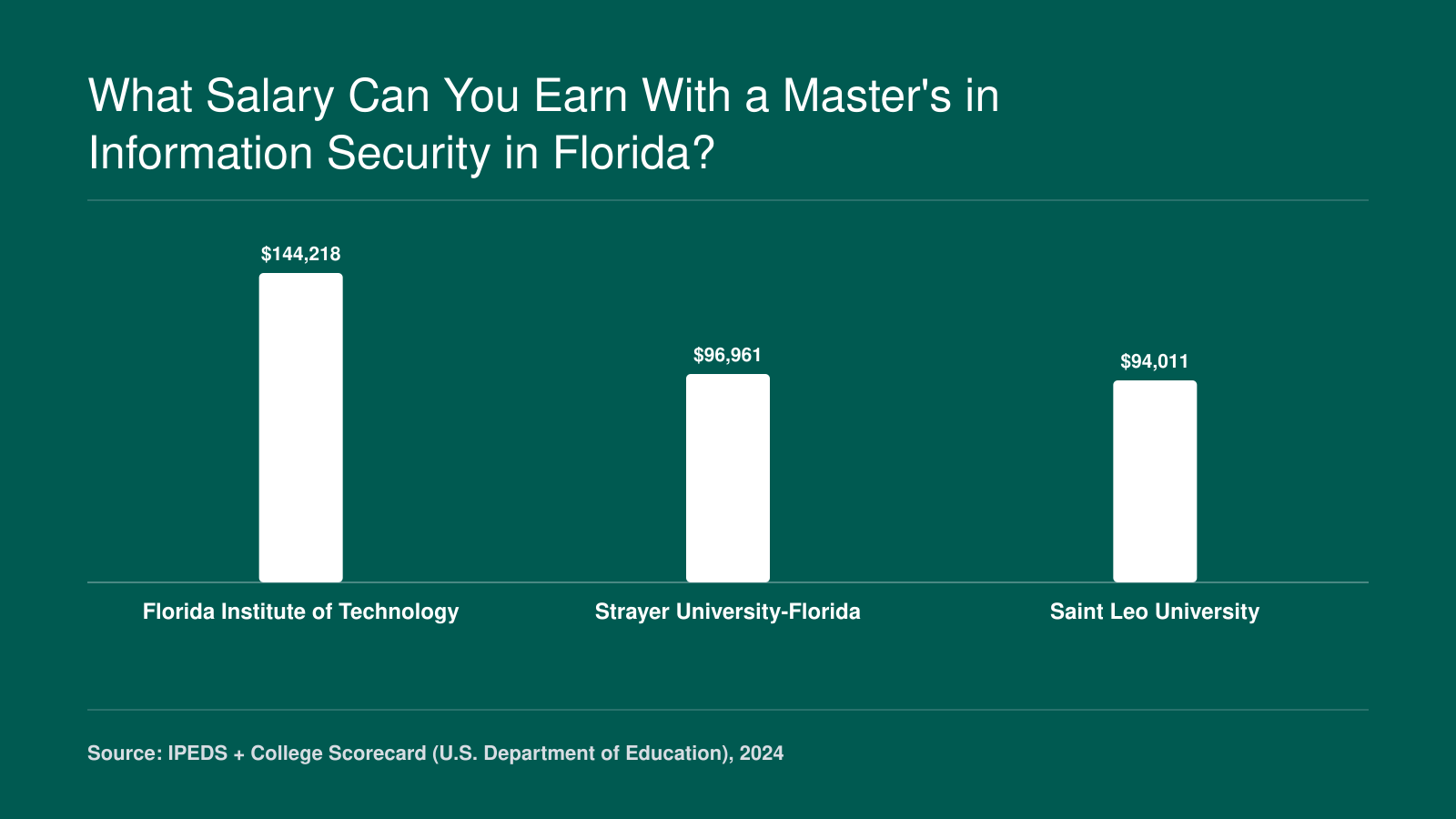
- College Scorecard shows Florida program earnings of $94,011 to $144,218 four years after finishing.
- Florida posted 23,792 cybersecurity job openings between May 2024 and April 2025, per CyberSeek.
- University of South Florida lists the GRE as required, though applicants with strong GPAs may request a waiver.
Top-Ranked Master's in Information Security and Assurance Programs in Florida
Florida's master's in information assurance options range from public research universities to career-focused private and online institutions, so cost and delivery format vary widely. The ten programs below are listed in rank order. NSA/DHS Center of Academic Excellence status is noted only where it could be confirmed, and graduation rates describe each university as a whole, not the cybersecurity program.
University of Central Florida
#1Orlando, FL · ~$9,000/yr (est.)
Best for: In-state students wanting a thesis option
UCF in Orlando offers a 30-credit M.S. in Cyber Security and Privacy with a technical track and an interdisciplinary track for future security managers. Thesis and non-thesis paths are available, and the university lists Florida-resident tuition far below its nonresident rate. The university graduates 78% of its students, and it appears on Florida's 2026 list of NCAE-C designated universities. A Lockheed Martin partnership supports its Cyber Innovation Lab.
- 30 credit hours: nine core credits plus seven electives
- Technical track covers networks, architecture and AI
- Interdisciplinary track adds management, human factors and criminal justice electives
- Thesis and non-thesis options
- No admission requirements beyond UCF's graduate admission
- Fall and spring deadlines of May 1 and November 1
- Does not directly lead to licensure or certification
University of South Florida
#2Tampa, FL · ~$10,000/yr (est.)
Best for: Working professionals studying online
USF in Tampa delivers its cybersecurity master's with an information assurance concentration online, centered on security controls, regulatory environment, risk management and incident response. A required practicum adds hands-on experience, and a ReliaQuest partnership offers a training lab and possible internship interviews. The university graduates 77% of its students. USF is on a 2026 Florida list of NCAE-C designated universities, but the NSA map we reviewed shows its CAE-CD period ending in 2025, so confirm current status with the school.
- Ten courses: four core, five concentration, plus a practicum
- Required three-credit practicum for industry experience
- Focus on risk management and the regulatory environment
- Covers information security controls and incident response
- Background in database management and systems analysis recommended
- Delivered online
University of Miami
#3Coral Gables, FL · ~$47,000/yr (est.)
Best for: Engineering graduates pursuing research or doctoral study
The University of Miami in Coral Gables houses its cybersecurity focus inside an M.S. in Electrical and Computer Engineering, so it suits technically trained applicants. Courses cover cryptography, digital forensics, network security and information assurance. This is the priciest program on the list, and the university graduates 84% of its students. The program does not require the GRE.
- 30 credit hours with a three-credit capstone
- Thesis or non-thesis path
- 3.0 GPA minimum and three recommendation letters
- No GRE required for MS applicants
- Bachelor's in engineering usually required
- Campus-based in Coral Gables
- Prepares for industry, government research or doctoral study
Strayer University-Florida
#4Tampa, FL · ~$15,000/yr (est.)
Strayer University's Tampa-based online M.S. in Cybersecurity is aimed at working adults and describes its curriculum as NSA-validated. It is among the lowest-priced options here and accepts military benefits and employer tuition reimbursement. Check program-level outcomes carefully, as the number of reported graduates is small.
- 45 credit hours across ten courses
- Fully online with 11-week classes
- 2.5 GPA minimum
- Transfer up to four classes
- NSA-validated cybersecurity curriculum
- Military benefits and employer reimbursement supported
- Tuition listed at $2,540 per course
University of West Florida
#5Pensacola, FL · $5,000 – $10,000/yr (est.)
UWF in Pensacola offers a 30-credit M.S. in Cybersecurity that can be completed face-to-face or fully online with synchronous classes. Four concentrations (Data Security, National Security, Security Management, and Software and System Security) let students tailor the degree. The university graduates 59% of its students, and the NSA CAE map shows UWF holding a CAE-CD designation through 2028.
- 30 credit hours, about 24 months over five semesters
- Four concentrations including National Security
- Face-to-face or fully online, synchronous classes
- Covers digital forensics and secure software development
- Requires a letter of intent, two references and a résumé
- Fall deadline of September 30
Florida Institute of Technology
#6Melbourne, FL · ~$24,000/yr (est.)
Florida Tech in Melbourne offers an M.S. in Information Assurance and Cybersecurity for students with technical backgrounds, available on campus or online. It is a private-university price point, but Scorecard data shows strong earnings for its graduates. The university graduates 64% of its students. The GRE is required.
- 30 credit hours with 15 credits of cybersecurity core
- Core covers cryptography, biometric authentication and secure communications
- Thesis or capstone option
- GRE required
- Prior statistics, discrete math and programming coursework needed
- Provisional admission available
- On campus or fully online
Keiser University-Ft Lauderdale
#7Fort Lauderdale, FL · ~$36,000/yr (est.)
Keiser University's Fort Lauderdale campus offers an M.S. in Information Security designed for IT professionals moving into senior roles. It is delivered online or hybrid and prepares students to sit for the CISSP exam. The university graduates 61% of its students.
- 30 credit hours, ten courses, about 20 months
- Online or hybrid delivery
- Covers cryptography, intrusion detection and computer forensics
- Capstone required
- Prepares for the CISSP exam
- Transfer up to 12 graduate credits
- Military benefits and employer reimbursement supported
Saint Leo University
#8Saint Leo, FL · ~$13,000/yr (est.)
Saint Leo's online master's in cybersecurity is a 30-credit program with eight-week terms and evening and weekend classes. It connects to the university's Center for Cybersecurity Education and a dedicated cyberforensic lab. The university graduates 45% of its students, the lowest rate among the nine schools with a comparable reported figure.
- 30 credit hours, fully online
- Eight-week academic terms
- Internships and research projects built in
- Dedicated cyberforensic lab
- Covers cryptography, cloud and mobile security
- Evening and weekend classes
Herzing University-Orlando
#9Winter Park, FL · ~$9,000/yr (est.)
Herzing University in Winter Park offers a fully online, asynchronous M.S. in Cybersecurity that many students finish in about a year. It has the lowest listed tuition per credit of the group and rolling admissions. The university graduates 37% of its students, so confirm completion odds before enrolling.
- 37 credit hours, about 12 months
- Fully online and asynchronous
- Tuition listed at $630 per credit
- Covers penetration testing, DevSecOps and digital forensics
- Prepares for CCSP, CISM or CISA
- Capstone required, optional internship
- Rolling admissions
Embry-Riddle Aeronautical University-Daytona Beach
#10Daytona Beach, FL · ~$23,000/yr (est.)
Embry-Riddle's Daytona Beach campus offers an online M.S. in Information Security and Assurance that blends managerial and technical content. Five concentrations include Incident Investigation and Response and Governance for Information and Knowledge Assurance. The university graduates 67% of its students. Check cost carefully, as net price is relatively high.
- Five concentration options
- Delivered online for working professionals
- Covers risk management, governance and business continuity
- Prior information systems degree expected
- Targets managerial and compliance roles
Cost & outcomes by school
Federal data for the highest-earning Information Security & Assurance programs, independent of the ranking above. Earnings are this field's master's graduates four years after completing, where the Scorecard reports them.
| School | Earnings | Tuition / yr | Debt | Grads/yr | Format |
|---|---|---|---|---|---|
| Florida Institute of Technology FL | $144,218 | $24,320 | — | 10 | Campus |
| Strayer University-Florida FL | $96,961 | $15,135 | $75,331 | 4 | Online |
| Saint Leo University FL | $94,011 | $12,870 | $56,375 | 35 | Online |
| Florida Atlantic University FL | — | $6,693 | — | — | Campus |
| Herzing University-Orlando FL | — | $9,370 | — | — | Online |
| DeVry University-Florida FL | — | $9,832 | — | — | Online |
| University of North Florida FL | — | $10,364 | — | — | Campus |
| University of South Florida FL | — | $10,428 | — | — | Online |
| Embry-Riddle Aeronautical University-Daytona Beach FL | — | $22,870 | — | — | Online |
| University of West Florida FL | — | $9,062 | — | 49 | Hybrid |
| University of Central Florida FL | — | $8,872 | — | 25 | Campus |
| University of Miami FL | — | $46,870 | — | — | Campus |
Sources: U.S. Department of Education. Tuition and graduates: IPEDS. Earnings and debt: College Scorecard, this field's master's graduates; a dash means no figure is reported.
Online and Hybrid Master's in Information Security Options in Florida
For working security professionals comparing master's in information security and assurance programs, online delivery is now the default, but pacing, live-class expectations, and testing rules still differ from school to school.
Fully online programs
- Herzing University-Orlando: Asynchronous, 12 months, with full-time and part-time enrollment.
- Saint Leo University: 30 credits in eight-week terms, with evening and weekend classes.
- Strayer University-Florida: 45 credits in 11-week courses.
- University of South Florida: The online master's in cybersecurity, including its Information Assurance concentration, requires no campus visits. The Computer Security Fundamentals concentration requires in-person testing, which can be done at approved national testing centers.
- Embry-Riddle Aeronautical University-Daytona Beach: Online and aimed at working professionals. Pacing details are not published.
Hybrid and mixed formats
The University of West Florida runs synchronous online classes over about 24 months (five semesters), with a fully online option. Keiser University-Ft Lauderdale is hybrid, and some on-campus participation is part of the format. Frequency is unspecified, so ask before enrolling. Florida Institute of Technology offers a fully online option described as mostly asynchronous with some live components. The University of Central Florida and the University of Miami are listed as campus programs.
Florida had 23,792 cybersecurity job postings between May 2024 and April 2025, according to CyberSeek (CompTIA, NICE and Lightcast). That count includes dedicated security roles and adjacent technical jobs requiring heavy security skills. Nationally, CyberSeek reports a 74% supply-versus-demand ratio for the same period.
GRE Waiver and Test-Optional Policies at Ranked Florida Master's Programs
Policies vary across master's programs in Florida, and several are not clearly published.
- University of South Florida: The information assurance and cybersecurity management master's lists the GRE as a requirement. Applicants with an accredited U.S. degree may request a waiver with a GPA of at least 3.00. Whether this changes for the current cycle is not stated.
- University of Miami: The electrical and computer engineering master's with a cybersecurity concentration states that no GRE is required for master's applicants, placing it among No-GRE master's programs.
- University of West Florida: The cybersecurity program page lists holistic admissions and a 3.0 GPA but no GRE statement. A separate tuition page says GMAT and GRE are "temporarily" waived, with no end date given.
- Florida Institute of Technology: The only catalog we could verify is from 2018-2019 and required the GRE General Test. A current policy is not confirmed.
The University of Central Florida lists no GRE requirement; for Strayer University-Florida, Keiser University-Ft Lauderdale, Saint Leo University, Herzing University-Orlando, Embry-Riddle Aeronautical University-Daytona Beach, University of North Florida, Florida Atlantic University, and DeVry University-Florida no published GRE policy was identifiable.
Before applying, email the graduate admissions office and get the current policy in writing.
What You'll Need to Apply to a Florida Information Security Master's
Requirements vary by school, so confirm details on each program's admissions page. These are the most common items.
- Bachelor's degree and minimum GPAA 3.0 is typical. UWF applies it to the last 60 hours of the bachelor's, and USF states 3.00.
- Prerequisite courseworkApplicants without a computing background may need programming, networking or math courses. UWF says non-CS/IT majors may be required to complete them.
- ResumeA current resume or CV is expected.
- Statement of purposeUSF asks for 250-500 words on your background and cybersecurity goals. UWF asks for a letter of intent.
- Recommendation lettersTwo are common, from faculty or professional references.
- English proficiencyInternational applicants should expect to submit proof of English proficiency. Check each school's accepted tests and score minimums.
- Deadlines and start termsFall, spring and summer starts are common. UWF lists Oct. 5, 2026 (Fall 2), Dec. 4 (Spring 1) and Feb. 12, 2027 (Spring 2). USF lists Oct. 15 for spring and Feb. 15 for summer. Confirm current dates before applying.
Related Articles
What Salary Can You Earn With a Master's in Information Security in Florida?
College Scorecard reports program-level median earnings of $94,011-$144,218 four years after finishing for the Florida schools below that publish a figure. Schools without a published program figure are left out rather than filled in with institution-wide numbers. For return on investment, Saint Leo University graduates carry median debt of $56,375, or about $641 a month over 10 years. Strayer University-Florida graduates carry $75,331, or about $857 a month. Florida Institute of Technology does not report program debt. Strayer's earnings come from a very small graduating group, so read that figure cautiously.
Frequently Asked Questions About Florida Information Security Master's Programs
Which Florida schools have NSA-designated cybersecurity programs?
Can I complete a master's in information security online in Florida?
Does a master's degree count toward the CISSP experience requirement?
Can out-of-state students pay in-state tuition for online programs at Florida public universities?
Compare Information Security & Assurance programs on the data that matters
Explore more Computers & IT specializations or browse every graduate field.
All Computers & IT programs