Master's Programs in Arizona
Every master's program reported by a school in Arizona: 550+ programs at 22 graduate schools, with the online options, costs and outcomes behind each one.

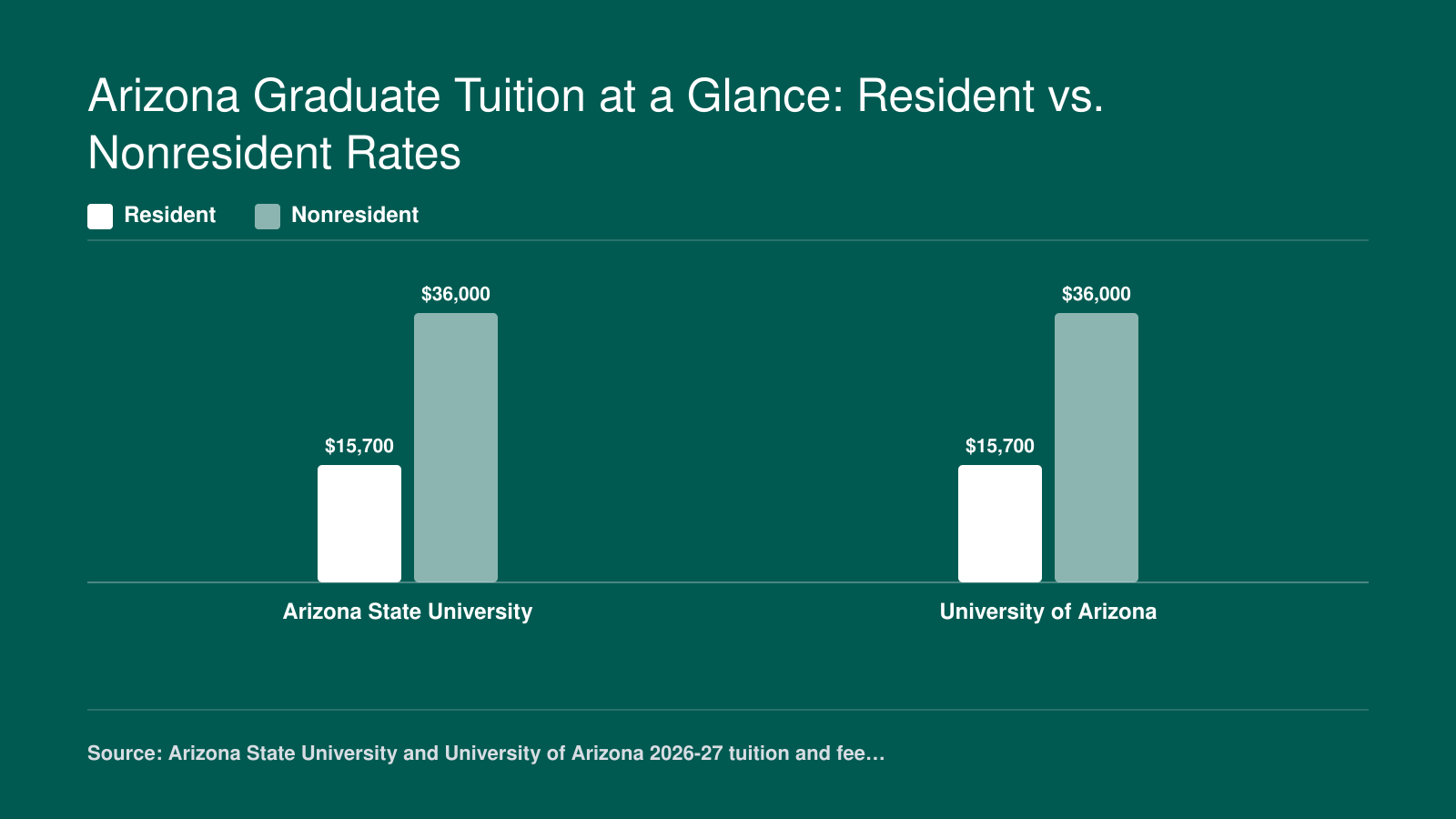
What does a master's in Arizona actually cost, and does the price buy a better outcome? The answer depends on which of four schools you choose. Arizona State University, the University of Arizona, and Northern Arizona University are public and priced by residency. Grand Canyon University is private and built largely around online delivery. At ASU and UA, estimated 2026-27 full-year graduate tuition and fees run $15,700 for residents and $36,000 for nonresidents.
That $20,300 gap, plus differences in format, admissions rules, and funding, shapes the decision more than program names do. The comparison covers resident and nonresident tuition, GRE policies, licensure paths, and graduate earnings.
A lower price does not guarantee a higher return, and a bigger name is not always the better value.
Key Points
- Arizona's public universities charge residents $15,700 and nonresidents $36,000 yearly (estimated).
- WICHE-state residents in participating programs pay at most 150% of resident tuition.
- ASU has held HLC accreditation since 1931; GCU, since 1968.
Popular degrees in Arizona
Master's programs in Arizona by field
Business & Management
- Healthcare Administration13 programs
- Management12 programs
- Public Administration11 programs
- Healthcare Management10 programs
- Accounting10 programs
- Organizational Leadership9 programs
- Management Information Systems8 programs
- Marketing8 programs
Education & Teaching
- Special Education14 programs
- Secondary Education10 programs
- Early Childhood Education8 programs
- Higher Education or Adult Education7 programs
- Educational Leadership6 programs
- Teaching6 programs
- Elementary Education6 programs
- Library Science or Library and Information Science or Library Media6 programs
Nursing
- RN to MSN10 programs
- Nursing Education or Nurse Educator9 programs
- Psychiatric Mental Health Nurse Practitioner6 programs
- Direct Entry MSN (MENP) or (DEMSN)5 programs
- Family Nurse Practitioner (FNP)4 programs
- Nurse Administrator3 programs
- Health/Nursing Informatics3 programs
- Family Nurse Practitioner3 programs
Psychology
- Counseling Psychology11 programs
- General Psychology8 programs
- Industrial Organizational Psychology4 programs
- Applied Behavior Analysis4 programs
- Forensic Psychology3 programs
- Clinical Psychology3 programs
- Sports Psychology2 programs
- Addiction Psychology2 programs
Healthcare
- Public Health13 programs
- Nutrition7 programs
- Health Administration7 programs
- Speech Pathology6 programs
- Health Informatics5 programs
- Health Education3 programs
- Clinical Research Management2 programs
Communications & Media
- Speech Pathology8 programs
- Communication5 programs
- Communication Disorders4 programs
- Journalism3 programs
- Media Communication3 programs
- Health Communication3 programs
- Technical Communication2 programs
- Strategic Communication2 programs
Counseling
- Marriage and Family Therapy or Marriage and Family Counseling9 programs
- Clinical Mental Health Counseling8 programs
- School Counseling6 programs
- Addiction Counseling4 programs
- Christian Counseling2 programs
Science & Engineering
- Sustainability or Environmental Management14 programs
- Geography7 programs
- Environmental Science6 programs
Social Work & Social Sciences
- Social Work8 programs
- Social Work Advanced Standing8 programs
- Sociology6 programs
- Human Services2 programs
- Political Science, Government2 programs
Computers & IT
- Cybersecurity11 programs
- Information Security & Assurance4 programs
- Data Analytics3 programs
- Machine Learning3 programs
Criminal Justice & Law
- Legal Studies4 programs
- Public Policy4 programs
- Homeland Security3 programs
- Business Law3 programs
- Master of Laws3 programs
- Fire Science or Fire Administration or Fire Leadership2 programs
Arts & Design
- Creative Writing9 programs
- Fine Arts1 program
Religion & Theology
- Christian Ministry3 programs
- Theology3 programs
- Divinity2 programs
- Christian Leadership1 program
- Youth and Family Ministry1 program
Arizona Graduate Tuition at a Glance: Resident vs. Nonresident Rates
Estimated 2026-27 full-year graduate tuition and fees at Arizona State University and the University of Arizona are $15,700 for residents and $36,000 for nonresidents, a gap of $20,300 that more than doubles the resident price. These figures use the six-unit semester rate, and program-specific differential tuition and fees can push costs higher. Northern Arizona University and Grand Canyon University are not charted because current official graduate rates could not be confirmed, so check their bursar pages directly.
The Real Cost of a Master's in Arizona: Residency, Fees, and Total Degree Price
A 30 to 36 credit master's at ASU Online's Fall 2026 rate of $605 per credit works out to roughly $18,150 to $21,780 in base tuition.1 At the $698 per-credit figure in the Arizona Board of Regents' 2026-27 schedule (up from $665 the year before)2, the same degree runs about $20,940 to $25,128. The published sources do not explain why those two figures differ, so confirm which one applies to your program before budgeting.
Turning Annual Rates Into a Degree Total
Multiply the per-credit rate by your program's required credits, then add fees. For private options such as Grand Canyon University, take the posted per-credit price and apply the same math. NAU lists $12,564 for its online graduate tuition3, but the page does not give a credit load, year, or fee breakdown, so it can't be converted into a per-credit comparison. Ask the program for its credit total and the rate behind that number.
Fees and Differential Tuition
Base tuition is rarely the whole bill. The Board-approved 2026-27 online graduate charges include mandatory fees on top of tuition2, and some programs add differential or program fees by college. Business, engineering, and nursing programs, including General MBA and Family Nurse Practitioner (FNP) tracks, are the usual places to look. Use each university's tuition estimator and the specific program page, not the general graduate rate.
How Residency Works
Arizona residency generally requires at least 12 months of continuous physical presence before the semester starts, plus clear evidence that you intend to make Arizona your home beyond being a student. Moving here primarily for school, or attending full time, generally does not establish residency. Evidence that counts includes Arizona employment and income, Arizona tax filing, a driver's license, vehicle registration, banking, and voter registration. The university guidance sets no looser standard for graduate students, so most out-of-state students should assume they will pay nonresident rates for the whole degree.
Online Billing Can Change the Math
ASU's Fall 2026 online graduate rate is the same $605 per credit for residents and nonresidents.1 The difference is the cap: residents stop at 11 credits ($6,664), while nonresidents pay per credit with no cap, so 12 credits costs $7,260 and 18 costs $10,890.1 Summer 2026 is billed per credit as well, at $695 for one credit and $11,235 for 18.4 For a part-time online student taking one or two courses a term, the cap rarely matters, which makes the online route a real option for someone outside Arizona.
The Western Regional Graduate Program
The WICHE Western Regional Graduate Program lets eligible residents of participating Western states enroll in approved out-of-state programs at no more than 150% of resident tuition.5 The University of Arizona participates. ASU does too, but only for approved programs, not online or doctoral ones, and it requires two years of residency in your home state.6 NAU's participation is not established in the sources, so check with the school directly.5
Through WICHE's Western Regional Graduate Program, residents of other WICHE member states and territories pay no more than 150% of resident tuition, rather than full nonresident rates, in participating programs at Arizona's public universities. According to WICHE's 2026 Arizona listings, the University of Arizona has 183 participating graduate programs and Arizona State University has 12.
Online, Hybrid, or On-Campus: How Arizona Universities Deliver Master's Degrees
Arizona's major universities deliver master's degrees through online, hybrid, and on-campus formats, but the schedules differ more than the credentials do.
Condensed Online Terms vs. Semester-Based Campus Schedules
ASU Online's most common online course runs 7.5 weeks, and most programs offer six start dates a year through Fall A/B, Spring A/B, and one or two summer sessions.1 The University of Arizona Online describes a mix of five-week intensives, 7.5-week courses, and some 15-week courses, with up to six start dates a year, though not every program opens in every session. Northern Arizona University Online and Grand Canyon University do not publish a single, current set of term lengths and start dates across all online master's tracks. Prospective students should confirm the calendar and cohort schedule for the specific degree, because accelerated online tracks and semester-based campus tracks can differ within the same university.
How Long a Master's Takes in Practice
For a 30 to 36 credit master's, full-time study usually lands between 1.5 and 2 years. ASU Online frames a typical 30-credit master's as 10 three-credit courses; most students finish in 18 to 24 months, and the university says a master's usually takes about two years with a full-time load of 12 to 15 credits per semester.2 A specific 2025-26 online M.A. in Education can run five semesters, or about 16 to 18 months.3 Part-time students should plan for 2 to 3 or more years, while accelerated online tracks can finish in about 12 to 18 months. There is no single statewide completion time; University of Arizona Online states completion varies by program, transfer credit, and course availability.
Online Means Online, Not Always 100 Percent Remote
Even a program marketed as online is not always fully remote. Licensure-based degrees such as counseling (an online master's in clinical mental health counseling), social work (online MSW programs), education, nursing, and some health professions require clinical placements, practicums, student teaching, or residencies that are completed in person at a site near the student. The course delivery may be online while the supervised hours are not. For working adults near the Phoenix, Tucson, and Flagstaff campuses, hybrid and evening options can preserve face-to-face cohort interaction while cutting commute frequency. Ask whether in-person components fall on evenings or weekends, whether field hours can be arranged with your current employer, and whether the university will allow you to switch between online and campus sections if a work schedule changes.
ASU Online states clearly that its diploma reads "Arizona State University" and that the transcript carries no online marker.4 The University of Arizona does not publish an equivalent blanket statement for every online master's program, but its online courses are delivered through the same university colleges. The same regional accreditation covers online, hybrid, and campus delivery, so the mode of instruction is not a separate institutional status. If the distinction matters to you, confirm the registrar's wording before committing.
GRE Policies, GPA Minimums, and Deadlines at Arizona's Major Graduate Schools
Graduate colleges in Arizona set a general admissions floor, but the program you actually apply to usually sets stricter rules on top of it. Read the department's page, not just the graduate college's, before you assume anything below applies to your track.
Do You Need the GRE or GMAT?
The short answer: often no, but check. Many Arizona master's programs have gone GRE-optional or dropped the test entirely over the past several years, joining the broader pool of master's programs with no GRE required. At Arizona State University, GRE, GMAT, or MAT scores may be required, and that decision is left to the individual academic unit rather than set university-wide.1 Expect research-heavy fields and some MBA programs to still require or recommend a score, while professional and online programs increasingly waive it. If a program lists the test as recommended, a strong score can strengthen an otherwise borderline file.
GPA and the Standard Document Set
Most graduate programs in the state anchor to a 3.0 minimum. ASU generally expects a cumulative GPA of 3.0 or higher2, and NAU asks for a 3.0 or equivalent, with applicants below that line sometimes eligible for conditional admission when the admitting program recommends it and gives a rationale.3 Grand Canyon University sets a lower published floor, at least a 2.25 GPA with 25 or more transferable credits from an approved institution.4 Many programs calculate that GPA on your last 60 credit hours rather than your entire undergraduate record.
The document package is fairly consistent across schools:
- Transcripts: official records from every institution attended.
- Statement of purpose: your goals and fit with the program.
- Letters of recommendation: usually two or three, often from faculty.
- Résumé or CV: especially for professional and business degrees.
Deadlines and Transfer Credit
Deadline structure splits along format. Funded, on-campus programs that award assistantships typically enforce a fixed fall deadline, often months before the term starts, because funding decisions happen early. ASU advises applying at least one to two months before your chosen start date6, and competitive funded tracks run earlier than that. Online programs more often use rolling admission with multiple start dates throughout the year, so you can apply closer to when you want to begin.
If you earned graduate credits elsewhere, plan on limits. ASU allows up to 12 graduate-level hours to transfer in, at the program's discretion, provided they carry a B or better, weren't used toward another degree, and are recent.5 NAU caps transfer credit at 9 units toward a 30 to 36 unit degree.7
Accreditation and Licensure: Making Sure Your Arizona Master's Counts
Arizona State University has been continuously accredited by the Higher Learning Commission since 1931, and HLC reaffirmed that status in July 2023, with the next review set for 2032-33.1 Grand Canyon University has held HLC accreditation since 1968.2 That regional, institutional accreditation determines whether a school's students are eligible for federal aid and makes credits far more likely to transfer. Before you apply to the University of Arizona or Northern Arizona University, confirm their current HLC status directly on the HLC site rather than assuming it.
Institutional vs. Programmatic Accreditation
Institutional accreditation covers the whole university. Programmatic accreditation covers one degree, and for licensed fields it is often the credential that matters most. The bodies to know:
- Counseling: CACREP
- Social work: CSWE
- Nursing: CCNE or ACEN
- Business: AACSB
- Education: CAEP or state program approval
- Speech-language pathology: the ASHA Council on Academic Accreditation (CAA)
Arizona examples show how this plays out. The University of Arizona's MA in Counseling with a Clinical Mental Health Counseling specialization holds CACREP accreditation through 2032, and its MS in Nursing is CCNE accredited, a distinction to keep in view as you compare MSN programs. Both ASU and the University of Arizona hold CAA accreditation for speech-language pathology3, with ASU's current cycle running through 2027.4 Grand Canyon University lists CACREP accreditation for its MS in Clinical Mental Health Counseling and MEd in School Counseling, and CSWE accreditation for its Master of Social Work, placing it among CSWE-accredited MSW programs.2
No single school holds every credential, so a strong name does not settle the question. Check the accreditor's own directory for the specific degree you want.
Check Your Campus and Format
Programmatic accreditation can differ by campus, specialization, and delivery format. An on-campus counseling track may be accredited while an online version of a similar degree is not, or the reverse. Ask the program whether the exact version you plan to take, including any online option, appears in the accreditor's listing, and whether that status is full, conditional, or under review. Grand Canyon's addiction-focused counseling degrees, for instance, are tied to a different accreditor (NASAC), and one of them carries conditional status.
Out-of-State Online Students
Licensure is set by each state, not by the university. If you will enroll online from outside Arizona, find the school's state authorization or professional licensure disclosure page before you pay a deposit. It states whether the program meets educational requirements for licensure in your state, and a program that qualifies you in Arizona may not qualify you elsewhere.
Arizona Licensure for Counselors and Social Workers
Paying for It: Assistantships, Tuition Waivers, and Employer Aid in Arizona
Can you get a master's in Arizona without paying full tuition? Sometimes, but mostly in research-oriented, on-campus programs. Funding is the biggest lever on your total degree price, so look at it before you compare sticker rates.
How Assistantships Work
A graduate assistantship trades work for support. At Arizona State University, University of Arizona, and Northern Arizona University, a typical half-time appointment (0.5 FTE) means about 20 hours a week of teaching or research. In return you generally get a tuition benefit, a stipend, and sometimes health coverage.
The details differ by campus and by appointment type:
- ASU: For 2026-27, the estimated minimum stipend for a 50% academic-year research or teaching assistant is $26,544.1 A start within the first nine weeks of a semester earns a full tuition award for that term, and the university covers the health premium if you elect its plan by the deadline.1 Graduate service assistants (GSAs) get no tuition award or premium support, and they still owe mandatory fees.2
- University of Arizona: Assistants must enroll in the student health plan during open enrollment to receive the health benefit. Confirm how much of the premium the university pays.
- NAU: Assistantships carry 100% tuition remission, though fees are excluded.4 Stipends vary by department. One Teaching and Learning posting lists $12,000 plus a waiver, but treat that as one department's figure, not a campus standard.5
Assistantships are rare in online and professional master's programs, including Online MBA. They cluster in thesis-track science, engineering, and journalism programs, where departments such as ASU's Cronkite School publish their own funding packages.6
Fellowships, Loans, and State Programs
Graduate colleges and departments also offer fellowships and scholarships, usually by nomination or application, and some are merit-based while others consider need. Amounts and deadlines change each cycle, so check each program's funding page.
Federal loan rules for graduate students have shifted recently, so check current unsubsidized limits and Grad PLUS availability with Federal Student Aid before you build a borrowing plan. If you are heading into a teaching field such as a master's in curriculum and instruction, ask the program about the Arizona Teachers Academy. Eligibility terms for master's students, including any service commitment, should come directly from the university.
Employer Aid
Some large Arizona employers have education partnerships with ASU or GCU, but terms vary: degree levels, eligible programs, and who qualifies. Do not assume a benefit that covers bachelor's study also covers graduate tuition; ask HR in writing. Federal tax rules let employers provide up to $5,250 a year in tuition assistance tax-free, so anything above that may be taxable income.
A Practical Tip
Ask about funding in the same email or meeting where you ask about admission. Departments often allocate assistantships alongside admission decisions, and a late question can mean the money is already committed.
What a Master's-Level Nurse Practitioner Earns in Arizona
Most nurse practitioner roles require a master's degree or higher, so the state's occupational wage is a useful benchmark.
Earnings, Employment, and ROI After an Arizona Master's
Return on investment for a master's comes down to two numbers: what the degree costs you in total, and how much more you earn afterward than you would with a bachelor's alone. Federal College Scorecard data, which reports median earnings for graduates of specific programs, is the best public tool for the second number. In Arizona it shows a clear pattern: your field, whether Data Analytics, nursing, business, or teaching, matters far more than your school.
Field Beats Brand
Start with a single university. At Arizona State, business administration and management graduates post median earnings of $141,437.1 Computer science grads land at $139,405 in one recent listing,3 while another summary, based on earlier cohorts in 2024 dollars, puts the figure at $177,303.2 Nursing sits at $86,576,1 and teacher education comes in at $53,195.1 That is a gap of more than $85,000 within one institution.
Grand Canyon University follows the same pattern:
- Nursing: roughly $118,000 to $124,000, depending on the listing4
- Computer and information sciences: $107,6414
- Education (general): $78,6994
- Educational administration: $73,5014
- Teacher education: about $53,000 to $57,0004
The University of Arizona's nursing master's graduates report $104,086. Comparable program-level earnings for Northern Arizona University are not yet published, and counseling outcomes are not available for any of these schools.
A Simple Payback Estimate
Take the total program price from the cost breakdown above, adding living costs if you will stop working. Estimate your annual raise over a bachelor's-level salary in your field, then divide cost by that raise to get rough payback years. Nonresident tuition enlarges the cost side, often substantially, so the same degree can take noticeably longer to pay off for an out-of-state student. In fields where medians sit in the $50,000s, such as teaching, a low-cost in-state or online option matters far more than it does in computing or business.
Location and Labor Market
Pay also depends on where you work. The Phoenix metro concentrates much of the state's healthcare, semiconductor manufacturing, and financial services employment, including MBA in Finance roles, and those roles generally pay more than similar jobs elsewhere in the state. If you plan to work in Flagstaff, Tucson, or a smaller community, check local salaries rather than relying on statewide medians.
So Which Programs Are Best?
No single ranking answers that. The best master's program in Arizona for you is the one that carries the accreditation your employer or licensing board requires, costs the least in total after residency and aid, comes in a format you can realistically finish, and shows documented graduate earnings in your specific field.
Read the Data With Care
Scorecard earnings cover only graduates who received federal financial aid, and they measure income several years after completion, so they lag the current job market. Listings for the same program sometimes disagree because of different cohorts and dollar adjustments. Treat these figures as directional, not as guarantees.
The Master's Earnings Premium in Arizona
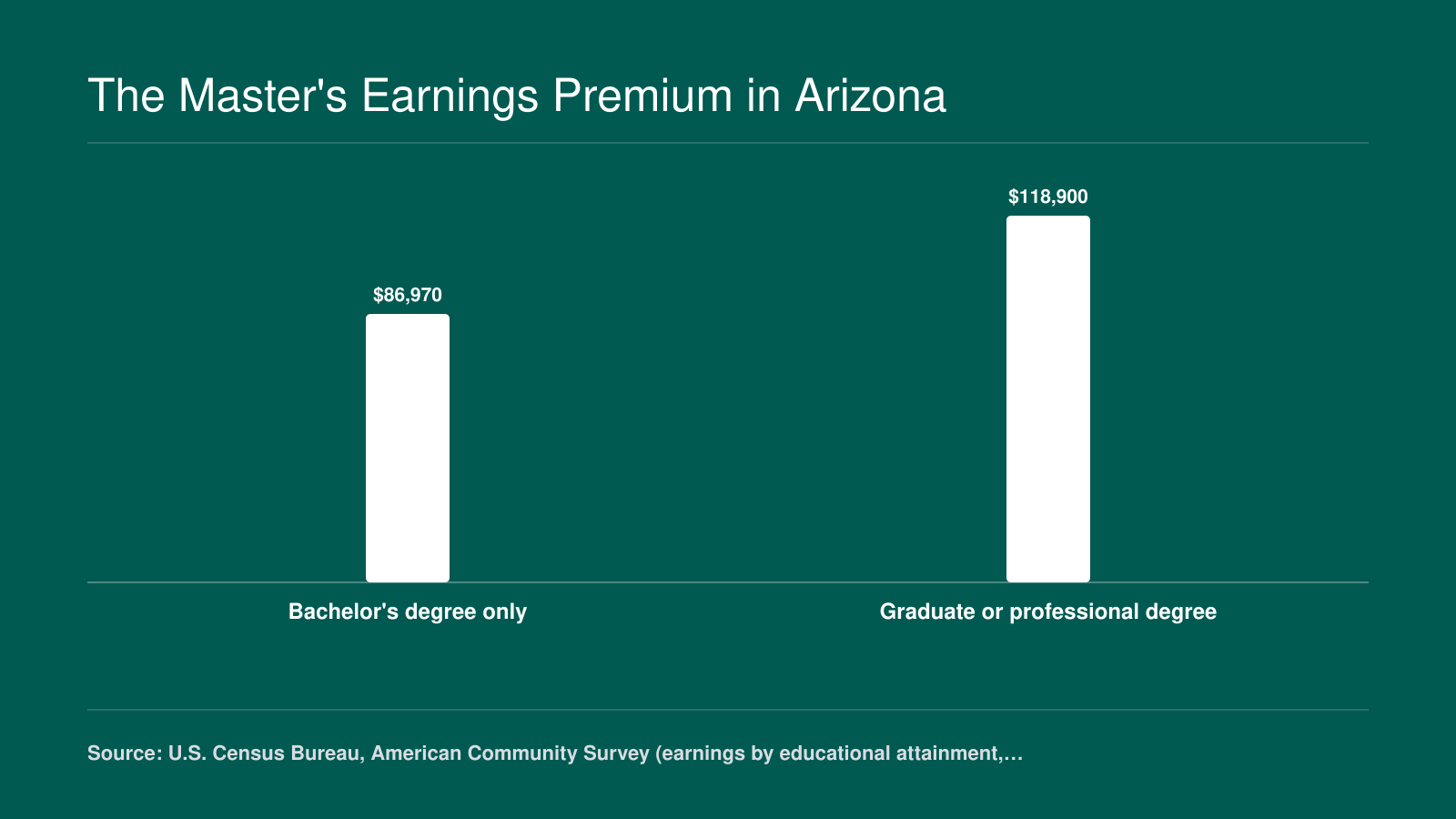
Nationally, workers with a graduate or professional degree earn about $31,930 more per year at the median than workers with only a bachelor's degree, using the most recent Census figures we could verify. State-level Arizona medians for the same two groups are not shown here because we could not confirm comparable figures. Treat the national gap as a benchmark, and compare it with the payback estimate above to see how long a program's cost takes to earn back.
Graduate schools in Arizona with the most master's programs
| School | City | Type | Master's programs | Online | Grad tuition / yr |
|---|---|---|---|---|---|
| Arizona State University | Tempe | Public | 108 | 55 | $13,587 |
| Arizona State University | Scottsdale | Public | 99 | 71 | $10,843 |
| Grand Canyon University | Phoenix | Private nonprofit | 89 | 89 | $10,015 |
| University of Arizona | Tucson | Public | 63 | 29 | $14,856 |
| Northern Arizona University | Flagstaff | Public | 48 | 27 | $13,023 |
| University of Phoenix-Arizona | Phoenix | Private for-profit | 35 | 35 | $15,208 |
| The University of Arizona Global Campus | Chandler | Public | 26 | 26 | $12,930 |
| Prescott College | Prescott | Private nonprofit | 19 | 19 | $18,630 |
| Ottawa University-Surprise | Surprise | Private nonprofit | 18 | 17 | $12,562 |
| Aspen University | Phoenix | Private for-profit | 14 | 14 | $5,910 |
| Pima Medical Institute-Tucson | Tucson | Private for-profit | 5 | 5 | — |
| Bryan University | Tempe | Private for-profit | 5 | 5 | $14,393 |
| Midwestern University-Glendale | Glendale | Private nonprofit | 5 | 2 | $49,369 |
| Brookline College-Phoenix | Phoenix | Private for-profit | 4 | 4 | — |
| International Baptist College and Seminary | Chandler | Private nonprofit | 4 | 3 | $8,280 |
Program counts are the verified master's listings in our directory; tuition is the school-wide average for a full-time graduate student (IPEDS).
Arizona Master's Programs: Common Questions
These are the questions prospective students ask most often when comparing Arizona master's degrees. Policies change by program and by year, so confirm details on each program's current admissions page before you apply.
Are there accredited online master's programs in Arizona?
Do I need to take the GRE for Arizona master's programs?
Can I get in-state tuition if I move to Arizona for grad school?
Is an online master's from ASU, UA, or NAU cheaper than on-campus?
Compare programs nationwide
Many Arizona residents study online. Every ranked list above has an online lens, or browse every field.
Online master's programs Browse all fields