Best Master's in Secondary Education Programs in Arizona
Compare 10 accredited Secondary Education programs in Arizona at 6 schools, with graduate earnings, cost, debt, and completion data from IPEDS and the U.S. College Scorecard.

A licensure-track master's and a degree built for teachers who already hold a certificate look similar in a catalog, but they lead to different outcomes. One puts a career changer in front of a classroom with an Arizona secondary certificate. The other adds pay-scale credit and subject depth for someone already teaching.
The programs here are online or hybrid, and clinical placement often matters more than delivery. Most of the cost and timeline gaps trace back to one question: does the degree include student teaching?
Key Points
- Only programs approved by the Arizona State Board of Education can recommend you for certification.
- Grand Canyon University has the lowest published tuition and fees here, at $10,015 per year.
- Arizona's NASDTEC agreement eases license transfer, but the receiving state makes the final call.
Top-Ranked Master's in Secondary Education Programs in Arizona
Five Arizona institutions offer a master's in secondary education that fits this page, and several run more than one version. Each card below separates the licensure routes from the non-licensure options so you can see which one leads to an Arizona teaching certificate. Graduation rates cited are institution-wide figures, not completion rates for these specific programs.
University of Arizona
#1Tucson, AZ · ~$15,000/yr (est.)
Best for: Aspiring teachers earning a salary while certifying
The University of Arizona in Tucson offers two secondary education master's routes, both leading to Arizona secondary certification. The HCAT program is a two-year alternative path in which you teach full time in grades 7-12 while completing coursework. Teach Arizona is a one-year, hybrid fast track with a year-long student teaching internship and an in-person Tucson cohort. The university graduates roughly 68% of its students overall, and eligible Teach Arizona students may qualify for Arizona Teachers Academy tuition support.
- Two-year M.Ed. with 51 total credit hours
- Alternative certification path: work as a paid teacher while studying
- Arizona secondary certification included
- Structured English Immersion endorsement included
- Equity-minded, culturally affirming teaching focus
- 3.0 GPA minimum and two letters of recommendation
- Offered at many campus locations and online
- One-year fast track with 36 total credit hours
- Starts in summer; synchronous online classes
- Hybrid format with an in-person option in Tucson
- Year-long student teaching internship
- Subjects include math, science, English, social studies and world languages
- Eligible for Arizona Teachers Academy tuition coverage
- Eligible for Arizona secondary certification
Grand Canyon University
#2Phoenix, AZ · ~$10,000/yr (est.)
Best for: Private and charter school hopefuls without licensure
Grand Canyon University in Phoenix is a large online provider with two secondary education master's versions at the same $625 per credit. One leads to initial Arizona licensure, while the other is non-licensure and suits people aiming for private, charter, online or international schools. The university graduates about 43% of its students overall. Its College of Education is approved by the Arizona State Board of Education to issue institutional recommendations for initial secondary licensure.
- 41 credit hours with initial licensure for grades 6-12
- 15-week student teaching practicum plus 100 clinical hours
- Eligible for an Arizona teaching license
- Entrance exam listed (GMAT or GRE) and 2.8 GPA minimum
- Up to 12 transfer credits accepted
- Fully online option available
- 33 credit hours in 6-week online course terms
- No teaching license required or earned
- 100 hours of classroom field experience
- 2.8 GPA minimum
- Up to 12 transfer credits accepted
- Aimed at private, charter, online and international school roles
Arizona State University
#3Scottsdale, AZ · ~$11,000/yr (est.)
Best for: Career changers picking a teaching subject area
Arizona State University's online M.Ed. in secondary education accepts a bachelor's degree in any field and leads to teacher certification for grades 6-12. You choose from 14 subject areas, complete a matching methods course, and finish with an applied research project. Graduates receive ASU's institutional recommendation for Arizona Department of Education certification. Rolling admissions with three start terms a year make it one of the more flexible entry points on this list.
- 30 credit hours across 16 courses, about five semesters
- 14 subject-area concentration options
- No entrance exam required; rolling admissions with three start dates
- 3.0 GPA minimum, with provisional admission at 2.75 to 2.99
- Three letters of recommendation required
- Asynchronous online classes with school-based field experiences
- Applied research project capstone
- IVP fingerprint clearance card required before field placement
Prescott College
#4Prescott, AZ · ~$19,000/yr (est.)
Prescott College offers an online M.Ed. in secondary education with a choice of a traditional licensure route or an alternative route. Under the alternative route you can work full time as a salaried teacher while completing licensure coursework. Applicants do not need GRE or GMAT scores, and there is no application fee. The college graduates about 56% of its students overall.
- Fully online, asynchronous coursework with multiple start dates
- Traditional or alternative pathway to certification
- 12-week student teaching placement on the traditional path
- Alternative Educator Preparation Certificate allows paid full-time teaching
- No entrance exam required and $0 application fee
- Partnership with the Arizona Department of Education
- Seven concentration options offered
University of Phoenix-Arizona
#5Phoenix, AZ · $15,000 – $20,000/yr (est.)
University of Phoenix-Arizona offers a Master of Arts in Education in Secondary Teacher Education for bachelor's holders with no teaching background. It pairs online coursework with field experience and student teaching under a supervising teacher. Admission is test optional, with a 2.5 GPA minimum and no essay. The university graduates about 21% of its students overall, a figure worth weighing alongside its lower per-credit price.
- 39 credit hours at $540 per credit with a locked tuition rate
- No GRE or GMAT required; test optional
- 2.5 GPA minimum and no admission essay
- 100 clinical hours plus student teaching
- 5 to 6 week course format, fully online option available
- Prepares for initial teacher licensure
- Military benefits and employer reimbursement supported
Cost & outcomes by school
Federal data for the highest-earning Secondary Education programs, independent of the ranking above. Earnings are this field's master's graduates four years after completing, where the Scorecard reports them.
| School | Earnings | Tuition / yr | Debt | Grads/yr | Format |
|---|---|---|---|---|---|
| Arizona State University AZ | $59,557 | $10,843 | $20,443 | 169 | Online |
| Arizona State University AZ | $59,557 | $13,587 | $20,443 | 53 | Online |
| University of Phoenix-Arizona AZ | $59,122 | $15,208 | $27,291 | 216 | Hybrid |
| University of Arizona AZ | $57,881 | $14,856 | $45,106 | 9 | Online |
| Grand Canyon University AZ | $56,764 | $10,015 | $31,340 | 1,662 | Online |
| Prescott College AZ | — | $18,630 | — | 4 | Online |
Sources: U.S. Department of Education. Tuition and graduates: IPEDS. Earnings and debt: College Scorecard, this field's master's graduates; a dash means no figure is reported.
Cost, debt & payoff
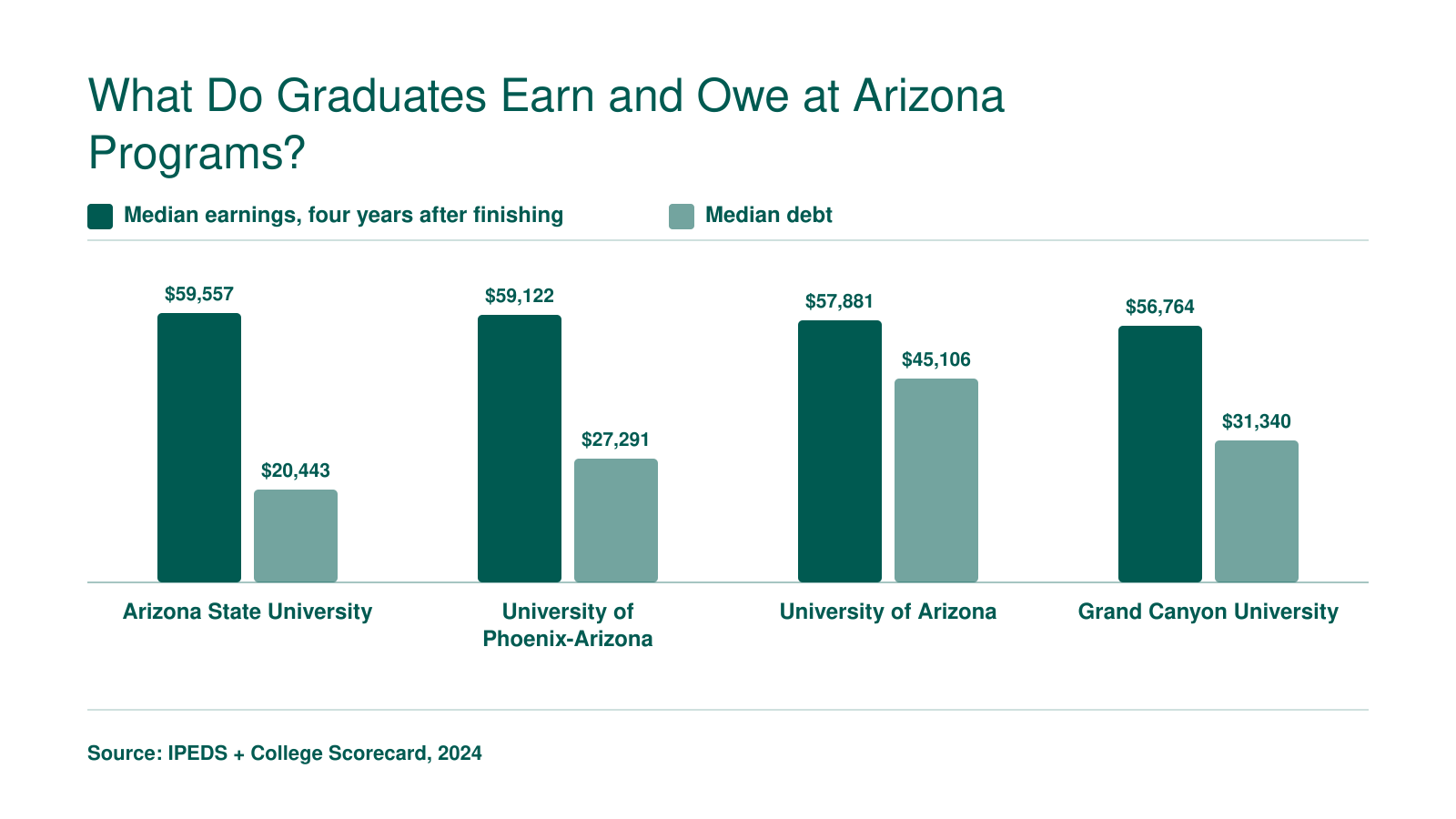
Median earnings of this field's master's graduates (4 yrs after completing) vs. their median federal loan debt · U.S. College Scorecard
Across these programs the median graduate earns about $59,122 and finishes with roughly $27,291 in debt — a ratio that clears a common rule of thumb (keep debt below first-year salary). Tuition and debt vary widely school to school, so check the per-school figures in the table above before you shortlist.
Accreditation and Arizona State Approval: Check This Before Comparing Programs
Before you compare tuition or format, confirm that a master's in secondary education program is approved by the Arizona State Board of Education. Only an approved program can recommend you for an Arizona secondary teaching certificate.
Regional accreditation, such as the Higher Learning Commission, covers the university. Program-level bodies like CAEP or AAQEP review educator preparation.1 Arizona State University and University of Arizona appear on the state approved-provider list; University of Phoenix holds HLC institutional accreditation.
Grand Canyon University shows the difference among M.Ed. programs in Arizona: its MEd in Secondary STEM Education leads to initial licensure and is approved by the state, while its MEd in Secondary Education does not.
Check the Arizona Department of Education's approved educator preparation programs page before applying.
Online and Hybrid Master's in Secondary Education Options in Arizona
Master's programs in secondary education vary more in clinical placement than in course delivery, even among the best online master's in secondary education programs. The programs below divide into fully online and hybrid formats; no campus-only option appears here. Among master's programs in Arizona, Arizona State University, Grand Canyon University, and Prescott College are online, while University of Phoenix-Arizona is hybrid. University of Arizona offers both an online HCAT route and a hybrid Teach Arizona track with synchronous Zoom sessions and a year-long half-day internship. Licensure still requires in-person work: GCU lists 100 observation hours and a 15-week practicum, and Prescott requires a 12-week student teaching placement. Clinical work can often be done while employed: ASU's alternative route is for full-time teachers of record, and University of Arizona's HCAT and Prescott support paid teacher-of-record pathways. Working teachers should compare asynchronous courses with scheduled evening sessions.
Which Arizona Master's Programs Waive the GRE or Make It Optional?
Two of the ranked programs publish enough detail to compare admission testing side by side.
- Arizona State University: No published GRE policy on the admissions page. Minimum 3.00 cumulative GPA in your last 60 credit hours; provisional admission is possible with 2.75 to 2.99. A bachelor's in an unrelated field is accepted.
- Grand Canyon University: The GRE is an alternative route, not a general requirement, applicants with a 2.8+ GPA can apply without it, so this program appears among Master's in Secondary Education Programs With No GRE Required, while those between 2.5 and 2.79 may qualify with a 300 combined GRE score. Admission is rolling, so you can apply anytime. An unrelated bachelor's is accepted, though prior teaching experience helps.
For University of Arizona, Prescott College, and University of Phoenix-Arizona, confirm current testing and GPA requirements directly on each admissions page before applying.
Related Articles
Master's in Secondary Education Arizona Cost and What You Pay After Aid
Cost differences among Arizona's secondary education master's programs are substantial enough to change which program lands among the Most Affordable Master's in Secondary Education Programs ranking. Grand Canyon University has the lowest published tuition and fees among the ranked schools at $10,015 per year. Prescott College's flat-rate program sits at $18,630, while University of Arizona's out-of-state rate reaches $34,110; its in-state rate is $14,856. Net price data is institution-wide, so use it as a campus benchmark rather than a promise of your final bill.
Per-credit pricing varies. GCU lists $625 per credit for 2026-27 graduate education courses, with an 18% online discount in eligible programs; one third-party listing for its 33-credit secondary STEM M.Ed. shows $615 per credit and $20,295 total, so confirm before budgeting against the Best Master's in STEM Education Programs in Arizona. University of Phoenix advertises $540 per credit. GCU accepts up to 12 transfer credits, which can shorten the degree.
Aid can cut the bill: the Arizona Teachers Academy covers tuition and mandatory fees for residents in qualifying programs, and the TEACH Grant offers up to $4,000 a year, capped at $8,000 for graduate study. Also check district reimbursement, military discounts, and school-specific scholarships.
Arizona Secondary Certificate Requirements
How Long Does a Master's in Secondary Education Take in Arizona?
Expect roughly 30 to 46 credits, and budget extra time on a licensure track at Arizona MAT schools, since student teaching has to fit the calendar. Arizona State University's MEd in Secondary Education is 30 credits. Its teacher-certification version runs 16 classes of 15 weeks each and can be done in as few as five semesters, summer included, with appropriate placements. Full time at ASU means 9 or more credits per fall or spring term1, and part-time students can stretch the program over additional semesters.
University of Phoenix education master's programs typically take 16 to 22 months, with clinical practice included and nine start dates a year.
For speed, ASU's accelerated master's in secondary education programs pathway shares up to 15 credits with the bachelor's, so many students finish both degrees in about five years.
What Do Graduates Earn and Owe at Arizona Programs?
These figures are program-level medians for master's graduates in secondary education. Earnings are measured four years after finishing, and debt is the median owed by completers. Compare the gap between the two bars for each school, not earnings alone.
Arizona Teaching License Transfer to Another State
Teacher mobility across state lines still runs on bilateral agreements rather than a single national credential, and Arizona is no exception. Arizona participates in the NASDTEC Interstate Agreement, which smooths the paperwork but guarantees nothing: the receiving state decides whether your Arizona certificate is acceptable and can still add its own exams, coursework, or experience requirements. Expect to submit an application, fee, transcripts, certificate verification, and a fresh background check, with subject-area comparability reviewed.2 Provisional and temporary Arizona certificates generally are not covered, so hold a standard secondary certificate before you move.2
Coming the other direction, Arizona reciprocates with all states.1 With a valid, comparable out-of-state certificate in good standing and an IVP fingerprint clearance card, no additional exams or work experience are required, and the fee is $60 per certificate, non-refundable.1 Expired, temporary, emergency, alternative, and out-of-country credentials do not qualify.1 Confirm rules with the destination state's education department before relocating.2
Questions Arizona Secondary Teaching Candidates Ask Most
These answers cover the practical questions candidates raise before enrolling. Requirements can change, so confirm details with the Arizona Department of Education and your program before you commit.
Are student-teaching placements in Arizona paid or unpaid?
Can I enroll in an Arizona secondary education master's with a bachelor's in a non-education field?
Which master's programs in Arizona lead to initial secondary teacher licensure?
Can I teach full time on an Arizona intern certificate while finishing my master's?
Do I need to pass a subject-knowledge exam before starting student teaching?
Is a master's degree required to teach high school in Arizona?
Compare Secondary Education programs on the data that matters
Explore more Education & Teaching specializations or browse every graduate field.
All Education & Teaching programs