Master's Programs in Virginia
Every master's program reported by a school in Virginia: 1,050+ programs at 40+ graduate schools, with the online options, costs and outcomes behind each one.

What does a master's degree actually cost in Virginia, and does it pay for itself? At private universities in the state, published per-credit rates run from about $550 to $1,340, so a 30-credit program can total anywhere from roughly $17,000 to over $40,000 before fees. Public universities add the in-state versus out-of-state split on top of that.
The choices themselves are wide: research universities like UVA and Virginia Tech, regional publics like JMU and Radford, and a deep bench of private and online options. The harder part is that cost, format, and career payoff rarely line up in the same program. A counseling license requires 60 graduate credits in Virginia; an MBA may take twelve months. Those constraints, not rankings, drive most of the decision.
Key Points
- Virginia private university master's rates run from $550 to $1,340 per credit.
- Virginia Tech's 2026-27 Dean's Assistantships can pay about $3,040 per month.
- Virginia counselor licensure requires a 60-semester-hour degree covering 13 core areas.
Popular degrees in Virginia
Master's programs in Virginia by field
Business & Management
- Healthcare Administration31 programs
- Management30 programs
- Healthcare Management28 programs
- Accounting24 programs
- General Business23 programs
- Finance22 programs
- Analytics20 programs
- Human Resource Management or HR Management19 programs
Education & Teaching
- Curriculum & Instruction34 programs
- Teaching29 programs
- Special Education24 programs
- Educational Leadership23 programs
- Secondary Education19 programs
- Reading & Literacy15 programs
- STEM Education or Science Education or Mathematics Education14 programs
- Elementary Education13 programs
Nursing
- Family Nurse Practitioner (FNP)17 programs
- Nursing Education or Nurse Educator12 programs
- Psychiatric Mental Health Nurse Practitioner10 programs
- Nurse Administrator8 programs
- Clinical Nurse Leader6 programs
- Health/Nursing Informatics4 programs
- RN to MSN4 programs
- MSN/MBA3 programs
Psychology
- Counseling Psychology20 programs
- Educational Psychology or School Psychology10 programs
- General Psychology9 programs
- Applied Behavior Analysis7 programs
- Industrial Organizational Psychology6 programs
- Forensic Psychology3 programs
- Developmental Psychology3 programs
- Applied Psychology3 programs
Healthcare
- Health Administration16 programs
- Public Health14 programs
- Nutrition8 programs
- Health Informatics7 programs
- Speech Pathology6 programs
- Exercise Science4 programs
- Health Education4 programs
- Clinical Research Management2 programs
Communications & Media
- Communication15 programs
- Speech Pathology8 programs
- Strategic Communication6 programs
- Communication Disorders6 programs
- Public Relations4 programs
- Media Communication3 programs
- Technical Communication2 programs
- Political Communication2 programs
Counseling
- Clinical Mental Health Counseling21 programs
- School Counseling16 programs
- Addiction Counseling5 programs
- Marriage and Family Therapy or Marriage and Family Counseling4 programs
- Christian Counseling3 programs
Computers & IT
- Cybersecurity18 programs
- Data Analytics10 programs
- Machine Learning7 programs
- Information Security & Assurance7 programs
Social Work & Social Sciences
- Social Work11 programs
- Sociology9 programs
- Social Work Advanced Standing8 programs
- Political Science, Government7 programs
- Human Services5 programs
Arts & Design
- Creative Writing20 programs
- Fine Arts4 programs
- Interior Design1 program
Religion & Theology
- Divinity7 programs
- Theology7 programs
- Christian Leadership4 programs
- Christian Ministry4 programs
- Youth and Family Ministry3 programs
Science & Engineering
- Environmental Science10 programs
- Geography6 programs
- Sustainability or Environmental Management6 programs
Criminal Justice & Law
- Master of Laws5 programs
- Homeland Security4 programs
- Public Policy4 programs
- Legal Studies3 programs
- Cybercrime1 program
- Business Law1 program
- Fire Science or Fire Administration or Fire Leadership1 program
Master's Programs in Virginia: What to Know Before You Apply
The real decision isn't which Virginia school carries the most prestige, it's which program fits your budget, schedule, and the career you're actually chasing. A degree that doubles your commute or your debt isn't a bargain, no matter whose name is on it. Before you compare individual programs, it helps to understand how the state's options are organized and which factors move the needle most.
The Landscape by School Type
Virginia's graduate options fall into three broad tiers:
- Flagship research universities: The University of Virginia, Virginia Tech, William & Mary, George Mason, and Virginia Commonwealth University anchor the state's research output and offer the widest range of doctoral-adjacent and professional master's degrees.
- Regional public universities: James Madison, Old Dominion, Radford, Longwood, Christopher Newport, Norfolk State, and Virginia State tend to run smaller, more teaching-focused programs, often at lower tuition and with strong regional employer ties.
- Private universities: These vary widely in price and focus, from faith-based institutions to specialized professional schools.
The Five Factors to Weigh First
- Residency and tuition: In-state rates at Virginia publics can cost a fraction of out-of-state tuition. Establishing residency, or choosing an online program with flat tuition, changes the math significantly.
- Delivery format: Fully online, hybrid, and low-residency options expand your choices beyond commuting distance.
- Program length: One-year accelerated master's degrees get you back to work faster; two-year tracks may allow assistantships that offset cost.
- Admissions requirements: GRE and GMAT policies vary, and many programs have gone test-optional.
- Licensure and career alignment: Fields like counseling, teaching, and nursing tie directly to Virginia licensure rules, so program approval matters as much as reputation.
Geography Shapes the Payoff
Where you study and work matters because Virginia's three major job markets reward different degrees. Northern Virginia's federal, defense, and tech employers drive demand for cybersecurity, data analytics, and graduates from public policy programs. Richmond blends state government, finance, and health systems. Hampton Roads leans toward defense, maritime, and healthcare roles. Proximity to these employers often determines which programs actually pay off.
The information here is built on published tuition, outcomes, and policy data rather than admissions brochures, so you can judge each program on what it costs and what graduates earn, not on how it markets itself.
Virginia Master's Programs Tuition Comparison: Public Universities, In-State vs. Out-of-State
The table lists only the Virginia public universities whose current graduate rates we could confirm from official pages. For UVA, Virginia Tech, William & Mary, George Mason, VCU, Old Dominion, Longwood, and Norfolk State, check each school's bursar or student accounts page for in-state and out-of-state rates, and use the SCHEV tuition and fees report and IPEDS to compare institutions side by side. Before you compare, confirm your residency classification, ask whether your program charges differential tuition, and separate mandatory fees from optional charges. Then set the total against expected pay and outlook for your field using BLS.gov and the relevant professional association.
| University | In-State Graduate Tuition & Fees | Out-of-State Graduate Tuition & Fees | Rate Basis (Annual or Per Credit) | Notes |
|---|---|---|---|---|
| James Madison University | $590 per credit hour ($534 tuition + $56 comprehensive fee) | $1,338 per credit hour ($1,282 tuition + $56 comprehensive fee) | Per credit hour, 2026-2027 graduate rates | Nursing classes carry an additional $104 per credit hour. Multiply the per-credit rate by your program's total credits to estimate the full cost. |
| Radford University | $14,386 per year, including mandatory fees ($10,132 tuition) | $19,820 tuition per year; the fee-inclusive total was not confirmed | Annual, 2025-2026 (semester rates also listed) | The in-state total is $7,193 per semester and includes a $120 technology fee and a $4,134 comprehensive fee. Out-of-state students should add mandatory fees to the tuition figure. |
What Private Universities in Virginia Charge for a Master's Degree
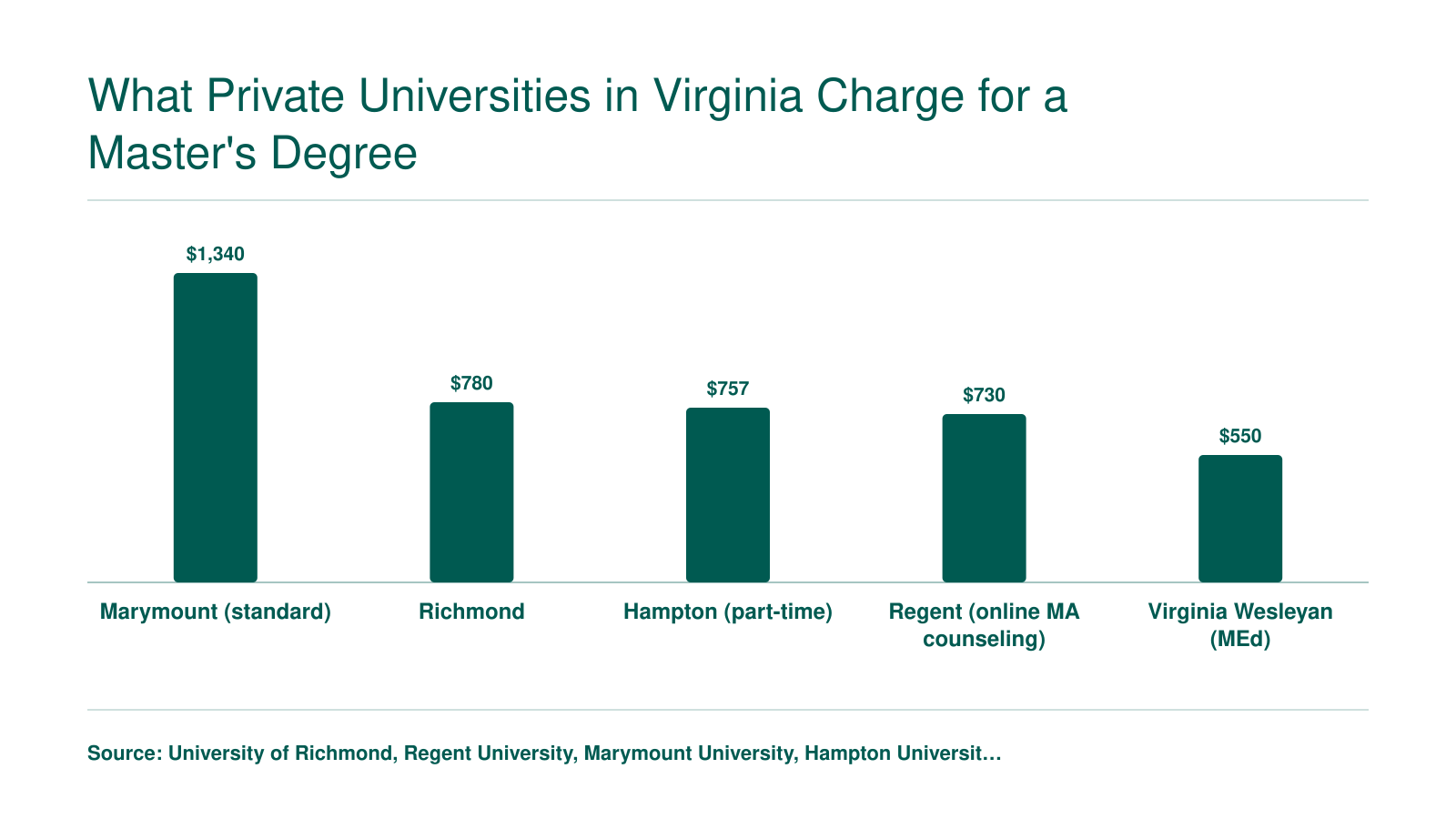
Published per-credit rates at Virginia private universities range from $550 to $1,340, and the program matters as much as the school. At 30 credits, Richmond's $780 rate works out to the published $23,400 total, Regent's online $730 rate to about $21,900, Hampton's part-time $757 rate to about $22,700, and Marymount's standard $1,340 rate to about $40,200 (about $48,200 at 36 credits). These are tuition-only estimates, and fees are extra. Virginia Wesleyan's $550 rate is for its 18-credit MEd, which totals $9,900. Marymount's MEd ($1,020) and MSW ($850) cost less than its standard rate, and Richmond's longer programs run up to 37 credits. Hampton's two official pages list different figures, so confirm with the school. Some private online programs can undercut public out-of-state rates, so compare those before assuming public is cheaper. We could not verify a current Liberty figure.
Online vs. On-Campus Master's Programs in Virginia: Fully Online, Hybrid, and Low-Residency
Fully online master's programs with no campus visits do exist in Virginia, but the label means different things from one school to the next, so verify it program by program.
The Four Formats
- Fully online: All coursework is delivered remotely and no campus trip is required. Some programs still schedule live sessions, so ask about synchronous requirements.
- Hybrid: Online coursework mixed with recurring in-person meetings, often evenings or weekends.
- Low-residency: Mostly online, plus short on-campus intensives, typically one to two weeks.
- Traditional on-campus: Classes, labs, and advising happen in person.
What Virginia Schools Actually Offer
Liberty University is the clearest example of the fully online model. Most of its online master's programs are 100% online with no residency, though a few require a one- or two-week intensive. Confirm your specific program, because the exceptions are not exhaustively listed.
Old Dominion's Online Master of Engineering Management (31 credits) is listed as fully online, but ODU does not treat every online master's that way. George Mason's Online MBA is described as 100% online with an optional one-week global residency, based on a secondary listing. We could not confirm campus requirements for GMU's online M.Ed. or UVA's online M.Ed.
For Virginia Tech, JMU, and VCU, we could not verify which master's programs are no-visit and which are hybrid or low-residency. Check each program page and ask admissions directly.
Clinical Fields Are Different
Counseling, nursing, and online MSW programs can deliver coursework online, but practicum and internship hours still happen in person at an approved site. Budget time and travel for those placements even if you never sit in a campus classroom.
Tuition and State Authorization for Out-of-State Students
There is no single flat out-of-state e-tuition rate across Virginia. ODU charges online courses taken in Virginia by domicile, and its 2026 on-campus-level rates run $672 per credit in-state versus $1,523 out-of-state. The Online MEM is listed at $620 per credit. Liberty bills by program rather than residency: $600 per credit for most online master's, $450 for the MAT and some M.Ed. programs, and $310 for military students. Liberty's Master of Divinity carries a per-credit cost of $2,850.
Some published totals:
- GMU Online MBA: $1,105.50 per credit across 48 credits, or $53,064.
- GMU Online M.Ed.: $805 per credit across 30 credits, or $24,150.
- UVA Online M.Ed.: $622 per credit across 30 credits, or $18,660.
If you live outside Virginia, also check state authorization. A school may not be approved to enroll students in your state, and that matters most for programs leading to licensure. Ask before you apply.
Popular Fields for Master's Degrees in Virginia, Including 1-Year Programs
Virginia's graduate market has shifted toward shorter, employment-focused formats, but the quickest routes are concentrated in business rather than counseling or psychology. The real choice is matching the degree to the license or job you want, not just the school name.
High-Demand Fields and Where They Sit
Psychology and counseling remain among the most searched master's areas in Virginia. James Madison, George Mason, and VCU all host counseling-related options, and Radford's M.S. in Counseling and Human Development is CACREP-accredited with a 60-credit clinical mental health counseling track and a 48-credit school counseling track. A master's in psychology is generally not a terminal path to licensure as a psychologist in Virginia, so if licensure is the goal, focus on counseling or school psychology programs rather than a general psychology master's.
Business is the clearest hub for accelerated MBA programs and other fast formats. UVA's Darden School and William & Mary's Raymond A. Mason School of Business anchor the category, but the one-year options often sit in specialized programs: UVA's McIntire M.S. in Commerce runs 10 months and 40 credits in person for recent graduates outside business; business majors are not eligible. William & Mary's residential MSBA runs 12 months and 30 credits. W&M also lists a 12-month MAcc and a 12-month M.S. in Nonprofit Management; its online MSBA runs 15 months and 32 credits.
Education and public policy add strong public-sector pathways. UVA Batten and George Mason's Schar School are frequent public policy destinations, and education master's programs at Virginia publics often align with teaching licensure or school leadership. Data science, cybersecurity, and engineering master's programs draw many students to Virginia Tech, though one-year formats are less standardized in those technical fields than in business.
Most Master's Take 1.5 to 2 Years
Most full-time master's programs in Virginia run about 1.5 to 2 years. The clearest true one-year programs are in business: UVA McIntire's M.S. in Commerce is 10 months, and W&M's residential MSBA, MAcc, and Nonprofit Management are 12-month designs. Counseling and clinical programs take longer. JMU's Clinical Mental Health Counseling is 36 months and 60 credits, and Radford's CACREP counseling tracks require 48 to 60 credits.
4+1 and Early-Entry Pathways
Several Virginia publics offer accelerated bachelor's-to-master's, or 4+1, routes. At William & Mary, undergraduate pages point to one-year MAcc or MSBA options, with AP/dual enrollment and early entry making a 3+1 or 4+1 plan more attainable. These paths can save time, but they often lock in a major or concentration early, so check the specific undergraduate requirements before committing.
Do Virginia Master's Programs Require the GRE or GMAT? Admissions and Deadlines
Many Virginia master's programs no longer require the GRE, but competitive business and STEM programs may still expect or reward scores, so check each department's page before you assume. Most programs ask for a bachelor's degree with a GPA often around 3.0, letters of recommendation, a statement of purpose, a résumé, and sometimes specific prerequisite coursework. If you want assistantship or fellowship consideration, apply by the earliest priority deadline, because funding is often decided on that first round. The table covers the Virginia Tech programs we could verify from official pages, and we have left out schools where current policies were not confirmed.
| University & Program | GRE/GMAT Policy | Priority / Final Deadline | Minimum GPA or Key Prerequisite |
|---|---|---|---|
| Virginia Tech Graduate School (general policy) | Varies by department; check the department listing | Domestic: August 1. International: April 1. Department deadlines may be earlier. | N/A (set by each department) |
| Virginia Tech, Computer Science M.S. | Not required for any degree program | December 1 (listed as December 1, 2025; confirm the current cycle) | N/A (see department page) |
| Virginia Tech, Industrial and Systems Engineering | Not required, but encouraged if your academic background is less competitive | January 16 | N/A (see program FAQ) |
| Virginia Tech, Higher Education and Student Affairs M.A.Ed. | Optional; you may submit scores | December 31 of the year before entry | N/A (see school admissions page) |
| Virginia Tech, Institute for Critical Technology and Applied Science graduate programs | N/A (not stated; check the program page) | March 1 for domestic regular applications | N/A (see program page) |
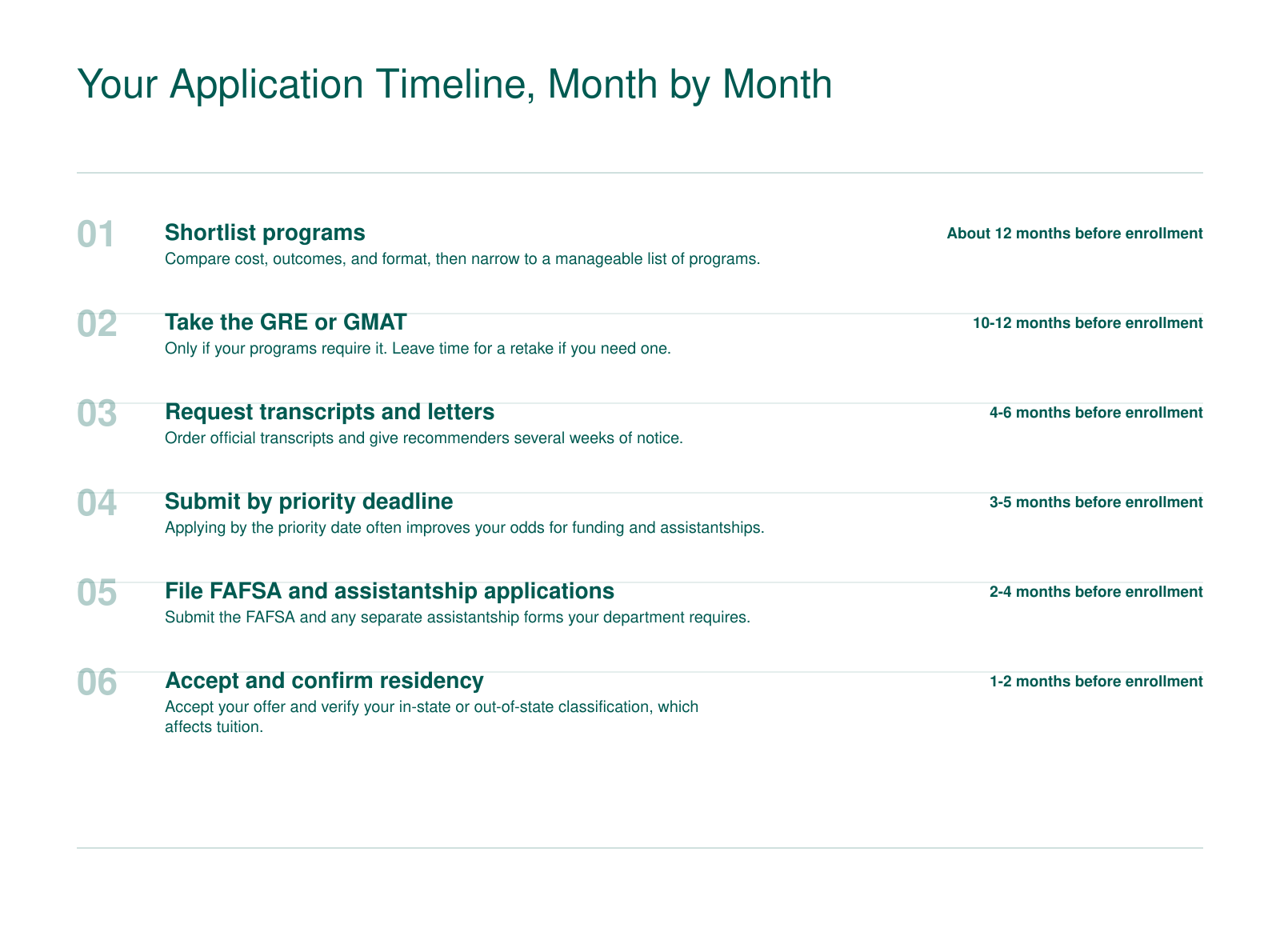
Your Application Timeline, Month by Month
Work backward from your intended start date. Deadlines vary by program, so confirm each school's dates, but this sequence keeps the major tasks in the right order.
Career Outcomes, Salaries, and Licensure for Virginia Master's Graduates
A master's degree pays off differently depending on the field you enter, and in Virginia the gap between a well-matched credential and an expensive misfire can shape your finances for a decade. Before you enroll, it's worth separating two questions: what graduates actually earn, and whether the degree qualifies you for the license your career requires.
Checking earnings before prestige
Several master's-level occupations are well represented in Virginia's labor market, including nurse practitioners, mental health counselors, social workers, education administrators, management analysts, and software developers. Wages for these roles vary widely by region, employer, and specialty, so treat any single number cautiously and look at the full range rather than a headline figure. The federal Bureau of Labor Statistics publishes state-level wage estimates by occupation, which give you a realistic anchor for what the field pays in Virginia.
For program-specific outcomes, two tools are more precise than a school's marketing. The U.S. Department of Education's College Scorecard reports earnings by field of study, so you can compare graduates of a specific program rather than an entire university. Virginia's State Council of Higher Education for Virginia (SCHEV) also publishes outcomes data for state institutions. Where these figures aren't yet available for a given program, that absence is itself worth noting; press the admissions office for what they can document.
Which degrees lead to Virginia licensure
Several graduate fields require a state license before you can practice, and the accreditor of your program often determines whether you qualify:
- Counseling (LPC): Issued by the Virginia Board of Counseling; CACREP-accredited programs are the cleanest path to meeting the 60 to 90 credit and 13 core-content requirements.12
- Clinical social work (LCSW): Issued by the Virginia Board of Social Work; your master's must come from a CSWE-accredited MSW program.3
- Teaching and school counseling: Endorsed by the Virginia Department of Education (VDOE); educator preparation programs carry CAEP accreditation.
- Nurse practitioner: Licensed by the Virginia Board of Nursing, typically through a CCNE-accredited graduate program and national certification.
Confirm eligibility before you pay
Do not assume a program qualifies you to be licensed in Virginia. This matters most for online programs based in other states, which may be accredited and reputable yet not aligned with Virginia's specific requirements. Ask each program, in writing, whether its graduates are eligible for the Virginia license you want. Confirming this before you enroll is far cheaper than discovering a gap after graduation.
Licensed Professional Counselor Path in Virginia
Paying for It: Financial Aid, Assistantships, and Choosing Value Over Prestige
Graduate assistantships are not one-size-fits-all
Virginia public universities do not have a single uniform assistantship policy. Virginia Tech's 2026-27 Dean's Assistantships can pay about $3,040 per month, with first-year packages commonly covering in-state tuition and the standard fall and spring tuition and fee obligations; second-year funding requires departmental matching, and eligibility is limited to U.S. citizens or permanent residents.1 James Madison University's typical assistantship may combine a stipend of roughly $10,464 across the year with a nine-credit tuition scholarship per semester, though mandatory fees and overload charges can still be the student's responsibility.2 George Mason University publishes minimum stipend rates, about $27,720 for a 12-month full-time assistantship and $20,790 for a 9-month appointment, but tuition waivers are encouraged rather than automatic.3 At Virginia Commonwealth University, 20-hour assistant appointments may carry minimum stipends of $9,000 or $7,500 depending on appointment length, with tuition and fee coverage varying by program.4 Because contracts differ, always ask for the full package: waiver amount, fee coverage, work hours, summer funding, and renewal terms.
Other money sources beyond assistantships
Graduate students can combine assistantships with federal aid. Federal Direct Unsubsidized Loans and Grad PLUS Loans are available for eligible U.S. students, and department scholarships can close smaller gaps. Large Virginia employers sometimes offer tuition assistance, particularly in health care, technology, defense, and government. Military-connected students should review the Virginia Military Survivors and Dependents Education Program, which can provide a tuition and fee waiver plus a stipend at Virginia public institutions for up to eight semesters or four years for qualifying spouses and children of veterans with permanent disabilities or service-related deaths.5 These benefits can significantly reduce net cost, but confirm current eligibility and award rules with the school and state agency.
Use total cost and target salary, not brand
Compare total cost: tuition plus fees plus any lost income if you reduce work hours. Then look at expected Virginia salaries for the target role. For licensure-driven fields such as clinical mental health counseling programs, teaching, and some health professions, employers generally care that you hold the required license and graduated from an accredited, licensure-eligible program. The lowest-cost in-state public option from the tuition comparison above is often the best value in those fields, even if another school has a bigger name. A higher-priced program only makes sense when it clearly improves earnings, clinical placement quality, or career access enough to justify the premium.
The Master's Degree Earnings Premium
Nationally, a master's degree comes with a measurable pay advantage.
Graduate schools in Virginia with the most master's programs
| School | City | Type | Master's programs | Online | Grad tuition / yr |
|---|---|---|---|---|---|
| Liberty University | Lynchburg | Private nonprofit | 132 | 116 | $8,730 |
| George Mason University | Fairfax | Public | 94 | 53 | $17,964 |
| Regent University | Virginia Beach | Private nonprofit | 76 | 76 | $17,869 |
| Old Dominion University | Norfolk | Public | 65 | 40 | $15,390 |
| University of Virginia | Charlottesville | Public | 63 | 17 | $23,526 |
| Virginia Commonwealth University | Richmond | Public | 63 | 28 | $17,252 |
| William & Mary | Williamsburg | Public | 37 | 12 | $17,666 |
| Marymount University | Arlington | Private nonprofit | 35 | 24 | $23,446 |
| Virginia Polytechnic Institute and State University | Blacksburg | Public | 35 | 9 | $18,564 |
| Radford University | Radford | Public | 31 | 18 | $13,762 |
| Strayer University-Virginia | Arlington | Private for-profit | 26 | 26 | $15,135 |
| Shenandoah University | Winchester | Private nonprofit | 26 | 23 | $26,722 |
| Longwood University | Farmville | Public | 26 | 18 | $7,758 |
| Mary Baldwin University | Staunton | Private nonprofit | 22 | 21 | $18,865 |
| Norfolk State University | Norfolk | Public | 21 | 9 | $13,412 |
Program counts are the verified master's listings in our directory; tuition is the school-wide average for a full-time graduate student (IPEDS).
Frequently Asked Questions About Master's Programs in Virginia
These answers cover the questions applicants ask most about cost, online options, residency, licensure, and program length. Confirm details with each program and the relevant state board before you commit.
Which Virginia universities offer the lowest tuition for in-state residents?
Are there fully online master's programs in Virginia with no campus visits?
Can I qualify for in-state tuition if I move to Virginia for grad school?
Can I get licensed in Virginia with an online master's from an out-of-state school?
Is a 1-year master's worth it compared with a 2-year program?
Compare programs nationwide
Many Virginia residents study online. Every ranked list above has an online lens, or browse every field.
Online master's programs Browse all fields