Best Master's in Sustainability Programs in Virginia
Compare 6 accredited Sustainability programs in Virginia at 5 schools, with graduate earnings, cost, debt, and completion data from IPEDS and the U.S. College Scorecard.

Choosing a sustainability master's in Virginia means weighing price against how closely a degree matches the field. Listed in-state tuition runs from $8,730 at Liberty University to $18,564 at Virginia Tech, and several programs here carry adjacent titles.
Liberty's online MPH centers on environmental health. Virginia Commonwealth University's M.S. is an engineering degree with an environmental and sustainable engineering concentration. Both suit specific careers rather than general sustainability management.
Virginia Tech's online Master of Natural Resources costs more but reports median earnings of $85,049 four years after graduation, a figure most programs here do not yet publish.
Key Points
- Liberty University lists the lowest program tuition here at $8,730, just ahead of Virginia Wesleyan University.
- Virginia Tech's programs skip the GRE, while other schools here don't publish a policy.
- Virginia Tech graduates report $85,049 median earnings four years out against $38,924 median debt.
Top Master's in Sustainability Programs in Virginia, Ranked
Virginia's sustainability graduate options range from a fully online natural resources degree to campus-based engineering and public health specializations. Several listings below are adjacent to a pure sustainability degree, so we note each program's focus. Graduation rates and net price figures describe the whole institution, not the individual master's program, so treat them as rough context.
Virginia Polytechnic Institute and State University
#1Blacksburg, VA · ~$19,000/yr (est.)
Best for: Working professionals needing flexible online study
Virginia Tech's online Master of Natural Resources is the most directly sustainability-focused program in Virginia on this list, built around sustainable development, conservation, and the policies that shape them. It is interdisciplinary and designed for working professionals, with an optional 10-day study abroad. The university's institution-wide graduation rate is roughly 86%, and it is institutionally accredited by SACSCOC. Tuition is a single per-credit rate for in-state and out-of-state students, so Virginia residency brings no discount.
- Fully online option for working professionals
- Five core courses, including Sustainability Systems: Living in the Biosphere
- Interdisciplinary curriculum with focus areas and electives
- Graduate certificates available as a starting point
- Accelerated and dual enrollment options
- Military benefits accepted; financial aid available
- Application deadline listed as January 1, 2027
- 30 total credit hours
- Fully online option available
- No thesis required
- 10-day face-to-face Global Study replaces the capstone project
Virginia Commonwealth University
#2Richmond, VA · ~$17,000/yr (est.)
Best for: Engineering graduates seeking campus-based specialization
Virginia Commonwealth University offers a campus-based M.S. in Engineering with a concentration in environmental and sustainable engineering, a technical route for students with an engineering or chemistry background. Coursework covers water, sustainable chemical engineering, and quantitative analysis, with partnerships among public institutions and private businesses in the Richmond region. The institution-wide graduation rate is about 63%, and VCU is institutionally accredited by SACSCOC. This is an engineering degree, not a general sustainability management degree.
- 30 total credit hours, thesis or non-thesis option
- Thesis option includes an oral defense
- 12 credits of concentration coursework
- Half of credits must be 600-level or above
- B.S. in engineering or chemistry required
- Entrance exam required
- Accelerated B.S. to M.S. pathway in five years
- Fall deadline June 1; spring deadline December 1
Virginia Wesleyan University
#3Virginia Beach, VA · ~$9,000/yr (est.)
Best for: Career changers without a sustainability background
Virginia Wesleyan University's Master of Environmental Studies is a 31-credit online program covering policy and permitting, sustainability assessment, environmental justice, climate change, and water resources. It is open to any undergraduate major, and no GRE or GMAT is required. The institution-wide graduation rate is about 42%, the lowest on this list, so confirm completion support for your situation. Our research did not confirm its institutional accreditor, so verify that directly with the university.
- 31 total credit hours, fully online
- $515 per credit
- No entrance exam required
- 2.7 GPA minimum
- Open to any undergraduate major
- Rolling admissions; full-time and part-time options
- Capstone project designed around your own community
- Guest instructors are active practitioners
Liberty University
#4Lynchburg, VA · ~$9,000/yr (est.)
Liberty University offers an online Master of Public Health with an environmental health specialization, a fit for students aiming at inspection, toxicology, or groundwater protection roles rather than corporate sustainability. Courses run asynchronously in 8-week terms, and the practicum can be completed at an approved site near where you live. The institution-wide graduation rate is about 65%. The school describes the program as CEPH-accredited, but our research could not verify that, so confirm with CEPH before enrolling.
- 42 total credit hours, fully online
- $600 per credit; reduced military rate listed at $310
- Asynchronous classes in 8-week terms with 8 start dates a year
- Practicum at an approved location near you
- Test optional; 2.5 GPA minimum
- Transfer up to 50% of the degree
- Covers toxicology, water and soil quality, and risk assessment
Cost & outcomes by school
Federal data for the highest-earning Sustainability programs, independent of the ranking above. Earnings are this field's master's graduates four years after completing, where the Scorecard reports them.
| School | Earnings | Tuition / yr | Debt | Grads/yr | Format |
|---|---|---|---|---|---|
| Liberty University VA | — | $8,730 | — | — | Online |
| Virginia Wesleyan University VA | — | $8,982 | — | — | Online |
| Virginia Commonwealth University VA | — | $17,252 | — | — | Campus |
| George Mason University VA | — | $17,964 | — | — | Campus |
| Virginia Polytechnic Institute and State University VA | — | $18,564 | — | — | Online |
Sources: U.S. Department of Education. Tuition and graduates: IPEDS. Earnings and debt: College Scorecard, this field's master's graduates; a dash means no figure is reported.
How We Rank These Virginia Sustainability Master's Programs
Our ordering of sustainability master's programs in Virginia comes from federal data that every university must report, not from reputation surveys or peer opinion polls. We pull graduate tuition, average net price after grants and scholarships, and institution-wide graduation rates from federal higher education reporting, then layer in graduate earnings and student debt wherever the U.S. Department of Education publishes figures at the program level. Sustainability is a newer field, so those program-specific numbers are not available everywhere.
Net price and graduation rate describe the whole institution rather than a single master's program. We still weight them, because a school that keeps costs manageable and sees its students through tends to do the same for sustainability students.
Online, hybrid, and campus Master's Programs in Virginia compete on one list. Format changes how you study, not what the degree costs or returns.
Online and Hybrid Sustainability Master's Options in Virginia
Three distinct formats show up among these environmental science master's programs, so the one that fits your schedule matters as much as the curriculum.
Online and Hybrid Formats
Virginia Wesleyan University's Master of Environmental Studies runs fully online, with full-time and part-time tracks and rolling admissions, which gives working professionals the most flexibility on this list. Liberty University's environmental health master's is also fully online, using asynchronous eight-week courses with eight start dates a year, plus a practicum you arrange at an approved site near you.
Virginia Tech's Executive Master of Natural Resources is the hybrid option: a cohort-based, accelerated 12-month program with monthly class weekends (five on campus near Washington, D.C., and six online) plus a 10-day global study experience. In-person attendance is required, and as of October 2026 the program is not accepting applications.
On-Campus
Virginia Commonwealth University's environmental and sustainable engineering concentration is campus-based and built around a thesis defense, best suited to students who can study in Richmond.
If you are holding down a full-time job, the fully online, part-time tracks will fit most easily; the hybrid cohort demands travel and fixed weekends.
Which Virginia Sustainability Master's Programs Waive the GRE
Both Virginia Tech programs with confirmed admissions data skip the GRE, so no test score stands between you and an application there. We could not confirm a published GRE policy for Virginia Commonwealth University, Virginia Wesleyan University, or Liberty University from official admissions pages, so we do not list a policy for them. Check each school's graduate admissions page directly before you plan your application timeline.
| School | Program | GRE Policy | Other Key Requirements |
|---|---|---|---|
| Virginia Polytechnic Institute and State University | Master of Natural Resources (MNR) | No GRE required | Minimum 3.0 GPA. Undergraduate degree, goals statement, current resume or CV, two professional recommendations, official transcripts, $75 non-refundable application fee, and English-language proficiency assessment for international students. |
| Virginia Polytechnic Institute and State University | Graduate study in Civil and Environmental Engineering | Not required (applicants may submit General GRE scores if desired) | GPA of 3.00 or higher on the last 60 semester hours for regular admission; 2.75 to 2.99 may be considered for provisional status. Bachelor's degree in engineering from an ABET-accredited program is normally expected; non-engineering applicants may need math and engineering mechanics coursework or proficiency exams. Decisions are based on the full application package. |
Related Articles
What a Master's in Sustainability in Virginia Costs, Plus Licensure and Certification
Liberty University lists the lowest program tuition here at $8,730, with Virginia Wesleyan University close behind at $8,982. Both charge the same rate to in-state and out-of-state students. Virginia Commonwealth University lists $17,252 in-state and $32,470 out-of-state. Virginia Tech's data shows $18,564 and $35,092, the highest figures here. However, Virginia Tech says its Online Master of Natural Resources uses one rate for every student, $970 per credit in summer 2026, so confirm the rate with the school.1
Sticker Price Versus Net Price
Per-credit math tells you more than a single tuition line. Virginia Wesleyan's $515 per credit across 31 credits comes to about $15,965 before fees. Liberty's environmental health MPH runs $600 per credit across 42 credits, roughly $25,200. Net price is the institution-wide average cost after grants, not a program-level figure. Those averages are $19,676 at Virginia Wesleyan, $23,433 at VCU, $24,953 at Virginia Tech and $29,357 at Liberty. Liberty has the lowest tuition but the highest net price, so ask each school for a program-specific estimate. Published fees and residency or travel costs vary, and Virginia Tech's program includes a 10-day global study trip.
Licensure and Certification
Virginia requires no state license for sustainability roles.2 Credentials are voluntary. LEED credentials help in green building, and ISSP's Sustainability Associate and Certified Sustainability Professional credentials suit broader practice.3 No Virginia-specific credential is confirmed.
Earnings for Sustainability Master's Graduates in Virginia
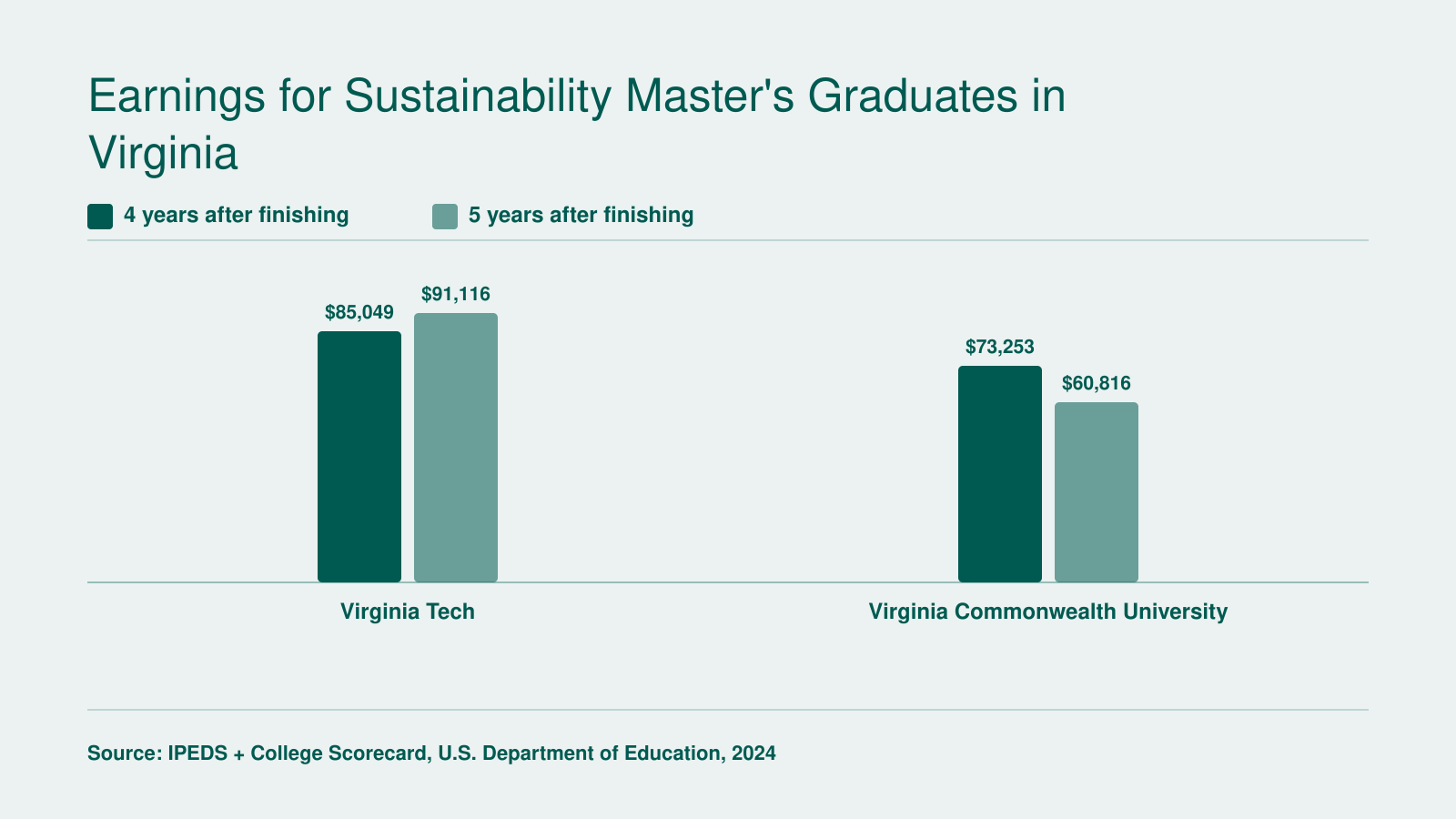
Program-level median earnings for graduates are shown four and five years after finishing, for the ranked programs that report them. Virginia Tech's program reports a median debt of $38,924 among graduates, which puts its $85,049 four-year and $91,116 five-year medians in context for return on investment. Graduates typically move into roles such as sustainability manager, environmental compliance specialist, and ESG analyst.
Frequently Asked Questions About Master's in Sustainability Programs in Virginia
These answers cover the questions prospective students ask most when comparing sustainability and environmental management degrees. Deadlines change each cycle, so confirm dates on the school's graduate admissions page before you apply.
What is the difference between a master's in sustainability and environmental management?
What jobs can you get with a master's in sustainability in Virginia?
When are application deadlines for Virginia sustainability master's programs?
Compare Sustainability programs on the data that matters
Explore more Science & Engineering specializations or browse every graduate field.
All Science & Engineering programs