Best Master's in Environmental Science Programs
Compare 400+ accredited Environmental Science programs at 230+ schools, with graduate earnings, cost, debt, and completion data from IPEDS and the U.S. College Scorecard.

A master's in environmental science is a graduate degree built on chemistry, ecology, hydrology, and data analysis, aimed at work in regulatory agencies, consulting firms, and research labs; most students finish in about two years, though timelines range from 16 to 36 months. Formats diverge: UC San Diego's climate science and policy degree runs one year, while Penn's environmental studies program can stretch to four years part time.
Price varies too. UC Berkeley lists about $15,900 in-state tuition for its environmental health sciences MS; Yale lists $55,960 for full-time students in its Master of Environmental Management. We compare programs on net price, debt, and earnings, not reputation.
Program-level earnings aren't yet published for most of these degrees, which makes price the firmest number to act on.
Key Points
- Listed graduate tuition ranges from $12,737 in-state at Florida to $65,936 at Princeton.
- Environmental science is the quantitative path; studies and management programs lean toward policy and administration.
- Oregon State and Arizona offer fully online coursework, but thesis and non-thesis credit requirements differ by school.
10 Master's in Environmental Science Programs for 2027
The programs below are ranked for students who care about career outcomes and cost, not just name recognition. We used federal data on graduate earnings and graduation rates, plus program-level research on concentrations and delivery formats, to identify ten master's in environmental science programs worth a close look.
Stanford University
#1Stanford, CA · $60,000 – $65,000/yr (est.)
Best for: Interdisciplinary Earth systems scholars
Stanford's Earth Systems program offers an interdisciplinary environmental science master's through a coterminal BS/MS or MA path, with eight academic tracks and an internship. Emphasizes hands-on learning and human-nature interactions. Research spans all seven Stanford schools through the Environment and Resources MS.
- Offers coterminal MS and MA degrees
- Eight academic tracks
- Includes Earth Systems internship
- Senior capstone project required
- Interdisciplinary focus on human-nature interactions
- Six concentration options
- 45 total credit hours
- Capstone required
- Joint MS with Stanford MBA or JD
- Housed in Doerr School of Sustainability
Harvard University
#2Cambridge, MA · $55,000 – $60,000/yr (est.)
Best for: Working professionals needing online flexibility
Harvard offers two distinct environmental science master's paths: a flexible online/hybrid Master of Liberal Arts in Extension Studies in Sustainability, and an on-campus Master of Science in Environmental Health. The sustainability program is designed for working professionals, with part-time study and performance-based admissions. The Environmental Health MS is a two-year campus program with thesis research and GRE required.
- Online or hybrid format
- 12 courses total
- Performance-based admissions
- Thesis or capstone project
- Part-time study option
- Stackable certificates available
- No environmental science background required
- Apply by 2027-01-19
- Two-year program length
- On-campus delivery
- GRE scores mandatory
- Three reference letters needed
- Focus on environmental exposures
- Thesis research component
- Covers epidemiology and occupational health
Princeton University
#3Princeton, NJ · ~$66,000/yr (est.)
Best for: Engineers targeting resilient infrastructure
Princeton's Master of Science in Engineering offers a concentration in Sustainable, Resilient Cities and Infrastructure Systems, one of six research areas. The program is research-driven and part of the Department of Civil and Environmental Engineering, with students working alongside PhD and M.Eng. students. Emphasis on water, climate, energy, and resilience planning.
- Concentration in Sustainable, Resilient Cities and Infrastructure Systems
- Six concentration options overall
- Students work alongside PhD and M.Eng. candidates
- Research areas include hydrology and atmospheric environment
- Campus-based in Princeton, NJ
Yale University
#4New Haven, CT · ~$50,000/yr (est.)
Yale's Master of Environmental Management is a two-year, 48-credit campus program with nine specializations, including Climate Change Science and Solutions. The curriculum blends natural and social sciences, policy, and management, with required summer experience and capstone. Known for strong environmental policy and climate networks.
- Two-year program
- 48 total credit hours
- Nine concentration options
- Climate Change Science and Solutions concentration
- 18 credits in specialization
- Required summer work experience
- Capstone required
- Over 100 courses offered
University of Pennsylvania
#5Philadelphia, PA · ~$48,000/yr (est.)
Penn's Master of Environmental Studies offers concentrations in Environmental Biology, Environmental Policy, and Environmental Sustainability. The 12-course campus program can be completed in 2-4 years, with interdisciplinary courses across Wharton and Engineering. Flexible full or part-time enrollment and internship/fieldwork opportunities.
- Concentration in Environmental Biology
- Fieldwork and internships available
- Research opportunities included
- Concentration in Environmental Policy
- Courses across Wharton and Engineering
- Professional development coaching
- Concentration in Environmental Sustainability
- Dual degree options available
- Sustainable campus environment
University of California-Berkeley
#6Berkeley, CA · ~$16,000/yr (est.)
UC Berkeley offers multiple environmental master's programs, including Environmental Health Sciences MS, Master of Forestry, and Master of Climate Solutions. Strong science and policy integration, with competitive admissions for EHS. Access to world-class faculty and research centers.
- Two-year campus program
- Thesis or research project required
- Focus on exposure assessment and toxicology
- Competitive admissions with 25% acceptance
- Average GPA 3.7
- GRE optional but recommended
- Careers in government and research
- Campus-based
- No GRE required
- Fall admission term
- 4+1 program option
- Department of Environmental Science Policy & Management
- One-year program
- Work experience required
- Capstone required
- Scholarships available
- Concurrent MBA/MCS option
- Equity and climate justice at core
University of Michigan
#7Ann Arbor, MI · $29,000 – $58,000/yr (est.)
Michigan offers an MS in Environmental Science and an MS in Environment and Sustainability with several dual-degree engineering concentrations. The Dearborn program has evening classes and research facilities like the Environmental Interpretive Center and Geospatial Analysis Lab. Ann Arbor's program is interdisciplinary with seven concentration options and accelerated master's for undergrads.
- Two-year program
- Evening and Saturday classes
- Full or part-time options
- Thesis or project emphasis
- Environmental Interpretive Center access
- Geospatial Analysis Lab available
- Focus on biology, chemistry, geology
- 42 total credit hours
- Seven concentration options
- Two-year program
- Accelerated master's for U-M undergrads
- Dual degree options available
- Customizable to individual interests
- Focus on sustainable energy systems
- Focus on sustainable design
- Focus on sustainable water resources
Duke University
#8Durham, NC · ~$67,000/yr (est.)
Duke's Nicholas School of the Environment offers a Master of Environmental Management with tracks like Coastal Environmental Management, Ecosystems Science and Conservation, and Ecotoxicology and Environmental Health, as well as a hybrid Duke Environmental Leadership MEM for mid-career professionals. Duke Forest and Beaufort coastal campus provide field-based learning.
- Two-year program
- Eight concentration options
- Apply by 2026-12-15
- Capstone required
- Financial aid available
- Internships last 10-12 weeks
- Certificates in Geospatial Analysis
- Duke Forest as living laboratory
- Hybrid for mid-career professionals
- Five concentration options
- Place-based learning
- Continuous leadership development
- Integrates science, policy, business
- Concentration: Coastal Environmental Management
- Concentration: Ecosystems Science and Conservation
- Concentration: Ecotoxicology and Environmental Health
University of California-San Diego
#9La Jolla, CA · $15,000 – $20,000/yr (est.)
UC San Diego offers a one-year Master of Advanced Studies in Climate Science and Policy and Marine Biodiversity and Conservation, plus an MS in Climate Sciences at Scripps. Focus on interdisciplinary climate science and policy, with strong marine research.
- One-year full-time campus program
- 50 credits required
- Focus on climate science and policy
- Capstone projects included
- One-year campus program
- Focus on marine conservation
- Applied learning opportunities
- 36 total units
- Master's thesis required
- Part of Climate-Ocean-Atmosphere Program
- Students fund themselves
- Identify advisor before applying
University of California-Los Angeles
#10Los Angeles, CA · ~$14,000/yr (est.)
UCLA offers an Environmental Science and Engineering doctoral program with concentrations in hazardous substances, contaminant migration, and restoration ecology, plus an Environment and Sustainability master's/PhD through the Institute of the Environment and Sustainability. Strong interdisciplinary research and field training.
- Concentration in hazardous substances
- No foreign language requirement
- Core courses in five categories
- Concentration in contaminant migration
- Requires residency period
- Field experience mandatory
- Concentration in restoration ecology
- 13 core courses required
- Field training opportunities
- Master's available on doctoral track
- PhD also offered
- Housed in Institute of the Environment and Sustainability
Cost & outcomes by school
Federal data for the highest-earning Environmental Science programs, independent of the ranking above. Earnings are this field's master's graduates four years after completing, where the Scorecard reports them.
| School | Earnings | Tuition / yr | Debt | Grads/yr | Format |
|---|---|---|---|---|---|
| American University DC | $104,878 | $36,754 | $26,500 | 51 | Campus |
| Yale University CT | $100,347 | $49,500 | $41,000 | 158 | Campus |
| Duke University NC | $96,411 | $66,523 | $48,310 | 150 | Campus |
| University of Houston-Clear Lake TX | $94,092 | $9,762 | — | 5 | Online or campus |
| University of Idaho ID | $92,396 | $10,816 | — | 56 | Online or campus |
| California State University-Fullerton CA | $91,697 | $8,994 | — | 12 | Campus |
| Webster University MO | $89,701 | $13,736 | — | 15 | Online or campus |
| University of California-Santa Barbara CA | $88,781 | $15,124 | $32,485 | 72 | Campus |
| University of Michigan MI | $87,988 | $28,886 | $35,377 | 217 | Campus |
| California State Polytechnic University-Humboldt CA | $77,785 | $9,921 | $24,185 | 33 | Campus |
| Georgia Southern University GA | — | $6,646 | — | — | Campus |
| Sul Ross State University TX | — | $6,661 | — | — | Online |
Sources: U.S. Department of Education. Tuition and graduates: IPEDS. Earnings and debt: College Scorecard, this field's master's graduates; a dash means no figure is reported.
Cost, debt & payoff
Median earnings of this field's master's graduates (4 yrs after completing) vs. their median federal loan debt · U.S. College Scorecard
Across these programs the median graduate earns about $74,899 and finishes with roughly $41,000 in debt — a ratio that clears a common rule of thumb (keep debt below first-year salary). Tuition and debt vary widely school to school, so check the per-school figures in the table above before you shortlist.
How We Rank the Best Environmental Science Master's Schools
Many lists of Science & Engineering Master's Programs rank programs by reputation or sticker tuition alone, which tells you how a school sounds rather than what its graduates get. We rank on outcomes instead, and we show you which numbers are specific to a program and which are not.
What We Weigh
Four inputs drive the ranking:
- Earnings: what graduates of the program earn after completing it.
- Debt: the median federal debt students carry at completion.
- Net price: the average cost after grants and scholarships, not the published rate.
- Completion: institution-wide completion and graduation rates.
Graduation rate and net price are institution-wide figures, not program-specific ones. We still use them because they are the best available signals of how well a school supports students to the finish line and what a typical family actually pays. Read them as context for the program-level earnings and debt figures, not as a verdict on the department.
Accreditation Is a Baseline
Every school ranked here holds institutional accreditation from an agency recognized by the U.S. Department of Education, such as HLC, SACSCOC, MSCHE, WSCUC, NECHE, or NWCCU.2 The Department recognizes accrediting agencies, not individual universities, as detailed in the FAQs Regarding the Department's Recognition of Accrediting Agencies. That matters because federal student aid, including Direct Loans, generally requires it.1 It also affects credit transfer and how employers and other universities view your degree.
There is no single mandatory programmatic accreditor for environmental science master's degrees. ABET covers environmental engineering, the Council on Education for Public Health covers public health, and NASPAA covers public administration and policy, including Online MPA programs.2 Do not assume a science degree carries any of those. Institutional accreditation does not vouch for a particular curriculum, so check faculty, fieldwork, labs, and thesis options yourself.
Each ranking card puts earnings, debt, net price, and completion side by side, labeling each figure as program-level or institution-wide.
Environmental Science vs. Environmental Studies, Sustainability, and Environmental Management
Program names in this field often overlap, but the differences shape day-to-day work. Environmental science is the natural-science, quantitative path: chemistry, hydrology, ecology, GIS, and modeling. Environmental studies is broader and more social-scientific, linking human behavior, law, history, and policy to environmental questions. Sustainability degrees focus on systems and organizational practice, while environmental management and policy degrees emphasize regulation, planning, and leadership.
Which degree leads where
- Environmental science: field and lab research, environmental sampling, data analysis, geospatial work, and modeling for agencies, consulting firms, and research institutes.
- Environmental studies: community engagement, environmental education, consulting and compliance support, and policy-adjacent roles that need both science literacy and social context.
- Sustainability: corporate sustainability, ESG reporting, campus or municipal sustainability, and operations roles inside companies or institutions.
- Environmental management or policy: compliance management, permitting, state and federal environmental agencies, policy analysis, and program leadership.
STEM designation depends on the CIP code, not the program name
A school can call a program Environmental Science and Sustainability, but the U.S. Department of Homeland Security determines STEM OPT eligibility by the six-digit CIP code recorded on a student's I-20. On the current DHS STEM Designated Degree Program List, CIP code 03.0104 (Environmental Science) is designated, and CIP code 03.0204 (Environmental/Natural Resource Economics) was added in the July 2025 update. Environmental Studies (03.0103), Natural Resources Conservation (03.0101), Sustainability Studies (30.3301), and Natural Resources Management and Policy (03.0201) are not shown as designated on the current list.1
For international students, STEM designation can add a 24-month extension to the initial 12-month post-completion OPT period, for up to 36 months total.1 The degree must have been earned within the previous 10 years, the employer must be enrolled in E-Verify2, and students must complete Form I-9833 before their designated school official recommends the extension. Because CIP codes can vary by campus or department, ask the admissions office to confirm the exact code before enrolling, and check the current DHS list.
Quick gut-check
If you want to run samples, build models, and interpret environmental data, choose environmental science. If you want to shape decisions, budgets, permits, or organizational change, consider environmental management, policy, or sustainability.
Online, Hybrid, and On-Campus Environmental Science Master's Formats Compared
Format changes how you complete field and lab work more than it changes the degree itself. Fully online programs such as Oregon State and Arizona let you finish coursework remotely, while Johns Hopkins blends evening campus classes, online study, and a residency or immersive experience. Check the thesis or project requirement before you enroll, because it determines whether you need lab access or in-person time.
| Format | Example Program | How Courses Are Delivered | On-Campus Commitment | Lab and Field Work |
|---|---|---|---|---|
| Fully online | Oregon State University, Online M.S. in Environmental Sciences | Offered through Oregon State Ecampus | All or nearly all requirements can be completed online | Research thesis or non-thesis project report; the non-thesis option lets you build the project into your current job |
| Online or in person (same degree) | University of Arizona, M.S. in Environmental Science | Fully online through Arizona Online, or earned in person | None for the online route; students can earn the degree from anywhere in the world | Thesis-based M.S. carries more research units and may require access to a lab |
| Hybrid (campus and online) | Johns Hopkins University, M.S. in Environmental Sciences and Policy | Evening classes in Washington, D.C., or Baltimore, or most of the program online | Residency on campus or an immersive learning experience, with flexibility on when and where | Compressed field course electives offered in summer and winter; may require travel, lodging, meals, and field-trip fees |
| On-campus | University of Arizona, M.S. in Environmental Science (in-person route) | Classroom and campus-based study | Attendance at the campus throughout the program | Thesis research can draw on campus lab access |
Related Articles
Master's in Environmental Science Cost: Tuition, Fees, and Net Price
Among the schools ranked here, published annual graduate tuition and fees span from about $6,400 in state at the University of Florida to roughly $65,900 at Stanford, with public flagships showing wide gaps between in-state and out-of-state rates (Florida charges about $28,700 out of state, while the University of Michigan charges about $60,900). The net price column is an institution-wide average after aid, not a quote for any individual graduate student. For per-credit context, the online M.S. in Environmental Science at the University of West Florida lists $386 per credit (about $11,600 for 30 credits), the University of Arizona's 30-credit online program lists $850 per credit, and Oregon State's 45-credit online M.S. lists $609 per credit; most programs require 30 to 45 credits, so total tuition often lands in the low-to-mid tens of thousands before fees, living costs, fieldwork travel, and lab expenses, and assistantships can waive tuition at some schools.
| School | In-state tuition and fees | Out-of-state tuition and fees | Average net price after aid |
|---|---|---|---|
| Princeton University | $62,688 | $62,688 | $6,128 |
| University of Florida | $6,381 | $28,659 | $6,541 |
| University of North Carolina at Chapel Hill | $8,994 | $41,203 | $11,655 |
| Georgia Institute of Technology | $12,058 | $34,484 | $12,116 |
| University of California-San Diego | $16,758 | $50,958 | $12,470 |
| University of California-Los Angeles | $15,203 | $49,403 | $12,548 |
| University of Michigan | $17,736 | $60,946 | $13,138 |
| Rice University | $64,144 | $64,144 | $13,370 |
| University of California-Berkeley | $16,347 | $50,547 | $13,481 |
| Stanford University | $65,910 | $65,910 | $13,807 |
Environmental Scientist Median Pay Nationwide
Before weighing tuition against payoff, it helps to know what the occupation pays.
Admissions Requirements: GRE, GPA, Prerequisites, and Deadlines
Requirements vary by program, and full 2026–27 detail is published for only some schools here. Use the two examples below as a benchmark, then confirm every figure on each program's own admissions page before you apply.
- Degree, GPA, and prerequisitesExpect a bachelor's degree and a GPA threshold near 3.0 to 3.2. UC Santa Barbara Bren sets a 3.0 minimum and accepts any undergraduate major, but expects two science courses (chemistry, biology, physics, earth science, or atmospheric science) and two math courses (such as calculus or statistics). Applicants submit a Prerequisite Verification Form. Duke's Science & Society M.A. looks for a 3.2 but reviews applications holistically and allows exceptions.
- GRE statusThe trend is away from the GRE. Duke's program makes it optional, so scores may be sent but are not required. Bren does not accept GRE scores at all for 2026–27. Check each school individually, since policies can change by cycle.
- Application materialsPlan on a statement of purpose, a resume, transcripts, and typically two to three letters of recommendation. Confirm the exact count with each program.
- Contacting facultyFor thesis tracks, reach out to a potential faculty advisor before applying. A shared research interest can strengthen your application and your funding prospects.
- DeadlinesBren's fall deadline is December 16, 2026, with the application opening in September 2026 and fall entry only. Duke's dates are for fall 2027 entry: early action January 21, 2027, regular March 18, 2027, and rolling through May 31, 2027. Funding-minded applicants should aim for the earliest date. Online programs more often admit on a rolling basis.
- English proficiencyInternational applicants whose prior degree was not taught in English are generally asked for TOEFL or IELTS scores. Minimum scores differ by school, so check the program's published thresholds.
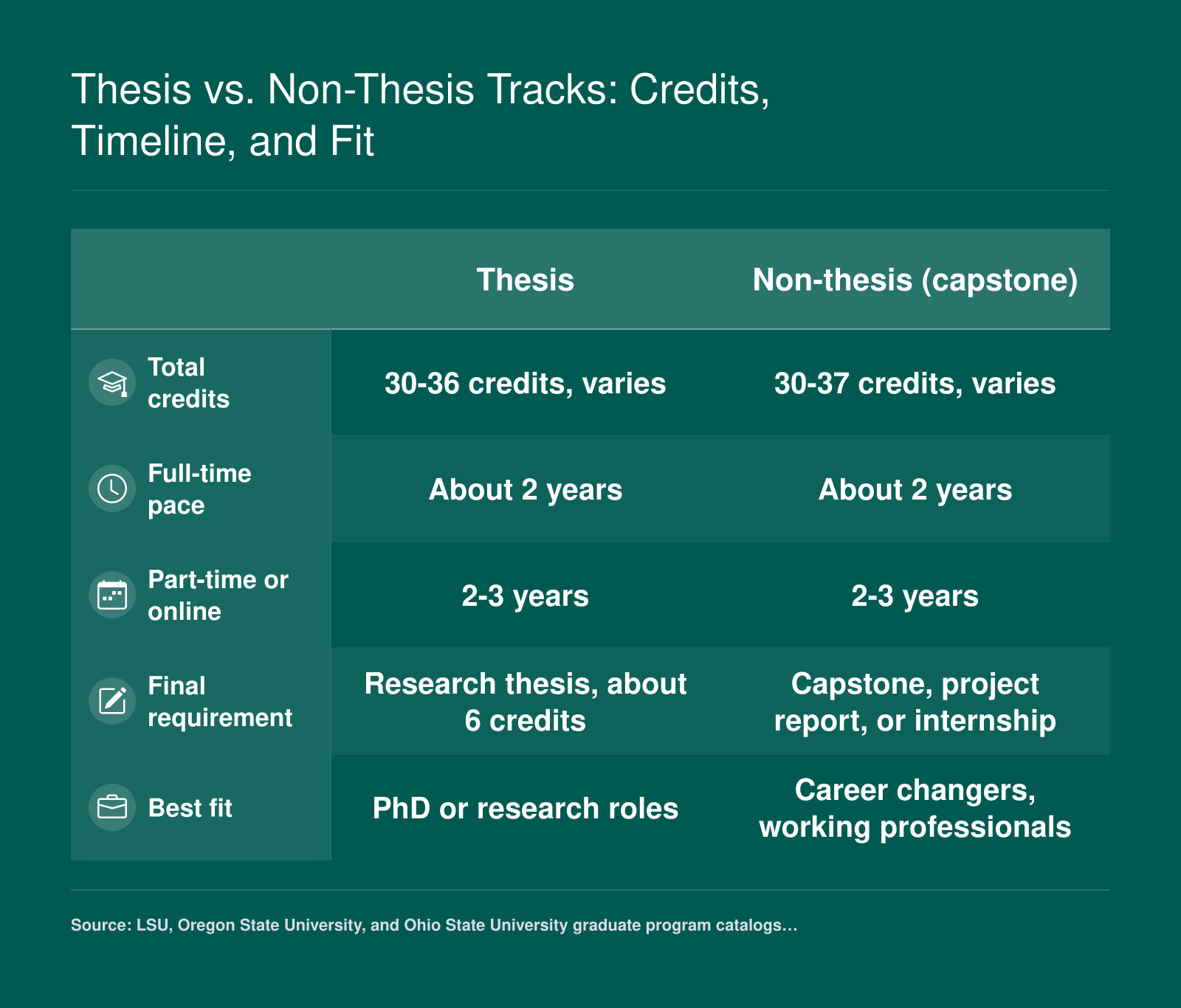
Thesis vs. Non-Thesis Tracks: Credits, Timeline, and Fit
Credit counts vary by school, so treat these as ranges and check each program. LSU requires 36 credits on both tracks, Ohio State's latest located handbook (2021-2022) lists 30 for thesis and 37 for non-thesis, and Oregon State requires 45 quarter credits, equal to 30 semester credits. Thesis suits students eyeing PhDs or research roles; a capstone suits career changers and working professionals.
Environmental Science programs by state
Environmental Science Master's FAQs
These answers draw on published requirements from individual universities, so details vary by school. Always confirm current terms on the program page before you apply.
How long does a master's in environmental science take?
Do environmental science master's programs require a thesis?
Can I get into an environmental science master's program with a non-science bachelor's degree?
Is it possible to have tuition covered through an assistantship as a master's student?
Compare Environmental Science programs on the data that matters
Explore more Science & Engineering specializations or browse every graduate field.
All Science & Engineering programs