Best Master's in Environmental Science Programs in Louisiana
Compare 5 accredited Environmental Science programs in Louisiana at 4 schools, with graduate earnings, cost, debt, and completion data from IPEDS and the U.S. College Scorecard.

Louisiana loses coastal wetlands by the acre, and its petrochemical corridor runs hard against federal regulation. That combination keeps demand steady for scientists who can measure sediment loss, model restoration, and track emissions along the lower Mississippi.
The programs here run from a fully online LSU degree at $585 per credit to research-heavy campus tracks at Tulane and UL Lafayette, plus applied environmental and urban forestry work at McNeese and Southern. Delivery mode, GRE policy, and total cost diverge sharply across them.
Program-level earnings data are sparse, so net price and funding are the clearer levers for comparing options.
Key Points
- LSU is the only program here with a documented online route.
- Tulane is the clearest no-GRE choice; LSU treats the GRE as optional.
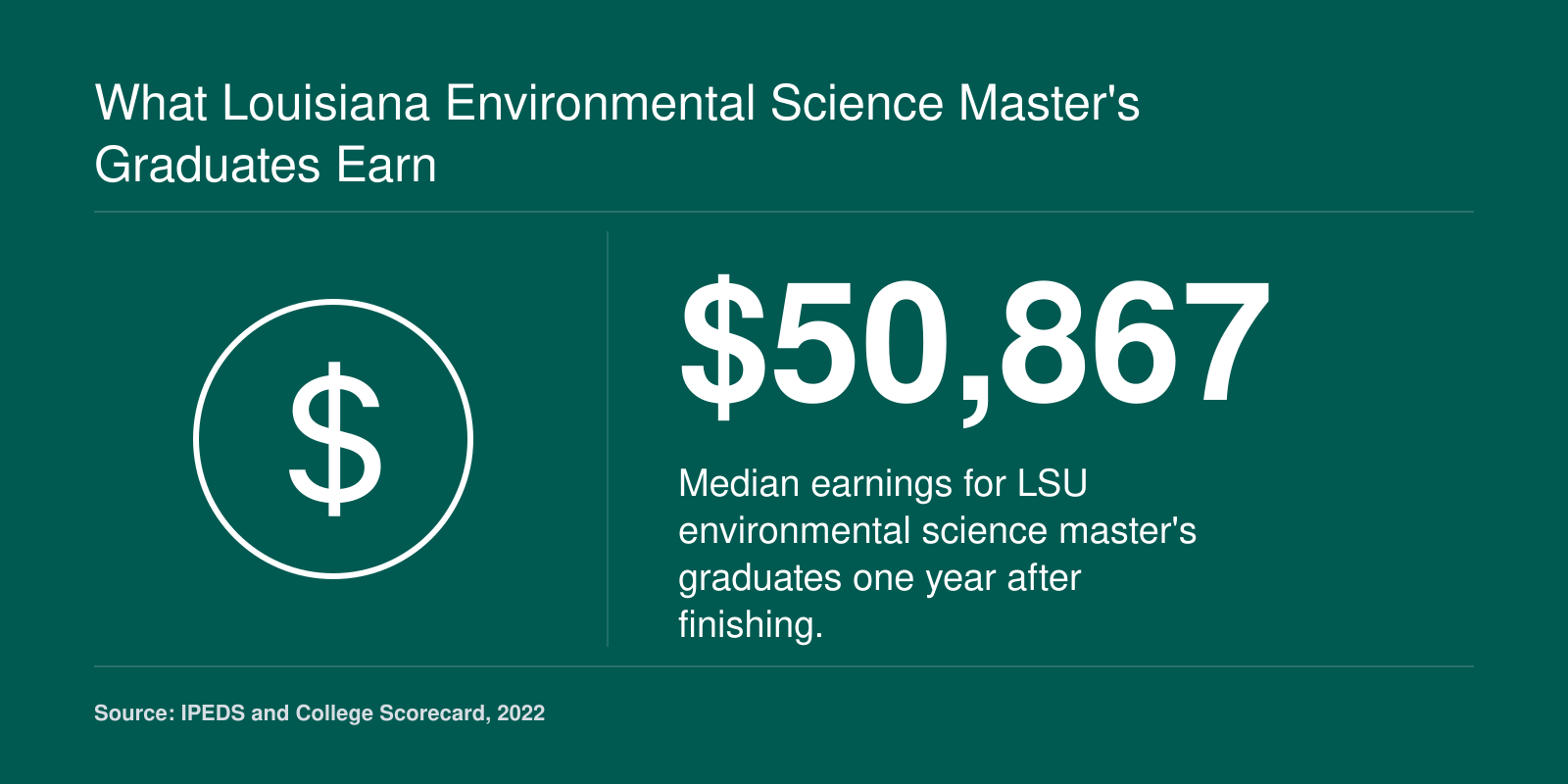
- LSU environmental science master's graduates earn a median $50,867 after one year.
Louisiana's Top Master's in Environmental Science Programs, Ranked
Louisiana's environmental science master's options range from a fully online LSU degree to research-based campus programs at Tulane and UL Lafayette, plus applied environmental and urban forestry tracks at McNeese and Southern. The right choice depends on delivery mode, concentration focus, and net price.
Tulane University of Louisiana
#1New Orleans, LA · ~$69,000/yr (est.)
Best for: Research-minded ecologists wanting thesis flexibility
Tulane's Ecology and Evolutionary Biology M.S. is a campus-based research degree with both thesis and non-thesis tracks, requiring 30 graduate credit hours and drawing on strengths in animal physiology, plant ecology, and environmental toxicology. In-state and out-of-state graduate tuition are both $68,678, with an average net price around $39,949. The university reports an 86% institution-wide graduation rate and holds SACSCOC accreditation, which supports federal financial aid eligibility.
- 30 credit hours for standard track; thesis track requires 24
- Thesis and non-thesis options
- Campus-based program in New Orleans
- Bachelor's degree with chemistry and biology coursework prerequisite
- Minimum 3.0 GPA for admission
- Independent study and internship opportunities
- Up to 6 transfer credits accepted
- 4+1 accelerated program option
Louisiana State University and Agricultural & Mechanical College
#2Baton Rouge, LA · $10,000 – $15,000/yr (est.)
Best for: Working professionals needing fully online flexibility
LSU Online's 36-credit Master of Science in Environmental Sciences is fully online and asynchronous, with flat-rate pricing of $585 per credit, about $21,060 total, and no out-of-state surcharge. The university's listed in-state graduate tuition is $11,954 and out-of-state is $28,631, with an average net price near $19,151; the online program itself uses flat-rate pricing. LSU reports a 69% institution-wide graduation rate and holds SACSCOC accreditation, which matters for federal aid eligibility.
- $21,060 total program tuition
- $585 per credit
- 36 total credit hours
- Fully online asynchronous classes
- 3.0 GPA minimum
- Three letters of recommendation
- GRE encouraged, substitutions considered
- Military benefits and employer reimbursement supported
University of Louisiana at Lafayette
#3Lafayette, LA · $10,000 – $15,000/yr (est.)
Best for: Wetland researchers seeking applied field access
UL Lafayette's M.S. in Environmental Resource Science offers soil and water and environmental quality concentrations, with a 35-credit curriculum and thesis or non-thesis tracks. In-state graduate tuition is $10,418 and out-of-state is $24,146, with an average net price around $13,530. The university reports a 53% institution-wide graduation rate and is SACSCOC-accredited, which helps students access federal financial aid.
- 35 credit hours required
- Thesis and non-thesis tracks
- Concentrations in soil and water and environmental quality
- Bachelor's degree in related field required
- Nine credit hours of general science prerequisite
- Assistantships and fellowships available
- Wetland research opportunities
- Strong Louisiana industry connections
McNeese State University
#4Lake Charles, LA · $5,000 – $10,000/yr (est.)
McNeese State University offers a campus-based Master of Science in Environmental Science through its Environmental and Chemical Sciences concentration, housed in Agricultural Sciences. In-state graduate tuition is $8,489 and out-of-state is $9,989, with an average net price near $12,493. The university reports a 47% institution-wide graduation rate; prospective students should verify institutional accreditation, which is required for federal aid eligibility.
- Campus-based Master of Science degree
- Environmental Science concentration
- Part of Agricultural Sciences
- Requires bachelor's degree and relevant prerequisites
- Competitive tuition costs
- Financial aid available
- Graduate-level coursework
- Focus on environmental issues
Southern University and A & M College
#5Baton Rouge, LA · $10,000 – $15,000/yr (est.)
Southern University Baton Rouge's Master of Science in Urban Forestry offers Environmental Studies, Geospatial Technologies, and Natural Resources Sustainability concentrations, with 30 to 36 credit hours and a thesis or capstone option. In-state graduate tuition is $9,922 and out-of-state is $17,272, with an average net price around $20,077. The university reports a 27% institution-wide graduation rate; accreditation should be verified directly, as institutional accreditation is required for federal financial aid.
- Concentrations in Environmental Studies, Geospatial Technologies, and Natural Resources Sustainability
- 30-36 credit hours
- Thesis or capstone option
- Minimum 2.7 GPA required
- GRE exam mandatory
- Resume, essay, and three recommendation letters
- Graduate assistantships available
- Campus-based program
Cost & outcomes by school
Federal data for the highest-earning Environmental Science programs, independent of the ranking above. Earnings are this field's master's graduates four years after completing, where the Scorecard reports them.
| School | Earnings | Tuition / yr | Debt | Grads/yr | Format |
|---|---|---|---|---|---|
| McNeese State University LA | — | $8,502 | — | — | Campus |
| Louisiana State University and Agricultural & Mechanical College LA | — | $13,027 | — | 35 | Online |
| University of Louisiana at Lafayette LA | — | $10,184 | — | 6 | Campus |
| Tulane University of Louisiana LA | — | $69,310 | — | — | Campus |
Sources: U.S. Department of Education. Tuition and graduates: IPEDS. Earnings and debt: College Scorecard, this field's master's graduates; a dash means no figure is reported.
Online and Hybrid Master's in Environmental Science Options in Louisiana
Louisiana has few fully online master's in environmental science programs, and the ranked schools bear that out. LSU is the one program here with a documented online route, while Tulane, UL Lafayette, McNeese and Southern University are listed as campus-based.
LSU's Online and Professional Formats
LSU splits its environmental science master's program into two tracks. The Thesis Option is campus-based and runs about 24 months. The Professional Option can be taken in person or online. LSU Online's version is 36 credits, fully online, with no on-campus appearance required, and it is asynchronous with no set class times. It is priced at $585 per credit, about $21,060 in total, with a locked rate and no out-of-state fees. LSU's pages do not show that the thesis route can be completed online, so don't assume it.
Deadlines to Confirm
- LSU on-campus M.S.: May 15 for fall, October 15 for spring.
- LSU Online: December 14, 2026, for classes starting January 11, 2027.
Current 2026 deadlines for the other ranked schools are not published here. Deadlines change yearly, so confirm each program page before you apply.
The Field-Work Trade-Off
Concentrations built around wetlands, coastal science or soil and water research usually depend on field sites and labs. UL Lafayette, for example, lists wetland research access on a campus-based program. Even where a hybrid format exists, expect in-person components.
GRE Requirements: Which Louisiana Master's Programs Waive or Make It Optional
Tulane is the clearest choice among Master's in Environmental Science Programs With No GRE Required for an environmental science master's in Louisiana. LSU treats the exam as optional, and UL Lafayette leaves the decision to individual programs.
GRE Policy by School
- Tulane University: The Earth and Environmental Sciences M.S. does not require GRE scores and does not consider them in admissions. Tulane sets no numeric minimum GPA for this program and weighs academic performance, including GPAs from previous degrees.
- LSU: LSU's official pages disagree. The Environmental Sciences M.S. admissions page lists the GRE as optional. The LSU Online page says scores are encouraged but that substitutions may be considered for exceptional applicants. Either way, the GRE is not a strict requirement. The Graduate School requires a 3.0 GPA on a 4.0 scale.
- UL Lafayette: Its graduate admissions page has no GRE rule specific to environmental science. It asks for GRE scores only when a program requires them. Unconditional master's admission requires a 2.75 overall GPA or a 3.0 in the last 60 undergraduate hours.
- McNeese State and Southern University: Confirm current GRE rules directly with each program office before you apply.
What Else Shapes Admission
GPA carries the most weight in the published rules for Master's Programs in Louisiana. LSU notes that departments may set thresholds above its 3.0 floor. Because LSU's two pages conflict, ask the department which policy applies to your entry term before deciding whether to sit for the exam.
Related Articles
Cost of a Master's in Environmental Science in Louisiana, Plus Licensure and Certification
The price spread across Louisiana's environmental science master's options is wide enough to change which degree makes financial sense, and the credential you need afterward may not be a license at all.
What the programs charge
McNeese State is the least expensive option here, with graduate tuition near $8,502 in-state and about $10,002 out-of-state, an unusually small residency penalty. Tulane anchors the other end at roughly $69,310, and as a private university it charges that figure regardless of where you live. UL Lafayette and Southern fall in between for residents, around $10,184 and $10,738 respectively, though both jump sharply for nonresidents. LSU's online Master of Science in Environmental Sciences prices differently: a flat $585 per credit across 36 credits, about $21,060 total, with no out-of-state surcharge.
Net price is not your price
Published net price figures are institution-wide averages after aid, weighted heavily toward undergraduates. Treat them as directional, not as a quote for your degree. For master's students, the real cost-cutters among the Most Affordable Master's in Environmental Science Programs are graduate assistantships and tuition waivers. UL Lafayette and Southern both advertise assistantships, which commonly pair a stipend with reduced or waived tuition and can cut a sticker price in half or better.
Licensure and certification
Louisiana does not license environmental scientists as a general occupation. The nearest regulated credential is Professional Geoscientist licensure through the Louisiana Board of Professional Geoscientists; verify its current education, experience, and examination requirements with the board directly, and check them against a program's curriculum before enrolling. Everything else is voluntary: NREP's Registered Environmental Manager and certifications from AIPG signal competence but carry no state authority.
Match the credential to the track. Agency and regulatory roles hire on degree and experience, consulting firms reward voluntary certification, and subsurface or geologic practice is where licensure actually matters.
What Louisiana Environmental Science Master's Graduates Earn
The latest federal data put median earnings for LSU environmental science master's graduates at $50,867 one year after finishing. No comparable program-level median is reported for the other schools on this list, so this is the only program-level earnings point available here.
FAQs About Environmental Science Master's Programs in Louisiana
What is the most affordable environmental science master's program in Louisiana?
Can I earn a master's in environmental science online in Louisiana?
What can I do with a master's in environmental science in Louisiana?
How much does an environmental science master's cost in Louisiana?
Compare Environmental Science programs on the data that matters
Explore more Science & Engineering specializations or browse every graduate field.
All Science & Engineering programs