Best Master's in Environmental Science Programs in Florida
Compare 27 accredited Environmental Science programs in Florida at 14 schools, with graduate earnings, cost, debt, and completion data from IPEDS and the U.S. College Scorecard.

Florida's coastal resilience, water management, and Everglades restoration work keeps environmental science hiring steady, but graduate tuition gaps are stark. Florida Atlantic University lists in-state tuition near $6,693, out-of-state near $18,482, and University of Miami posts $46,870.
The ranked programs below mix campus and online formats. Since Florida does not license environmental scientists broadly, applicants should pick a specialization early and compare cost against that credential.
Key Points
- Florida Atlantic University posts the lowest tuition: about $6,693 in-state, $18,482 out-of-state.
- Florida Gulf Coast University is the only program here with published graduate earnings, roughly $53,466.
- Florida has no single environmental scientist license, and the Professional Geologist license requires five years of experience.
Best Master's in Environmental Science Programs in Florida: Ranked List
What separates the strongest Florida programs is value, graduate outcomes, and format flexibility: a few state universities pair low in-state tuition with online or thesis-optional options, while the private options cost far more. Each card below shows the city, delivery format, tuition, net price, and any concentration. Graduation rates cited are institution-wide, not specific to the environmental program. Where program-level earnings are published, they come from small graduate cohorts, so treat them as a rough guide.
University of Florida
#1Gainesville, FL · ~$13,000/yr (est.)
Best for: Working professionals needing online flexibility
The University of Florida in Gainesville pairs a fully online environmental science track with a campus-based public health option in environmental health. The online track suits Florida professionals working with agricultural, forest, urban, or wetland soil and water quality, and UF accepts approved tuition waivers from Florida state agencies and UF employees. The institution-wide graduation rate is about 91%, the highest on this list.
- Delivered fully online
- 30 credits required
- Thesis or non-thesis option
- Time to degree is 2 to 4 years
- 3.0 GPA admission requirement
- Self-supporting tuition model; fully online students skip several campus fees
- Bachelor's degree required; prerequisite science courses may be needed
- Campus-based concentration
- CEPH accredited
- 42 or 48 credits depending on pathway
- Includes internship and applied practice experience
- Capstone project required
- Accelerated option available
- Admissions through SOPHAS
Florida State University
#2Tallahassee, FL · ~$11,000/yr (est.)
Best for: Aspiring aquatic scientists wanting thesis research
Florida State University in Tallahassee offers aquatic environmental science on campus, with both a thesis-based degree and a non-thesis professional master's. Neither track sets a GRE minimum, and attendance can be full or part time. The institution-wide graduation rate is about 86%, and the program fits students who want research depth in aquatic systems.
- Campus-based Master of Science
- Thesis and non-thesis tracks
- 33 to 36 credit hours
- 3.0 GPA admission requirement; no GRE minimum
- Joint JD/MS pathway available
- Internship opportunities
- Non-thesis professional degree
- 36 credit hours with a capstone project
- No GRE requirement
- Professional development focus
- Full or part-time attendance
Florida International University
#3Miami, FL · ~$11,000/yr (est.)
Best for: Policy-minded students drawn to Latin America
Florida International University in Miami offers a campus-based Master of Science in Environmental Studies that blends natural resource science with policy and sustainable development. Concentrations focus on the regional geology of South Florida, the Caribbean, or Latin America. Students who want a shorter, policy-oriented path may also look at FIU's Professional Science Master's in Environmental Policy and Management, which is 31 credits, requires no GRE, and is designed to finish in 16 months.
- Campus-based program in Miami
- Emphasis on environmental policy and natural resource science
- Bachelor's degree required for admission
- Resources from the Agroecology Program
- Financial aid available
- Concentration in the regional geology of South Florida
- Prepares for geosciences careers
- Caribbean regional focus
- Emphasis on cultural and political contexts
- Latin America regional focus
- Covers sustainable development and natural resource management
University of Central Florida
#4Orlando, FL · ~$9,000/yr (est.)
The University of Central Florida in Orlando delivers its environmental engineering master's online, with an emphasis on pollution control, water treatment, and waste management. Per-credit pricing is published, and the program is built for working professionals heading into government, consulting, or industry. The institution-wide graduation rate is about 78%. Applicants should note that the track expects a science, math, or engineering background.
- Online with no on-campus requirements
- 30 credit hours
- In-state tuition $369.65 per credit
- Out-of-state tuition $1,276.48 per credit
- Science or math background required
- Undergraduate engineering courses needed for articulation
- Fully online, 30 credit hours
- Thesis or non-thesis options; portfolio for non-thesis
- Three recommendation letters and a statement of objectives
- No GRE required generally
- Equipment fee of $16 per semester
- Online with thesis and non-thesis options
- Bachelor's in engineering required
- Research or design project included
- Courses in wastewater, potable water, and hazardous waste
- Part-time students pay an $8 equipment fee
University of South Florida
#5Tampa, FL · ~$10,000/yr (est.)
The University of South Florida in Tampa offers an M.S. in Environmental Science & Policy through its geosciences department, with thesis and professional tracks. Students choose among concentrations in wetlands and water resources, climate and meteorology, or coasts and hazards. Federal data shows median earnings of about $60,986 four years after completion for the program, based on a small graduate cohort. The institution-wide graduation rate is about 77%.
- Campus-based M.S. with thesis and professional tracks
- Core courses in science, policy, and quantitative methods
- Customizable electives
- Bachelor's degree required for admission
- Prepares for doctoral study or workforce roles
- Concentration in climate and meteorology
- Policy and management coursework included
- Concentration in coasts and hazards
- Focus on practical skills development
University of Miami
#6Coral Gables, FL · ~$47,000/yr (est.)
The University of Miami in Coral Gables runs its Environmental Science and Policy program through the Rosenstiel School, with strong marine and climate emphasis. It is a private institution with the highest listed tuition in this ranking, so assistantships and funding offers matter when comparing value. The institution-wide graduation rate is about 84%, and the program is a fit for research-oriented students targeting climate, coastal, or ecosystem work.
- Campus-based MS (PhD also offered)
- GRE optional for admission
- TOEFL required for non-native English speakers
- Research-intensive, interdisciplinary curriculum
- Funding opportunities available
- Coastal Zone Management concentration
- Focus on marine resource management
- No GRE required per program listing
- Prepares for policy careers
- Ecosystem Modeling and Sustainability concentration
- Research-focused curriculum on marine sustainability
- Funding assistantships available
Florida Atlantic University
#7Boca Raton, FL · $7,000 – $18,000/yr (est.)
Florida Atlantic University in Boca Raton offers a campus-based M.S. in Environmental Science with thesis and non-thesis options and a focus on environmental restoration. The degree now sits within the School of Environmental, Coastal, and Ocean Sustainability, giving students access to faculty across FAU's South Florida campuses. Assistantships and fellowships may provide tuition waivers and stipends. The institution-wide graduation rate is about 63%.
- Campus-based Master of Science
- Thesis and non-thesis options
- Flexible curriculum tailored to subdisciplines
- Hands-on research in environmental restoration
- Prepares for research, management, and regulation careers
University of West Florida
#8Pensacola, FL · $5,000 – $10,000/yr (est.)
The University of West Florida in Pensacola offers a 30-hour M.S. in Environmental Science with research strengths in coastal science, paleoclimatology, landscape ecology, GIS, and aquatic biogeochemistry. Alabama residents qualify for a discounted differential tuition rate, and an online non-thesis format is available for eligible students. The institution-wide graduation rate is about 59%.
- 30 credit hours with thesis or non-thesis track
- Up to 6 hours of thesis credit or 3 hours of internship
- Nine-hour core including Graduate Seminar and Sampling and Analysis
- 3.0 GPA minimum and three letters of recommendation
- Prerequisites in chemistry, upper-level science, and statistics
- GIS graduate certificate available
Ana G. Mendez University
#9Orlando, FL · ~$10,000/yr (est.)
Ana G. Mendez University in Orlando offers an online Master of Science in Environmental Planning aimed at working professionals pursuing leadership roles in environmental management. The curriculum is competency-based and centers on sustainable development, with career paths such as natural resources planner. Graduation rate data is not reported for the institution, and program-level earnings are not yet available.
- Delivered online
- Competency-based curriculum
- Focus on environmental management and sustainable development
- Serves public and private sector careers
- Admission requirements listed in the academic catalog
Florida Gulf Coast University
#10Fort Myers, FL · ~$9,000/yr (est.)
Florida Gulf Coast University in Fort Myers offers a campus-based, thesis-driven M.S. in Environmental Science focused on uplands, wetlands, estuaries, and coastal systems. Concentrations include organismal and ecosystem ecology and marine science, and a limited number of competitive tuition waivers are available. Federal data shows median earnings of about $53,466 one year and $66,340 four years after completion, based on a small cohort. The institution-wide graduation rate is about 57%.
- Campus-based, 36 credit hours
- Thesis project included
- Minimum 3.0 GPA for admission
- Small class sizes and research opportunities
- Graduate assistantships and scholarships available
- Concentration in organismal and ecosystem ecology
- Integrated ecosystem study with field and lab techniques
- Marine science concentration
- Thesis-based, 36 credit hours
Cost & outcomes by school
Federal data for the highest-earning Environmental Science programs, independent of the ranking above. Earnings are this field's master's graduates four years after completing, where the Scorecard reports them.
| School | Earnings | Tuition / yr | Debt | Grads/yr | Format |
|---|---|---|---|---|---|
| Florida Gulf Coast University FL | $66,340 | $8,961 | — | 16 | Campus |
| University of South Florida FL | $60,986 | $10,428 | — | 12 | Campus |
| University of Central Florida FL | — | $8,872 | — | — | Online |
| Florida State University FL | — | $10,553 | — | — | Campus |
| University of Florida FL | — | $12,737 | — | — | Online |
| Florida Atlantic University FL | — | $6,693 | — | 10 | Campus |
| University of West Florida FL | — | $9,062 | — | 12 | Campus |
| Florida International University FL | — | $11,334 | — | 18 | Campus |
| Ana G. Mendez University FL | — | $10,455 | — | 8 | Online |
| Florida Agricultural and Mechanical University FL | — | $9,876 | — | 3 | Campus |
| Bethune-Cookman University FL | — | $14,100 | — | — | Campus |
| Nova Southeastern University FL | — | $24,830 | — | 20 | Campus |
Sources: U.S. Department of Education. Tuition and graduates: IPEDS. Earnings and debt: College Scorecard, this field's master's graduates; a dash means no figure is reported.
Online and Hybrid Master's in Environmental Science Options in Florida
Which Florida environmental science master's programs can you finish online, and how much on-campus time will they actually require? A few Master's Programs in Florida offer flexible delivery, but the formats differ.
University of West Florida's M.S. in Environmental Science is offered face-to-face, hybrid, or online. The online version uses synchronous real-time classes, often in the late afternoon or early evening, and takes about 24 to 30 months to complete 30 credits. No required on-campus residency is listed for the online M.S., but Gulf Coast field labs are optional research experiences.
University of Florida's online M.S. in Soil, Water, and Ecosystem Sciences, Environmental Science track, is fully online with 30 credits and thesis or non-thesis options. University of South Florida's M.S. in Environmental Science and Policy is listed as an online program with concentrations in wetlands and water, climate and hazards, GIS, conservation, sustainability, and environmental policy, though USF's materials are less explicit about fully online versus hybrid delivery.
Any fieldwork-heavy or thesis option may require in-person lab, field, or residency time even when coursework is online. Working professionals often do best with non-thesis online tracks, while career changers who want research assistantships may need a program with campus access.
Florida Master's Programs That Waive or Make the GRE Optional
Some Florida environmental science master's programs have quietly become No-GRE master's programs, while others leave prospective students to check every program page individually because no test policy is stated. The contrast matters most for applicants deciding whether to schedule a test at all.
- University of Central Florida: GRE is not required for admission to the environmental engineering MS, environmental engineering sciences track.1
- Florida Gulf Coast University: No minimum GRE score requirement; the program expects a 3.0 undergraduate GPA.
- University of West Florida: No GRE policy published on the program page; the online environmental science MS lists an August 1 fall deadline.
- Florida Atlantic University: No GRE policy published in the admissions excerpt; the MS in environmental science asks for a 3.0 GPA and a January 15 fall deadline.
- Florida International University: No GRE policy published for either the environmental engineering MS or the environmental studies MS; the environmental studies program lists a February 1 fall deadline and a B average in upper-level work.
Because GRE policies can shift by term and department, confirm the current test requirement and deadline directly with each program before applying.
Related Articles
Cost, Funding, and Florida Certification for Environmental Science Master's Students
How much does a master's in environmental science cost in Florida, and how big is the in-state discount? Program-level tuition ranges widely. Florida Atlantic University is the lowest at about $6,693 in-state and $18,482 out-of-state. Florida Gulf Coast University charges about $8,961 in-state versus $31,216 out-of-state, a gap of more than $22,000. Bethune-Cookman University charges one rate of about $14,100 regardless of residency. Program-level debt figures are not published for most of these programs.
Per-credit rates
The University of West Florida lists $378.85 per credit for 2026-2027, about $11,575 for the full program. Its online out-of-state waiver covers up to 90% of the non-resident portion, but it must be requested each semester and does not cover other fees. The University of Florida lists $532.52 per credit, about $16,950 total, as a projected estimate.1 Its online fee treatment is inconsistent on the school's own page, so confirm the final figure with the program.
Funding
University of Florida fellowships and assistantships cover tuition for up to 9 credits in fall and spring and 6 in summer, though students still pay non-matriculation fees. Florida Gulf Coast University assistantships go to competitive, full-time students taking 9 or more credits, and its limited waivers cover in-state matriculation fees only. Bethune-Cookman University lists competitive scholarships and tuition waivers. Out-of-state students should check Florida residency classification rules before assuming in-state rates.
Certification
Florida has no single state license for environmental scientists. Specific credentials can still matter by career path, as the next box explains.
Florida Credentials for Environmental Science Graduates
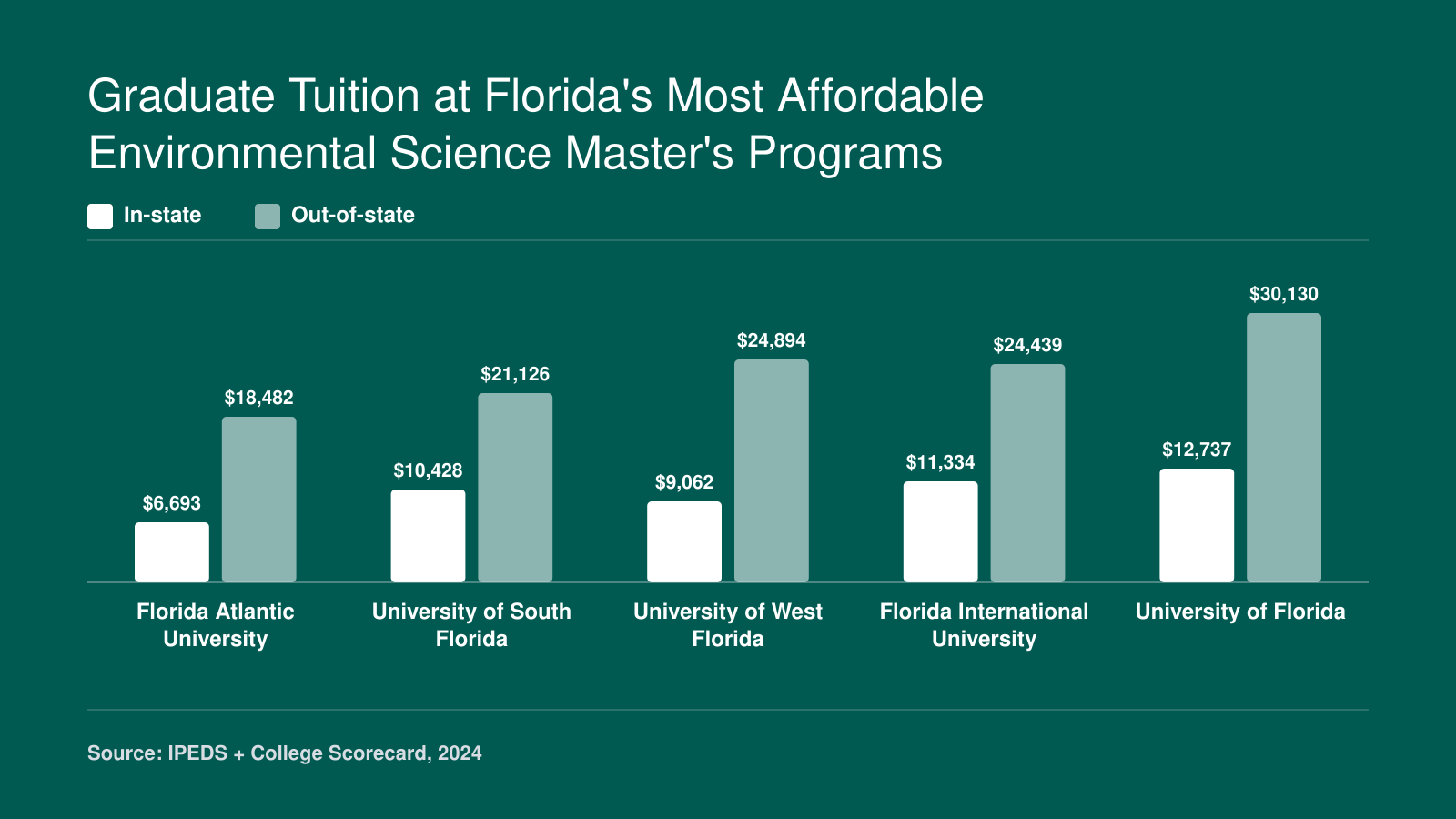
Graduate Tuition at Florida's Most Affordable Environmental Science Master's Programs
Figures show published graduate tuition and fees for each program, not net price after aid. Florida Atlantic University posts the lowest numbers for both residents and nonresidents. The residency gap is large: out-of-state students pay roughly $10,700 to $17,400 more, with the widest difference at University of Florida.
Careers and Earnings After a Florida Master's in Environmental Science
What do graduates of these programs actually earn, and who hires them?
What the earnings data shows
Florida Gulf Coast University is the one program here with published graduate earnings: a median of roughly $53,466 one year after finishing and about $66,340 four years out, with essentially all completers reported as working a year after graduation. Set against a median graduate debt near $17,600, that return holds up. Program-level earnings have not yet been published for the environmental science master's at the University of Miami, Florida International University, Nova Southeastern University, Florida Atlantic University, or the University of West Florida, so weigh those on net price and research fit instead. Campus-wide earnings figures exist for some schools, but they cover every graduate, not this degree.
Where Florida graduates land
The Florida Department of Environmental Protection, headquartered in Tallahassee with district offices from Pensacola to Fort Myers,1 advertised Environmental Specialist I and III roles in October 2026.2 The Fish and Wildlife Conservation Commission carries roughly 2,118 established positions plus about 800 OPS slots across biological scientist, technician, and administrator classes.3 The five regional water management districts recruit through their own portals.4 Florida State and the University of West Florida both build internship credit into the degree, which matters for permitting and compliance work.
Frequently Asked Questions About Environmental Science Master's in Florida
These answers draw on program requirements published by the schools ranked here. Credit hours, formats, and timelines vary by track, so confirm details with each program before you apply.
Is a master's in environmental science worth it?
How long does a master's in environmental science take in Florida?
Should I choose a thesis or non-thesis environmental science master's?
Can I work full time while earning an environmental science master's in Florida?
Compare Environmental Science programs on the data that matters
Explore more Science & Engineering specializations or browse every graduate field.
All Science & Engineering programs