Master's Programs in Ohio
Every master's program reported by a school in Ohio: 1,300+ programs at 60+ graduate schools, with the online options, costs and outcomes behind each one.

A master's program in Ohio can cost anywhere from under $15,000 in resident tuition and fees at a public university to well over $40,000 at a private one, and the gap widens sharply for out-of-state students who pay a nonresident surcharge. That spread, not prestige, is the real decision Ohio applicants face.
The popular fields, degree types, and graduate schools are listed elsewhere on this page. The focus here is the money and mechanics: the total cost of a master's degree, which programs waive the GRE, how assistantships work, and the accreditation and licensure rules for fields like clinical mental health counseling that determine whether a degree qualifies you for a job.
Two programs with identical price tags can produce very different earnings, and the sticker price rarely tells you which is which.
Key Points
- Ohio State's 2026 resident budget totals $35,906, and living costs outweigh tuition.
- Check CACREP accreditation and Ohio board rules before enrolling, or a cheap degree may not qualify you for a license.
- Master's holders earn a median $1,876 weekly versus $1,578 for bachelor's holders.
Popular degrees in Ohio
Master's programs in Ohio by field
Business & Management
- Healthcare Administration45 programs
- Marketing40 programs
- Management40 programs
- Accounting35 programs
- Analytics32 programs
- General Business30 programs
- Finance30 programs
- Healthcare Management21 programs
Education & Teaching
- Special Education47 programs
- Educational Leadership28 programs
- Curriculum & Instruction25 programs
- Reading & Literacy21 programs
- Teaching20 programs
- Music Education20 programs
- Secondary Education14 programs
- Art Education10 programs
Nursing
- Family Nurse Practitioner (FNP)25 programs
- Psychiatric Mental Health Nurse Practitioner22 programs
- Nursing Education or Nurse Educator17 programs
- MSN/MBA11 programs
- Adult Gerontology Acute Care Nurse Practitioner10 programs
- Nurse Administrator9 programs
- Pediatric Nurse Practitioner8 programs
- Adult Gerontology Primary Care Nurse Practitioner8 programs
Healthcare
- Nutrition20 programs
- Health Administration18 programs
- Speech Pathology17 programs
- Public Health12 programs
- Health Informatics11 programs
- Exercise Science9 programs
- Health Education4 programs
- Clinical Research Management2 programs
Communications & Media
- Speech Pathology25 programs
- Communication20 programs
- Communication Disorders12 programs
- Strategic Communication7 programs
- Organizational Communication4 programs
- Journalism2 programs
- Health Communication2 programs
- Media Communication1 program
Social Work & Social Sciences
- Social Work35 programs
- Social Work Advanced Standing19 programs
- Sociology11 programs
- Political Science, Government5 programs
- Human Services3 programs
Counseling
- Clinical Mental Health Counseling29 programs
- School Counseling24 programs
- Marriage and Family Therapy or Marriage and Family Counseling3 programs
- Addiction Counseling3 programs
- Christian Counseling3 programs
Psychology
- Educational Psychology or School Psychology10 programs
- School Psychology7 programs
- Industrial Organizational Psychology6 programs
- General Psychology5 programs
- Applied Behavior Analysis5 programs
- Clinical Psychology3 programs
- Developmental Psychology3 programs
- Counseling Psychology3 programs
Religion & Theology
- Theology16 programs
- Divinity15 programs
- Christian Ministry11 programs
- Christian Leadership3 programs
- Youth and Family Ministry2 programs
- Urban Ministry1 program
Arts & Design
- Creative Writing36 programs
- Fine Arts3 programs
Computers & IT
- Data Analytics16 programs
- Cybersecurity14 programs
- Information Security & Assurance5 programs
- Machine Learning4 programs
Science & Engineering
- Environmental Science17 programs
- Geography10 programs
- Sustainability or Environmental Management8 programs
Criminal Justice & Law
- Master of Laws6 programs
- Legal Studies5 programs
- Business Law3 programs
- Homeland Security1 program
- Public Policy1 program
Understanding the Real Cost of a Master's Degree in Ohio
At Ohio publics, nonresident students pay a surcharge on top of the in-state rate, so the out-of-state gap can run from roughly double (Ohio University, Cleveland State) to more than three times the resident price (Ohio State), while private universities such as Dayton charge one rate to everyone. Most Ohio schools price graduate study by the credit hour, and many online programs charge a flat rate or waive the nonresident surcharge, which is why online study is a common affordable path for out-of-state students; always confirm the rate on the specific program page. Multiply the per-credit rate by the program's credit count (30 to 36 credits is typical) to get the number that matters: based on the rates below, tuition alone runs roughly $18,000 to $31,000 for public in-state students, about $34,000 to well over $100,000 for public out-of-state students on standard on-campus rates, and around $24,000 to $28,000 at Dayton's published rate for its communications, English, public administration, and theology programs, with other private programs often priced higher. Fees, books, and living costs are extra, and tuition for some programs differs from the standard graduate rate shown here.
| University | Public/Private | In-State Graduate Tuition | Out-of-State Graduate Tuition | Pricing Basis (Per Credit/Annual) |
|---|---|---|---|---|
| Ohio University | Public | $608 per credit hour | $1,128 per credit hour | Per credit hour; Athens campus graduate tuition, 2026-27 |
| Cleveland State University | Public | $655.90 per credit hour | $1,238.55 per credit hour | Per credit hour; rate for 1 to 12 credits |
| University of Cincinnati | Public | $746.00 per credit hour (Ohio resident total, including standard graduate and professional fees) | N/A | Per credit hour |
| The Ohio State University | Public | $854.63 per credit hour | $2,804.07 per credit hour ($854.63 instructional fee plus $1,949.44 nonresident surcharge) | Per credit hour; applies to graduate programs without a separate published rate |
| University of Dayton | Private | $790 per credit hour (Communications, English, Public Administration, Theology and Religious Studies; other programs have their own published rates) | Same rate as in-state (private, one rate for all students) | Per credit hour; program-specific graduate rates |
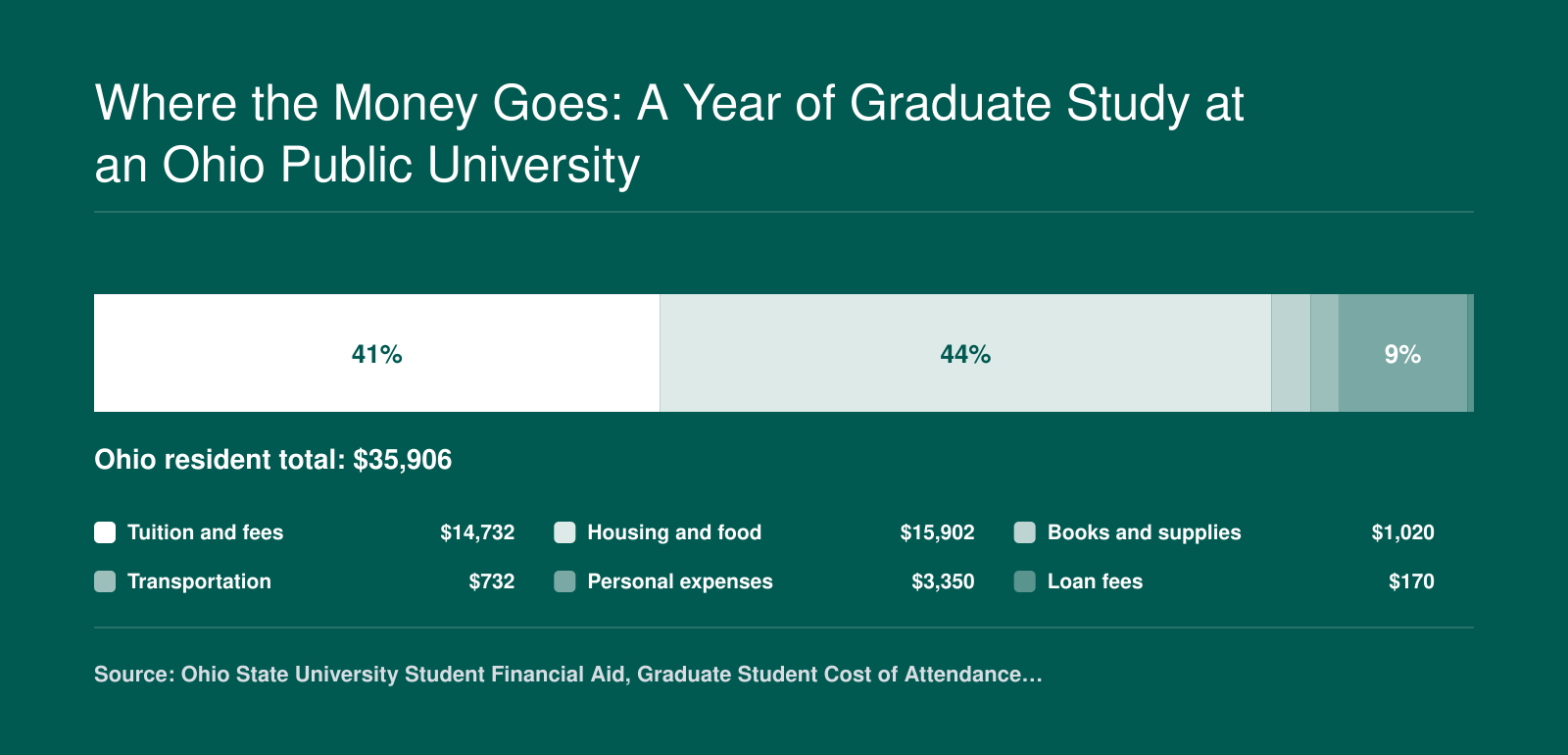
Where the Money Goes: A Year of Graduate Study at an Ohio Public University
Ohio State publishes a 2026-2027 budget for a full-time graduate student enrolled for two semesters, and the Ohio-resident off-campus total is $35,906. Housing and food alone ($15,902) edge out tuition and fees ($14,732), and all living costs together outweigh the bill from the university. That matters when you compare an assistantship that covers tuition but not rent, or an online program you can complete from home. Nonresidents face a total of $67,726, which includes $31,192 in non-resident fees. Actual amounts vary by program, credit hours and housing choices, and the published material does not give a separate on-campus graduate breakdown.
Program Formats: Online, Hybrid, Part-Time and Accelerated
Ohio's graduate delivery formats have settled into a practical three-way split, but the word "online" still hides meaningful in-person requirements. Understanding the differences up front protects your schedule and your tuition budget.
What Online and Hybrid Actually Mean in Ohio
At Ohio University, fully online means coursework can be completed remotely, while hybrid programs mix mostly online learning with selected in-person sessions. Even a program labeled online may require residencies, clinicals, or supervised fieldwork. On-campus programs remain the traditional face-to-face route, while hybrid formats aim to reduce commute time without eliminating all campus days. Ohio University is a common anchor for online searches because it lists roughly 30 online graduate programs across eight colleges. Its Professional MBA is hybrid with classroom components, a format worth weighing among best MBA programs, and its Master of Social Work combines weekly in-person days with online coursework. Ohio State's Master in the Study of Law can be taken fully online or hybrid1, and its online Master of Public Health for experienced professionals is primarily asynchronous with some synchronous sessions and no required campus travel, a structure increasingly common in online mph programs.
Typical Completion Times and Part-Time Loads
A full-time Ohio master's degree usually takes about 1.5 to 2 years, while part-time enrollment often stretches to 2.5 to 4 years. Ohio University's Master of Social Work, for example, offers 1-year, 2-year, 3-year, and 4-year tracks. Its Master of Global Health can be finished in as few as 18 months with 36 credits, and its online Master of Arts in English can take as few as 16 months. Ohio State's Master in the Study of Law defines part-time as 1 to 7 credit hours per term and full-time as 8 or more, with completion possible in as little as 12 months or up to 48.1 Ohio University's graduate rules also set a minimum of 30 semester hours for a master's and a maximum completion window of six calendar years.
Accelerated Terms and 4+1 Options
Some Ohio online programs compress courses into 7-week terms. Ohio University's online MA in English uses 7-week blocks, while its Master of Social Sciences offers 7- or 14-week formats. Before enrolling, ask whether compressed terms at your target school run 7 or 8 weeks and how many credits you will carry in a single session. For working professionals, a 7-week term means less multitasking across multiple long courses, but each week carries more reading and assignments. Ohio University also offers a 4+1 path in information and telecommunication systems: students begin graduate credits in their senior year, finish the bachelor's after four years, and complete the master's one year later. Ohio Dominican University runs similar five-year 4+1 options for an MBA, MS in Sport Management, or MA in English.2
Admissions and No-GRE Pathways at Ohio Graduate Schools
What Most Applications Require
Ohio graduate schools ask for a similar core package. Expect a bachelor's degree from a college with regional accreditation, official transcripts, a statement of purpose, letters of recommendation, a resume, and an application fee. Many programs also want a writing sample or portfolio.
GPA floors differ by school. Ohio State's Graduate School sets a 3.0 cumulative minimum on a 4.0 scale. Kent State generally expects at least a 2.750 undergraduate GPA, and some programs ask for more.1 Ohio University publishes no university-wide minimum, though individual programs can set their own. Treat any figure as a starting point and confirm it with the program.
Which Programs Skip the GRE
The published policies do not support a clean list of no-GRE master's programs by field, so check each department. What the sources do show:
- Ohio State: The Graduate School imposes no GRE or GMAT requirement, but individual programs may require either or grant their own waivers. A score can also be requested if you studied at an unaccredited institution or your GPA is below 3.0.
- Ohio University: Testing varies by program, and scores older than five years are not accepted.
- Kent State: Testing is set at the program level.
For Cincinnati, Bowling Green, Wright State, Cleveland State, and Dayton, we found no published 2026 testing rules. Look at each program page directly.
Where Tests Still Matter
Tests tend to persist in some MBA, research-track, and competitive STEM programs, and in cases where an applicant's GPA is low. Where a GMAT or GRE is listed, ask whether a waiver exists. Waivers commonly turn on a strong GPA, relevant work experience, or an earlier graduate degree, but the criteria are set by each program.
Deadline Patterns
Deadlines are mostly program-specific. Ohio State's Graduate School sets outer limits of July 27 for autumn, December 21 for spring, and May 12 for summer, but programs often close earlier. Ohio University's default fall deadline is August 1 for domestic applicants, with February 1 for international students who need an I-20 or DS-2019. Spring is December 1 (September 1 international), and summer is April 1 (December 1 international).
Neither school sets one university-wide priority date for funding. Assistantship and fellowship consideration is decided by program, and it often runs earlier than the admission deadline. Many online programs admit on a rolling basis, but applying early still helps if you want aid.
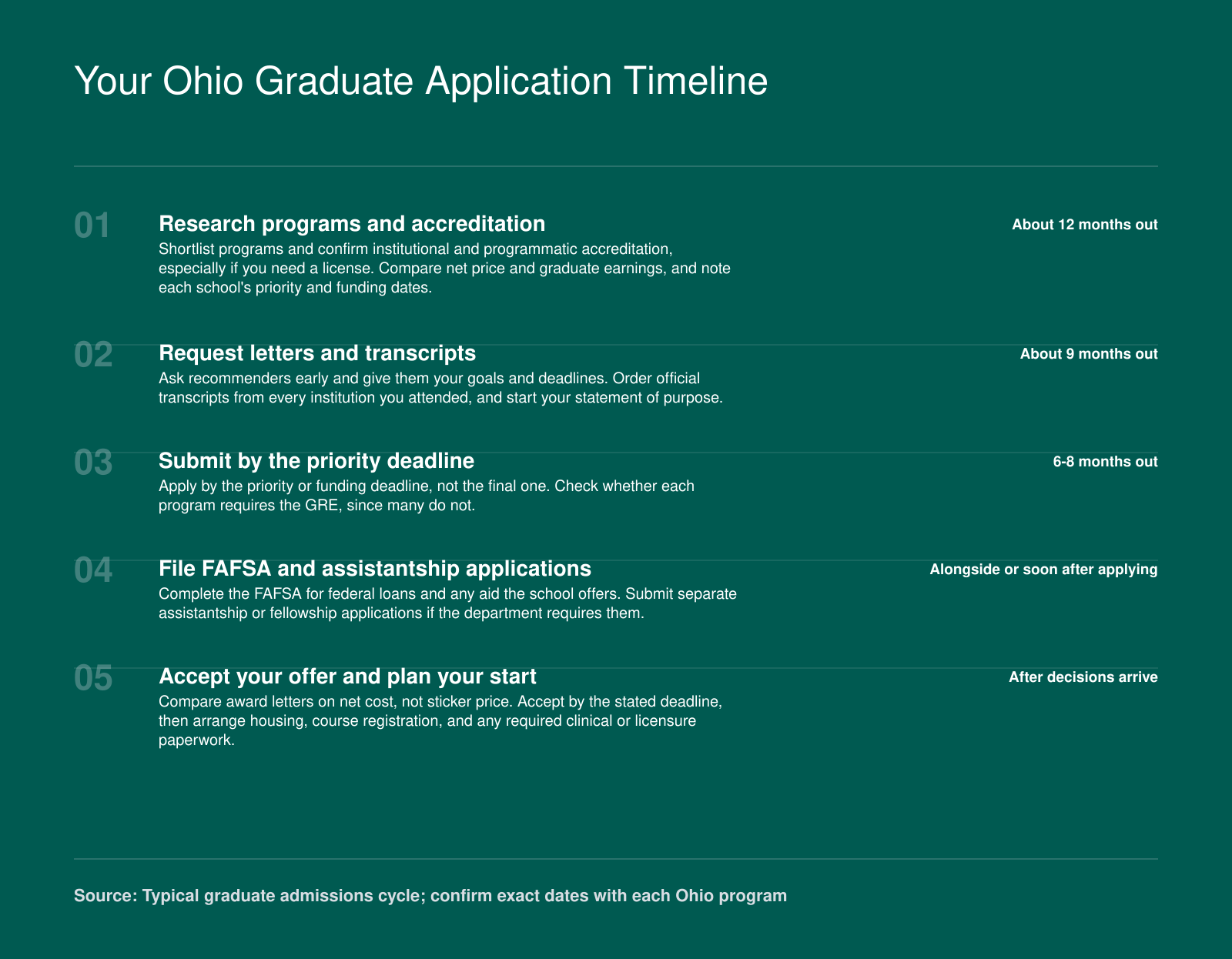
Your Ohio Graduate Application Timeline
Application order matters as much as application quality. Work backward from the earliest funding deadline at your target schools, not the final admission deadline. Funding decisions often follow the earliest deadline, so applying late can leave you admitted but unfunded.
Funding Your Ohio Master's: Assistantships, Scholarships and Loans
A graduate assistantship is the single most valuable funding source in Ohio graduate education, and it is also the one that most shapes how you have to enroll. Assistantships typically pair a stipend with a tuition waiver or scholarship, which means the right appointment can turn a five-figure sticker price into something close to free, plus income.
How assistantships work
Ohio universities award teaching, research and administrative appointments through academic departments, not the financial aid office, so you apply to the department and often to the program itself. At Ohio State, a 50 percent graduate associate appointment for 2026-2027 pays $26,073 over nine months, roughly $2,897 a month before deductions; exact waiver coverage and duties vary by program, so ask the department what tuition is covered and what is not. Ohio University caps graduate appointments and recruitment scholarships at 20 work hours per week. Registration minimums are set locally: Teacher Education assistants at Ohio University, for example, must register for 12 hours in fall and spring and 9 in summer.
Two caveats matter. Assistantships are almost always tied to full-time, on-campus enrollment, and they are rare for fully online students. If you intend to study online or part-time while working, build your budget around other sources.
Fellowships, departmental awards and employer help
Competitive fellowships and departmental scholarships are usually awarded from your admission file, which is one more reason to apply by the priority deadline rather than the final one. If you are employed, check your tuition reimbursement benefit: employers can provide up to $5,250 per year in educational assistance tax-free to you under federal rules, and many Ohio employers in healthcare, manufacturing and public agencies offer it.
Borrowing, under new rules
Graduate students borrow through Direct Unsubsidized Loans, with an annual limit of $20,500.1 Federal graduate lending changed substantially as of July 1, 2026: Grad PLUS is generally no longer available to new graduate borrowers2, with a narrow exception for students already enrolled and borrowing before that date, and even that grandfathered access is time-limited3. New aggregate caps also apply, including a $100,000 graduate borrowing limit for students who never attended a professional program and a $257,500 lifetime ceiling across federal borrowing.1 Transition rules are genuinely complicated and your eligibility depends on when you started. Confirm your own limits on studentaid.gov before you count on a number.
Accreditation and Licensure: What to Verify Before You Enroll
Institutional accreditation tells you a college is legitimate. Programmatic accreditation, together with state board rules, tells you whether a specific degree will qualify you for a license. Check both before you enroll.
Start With the Institution
Most Ohio colleges and universities are accredited by the Higher Learning Commission (HLC), an institutional accreditor. You can confirm a school's status in the HLC directory or in the U.S. Department of Education's accreditation database. The Ohio counselor board, for example, treats accreditation by a Department of Education- or CHEA-recognized agency as a baseline.1 But HLC status alone does not make a counseling, nursing, or education program licensure-qualifying, so verify each school's current standing directly rather than assuming it.
Programmatic Accreditors to Look For
- CACREP (counseling): Clinical programs typically build in a 100-hour practicum and a 600-hour internship.2 Graduates of non-CACREP programs can still apply for the Ohio LPC, but they must document a qualifying graduate counseling degree and the same 100/600 hours.1
- CSWE (social work): The standard accreditor for MSW programs. Confirm current licensing requirements with the board.
- CCNE or ACEN (nursing): The main nursing accreditors for MSN schools and a common employer expectation.
- CAEP (education): Educator preparation accreditation for accredited M.Ed. programs. Ohio University, for instance, describes its licensure programs as state and nationally accredited.
- AACSB (business): No license depends on it, but it is a recognized quality signal for MBA and business master's programs.
Know Which Ohio Board Licenses You
Educators are licensed through the Ohio Department of Education and Workforce. Whether a master's is required varies by license and pathway, so check the current rule for your target license. Counselors, social workers, and marriage and family therapists go through the Ohio Counselor, Social Worker and Marriage and Family Therapist Board. Since January 1, 2026, LPC applicants may sit either the NCE or the NCMHCE.
APRNs are licensed by the Ohio Board of Nursing. Applicants need a master's or doctoral nursing degree that qualifies them for a national certification exam.3 They also need at least 45 contact hours of graduate advanced pharmacology, generally completed within five years of applying.3 Your program submits an official transcript showing the degree and pharmacology completion.
If You Are Studying Online From Out of State
An out-of-state online program may be fully accredited and still fall short of Ohio's rules. Look for the school's state authorization status and its professional licensure disclosures for Ohio. If the disclosure is vague or missing, email the program and the relevant Ohio board, and keep the answers in writing.
Ohio Counselor and Social Worker Licensure
Career and Salary Outcomes: Using College Scorecard to Check ROI
A $45,000 master's can be a bargain or a mistake, and the sticker price alone will not tell you which. What settles the question is the relationship between what you borrow and what graduates of that specific program actually earn.
How to run the lookup
Go to the federal College Scorecard, search the Ohio school by name, then open its field of study view rather than the institution summary. That view separates master's-level results from bachelor's and lists, for each field the school reports, median earnings after completion and median debt at graduation. Write down both numbers for every program on your shortlist, then compare across schools in the same field. Two Ohio universities offering the same degree can show meaningfully different debt loads for similar earnings, and that gap is the clearest value signal available.
Which fields tend to pay
Nationally, computer science master's programs report some of the strongest results: a median of roughly $108,219 in early-career earnings against median debt near $31,390 in the most recent cohort. The spread, though, is enormous, with reported earnings running from about $64,598 to nearly $199,761 depending on the institution, so a national median tells you almost nothing about a particular Ohio program. Nursing, engineering and business tend to cluster above education and the humanities. Ohio-specific examples are uneven: Ohio State reports 74% of its Class of 2023 master's graduates employed within a year, two-thirds of them staying in Ohio, while statewide pay for master's-prepared education professionals typically falls between $46,100 and $67,500.
Read the caveats, then apply a rule of thumb
Scorecard only publishes figures for programs with enough federal aid recipients to protect privacy, so smaller Ohio programs often show blanks. The earnings shown cover aid recipients only, not self-funded or employer-sponsored students, which can skew results in fields like business analytics. For a quick test, keep total borrowing at or below one year of expected earnings. A useful benchmark: computer programming graduates nationally carry debt equal to about 0.24 times their earnings, a comfortable ratio. Anything approaching 1.0 deserves scrutiny.
Finally, cross-check against Ohio labor data. The Ohio Department of Job and Family Services publishes occupational wage estimates by region, and the Bureau of Labor Statistics covers national projections. Columbus, Cleveland and Cincinnati pay differently for the same credential.
The Master's Degree Earnings Premium
Master's degree holders earn a median $1,876 per week versus $1,578 for bachelor's holders, a $298 weekly premium.
Graduate schools in Ohio with the most master's programs
| School | City | Type | Master's programs | Online | Grad tuition / yr |
|---|---|---|---|---|---|
| University of Cincinnati | Cincinnati | Public | 91 | 46 | $14,902 |
| Ohio University | Athens | Public | 81 | 48 | $9,720 |
| Ohio State University | Columbus | Public | 75 | 22 | $13,901 |
| Kent State University | Kent | Public | 64 | 36 | $12,483 |
| University of Toledo | Toledo | Public | 61 | 35 | $17,605 |
| Bowling Green State University | Bowling Green | Public | 60 | 34 | $10,291 |
| Cleveland State University | Cleveland | Public | 57 | 32 | $11,297 |
| Franklin University | Columbus | Private nonprofit | 55 | 55 | $12,090 |
| Case Western Reserve University | Cleveland | Private nonprofit | 54 | 19 | $53,980 |
| Miami University | Oxford | Public | 49 | 23 | $16,751 |
| University of Akron | Akron | Public | 49 | 25 | $10,125 |
| Xavier University | Cincinnati | Private nonprofit | 47 | 24 | $19,218 |
| Wright State University | Dayton | Public | 41 | 17 | $15,771 |
| Ashland University | Ashland | Private nonprofit | 37 | 34 | $8,400 |
| Youngstown State University | Youngstown | Public | 31 | 20 | $6,848 |
Program counts are the verified master's listings in our directory; tuition is the school-wide average for a full-time graduate student (IPEDS).
Questions Ohio Grad School Applicants Ask
These answers cover the questions we hear most from international applicants and from students weighing speed and online options. Requirements vary by department, so confirm details with your program before you apply.
What do international students need to apply to master's programs in Ohio?
Can international students work while earning a master's in Ohio?
Can I finish a master's in Ohio in one year?
Do Ohio residents get in-state tuition at online programs from other states?
Compare programs nationwide
Many Ohio residents study online. Every ranked list above has an online lens, or browse every field.
Online master's programs Browse all fields