Best Master's in Healthcare Administration Programs in Ohio
Compare 24 accredited Healthcare Administration programs in Ohio, with graduate earnings, cost, debt, and completion data from IPEDS and the U.S. College Scorecard.

Ohio's large hospital systems and health networks in Columbus, Cleveland and Cincinnati create steady demand for trained administrators, and the master's programs in Ohio that supply them now span campus, hybrid and fully online formats.
Campus and online master's in healthcare administration programs share one page here, ranked on public outcomes data from IPEDS and College Scorecard rather than reputation surveys.
The central tension is cost against credential. Public tuition runs well below private, but accreditation and degree type shape which fellowships and employers a diploma reaches.
Key Points
- CAHME accreditation can matter for administrative fellowships, so confirm it before you apply.
- In-state graduate tuition ranges from about $6,800 to $25,000 among the lowest-cost programs here.
- Many Ohio schools waive or relax the GRE, so check each admissions page for 2027.
MHA at a glance
- Common degrees
- MHA · MSHA · MS in Health Administration · MBA (Healthcare)
- Typical length
- 2 years full-time (1–3 depending on format)
- Formats
- On-campus, online, and hybrid
- Programmatic accreditation
- CAHME (the gold standard for MHA programs)
- Common concentrations
- Hospital administration, health informatics, policy, long-term care
- Typical entry
- Bachelor's degree; GRE increasingly optional
Top 10 Master's in Healthcare Administration Programs in Ohio for 2027
Ohio's list mixes full-time campus programs, fully online options and hybrid formats. Some are traditional MHA degrees, and others are MBA or allied health degrees with a healthcare concentration. Costs run from public universities with graduate tuition near $8,400 to private programs above $19,000, so format and price matter as much as the name on the diploma.
Ohio State University
#1Columbus, OH · ~$14,000/yr (est.)
Best for: Career starters wanting in-person clinical rotations
Ohio State's Master of Health Administration is a full-time, in-person program in Columbus built around clinical rotations, with dual degrees in public administration, business, medicine and law. The university graduates about 88% of its students, the strongest institution-wide rate in this group. Graduate tuition is listed at $12,890 for Ohio residents and $41,729 for nonresidents. Median earnings one year after completion were about $73,400 and median debt about $30,900, so residents get the clearest value. Working professionals can also look at its online Executive MHA.
- Full-time, in-person curriculum in Columbus
- CAHME accredited
- Unique clinical rotations for real-world exposure
- Dual degrees in public administration, business, medicine and law
- Fully online Executive MHA available for working professionals
- Covers healthcare organization, financing, policy and management
University of Cincinnati
#2Cincinnati, OH · ~$15,000/yr (est.)
Best for: Working healthcare staff studying part-time online
The University of Cincinnati delivers its Executive Master of Health Administration 100% online, with no in-person residency and no GRE or GMAT. It is a 40-credit, part-time program taken at six to nine credits per semester. The university graduates about 75% of its students, and graduate tuition is listed at $13,224 for residents and $24,996 for nonresidents, a modest out-of-state premium. Median earnings one year after completion were about $72,900.
- CAHME accredited, 100% online with no residency
- No entrance exam required
- 40 credits across 13 courses with a capstone
- Fast-Track and Extended tracks
- 3.0 minimum GPA and two recommendation letters
- Two years of healthcare experience preferred
- Spring 2027 application deadline is December 4, 2026
Ohio University
#3Athens, OH · ~$10,000/yr (est.)
Best for: Data-focused professionals moving into healthcare leadership
Ohio University offers a fully online MHA with a Business Analytics specialization, and graduates also earn a graduate certificate in analytics. It has the lowest in-state graduate tuition among the top three at $9,444, and $17,436 for nonresidents. The university graduates about 65% of its students. Median earnings one year after completion were about $91,200, among the highest figures reported in this list.
- Business Analytics concentration with a graduate certificate
- 36 credits, typically completed in two years
- Fall, spring and summer start dates
- Fully online with no on-campus residency
- 3.0 minimum GPA and one recommendation letter
- Descriptive, prescriptive and predictive analytics coursework
- Capstone project focused on strategic planning
Xavier University
#4Cincinnati, OH · ~$19,000/yr (est.)
Xavier's Master of Health Services Administration is a cohort-based, on-campus program in Cincinnati with cohorts of about 20 students. It is notable for a paid co-op that begins in the second semester and a third-year administrative residency. The program is CAHME accredited and no GMAT or GRE is required. Graduate tuition is listed at $19,190 for all students, and the university graduates about 69% of its students. Median earnings one year after completion were about $82,000.
- CAHME accredited, full-time and on campus
- Three-year format with a third-year administrative residency
- Paid co-op available from the second semester
- Cohorts capped at about 20 students
- No GMAT or GRE required
- 3.0 minimum GPA and two recommendation letters
- Access to 25 major regional healthcare systems
Mercy College of Ohio
#5Toledo, OH · ~$25,000/yr (est.)
Mercy College of Ohio in Toledo offers a fully online, asynchronous MHA with a curriculum that is entirely healthcare-focused, with no generic business classes. Graduate tuition is listed at $23,350. The college graduates about 56% of its students, lower than most peers here. No GRE or prior healthcare experience is required, and a Healthcare Leadership Graduate Certificate is built in. Program-level earnings are not available for comparison.
- Fully online, asynchronous courses
- No GRE and no prior healthcare experience required
- Healthcare Leadership Graduate Certificate included at no extra cost
- Full-time and part-time options
- One 3-credit course at a time, over six semesters
- Credit for Expertise and prior learning credit
Otterbein University
#6Westerville, OH · ~$14,000/yr (est.)
Otterbein's Master of Science in Allied Health with a Healthcare Administration concentration is a hybrid program for working professionals in Westerville. Students can finish with a thesis or a hands-on practicum. Graduate tuition is listed at $13,474. The university graduates about 68% of its students. Unlike several Ohio peers, its listing shows the GRE as required.
- Hybrid format blending online and classroom learning
- 30 credits with a thesis or practicum option
- GRE listed as required
- 3.0 minimum GPA and two recommendation letters
- Work experience required
- Rolling admissions with merit scholarships
- Elective can come from any graduate program
Mount Vernon Nazarene University
#7Mount Vernon, OH · ~$11,000/yr (est.)
Mount Vernon Nazarene offers an online MBA in Health Care Administration that costs $17,928 in total tuition, at $498 per credit. It is a business degree with healthcare courses, not a stand-alone MHA. Most students finish in 19 months, and a Fast-Track option can cut that to 11 to 15 months. The university graduates about 68% of its students, and median earnings one year after completion were about $91,200.
- 100% online, 36 credits across 12 courses
- $17,928 total program tuition
- 19-month format with an 11 to 15 month Fast-Track
- No application fee
- Business core plus legal aspects, quality management and strategy
- Designed for working adults
- Christian university with ethical leadership woven through
Baldwin Wallace University
#8Berea, OH · ~$17,000/yr (est.)
Baldwin Wallace's on-campus MBA with a Healthcare Management specialization pairs a full business core with coursework in healthcare policy, law, ethics, informatics and economics. It suits students aiming at hospitals, long-term care, device makers or pharma. Graduate tuition is listed at $16,738, and the university graduates about 67% of its students. Program-level earnings are not reported.
- On-campus MBA with a Healthcare Management specialization
- Core in accounting, finance, marketing and strategy
- Healthcare policy, law, ethics, informatics and economics courses
- Targets hospitals, long-term care, device and pharma employers
Bowling Green State University
#9Bowling Green, OH · ~$10,000/yr (est.)
Bowling Green State University offers the lowest graduate tuition on this list, at $8,418 for Ohio residents and $14,410 for nonresidents. Its Master of Health Services Administration has 37 credits and an internship plus capstone. Full-time and part-time study is available, with evening classes and synchronous or asynchronous online options. The university graduates about 64% of its students. Program-level earnings are not reported.
- 37 credits with an internship and capstone
- Full-time or part-time study
- Evening classes and online synchronous or asynchronous options
- Fall, spring and summer starts
- Taught by active healthcare executives
- Annual case competition and alumni network
Walsh University
#10North Canton, OH · ~$14,000/yr (est.)
Walsh University in North Canton offers a hybrid MBA in Healthcare Management that combines business fundamentals with courses in healthcare finance, quality, law and policy. A strategic management capstone ties it together. Graduate tuition is listed at $13,400. The university graduates about 59% of its students, and program-level earnings are not reported.
- Hybrid MBA with a Healthcare Management specialty
- 36 to 37 credit hours
- Quality and performance management, healthcare finance and economics
- Legal and policy aspects of healthcare
- Capstone in strategic management
Cost & outcomes by school
Federal data for the highest-earning Healthcare Administration programs, independent of the ranking above. Earnings are this field's master's graduates four years after completing, where the Scorecard reports them.
| School | Earnings | Tuition / yr | Debt | Grads/yr | Format |
|---|---|---|---|---|---|
| Mount Vernon Nazarene University OH | $121,720 | $10,674 | $27,971 | 14 | Online |
| Xavier University OH | $114,393 | $19,218 | $44,500 | 44 | Campus |
| Ohio University OH | $110,913 | $9,720 | $37,230 | 114 | Online |
| University of Cincinnati OH | $99,407 | $14,902 | $42,482 | 54 | Online |
| Ohio State University OH | $95,359 | $13,901 | $30,883 | 59 | Campus |
| Tiffin University OH | $93,460 | $17,000 | $36,426 | 9 | Hybrid |
| Franklin University OH | $74,875 | $12,090 | $30,750 | 53 | Online |
| Ashland University OH | — | $8,400 | — | — | Online |
| Cedarville University OH | — | $11,015 | — | — | Online |
| Cleveland State University OH | — | $11,297 | — | — | Online |
| Youngstown State University OH | — | $6,848 | $34,047 | 12 | Online |
| John Carroll University OH | — | $15,782 | — | — | Campus |
Sources: U.S. Department of Education. Tuition and graduates: IPEDS. Earnings and debt: College Scorecard, this field's master's graduates; a dash means no figure is reported.
Cost, debt & payoff
Median earnings of this field's master's graduates (4 yrs after completing) vs. their median federal loan debt · U.S. College Scorecard
Across these programs the median graduate earns about $99,407 and finishes with roughly $35,237 in debt — a ratio that clears a common rule of thumb (keep debt below first-year salary). Tuition and debt vary widely school to school, so check the per-school figures in the table above before you shortlist.
Which Ohio MHA Programs Are CAHME Accredited?
CAHME is the main accreditor for stand-alone health administration master's programs. Employers recognize it, and many competitive administrative fellowships look for graduates of accredited programs. MBA or MPH programs with a health track may hold other accreditors instead, so a missing CAHME listing does not mean a program lacks accreditation. Statuses below are current as of fall 2026, so confirm any program on the CAHME program directory before you apply.
| School | Program | CAHME Status | Format |
|---|---|---|---|
| The Ohio State University | Master of Health Administration (MHA) | Accredited (since 1972; next site review Fall 2031) | Residential full-time cohort; part-time also offered |
| University of Cincinnati | Master of Health Administration (MHA, including MHSA/MHSc) | Accredited (initial accreditation effective October 2023) | Online, executive, part-time |
| Ohio University | Online Master of Health Administration (MHA) | Candidate for accreditation | Online |
| Xavier University | Master of Health Services Administration (MHSA) | Accredited | Campus and online; full-time MHSA is on campus |
| Cleveland State University | N/A | Not identified as CAHME-accredited | N/A |
| Wright State University | N/A | Not identified as CAHME-accredited | N/A |
| Walsh University | N/A | Not identified as CAHME-accredited | N/A |
Online and Hybrid Master's in Healthcare Administration Options in Ohio
An online or hybrid master's in healthcare administration moves most coursework off campus, but the rules for live sessions, site visits and practicums vary widely. The programs here include fully online, hybrid and campus formats, with several online MHA programs in Ohio at Cincinnati, Ohio University, Mercy College of Ohio and Mount Vernon Nazarene, hybrid options at Otterbein and Walsh, and online executive options at Ohio State and Xavier.
Ohio University and Ohio State both run asynchronous online MHA programs. Ohio University's 36-credit program takes one seven-week course at a time over about two years, with no residency. Ohio State's 45-credit Executive MHA is asynchronous, with optional networking events and no mandatory residency. Bowling Green lists both synchronous and asynchronous options. Xavier's online Executive MHSA (42 credits, no campus visits) expects at least three years of healthcare experience, while its full-time MHSA includes a third-year administrative residency.
Cincinnati and Ohio University list a capstone. Neither publishes whether working professionals can complete practical requirements at their own employer, so ask admissions directly.
Accelerated formats
Ohio State can finish in as little as 18 months, and Ohio Dominican describes an 18-month accelerated master's program online. Mount Vernon Nazarene's 36-credit MBA in health care administration has a fast-track option of 11 to 15 months. Case Western reports a one-year accelerated track, but its delivery details are not published.
Related Articles
Check CAHME accreditation before you apply, since it can matter for fellowships and some employers, and look for a GRE waiver, which can save you both time and money.
Cost of a Master's in Healthcare Administration in Ohio, Plus Licensure and Certification
The five lowest-cost programs here run from about $6,800 to $25,000 in listed in-state tuition, and the in-state versus out-of-state gap is widest at Ohio State and Wright State. Net price is an institution-wide average after aid, not a quote for the MHA itself. For online study, Ohio University lists 36 credits at $700 per credit for Ohio residents ($25,200 total) and $722 for nonresidents ($25,992), excluding fees and subject to change. Most hospital administration jobs need no Ohio license, but nursing home administrators must be licensed by the Ohio Board of Executives of Long-Term Services and Supports, which requires BCI and FBI background checks and a residency of at least 35 hours a week. FACHE board certification is optional: it requires a master's degree, five years of experience, and a $225 exam.
| School | Graduate tuition, in-state | Graduate tuition, out-of-state | Net price after aid (institution-wide average) |
|---|---|---|---|
| Youngstown State University | $6,848 | $7,028 | $12,767 |
| Cleveland State University | $11,297 | $21,107 | $14,764 |
| Wright State University | $15,771 | $25,759 | $15,415 |
| Ohio State University | $13,901 | $42,740 | $17,339 |
| Mercy College of Ohio | $25,013 | $25,013 | $17,989 |
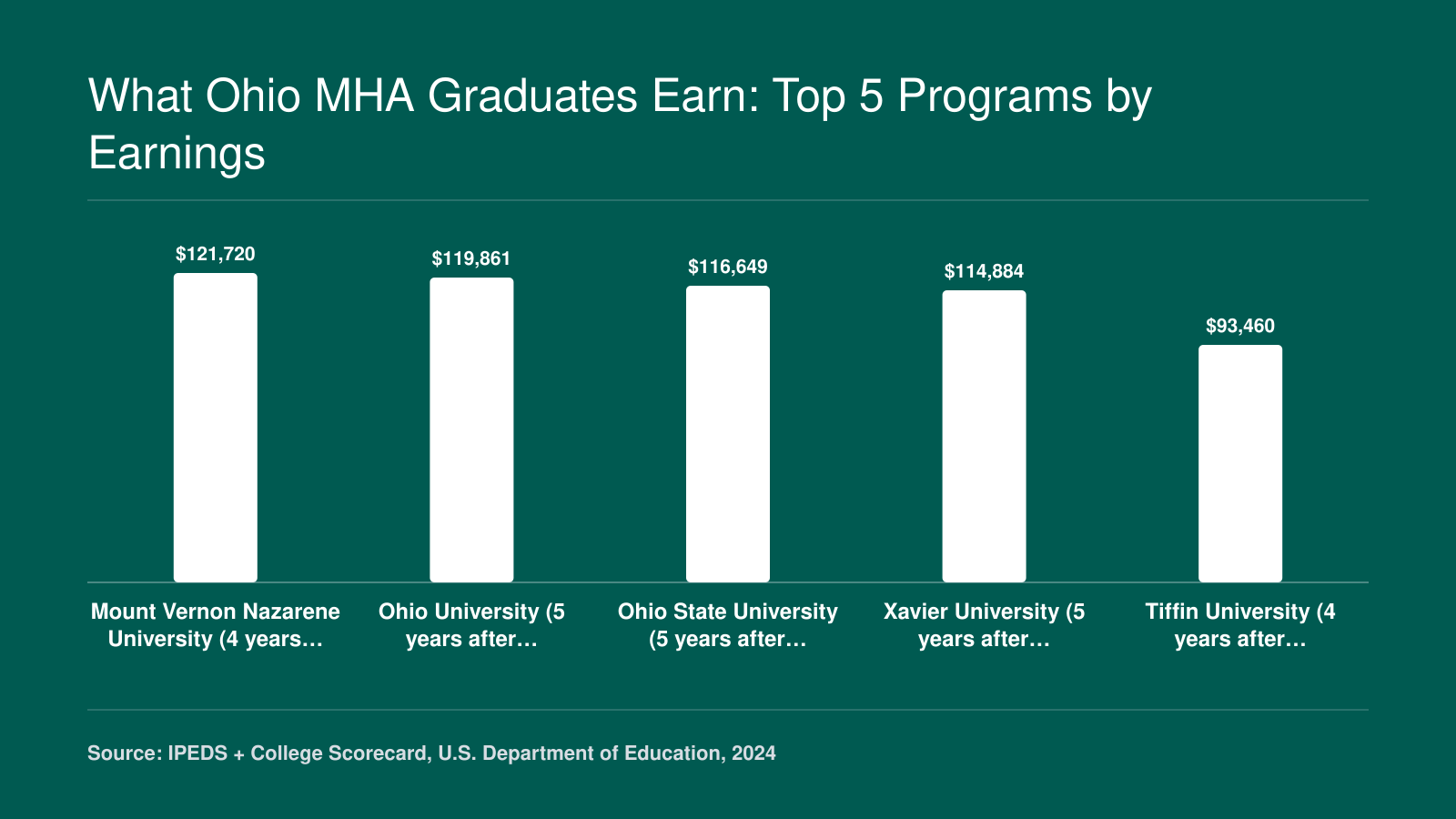
What Ohio MHA Graduates Earn: Top 5 Programs by Earnings
These are median earnings for graduates of each school's healthcare administration master's program. The measurement window differs by school, so each label states how long after finishing the figure was taken. Compare across windows with care. Median program debt was $27,971 at Mount Vernon Nazarene University, $37,230 at Ohio University, $30,883 at Ohio State University, $44,500 at Xavier University, and $36,426 at Tiffin University. Mount Vernon Nazarene pairs the highest earnings here with the lowest debt, while Xavier carries the heaviest debt of the group.
Frequently asked questions
Is a master's in healthcare administration worth it?
For people aiming at management and leadership in healthcare, it usually is — most director- and executive-level roles expect a graduate degree, and healthcare management is among the fastest-growing management fields. Whether a specific program is worth it depends on its cost, completion rate, and what its graduates actually earn, which is exactly what the ranking on this page compares.
MHA vs. MBA — which is better for healthcare?
An MHA goes deep on healthcare — operations, policy, financing, and the regulatory environment specific to the industry. An MBA (or MBA with a healthcare concentration) is broader business training that travels across industries. Choose the MHA if you're committed to healthcare and want role-specific depth; choose the MBA if you want general management flexibility or may work outside healthcare. Many schools offer both, and some offer a dual degree.
Can you get an MHA online?
Yes — online and hybrid MHA programs are widely available and common, since much of the coursework suits remote study. Look for the same CAHME/regional accreditation you'd want in an on-campus program. Use the "Online" filter on the ranking to see programs with an online option.
Do you need the GRE for an MHA?
Increasingly, no. A large and growing share of MHA programs have made the GRE optional or dropped it, weighting your undergraduate record and work experience instead. Requirements vary by school, so check each program.
How long does an MHA take?
Most full-time MHA programs run about two years; accelerated options can finish in roughly 12–18 months, and part-time or online formats built for working professionals may take longer. Program length and total credits are listed per school where available.
Compare Healthcare Administration programs on the data that matters
Explore more Business & Management specializations or browse every graduate field.
All Business & Management programs