Best MPH Programs
Compare 440+ accredited Public Health (MPH) programs, with graduate earnings, cost, debt, and completion data from IPEDS and the U.S. College Scorecard.

A CEPH-accredited MPH at the University of Florida lists graduate tuition near $12,737 for residents. The same credential at USC runs about $71,515. Both take roughly two years, both require applied practice hours, and both qualify a graduate to sit for the CPH exam.
Format widens the gap further. UNC Chapel Hill delivers its MPH in a hybrid format with 200 practice hours; UCLA's community health sciences track requires 400 field hours on a weekday campus schedule.
Much of public health hiring sits in government agencies, hospital systems, and nonprofits, where salary bands are set by grade and funding source rather than by the name on the diploma.
Key Points
- Boston University's 2026-2027 MPH budget totals $97,357, with $73,024 of it tuition.
- Five of the ten ranked programs are fully online, and the rest are hybrid or on campus.
- Yale's total estimated cost runs $28,132 above its tuition and fees.
10 MPH Programs in the USA for 2027
Here are 10 MPH programs that combine strong public health training with different delivery formats and price points. The cards highlight concentrations, credit hours, and early-career earnings where they are reported so you can compare programs side by side.
Harvard University
#1Cambridge, MA · $55,000 – $60,000/yr (est.)
Best for: Working professionals needing flexible online study
Harvard's online MPH Generalist is a part-time, 45-credit program built for working professionals, with asynchronous courses and optional live sessions. Students complete an Applied Practice Experience and can add certificates in Healthcare Management or Applied Data Analysis. One year after finishing, median earnings are about $108,000, and the university graduates 98% of students overall.
- CEPH accredited
- 45 total credit hours
- Part-time, 2-year format with asynchronous courses and optional live sessions
- Applied Practice Experience (practicum) required
- Healthcare Management Certificate option
- Applied Data Analysis Certificate option
Columbia University in the City of New York
#2New York, NY · ~$58,000/yr (est.)
Best for: Students wanting rigorous campus cohort
Columbia's campus-based MPH spans two years and integrates seven components, from core courses and certificates to a practicum, leadership training, and a chosen department. Students pick a department among Biostatistics, Environmental Health Sciences, Epidemiology, Health Policy and Management, Population and Family Health, or Sociomedical Sciences. The university graduates 96% of students overall, and median earnings one year after finishing are about $72,000.
- CEPH accredited
- 6 concentration options
- 2-year program
- Integrates seven program components
- Interdisciplinary, integrated, collaborative
University of California-Berkeley
#3Berkeley, CA · ~$16,000/yr (est.)
Best for: California residents pursuing hybrid public education
UC Berkeley's hybrid MPH combines online coursework with two brief on-campus sessions, so working professionals can complete much of the degree from a distance. Students choose from 11 concentrations, including epidemiology and health policy and management, and no entrance exam is required. The university graduates 93% of students overall.
- CEPH accredited
- 11 concentration options
- No entrance exam required
- Test optional
- Hybrid program with two on-campus sessions
Johns Hopkins University
#4Baltimore, MD · ~$65,000/yr (est.)
Johns Hopkins offers an unusually flexible MPH that can be completed in 11 months to 4 years, onsite, online, or hybrid. The 80-credit curriculum includes a 100-hour practicum and a capstone, with concentration options such as aging and public health and epidemiologic and biostatistical methods. One year after finishing, median earnings are about $71,000, and the university graduates 94% of students overall.
- CEPH accredited
- 13 concentration options
- No entrance exam required
- Test optional
- As little as 11 months or up to 4 years
- 80 total credit hours
- 100 clinical hours
- Capstone required
University of Maryland-College Park
#5College Park, MD · ~$18,000/yr (est.)
Maryland's 45-credit MPH is a two-year, cohort-based program anchored in the Maryland/DC region, with nine concentrations and an online Public Health Practice and Policy track. Students complete an integrated core in epidemiology, biostatistics, and policy, followed by internships and capstone projects with government and nonprofit employers. One year after finishing, median earnings are about $73,000, and the university graduates 89% of students overall.
- CEPH accredited
- 9 concentration options
- 2-year program
- 45 total credit hours
- Integrated core courses in epidemiology, biostatistics, policy
- Located in Maryland/DC national capital region
- Cohort-based learning model
- Opportunities for internships and capstone projects
University of Florida
#6Gainesville, FL · ~$13,000/yr (est.)
Florida's CEPH-accredited MPH offers six concentrations, including biostatistics, environmental health, and epidemiology, available on campus or online. The 48-credit program includes an Applied Practice Experience and an Integrated Learning Experience, along with one-on-one faculty mentoring. One year after finishing, median earnings are about $55,000, and the university graduates 91% of students overall.
- CEPH accredited
- 6 concentration options
- 48 total credit hours
- One-on-one faculty mentoring
- Applied Practice Experience
- Integrated Learning Experience
- Online MPH option
- Campus MPH option
University of California-Los Angeles
#7Los Angeles, CA · ~$14,000/yr (est.)
UCLA's MPH in Community Health Sciences is a 68-quarter-credit, two-year program with a 400-hour applied practice placement in a health agency. It emphasizes health equity, program planning and evaluation, and offers an accelerated track for medical students. One year after finishing, median earnings are about $75,000, and the university graduates 93% of students overall.
- CEPH accredited
- 2-year program
- 68 total credit hours
- 400 clinical hours
- Capstone required
- Health equity and health disparities focus
- Field placement in U.S. or abroad
- Accelerated option for medical students
University of North Carolina at Chapel Hill
#8Chapel Hill, NC · ~$13,000/yr (est.)
UNC Gillings offers an online MPH with four concentrations, including applied epidemiology, health policy, leadership in practice, and nutrition. The curriculum starts with the Gillings Core and includes a 200-hour mentored practicum; no GRE is required, and students can choose full-time or part-time pacing. One year after finishing, median earnings are about $61,000, and the university graduates 91% of students overall.
- CEPH accredited
- 4 concentration options
- No entrance exam required
- Test optional
- Complete in 20-36 months
- 200 clinical hours
- Capstone required
- Full-time and part-time options
University of Southern California
#9Los Angeles, CA · ~$72,000/yr (est.)
USC's MPH requires 42 semester units of core courses, then a specialization in one of five areas: biostatistics/epidemiology, community health promotion, global health, health services and policy, or generalist. The program includes a practicum and capstone, and is offered on-campus and online. One year after finishing, median earnings are about $59,000, and the university graduates 92% of students overall.
- CEPH accredited
- 5 concentration options
- 42 total credit hours
- Capstone required
- On-campus and online formats
- Prepares for government and non-profit careers
Cornell University
#10Ithaca, NY · ~$30,000/yr (est.)
Cornell's campus-based MPH follows a cohort model and builds broad public health knowledge plus a concentration in emergency preparedness, environment and climate, food systems, or infectious disease epidemiology. The 52-credit program includes an applied practice project and a portfolio documenting 40 competencies, and the university graduates 95% of students overall.
- CEPH accredited
- 4 concentration options
- 2-year program
- 52 total credit hours
- Full-time and part-time options
- Cohort-based structure
- In-person instruction mode
- Community-engaged projects with partners
Cost & outcomes by school
Federal data for the highest-earning Public Health (MPH) programs, independent of the ranking above. Earnings are this field's master's graduates four years after completing, where the Scorecard reports them.
| School | Earnings | Tuition / yr | Debt | Grads/yr | Format |
|---|---|---|---|---|---|
| Western Governors University UT | — | $9,320 | — | 50,258 | Online |
| Grand Canyon University AZ | — | $10,015 | — | 24,308 | Online |
| Liberty University VA | — | $8,730 | — | 19,236 | Campus |
| Walden University MN | — | $10,885 | — | 16,946 | Online |
| Arizona State University AZ | — | $10,843 | — | 14,144 | Campus |
| American College of Education IN | — | $6,600 | — | 9,876 | Online |
| Pennsylvania State University-Penn State New Kensington PA | — | $24,142 | — | — | Hybrid |
| Pennsylvania State University-Penn State Lehigh Valley PA | — | $25,234 | — | — | Hybrid |
| Pennsylvania State University-Penn State Altoona PA | — | $25,356 | — | — | Hybrid |
| University of North Texas TX | — | $9,091 | — | 9,932 | Campus |
| Capella University MN | — | $15,092 | — | 14,818 | Online |
| Columbia Southern University AL | — | $3,936 | — | 4,312 | Online |
Sources: U.S. Department of Education. Tuition and graduates: IPEDS. Earnings and debt: College Scorecard, this field's master's graduates; a dash means no figure is reported.
Inside Our Scoring: Outcomes Data Over Reputation
Graduate rankings are slowly being pulled away from reputation surveys, as federal reporting has made it possible to see what students in a specific degree actually earn and borrow.
Where the numbers come from
Every figure on this page traces back to a public federal dataset. Tuition, enrollment, and graduation rates come from the Integrated Postsecondary Education Data System, which schools are legally required to report. Earnings, median debt at graduation, and the number of degrees conferred come from the College Scorecard, which reports program-level outcomes where available, uses institution-wide figures where that is the best available, and leaves the metric blank when neither is published. Nothing here is drawn from a survey of deans, a self-submitted questionnaire, or a school's own marketing materials.
That distinction matters. Peer-assessment rankings reward research funding, faculty publication volume, and name recognition built over decades. Those things can be real markers of quality, but they do not tell a student whether an MPH from a given school pays back its cost.
What this data cannot tell you
We would rather flag the gaps than paper over them:
- Net price is an institution-wide average after grant aid, so it reflects the whole university, not the public health school specifically.
- Graduation rates are also campus-wide and skew toward undergraduates.
- Some MPH programs have no published earnings at all, usually because the graduating cohorts are too small to report without risking student privacy. A blank is not a bad result; it is a blank.
How to use the list
Build a shortlist of four or five programs based on format, concentration, and total cost first, whether that means online MPH programs or a campus-based cohort. Then confirm current CEPH accreditation status and check admissions requirements with each program before you apply.
CEPH Accreditation Check: Who's Accredited and When It Was Last Confirmed
CEPH accreditation matters because it determines eligibility for the Certified in Public Health (CPH) exam, it is often expected in federal and state public health job postings, and some fellowships require a CEPH-accredited degree. CEPH accredits two kinds of units: a School of Public Health (SPH), which is a full college-level unit with multiple departments, and a standalone Public Health Program (PHP), which accredits a narrower set of degrees. Both can lead to an accredited MPH, but a PHP usually offers fewer concentrations and a smaller faculty, so check that the specialty you want is covered. In the CEPH list as of October 2026, Brown is the only school in our top 10 accredited as an SPH, and every school is listed as accredited. Florida State and the University of Tennessee, Chattanooga show terms running through 12/31/2026, so confirm their current status before you apply. Verify any school yourself on ceph.org by searching the accredited schools and programs list, and confirm that your specific degree, including any online MPH track, sits inside the accredited unit.
| School | CEPH Unit Type | Accreditation Status | Last Accreditation Action / Term Through |
|---|---|---|---|
| Brown University | School of Public Health | Accredited | 12/31/2028 |
| Adelphi University | MPH Program | Accredited | 07/01/2027 |
| Charles R. Drew University of Medicine and Science | MPH & BSPH Programs | Accredited | 07/01/2032 |
| Fairfield University | Public Health Program | Accredited | 07/01/2030 |
| Florida State University | MPH Program | Accredited | 12/31/2026 |
| Louisiana State University-Shreveport/Louisiana State University Health Sciences Center-Shreveport | MPH Program | Accredited | 07/01/2028 |
| Sacred Heart University | MPH Program | Accredited | 07/01/2030 |
| Tennessee State University | BS & MPH Programs | Accredited | 07/01/2028 |
| University of Illinois at Springfield | MPH Program | Accredited | 07/01/2028 |
| University of Tennessee, Chattanooga | MPH Program | Accredited | 12/31/2026 |
Related Articles
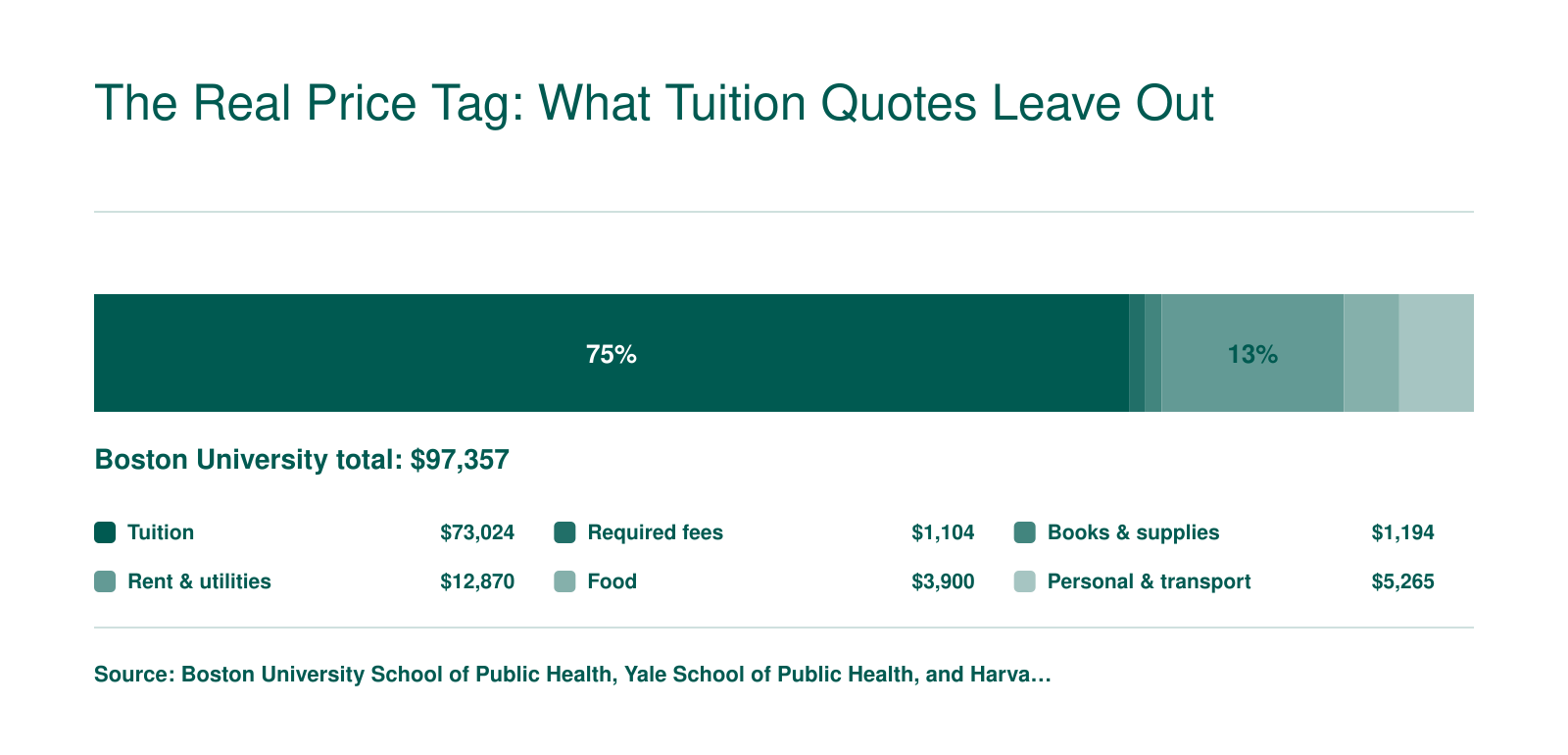
The Real Price Tag: What Tuition Quotes Leave Out
Boston University's published 2026-2027 budget for full-time MPH students totals $97,357, and tuition is $73,024 of it. At Yale, tuition and fees come to $57,931, but the school's total estimated cost is $86,063, so about $28,132 sits outside the tuition bill. Published budgets rarely price practicum travel, background checks, or unpaid hours, so those costs come on top.
Fully Online, Hybrid, or on Campus: How MPH Formats Really Differ
The word "online" now covers everything from fully remote coursework to programs that still bring you to campus and require you to log in at fixed times.
How the Top 10 Split
Among the ten ranked programs, five are listed as campus-based (Columbia, Maryland, UCLA, USC, Cornell), four as hybrid (Berkeley, Johns Hopkins, Florida, UNC), and one as online (Harvard). Berkeley's hybrid format includes two on-campus sessions. Florida offers both an online and a campus option. Hopkins lists an online/part-time format with 2026 starts in January, June, and November, and January 2027, but the sources we reviewed do not say whether it carries residency or live-session requirements. Ask the program directly.
Hidden In-Person and Live Requirements
- UNC Gillings MPH@UNC: Classes meet live on Zoom, with recordings available on demand. The program also holds an in-person Immersion, next scheduled for November 12 to 13, 2026, in Chapel Hill. There is no fee, but you pay for your own lodging and travel. We could not confirm whether attendance is mandatory, so confirm before assuming you never have to visit.
- George Washington MPH@GW: Coursework is typically asynchronous, yet weekly live Zoom sessions are mandatory, usually 80 to 90 minutes. The accelerated version asks for roughly 120 minutes of faculty-led and 90 minutes of student-led sessions each week.
- Harvard: The online listing mentions an optional campus visits program.
We could not verify current immersion, residency, or live-session rules for the University of South Florida or Tulane, so check their pages yourself.
Which Ones Avoid Campus Entirely?
GW is the clearest case: no required immersion or residency turned up in our research. That does not guarantee every pathway is fully remote, and the live-session schedule is a real commitment if you work across time zones or irregular shifts. Get the no-campus claim in writing from admissions.
Two Checks Before You Apply
First, confirm the online MPH sits inside the school's CEPH-accredited public health unit, not a separate college offering a similarly named degree. Second, if you live outside the school's state, ask whether it is authorized to enroll students where you reside. This matters most for practicum placements and licensure-linked roles.
Getting in: GRE Waivers, Deadlines, and What Admissions Committees Want
Requirements differ by school and sometimes by department, so confirm details for your specific concentration. We could not verify current MPH policies for Michigan or UNC, so check those schools directly.
- SOPHAS vs. direct application, and timingEmory and Columbia both use SOPHAS, the centralized public health application. Boston University's requirements page does not state whether it participates, so check before you start. Fall applications generally open the summer before. Emory's priority deadline is January 5, 2027 and BU's is January 15, 2027. Johns Hopkins' listed deadline of September 15, 2026 is for the January 2027 term, not fall.
- GRE policyEmory does not require or consider the GRE, though its Biostatistics and Bioinformatics department treats it as optional. BU does not require or consider it. Columbia listed the GRE as optional for Fall 2026, but policies can vary by program, so verify yours.
- GPA and quantitative courseworkEmory has no single required GPA and reviews applications holistically, though 3.0 or higher is competitive. Its MPH in Epidemiology asks for one college math course and one college science course.
- Statement, recommendations, and experienceExpect transcripts, a personal statement, a resume or CV, and three letters of recommendation (Columbia's requirement). Public health or related work experience strengthens the file.
- English proficiency for international applicantsColumbia accepts TOEFL, IELTS, or Duolingo scores. International applicants may also need a credential evaluation. Emory prefers international applications by May 1, 2027, and BU's international final deadline is April 1, 2027.
- Alternative evidence of readinessWhere test scores are not considered, the rest of your file carries more weight. Columbia lists quantitative or analytical evidence among its typical requirements, so strong statistics grades, graduate coursework, or analytical work experience can help. Ask admissions whether a specific substitute is accepted.
Public Health (MPH) programs by state
Compare Public Health (MPH) programs on the data that matters
Explore more MPH specializations or browse every graduate field.
All MPH programs