Best Master's in Health Education Programs
Compare 180+ accredited Health Education programs at 150+ schools, with graduate earnings, cost, debt, and completion data from IPEDS and the U.S. College Scorecard.

The job title "health education specialist" sits behind a credential: most employers want the CHES certification from NCHEC, and a growing number ask for the master's-level MCHES. That one requirement reshapes the decision. A degree that maps its coursework to NCHEC's competency areas gets you ready for the exam; one that doesn't leaves you studying on your own time.
The programs here split three ways in practice: CHES-aligned health promotion tracks, licensure paths toward classroom teaching, and MPH concentrations aimed at community and population health roles. They rarely lead to the same job.
We ranked 29 schools (37 program listings), online and campus formats both, on verifiable outcomes rather than name recognition. Published earnings and program debt remain thin across much of this field, which makes format, cost, and credential fit the levers that actually move your result.
Key Points
- Of 29 tracked programs, 20 are campus-based and six are hybrid.
- Rankings use federal IPEDS and College Scorecard data, not reputation surveys.
- Choose NCHEC-aligned coursework to prepare for CHES and later MCHES steps.
The 10 Best Master's in Health Education Programs for 2027
This ranking is built on verifiable outcomes data, not reputation surveys or prestige. We looked at graduate earnings, institution-wide graduation rates, and net price across federal sources to identify master's programs that combine strong career preparation with realistic costs.
University of California-Berkeley
#1Berkeley, CA · ~$16,000/yr (est.)
Best for: Social determinants scholars wanting hybrid public health training
UC Berkeley's Health and Social Behavior MPH is built around social and behavioral determinants of health, with a strong emphasis on race, culture, and gender across the curriculum. The 48-unit program combines core public health training with a required 12-week internship and a capstone comprehensive exam. The university's high institution-wide graduation rate and strong graduate earnings signal a powerful return for the degree's modest in-state tuition. The hybrid format and optional GRE make it accessible to experienced health professionals who need flexibility without losing Berkeley's research depth.
- Two-year hybrid online and campus program
- 48 units required for completion
- Required 12-week public health internship
- Focus on race, culture, and gender across courses
- Two years of health-related work experience required
- GRE scores optional for admission
- Average admitted GPA approximately 3.69
- Capstone comprehensive exam required
Yale University
#2New Haven, CT · ~$50,000/yr (est.)
Best for: Aspiring health behavior change leaders needing campus rigor
Yale's MPH with a Health Behavior Change concentration is an intensive two-year campus program that combines biostatistics, epidemiology, and social justice with specialized electives and an applied practice experience. Graduates complete a thesis or capstone, and the school's extremely high completion rate and strong alumni earning power are backed by Yale's national reach. The program is a fit for students who want rigorous, campus-based training and a broad public health skill set rather than an online convenience program.
- Two-year campus-based program
- Core courses include biostatistics, epidemiology, and social justice
- Applied practice experience included
- Master's thesis or capstone required
- Part of Yale School of Public Health
Columbia University in the City of New York
#3New York, NY · ~$58,000/yr (est.)
Best for: Community health educators seeking CHES certification eligibility
Columbia's Master of Science in Community Health Education is a CEPH-accredited 42-credit program that explicitly prepares graduates for CHES certification. The curriculum spans epidemiology, biostatistics, social marketing, and program planning, and includes a 180-hour fieldwork practicum and capstone portfolio. Columbia's strong institution-wide completion rate and very high graduate earnings make it a high-cost, high-return option for students who want a New York City health education network.
- 42 credits, two-year full-time or part-time
- CEPH accredited
- 180-hour fieldwork practicum required
- Capstone portfolio required
- Coursework in epidemiology, biostatistics, social marketing, and program planning
- Eligible for CHES certification
- Application fee of $75
University of California-Los Angeles
#4Los Angeles, CA · ~$14,000/yr (est.)
UCLA's MPH in Community Health Sciences with a Health Promotion and Health Education concentration is a campus-based program located in one of the nation's most diverse public health environments. The program emphasizes health promotion strategies and community wellness, with access to UCLA's deep public health faculty. The university's strong graduation rate and competitive in-state tuition make it especially appealing for California residents weighing cost against long-term public sector earnings.
- Campus-based program in Los Angeles, CA
- Concentration in Health Promotion and Health Education
- Offered through Department of Community Health Sciences
- Contact department for faculty roster and course descriptions
University of California-San Diego
#5La Jolla, CA · $15,000 – $20,000/yr (est.)
UC San Diego's MPH with a Health Behavior concentration explores how behavioral, social, and cultural factors shape health and disparities. The two-year campus program includes core public health disciplines and prepares students for population health careers in research, policy, and practice. Its solid graduation rate and in-state tuition structure offer a practical California option for students focused on health equity.
- Two-year campus-based program
- Concentration in Health Behavior
- Examines behavioral, social, and cultural factors affecting health
- Bachelor's degree required for admission
University of Florida
#6Gainesville, FL · ~$13,000/yr (est.)
The University of Florida's online Master of Science in Health Education and Behavior is designed around the CHES exam, with the program reporting an 82.6% pass rate. Students can choose among several online concentration paths, including health communication, health promotion for priority populations, and patient health education, while completing coursework that covers program planning, implementation, and evaluation. The fully online format and competitive in-state tuition make it a strong value for working professionals who need flexibility. Florida's institution-wide graduation rate is strong, and the program's alumni earnings are solid for the health education field.
- Online program format
- No concentration specified
- Customizable electives available
- Covers program evaluation and health promotion
- Flexible for working professionals
- Health communication concentration
- Fully online, no campus visits required
- Prepares for CHES exam
- Flexible scheduling options
- Expert faculty guidance
- Health promotion for priority populations concentration
- 100% online program
- CHES exam preparation
- No on-campus requirements
- Diverse student community
- Patient health education concentration
- Online program delivery
- Experiential learning components
- Financial aid options available
- Support for dietitian exam prep
University of Virginia
#7Charlottesville, VA · ~$24,000/yr (est.)
The University of Virginia's MPH offers campus-based training with concentrations in Research in Practice, Health Policy, and Law & Ethics. The program emphasizes quantitative and qualitative research methods, health policy analysis, and community partnerships. UVA's very high institution-wide graduation rate and strong institutional outcomes add confidence to the degree, while the in-state tuition is competitive for a flagship public university.
- Campus-based program in Charlottesville, VA
- Concentrations in Research in Practice, Health Policy, Law & Ethics
- Focus on quantitative and qualitative research methods
- Community partnerships emphasis
- Nationally accredited
University of California-Irvine
#8Irvine, CA · ~$15,000/yr (est.)
UC Irvine's MPH is a CEPH-accredited campus program offering concentrations in Biostatistics, Community Health, and Epidemiology. Students complete six quarters full-time or can pursue the degree part-time, with coursework that builds data analysis, policy, and leadership skills. The university's solid graduation rate and accessible in-state tuition make it a practical public health option in Orange County.
- Campus-based program
- Six quarters full-time, part-time option available
- CEPH accredited
- Concentrations available in Biostatistics, Community Health, and Epidemiology
- Includes practicum experience
- Prepares for doctoral studies
Dartmouth College
#9Hanover, NH · $65,000 – $70,000/yr (est.)
Dartmouth's MPH is available as an 11-month on-campus program or a 22-month online option, with the on-campus clock running at $79,450 and the online path at $39,725 per year. The program focuses on health policy and clinical practice, and includes an applied practice experience and practicum project. Dartmouth's very high institution-wide graduation rate and national name recognition make it a premium choice for students who can afford the tuition or secure merit scholarships.
- 11-month on-campus or 22-month online option
- On-campus tuition $79,450
- Online tuition $39,725 per year
- Merit scholarships available
- CEPH accredited
- Focus on health policy and clinical practice
Northwestern University
#10Evanston, IL · ~$55,000/yr (est.)
Northwestern's Master of Science in Health Professions Education is a two-year, part-time hybrid program for clinicians and educators who want formal training in curriculum development and educational leadership. The format combines online courses with four in-person residencies and culminates in a mentored capstone project. The university's strong institution-wide graduation rate and national brand make it attractive, though its higher net price means it is best for those with employer support or specific education leadership goals.
- Two-year part-time hybrid program
- Four in-person residencies required
- Focus on curriculum development
- Capstone project with mentoring
- Designed for clinicians and educators
- Eight core courses offered
Cost & outcomes by school
Federal data for the highest-earning Health Education programs, independent of the ranking above. Earnings are this field's master's graduates four years after completing, where the Scorecard reports them.
| School | Earnings | Tuition / yr | Debt | Grads/yr | Format |
|---|---|---|---|---|---|
| University of West Florida FL | $111,363 | $9,062 | — | 66 | Online |
| University of California-Los Angeles CA | $110,900 | $14,476 | $52,445 | 198 | Campus |
| Arizona State University AZ | $100,713 | $10,843 | $32,995 | 42 | Online |
| Arizona State University AZ | $100,713 | $13,587 | $32,995 | 1 | Online |
| University of Kentucky KY | $100,253 | $14,644 | $40,014 | 53 | Online |
| Nova Southeastern University FL | $98,338 | $24,830 | $51,097 | 36 | Online |
| University of Maryland-College Park MD | $96,194 | $18,276 | $41,326 | 118 | Campus |
| University of Nevada-Reno NV | $93,116 | $7,032 | $43,452 | 52 | Campus |
| University of Alabama at Birmingham AL | $91,073 | $8,640 | $32,000 | 276 | Online |
| California State University-Long Beach CA | $88,743 | $8,898 | $26,210 | 40 | Campus |
| University of Minnesota-Twin Cities MN | $88,156 | $22,017 | $45,315 | 155 | Online or campus |
| University of New Mexico NM | $87,995 | $9,860 | $32,069 | 37 | Online |
Sources: U.S. Department of Education. Tuition and graduates: IPEDS. Earnings and debt: College Scorecard, this field's master's graduates; a dash means no figure is reported.
Cost, debt & payoff
Median earnings of this field's master's graduates (4 yrs after completing) vs. their median federal loan debt · U.S. College Scorecard
Across these programs the median graduate earns about $81,983 and finishes with roughly $39,823 in debt — a ratio that clears a common rule of thumb (keep debt below first-year salary). Tuition and debt vary widely school to school, so check the per-school figures in the table above before you shortlist.
How We Rank Health Education Master's Programs
What the Data Covers
The hardest part of choosing a health education master's is separating a famous name from a program that pays off on what you'll spend. Our ranking uses IPEDS and College Scorecard figures rather than reputation. That data covers graduate tuition, net price, graduation rate, and any program-level earnings and debt the government publishes. That's how the University of Florida, with in-state graduate tuition of $12,737 and an online format, lands in the same top 10 as Yale and Columbia, where graduate tuition runs roughly $49,500 to $58,000.
Where the Numbers Fall Short
Know the limits. The graduation rate and net price describe the whole institution, not the health education program itself. Program-level earnings are reported only when enough graduates complete in a given window, so small cohorts are often suppressed. For the programs on this list, program-specific earnings are not yet available. Treat any single figure as a signal, not a verdict.
Every ranked school holds regional (institutional) accreditation. Programmatic accreditation, such as CEPH for public health degrees, is a separate question covered in our Best MPH Programs and online MPH programs comparisons below.
How to Use This List
Use the ranking to build a shortlist. Then do the checking no dataset can do for you:
- CHES eligibility: Confirm the curriculum meets the coursework requirements for the Certified Health Education Specialist exam.
- Licensure fit: If you plan to teach health in K-12 schools, verify the program leads to licensure in your state.
Online vs. Campus Health Education Master's Degrees: What Changes, What Doesn't
Does an online health education master's still put you in the field? Almost always, yes. The format changes where you take classes, not whether you do supervised practice.
The format mix skews campus
Most of the programs ranked here are delivered on campus, a smaller group runs as hybrids that pair online coursework with periodic residencies or weekly in-person sessions, and only a handful are built for fully online study. The University of Florida's health education and behavior master's, Purdue's MPH with a family and community health concentration, and Clemson's cohort-based online MPH are the clearest fully remote options. Hybrids like Northwestern's health professions education degree and NC State's health professions education M.Ed. sit in between, with online terms punctuated by scheduled campus time.
Fieldwork does not disappear online
Online health education master's programs generally require somewhere between 160 and 300 supervised practicum hours. The 200-hour applied practice experience is the common benchmark at CEPH-accredited MPH programs, and Purdue's online track states that figure outright; Georgia's campus MPH asks for 300 hours. In online programs, students usually identify a local site themselves rather than receiving a faculty-assigned placement, then submit it for approval. Typical settings include county health departments, community nonprofits, hospitals, and federal agencies. A qualified preceptor must supervise the work, and many programs allow a placement with your current employer as long as the project is distinct from your regular job duties.
Ask about placement support before you deposit
State authorization for field placements is handled case by case, so a school licensed to enroll you online may still need approval before you can complete supervised hours in your state. Ask admissions directly: who finds the site, who vets the preceptor, and whether your state has caused problems before.
Online suits working health professionals with existing community contacts who can source a site quickly. Campus and hybrid formats favor career changers who want faculty-brokered placements, cohort networking, and direct access to local health agencies.
Related Articles
Master's in Health Education vs. MPH: Which Degree Fits Your Goals?
Both degrees train people to improve health outcomes, but they aim at different parts of the problem. A master's in health education teaches you to design, deliver, and evaluate programs that change individual and group behavior: how to assess what a community needs, build a curriculum or campaign, and measure whether it worked. An MPH trains you in population health science: epidemiology, biostatistics, environmental health, policy, and systems-level practice, with health promotion usually available as one concentration among several.
Coursework and career paths
Health education core sequences lean on health behavior theory, program planning, communication, instruction, and evaluation. MPH cores are built on the foundational public health competencies and anchor in epidemiology and biostatistics. Health education graduates typically become health education specialists, wellness coordinators, patient education staff, or school health teachers. MPH graduates more often move into analyst, surveillance, policy, or agency program roles. The split is not absolute: many health education master's programs include epidemiology and community assessment, and plenty of MPH students concentrate in health promotion.
Accreditation, decoded
This is where applicants get tripped up. CEPH accredits schools and programs of public health1, which covers MPH degrees and health education programs that are classified as public health programs. A master's in health education does not automatically need CEPH accreditation simply because of its title: many hold only institutional accreditation. If the degree leads to P-12 teaching licensure, the educator preparation side may involve CAEP, depending on your state's rules. SOPHE is a professional membership society supporting competencies, advocacy, and professional development.2 It is not an accreditor, and the CHES and MCHES credentials are awarded by NCHEC, not SOPHE. Either degree can qualify you to sit for CHES if the coursework maps to the responsibilities and competencies, so verify that mapping with the program directly.
The verdict
- Aspiring CHES-certified program planner: the health education master's is the more direct route.
- School health teacher: choose an education-housed program with a licensure pathway.
- Epidemiology-leaning analyst: take the CEPH-accredited MPH.
Median Pay for Health Education Specialists
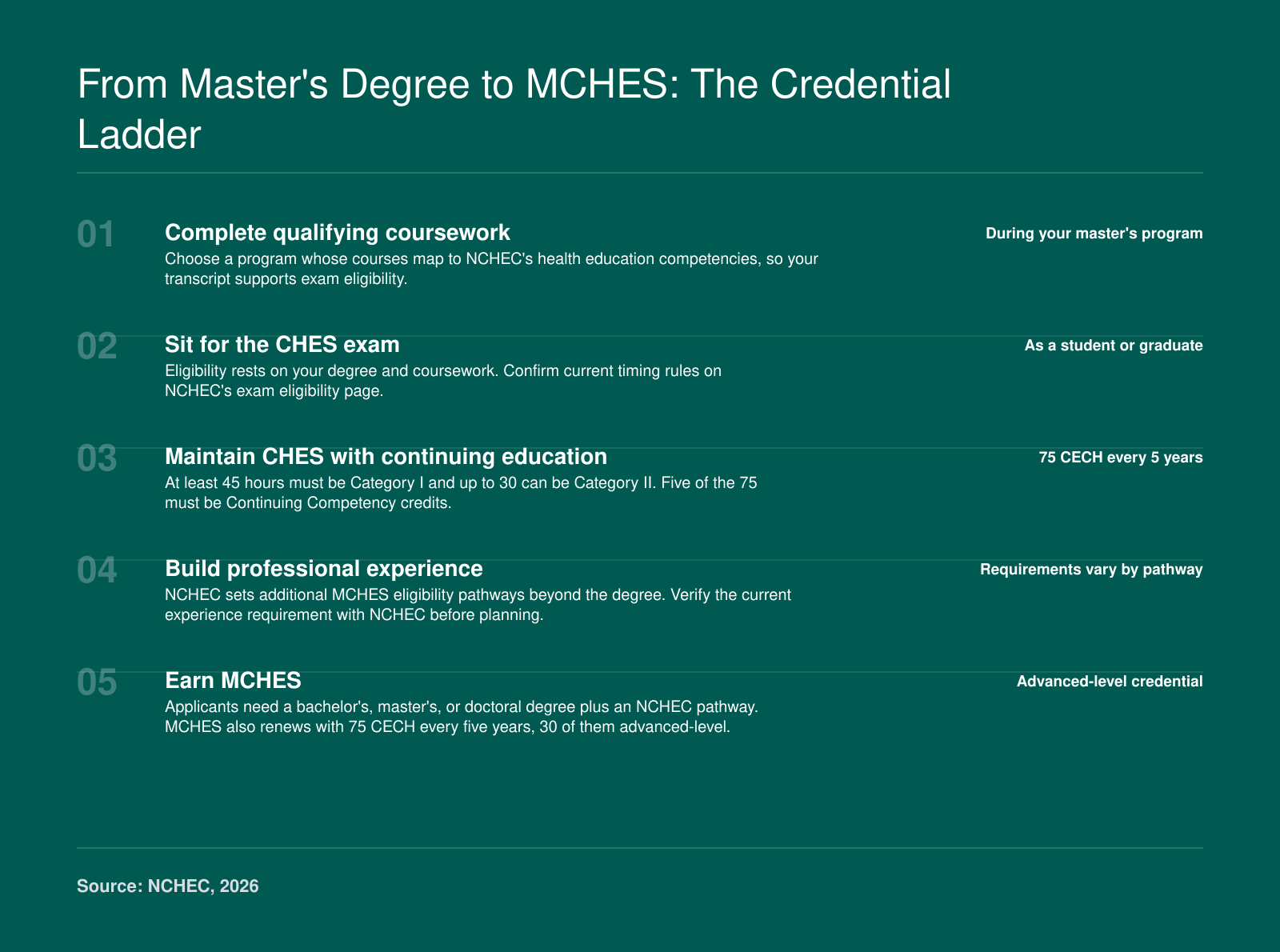
From Master's Degree to MCHES: The Credential Ladder
Your degree is the first rung, not the last. That is why credential-mapped coursework matters when you choose a program: a curriculum aligned to NCHEC competencies prepares you for the exam and starts the clock on every later step.
What You Need to Apply to a Health Education Master's Program
Requirements vary by school and by track (non-teaching health promotion versus licensure-oriented health education), so confirm details with each program. Most 2026 applications look like this.
- Bachelor's degreeA bachelor's degree is the baseline at every program we reviewed. Some schools prefer a health-related major, and others accept any major but may add prerequisites to fill gaps.
- Minimum GPAPublished minimums run from 2.5 (University of South Alabama) to 3.25 (University of Central Arkansas, Eastern Illinois University). Texas State lists 2.75, and Idaho State and the University of Florida list 3.0. Meeting the minimum does not guarantee admission, and some schools measure upper-division or recent coursework rather than the overall GPA.
- GREMany programs have dropped it. Idaho State, the University of Florida, American University, and Texas State do not require it. Others still do: Central Arkansas asks for a GRE under five years old with a 3.0 Analytical Writing score unless you qualify for an exemption, and Cincinnati lists the GRE, GMAT, or MCAT. South Alabama accepts the GRE or MAT for applicants below its GPA minimum.
- Prerequisite courseworkThere is no universal list. Delaware's Health Promotion MS expects psychology, sociology, and statistics, plus health-related courses. South Alabama may add prerequisites if your major coursework falls short. Check for biology, anatomy, or statistics requirements if your background isn't in health.
- Essay, recommendations, and resumeExpect a statement of purpose or career-goals essay, plus one to three recommendation letters: American asks for one, Idaho State and Cincinnati two, Delaware three. American also requires a resume. International applicants need English scores, such as a TOEFL of 80 at Florida or 100 at Delaware.
- Teaching-track extrasIf you are pursuing licensure, ask whether the program requires a basic skills test or background check. We found no single national standard, so these rules depend on the school and state.
Cost, Net Price, and ROI Across Health Education Schools
The tuition figures below are graduate tuition and fees only; they exclude program-specific costs like practicum or field experience fees, online or distance learning fees, background checks, and the CHES exam. The CHES exam fee ranges from $230 to $400 depending on application timing and student status, and additional processing or transfer fees may apply. Net price is an institution-wide average after all federal, state, and institutional aid, not a personalized quote; a simple ROI check compares your total expected debt against the median annual wage for health education specialists cited earlier in this guide.
| School | In-State Tuition | Out-of-State Tuition | Net Price (After Aid) | Median Debt | 10-Year Monthly Payment | ROI Ratio |
|---|---|---|---|---|---|---|
| Johns Hopkins University | $65,230 | $65,230 | $18,809 | $10,250 | N/A | 8.54 |
| Yale University | $67,250 | $67,250 | $23,777 | $12,975 | $711 | 7.75 |
| University of California-Berkeley | $16,347 | $50,547 | $13,481 | $13,000 | N/A | 7.11 |
Health Education programs by state
Frequently Asked Questions About Health Education Master's Degrees
These answers cover the questions prospective students ask most about cost, value, length, and CHES timing. Figures vary by school and format, so confirm current numbers with each program before you apply.
How much does a master's in health education cost?
Is a master's in health education worth it?
How long does a master's in health education take, and how many credits is it?
Can I sit for the CHES exam before I finish my degree?
Compare Health Education programs on the data that matters
Explore more Healthcare specializations or browse every graduate field.
All Healthcare programs