Best Master's in Health Education Programs in Missouri
Compare 6 accredited Health Education programs in Missouri, with graduate earnings, cost, debt, and completion data from IPEDS and the U.S. College Scorecard.

A master's in health education trains people to design and evaluate programs that change health behavior, in schools, hospitals, community agencies, and public health departments. Many Missouri programs lead toward CHES eligibility, though some target health professions educators or K-12 teachers instead, so the label "health education" covers different careers.
The tension is cost against payoff. Tuition here runs from roughly $7,400 a year at one online program to over $43,000 at another, and program-level graduate earnings span a similarly wide range. Campus, online, and hybrid formats compete directly, and the most affordable master's in health education programs are not always the ones that fit a CHES-track career.
Key Points
- Program-level median earnings range from $48,502 to $112,869, but the measurement windows differ.
- Mizzou, Northwest Missouri State and A T Still offer online or hybrid paths.
- CHES and MCHES are voluntary national credentials, and Missouri requires no state license.
Best Master's in Health Education Programs in Missouri, Ranked
Missouri's master's options in health education range from a CEPH-accredited online MPH to campus programs in health promotion and hybrid degrees for health professions educators. Not every program is built for CHES-track health educators, so check each card for what the program actually teaches and what it says about certification.
University of Missouri
#1Columbia, MO · ~$14,000/yr (est.)
Best for: Online learners targeting health policy careers
The University of Missouri offers an online Master of Public Health with a Health Promotion and Policy emphasis, and the program is CEPH-accredited. The emphasis pairs health promotion coursework with a policy focus through ties to the Truman School of Government and Public Affairs. The school has a graduation rate of about 75%, and its average net price is roughly $20,000 as an institution-wide estimate. Mizzou states that CHES candidates need at least 25 credit hours of health education coursework with a C or better, so students should confirm their plan of study against that threshold.
- Fully online format
- CEPH-accredited MPH
- 42 credit hours
- Health Promotion and Policy emphasis
- 150-hour public health agency internship
- Applications go through SOPHAS
- Policy focus tied to the Truman School
- Covers maternal health, substance use and aging populations
University of Missouri-Kansas City
#2Kansas City, MO · $14,000 – $32,000/yr (est.)
Best for: Clinicians moving into health professions teaching
The University of Missouri-Kansas City offers a hybrid Master of Health Professions Education aimed at working professionals who want to teach or lead in health education settings. It focuses on applying learning principles and educational research rather than community health promotion. The school has a graduation rate of about 55%. This program does not appear to be a CHES-track degree, so it suits educators more than public health practitioners.
- Hybrid format
- 33 credit hours
- Two to three courses per semester
- Bachelor's degree or relevant experience accepted
- TOEFL or IELTS for international applicants
- Elective courses available
- No concentration specified
Northwest Missouri State University
#3Maryville, MO · $5,000 – $10,000/yr (est.)
Best for: K-12 educators advancing in physical education
Northwest Missouri State University offers an online Master of Science in Education in Health and Physical Education, built for teachers and coaches seeking advancement. It is one of the lower-priced options in the state, with the same tuition for in-state and out-of-state students. The school has a graduation rate of about 54%. The program does not lead to licensure or certification, so it fits school-based roles rather than CHES-track work.
- Online delivery
- 30 credit hours
- About $407 per credit
- Same tuition in-state and out-of-state
- Can be finished in as few as 12 months
- Minimum 2.75 GPA
- GRE score of 280 or higher is one option, and work experience is considered
- Adaptive physical education and curriculum development focus
Lindenwood University
#4Saint Charles, MO · ~$11,000/yr (est.)
Lindenwood University in Saint Charles offers hybrid Master of Science in Health Sciences options with on-campus and online components. Tracks lean toward fitness, wellness and sport performance rather than community health education. The school has a graduation rate of about 49%. Students interested in the public health side should note the curriculum includes some public health coursework, but it is not a CEPH-accredited MPH.
- Hybrid with on-campus and online options
- Public health, exercise physiology and nutrition coursework
- Business management components
- Aimed at health and fitness industry careers
- Hybrid format
- Strength and conditioning emphasis
- Exercise physiology focus
- Laboratory instruction included
- Research opportunities available
- Hybrid format
- No GRE required
- Minimum 3.0 GPA
- Prerequisites in key courses
- NSCA recognized program
- Rolling admissions
Missouri State University
#5Springfield, MO · ~$8,000/yr (est.)
Missouri State University in Springfield offers a campus-based Master's in Health Promotion and Wellness Management, the closest match on this list to a traditional health education degree. The university says the coursework helps students qualify for the CHES exam, though it does not state that qualification is automatic. No programmatic accreditor is identified for this specific program. The school has a graduation rate of about 58%.
- Campus-based format
- Coursework helps students qualify for the CHES exam
- Interdisciplinary curriculum including psychology and management
- Professional networking opportunities
- No CEPH or other programmatic accreditor identified
Central Methodist University-College of Graduate and Extended Studies
#6Fayette, MO · $5,000 – $10,000/yr (est.)
Central Methodist University's graduate college offers a fully online Master of Health Professions Education for healthcare professionals who want to become educators. The curriculum centers on curriculum design, instructional techniques, assessment and ethical leadership. Its published tuition is among the lowest in the state, though outcome data for this program is limited by small completion numbers.
- Fully online
- Bachelor's degree in a health field with a 3.0 GPA
- Statistics course prerequisite
- Resume and cover letter required
- B minimum grade in courses
- Five-year completion limit
- Curriculum design and assessment focus
- Diversity and inclusion emphasis
Fontbonne University
#7Saint Louis, MO · ~$13,000/yr (est.)
Fontbonne University in Saint Louis offers a campus-based Master of Arts in Health Advancement and Promotion within its Family Sciences Department. The program emphasizes advocacy, leadership and health messaging, with small classes and elective choices for tailoring a concentration. Federal outcome data for the school was limited in our dataset, so students should ask the program directly about costs and graduate results.
- Campus-based format
- Health behavior theory coursework
- Social media for health messaging
- Advocacy and leadership focus
- Elective choices for a personalized concentration
- Small class sizes
- Housed in the Family Sciences Department
A T Still University of Health Sciences
#8Kirksville, MO · $40,000 – $45,000/yr (est.)
A.T. Still University of Health Sciences in Kirksville offers an online Master of Education in Health Professions Education geared to clinicians and educators. The program is regionally accredited by HLC. It is a teaching-focused degree rather than a health promotion degree, and its published tuition is higher than most public options in the state.
- Online format
- 30 credit hours
- About 18 months to complete
- Four start dates per year
- Customizable capstone project
- Minimum 2.5 GPA
- Essay and resume required
- Institution accredited by HLC
Cost & outcomes by school
Federal data for the highest-earning Health Education programs, independent of the ranking above. Earnings are this field's master's graduates four years after completing, where the Scorecard reports them.
| School | Earnings | Tuition / yr | Debt | Grads/yr | Format |
|---|---|---|---|---|---|
| A T Still University of Health Sciences MO | $102,888 | $43,335 | $60,640 | 79 | Online |
| Central Methodist University-College of Graduate and Extended Studies MO | — | $7,425 | — | — | Online |
| Northwest Missouri State University MO | — | $8,096 | — | — | Online |
| Lindenwood University MO | — | $11,246 | — | — | Hybrid |
| University of Missouri-Kansas City MO | — | $13,726 | — | — | Hybrid |
| Missouri State University MO | — | $8,204 | — | 27 | Campus |
Sources: U.S. Department of Education. Tuition and graduates: IPEDS. Earnings and debt: College Scorecard, this field's master's graduates; a dash means no figure is reported.
Online and Hybrid Master's in Health Education Options in Missouri
When you are balancing a job and a degree, format matters as much as curriculum, and Master's Programs in Missouri split into three groups. Fully online options include Mizzou's health promotion and policy track, Northwest Missouri State's health and physical education degree, Central Methodist's health professions education program, and A T Still's health professions education degree. Hybrid formats, which blend online coursework with some on-campus time, cover the University of Missouri-Kansas City's health professions education degree and Lindenwood's fitness and wellness specialization. Campus-based options include Missouri State's health promotion and wellness management program and Fontbonne's health advancement and promotion degree.
In-person requirements to plan for
Mizzou's online degree requires no campus visits, though it does include an internship and a capstone. Missouri State's online public health degree requires a field experience arranged in your own region based on your career goals, so you complete it locally rather than on campus. Published materials for these programs do not spell out mandatory orientations or residencies.
Weighing the trade-off
Best Online Master's in Health Education Programs fit working teachers and health professionals who cannot relocate. Campus programs make graduate assistantships and local field placements easier to secure. On cost, both Mizzou and Missouri State charge all online students a single rate regardless of residency; Mizzou publishes $653 per credit, roughly $27,426 across 42 credits.
Which Missouri Health Education Master's Programs Waive or Make the GRE Optional
Graduate admissions for health education master's programs now lean more on GPA, coursework and work history than on test scores, and national No-GRE master's programs listings can be a useful cross-check, yet most Missouri programs never state their GRE stance outright. Here is what each school's published admissions material shows.
School-by-School GRE Policies
- University of Missouri: The MPH with a Health Promotion and Policy emphasis takes applications through SOPHAS.1 Deadlines are February 1 (fall priority), May 1 (fall final) and November 1 (spring), with no summer entry. No GRE policy is published for this program.
- Northwest Missouri State University: Requires a 2.75 minimum GPA and lists a GRE score of 280 or higher, along with work experience, among its admission considerations.
- Missouri State University: The Graduate College does not require the GRE campus-wide, but about half its programs do. Only a program director can grant a waiver, and a GRE required because an applicant misses minimum admission standards cannot be waived. Check the health promotion program's own rule.
- Central Methodist University: Asks for a 3.0 GPA, a statistics prerequisite, a resume and a cover letter. No GRE policy is published.
- A T Still University: Requires a 2.5 GPA, English proficiency, an essay and a resume, with four start dates a year. No GRE policy is published.
- University of Missouri-Kansas City, Lindenwood and Fontbonne: Kansas City accepts a bachelor's degree or professional experience and asks international applicants for TOEFL or IELTS. None of the three publishes a GRE policy.
Before You Apply
Test policies change each admission cycle. Ask the graduate office directly whether the GRE is required, optional or waivable, and get the answer in writing.
Related Articles
What a Master's in Health Education Costs in Missouri
The table shows the lowest-cost programs here, using annual tuition and fees alongside net price, which is an institution-wide average after aid and not a quote for any one program. To estimate a full program cost, multiply the per-credit rate by total credits, and check the school's current bill. Per-credit rates were confirmed only for Northwest Missouri State and the Missouri State MPH, and assistantship or departmental scholarship details were not confirmed for these programs, so ask each department directly.
| School and program | Annual tuition and fees, in-state | Annual tuition and fees, out-of-state | Net price after aid | Median federal debt (program) | Per-credit rate and credits |
|---|---|---|---|---|---|
| University of Missouri-Kansas City, Master of Health Professions Education (hybrid) | $12,587 | $30,227 | $13,310 | N/A | Per-credit rate N/A; 33 credit hours |
| Central Methodist University, Master of Health Professions Education (online) | $7,440 | $7,440 | $14,601 | N/A | Per-credit rate N/A; credit hours not specified |
| Northwest Missouri State University, MSEd in Health and Physical Education (online) | $10,611 | $17,324 | $16,244 | $17,000 | $407 per credit, same for in-state and out-of-state; 30 credit hours; $12,210 total |
| Missouri State University, Health Promotion and Wellness Management (campus) | $9,502 | $18,770 | $17,613 | $20,354 | Missouri State MPH, 2025-26: $394 in-state, $786 out-of-state; credit hours N/A |
| Lindenwood University, Health Sciences, Fitness and Wellness (hybrid) | $21,600 | $21,600 | $19,638 | $24,501 | Per-credit rate N/A; credit hours N/A |
What Do Graduates of Missouri Health Education Master's Programs Earn?
Program-level median earnings run from $48,502 to $112,869, but the windows differ. They are measured five years after finishing for A T Still, Missouri State and Northwest, four years for UMKC, and one year for Lindenwood. A T Still's figure covers a health professions education degree, so it is not a like-for-like comparison. For context, Missouri's 2025 median wage is $54,059 for health education specialists and $50,774 for community health workers. These roles are found mainly in school districts, local health departments, hospitals, nonprofits, and corporate wellness programs.
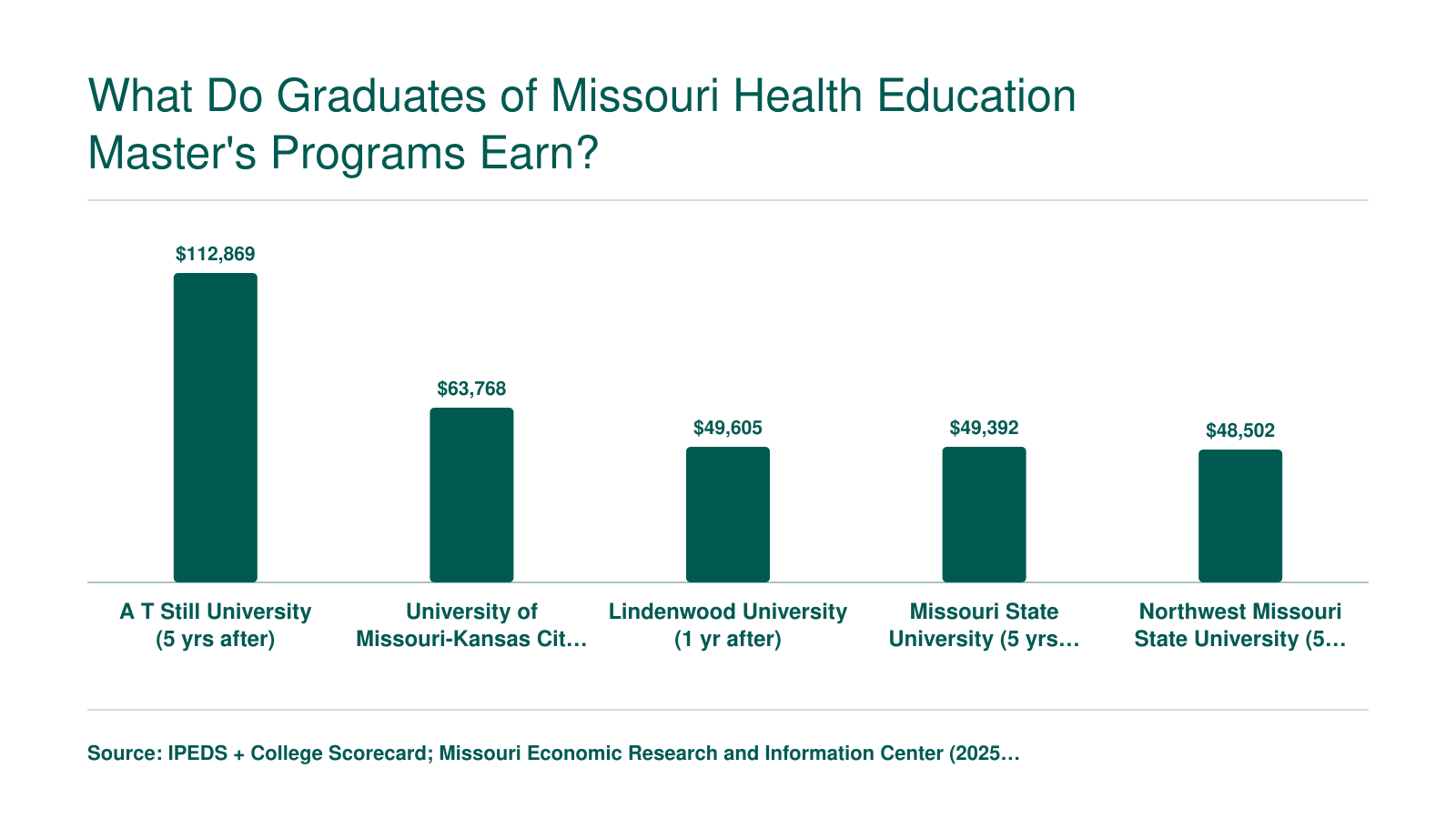
A health education master's pays off only when graduate earnings justify the price, so weigh net price against real outcomes, not the name on the diploma.
CHES Eligibility and Missouri Health Education Certification
What does it actually take to become certified in health education in Missouri?
CHES and MCHES are voluntary national credentials
The CHES exam is offered by NCHEC. To sit for it, you need a bachelor's degree or higher and either a qualifying health education major or 25 semester credits (37 quarter hours) addressing the Eight Areas of Responsibility. NCHEC requires at least 12 semester credits in process-focused coursework and caps topic-focused courses at 9 and other courses at 6. MCHES is the advanced credential and requires a master's degree or higher plus five years of documented health education specialist experience. You do not have to hold CHES first if you independently meet MCHES requirements.
Missouri teaching certification is separate
CHES is not a license to teach. To teach health in Missouri K-12 public schools, you need Missouri DESE teacher certification in the Health subject area, governed by state rules 5 CSR 20-400.500 through 5 CSR 20-400.700. That route requires passing the state's designated content assessment. If you already hold a bachelor's degree, Missouri's alternative route typically includes about 30 semester hours in a college of education, a two-year provisional certificate, and the assessment, after which the college recommends you for an initial professional certificate.
Choose based on your goal
If your goal is CHES, pick a master's that explicitly aligns its curriculum with NCHEC. If you plan to teach K-12 health, choose a program with an educator certification route, such as a Master of Arts in Teaching (MAT) in Missouri or a Missouri secondary teaching certification master's program.
Compare Health Education programs on the data that matters
Explore more Healthcare specializations or browse every graduate field.
All Healthcare programs