Master's Programs in New Hampshire
Every master's program reported by a school in New Hampshire: 280+ programs at 14 graduate schools, with the online options, costs and outcomes behind each one.

New Hampshire's graduate pricing splits cleanly: the University System of New Hampshire (UNH, Plymouth State, Keene State) charges separate in-state and out-of-state graduate rates, while Southern New Hampshire University and several small private colleges set their own per-credit prices, some flat for online master's degrees. That means the same master's degree can differ by thousands of dollars in total cost depending on residency, school, and delivery format.
Because the Master's Programs by Degree and Field directory already names the fields and schools, the useful work is comparing total cost of a master's degree, per-credit cost times required credits, format and pacing, admissions barriers, funding, and licensure fit. The cheapest per-credit online program is not automatically the best value if it adds a year or lacks a required accreditation.
In most fields, the payoff question comes down to earnings and debt: a lower-priced accredited program with strong licensure pass rates often beats a costlier campus brand.
Key Points
- Compare per-credit rates times required credits, not yearly sticker prices.
- Employer aid can cover up to $5,250 of tuition tax-free in 2026.
- New Hampshire clinical mental health counseling licensure requires a 60-credit degree.
Popular degrees in New Hampshire
Master's programs in New Hampshire by field
Business & Management
- Healthcare Administration14 programs
- Finance11 programs
- Management10 programs
- Healthcare Management9 programs
- Project Management9 programs
- Public Administration8 programs
- Marketing8 programs
- Information Technology Management6 programs
Education & Teaching
- Curriculum & Instruction7 programs
- Special Education7 programs
- Educational Leadership6 programs
- Elementary Education5 programs
- Educational Technology or Instructional Design4 programs
- Secondary Education4 programs
- Teaching3 programs
- Art Education3 programs
Nursing
- Nursing Education or Nurse Educator7 programs
- Psychiatric Mental Health Nurse Practitioner4 programs
- Family Nurse Practitioner (FNP)3 programs
- Adult Gerontology Acute Care Nurse Practitioner2 programs
- Clinical Nurse Leader2 programs
- Nurse Executive Leader2 programs
- RN to MSN2 programs
- Direct Entry MSN (MENP) or (DEMSN)2 programs
Healthcare
- Public Health5 programs
- Health Administration4 programs
- Exercise Science3 programs
- Nutrition3 programs
- Health Informatics2 programs
- Health Education1 program
- Speech Pathology1 program
Counseling
- Clinical Mental Health Counseling10 programs
- School Counseling3 programs
- Marriage and Family Therapy or Marriage and Family Counseling2 programs
Psychology
- Educational Psychology or School Psychology4 programs
- General Psychology2 programs
- School Psychology2 programs
- Developmental Psychology2 programs
- Child Psychology1 program
- Forensic Psychology1 program
- Industrial Organizational Psychology1 program
Social Work & Social Sciences
- Human Services4 programs
- Sociology3 programs
- Social Work Advanced Standing3 programs
- Social Work2 programs
- Political Science, Government1 program
Computers & IT
- Cybersecurity7 programs
- Data Analytics3 programs
- Information Security & Assurance2 programs
Arts & Design
- Creative Writing8 programs
- Fine Arts1 program
Communications & Media
- Communication2 programs
- Media Communication1 program
- Public Relations1 program
- Communication Disorders1 program
- Speech Pathology1 program
Science & Engineering
- Sustainability or Environmental Management4 programs
- Environmental Science1 program
Criminal Justice & Law
- Public Policy3 programs
- Homeland Security1 program
- Master of Laws1 program
What Drives the Cost of a Master's Degree in New Hampshire
The biggest shift in New Hampshire graduate pricing is the growing split between flat-rate online degrees and campus programs that still charge residency-based rates. Three cost levers matter most: public versus private status, in-state versus out-of-state tuition at University System of New Hampshire campuses, and whether the program uses one online price for everyone.
Public vs. private and residency
At the University of New Hampshire, in-state graduate tuition is $820 per credit, while out-of-state students pay $1,430, a difference of $610 per credit before fees. Plymouth State's resident rate is $599 with a $44 per-credit fee, bringing the effective cost to $643, versus $830 for nonresidents.1 Private online providers often ignore residency entirely: Southern New Hampshire University charges $659 per credit2, and New England College lists $585 per credit for some online graduate programs.
Why total credits matter more than sticker price
A lower per-credit price can mislead if the degree is longer. A 30-credit in-state program at UNH at $820 per credit costs $24,600 in tuition, before the $50 registration charge. A 60-credit program at New England College's $585 rate would cost $35,100, even though the per-credit price is $235 lower. For reference, SNHU's 36-credit degree at $659 per credit comes to $23,724.2 Before choosing a cheap per-credit option, compare the total credits required for the degree.
Mandatory fees to watch
Campus and online programs add charges beyond tuition. Plymouth State's $44 per-credit fee is explicit.1 UNH adds a $50 registration fee for part-time students, and some programs carry technology, student activity, or clinical and practicum fees. Online programs often fold technology into tuition, but New England College shows a $67 per-term charge for some tracks, and Franklin Pierce lists a $300 comprehensive fee on at least one schedule.3 Ask for a full cost sheet, not just the per-credit rate.
The cheapest starting point
For many students, the lowest published per-credit tier is New England College's $585 online rate, with Plymouth State's in-state effective rate of $643 close behind. The trade-off is that the cheapest online options may have fewer campus-based networking, research, or clinical placement supports, while public in-state pricing still requires New Hampshire residency and may not be available in every field.
New Hampshire Master's Tuition Comparison by School and Format
Comparing master's tuition in New Hampshire starts with a per-credit rate, not a yearly sticker price. A program's real cost is the per-credit rate multiplied by the number of credits required, then plus books, fees, supplies, and living expenses. The rates below are published 2025-26 graduate tuition figures and do not include those additional costs.
Published 2025-26 graduate tuition rates
- UNH Carsey School, NH resident: $800 per credit. A 30-credit online MPA totals about $24,000; a 36-credit MCD or MPA totals about $28,800; a 40-credit MPP totals about $32,000.
- UNH Carsey School, out-of-state: $880 per credit. Those same credit counts total roughly $26,400, $31,680, and $35,200.
- SNHU on-campus: $793 per credit, or $14,274 for an 18-credit, two-semester academic year. A 30-credit degree is about $23,790; a 36-credit degree is about $28,548.1
- SNHU online: $659 per credit. A 30-credit degree totals $19,770; a 36-credit degree totals $23,724. Active-duty military students pay $470 per credit, or $14,100 for 30 credits and $16,920 for 36.2
- UNH online example: one official online cost-of-attendance page implies about $640 per credit for a 9-credit full-time term, but that is a budget example rather than a program-wide tuition rate.
UNH does not publish one institution-wide graduate per-credit rate, so the Carsey School figures above, including the Master of Public Policy, are program-specific and should not be read as the rate for every UNH master's program. Keene State and Antioch University New England did not publish a single comparable 2025-26 graduate per-credit rate on their official tuition pages at the time of writing; applicants should request each program's rate sheet directly.
Where the value gap shows up
The widest gap among published figures is between the $880 out-of-state Carsey rate and SNHU's $470 active-duty military online rate, a difference of $410 per credit. For in-state students, SNHU's $659 online rate is the lowest standard figure shown here, undercutting UNH's $800 resident Carsey rate. Out-of-state students studying online also find the lowest standard rate at SNHU's $659 per credit, well below the $880 Carsey nonresident rate.
Online, Hybrid, and Campus Master's Programs in New Hampshire
A fixed list of online programs goes stale quickly, while a direct check with the school stays accurate. Term lengths, start dates, and advertised completion times change often, so confirm them with each institution rather than relying on any static summary, including this one.
How to Search Each School
Start with the official program pages at the University of New Hampshire (including UNH Online), Southern New Hampshire University, New England College, Rivier University, Franklin Pierce University, and Plymouth State University. Then work through a simple routine:
- Use each site's search box for "online master's" or "hybrid graduate program."
- Open the admissions page for application deadlines and start terms.
- Read the curriculum page for course sequence, credit count, and term structure.
- Note whether the format is labeled fully online, hybrid, or on campus, since schools use these labels differently.
Questions for Admissions Offices
Email or call the program coordinator, not just the general admissions line. Ask:
- Is the program fully online or hybrid?
- How long are the terms?
- When are the start dates?
- What is the advertised completion time, and is it based on full-time or part-time study?
- Are there residency, clinical, practicum, or internship requirements, and can they be completed near where you live?
That last question matters most in fields such as counseling, M.Ed. programs, and MSN programs, where in-person hours can change both cost and schedule.
Sources for Verification
Cross-check what a school tells you against independent sources:
- BLS.gov: Occupational outlook and wage data for your target career.
- Regional accreditors: Confirm the institution's accreditation status on the accreditor's own website.
- Professional associations: Field-specific bodies often list recognized programs and licensure expectations.
- NCES College Navigator: Compare institutions and review accreditation details.
Save the answers you get in writing. When two programs look similar, the one with clearer terms, predictable start dates, and fewer surprise requirements is usually the safer choice.
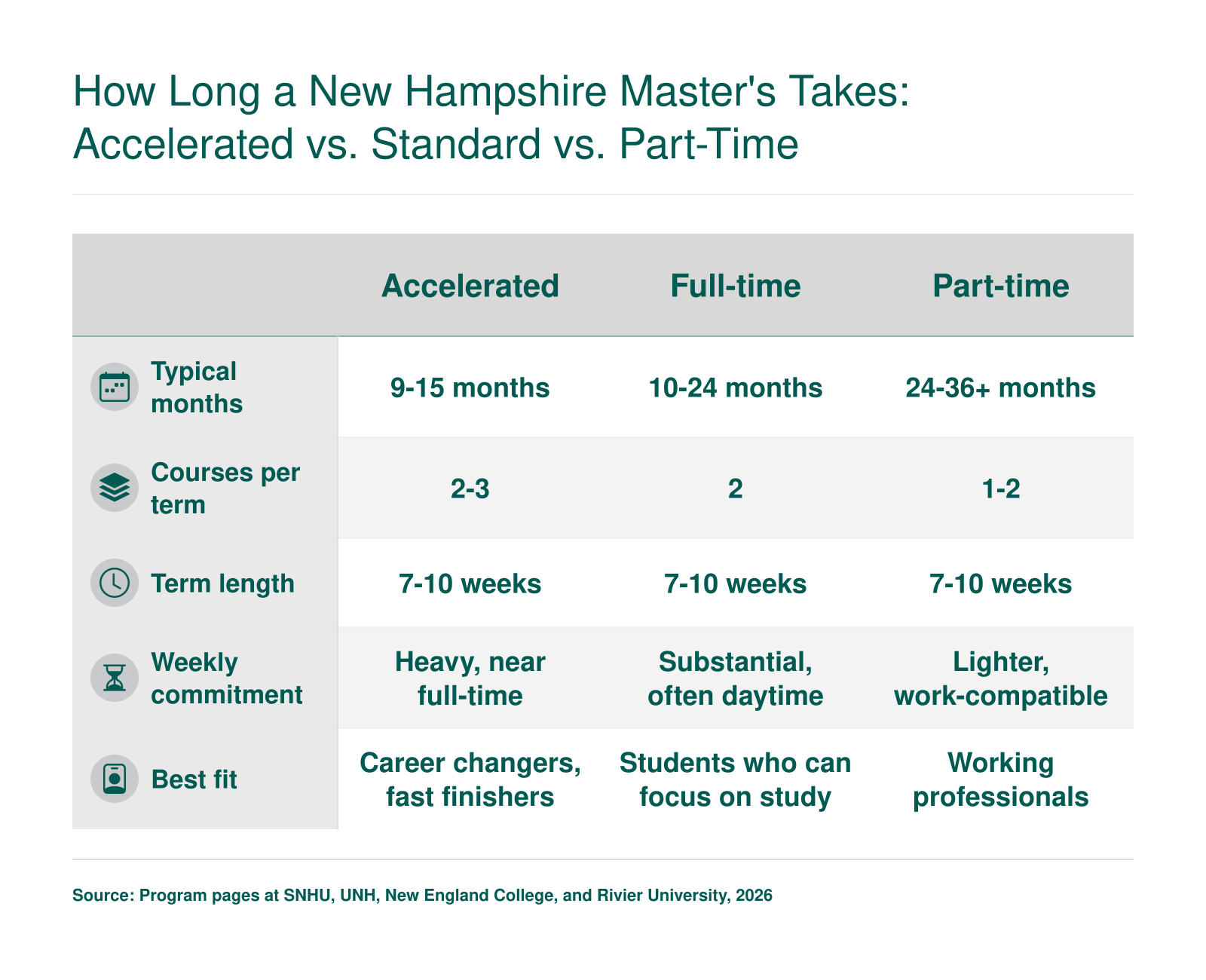
How Long a New Hampshire Master's Takes: Accelerated vs. Standard vs. Part-Time
Pacing varies by school and program, so treat these as advertised ranges rather than guarantees. Clinical and licensure-track programs rarely compress below two years because of practicum hours.
Admission Requirements for New Hampshire Master's Programs
Requirements vary by program, so treat this as a baseline and confirm details with the department you are applying to. The policies below come from published University of New Hampshire and Plymouth State University graduate admissions pages. Current 2026 details for Southern New Hampshire University, New England College, and Rivier were not available to us, so check those schools directly.
- Bachelor's degree and GPABoth UNH and Plymouth State require a bachelor's degree from an accredited institution. UNH graduate admission is competitive. UNH Online lists a 3.0 GPA over the last 60 credit hours, or a 3.0 in a prior graduate degree. Plymouth State cites 3.0 for most programs, but its catalog says GPA requirements vary by program.
- Application materialsExpect transcripts, a resume, a statement of purpose, and recommendations. Plymouth State's recommendation requirement runs from one to three letters depending on the program.
- GRE and GMATThe UNH Online programs covered by its application page do not require the GRE or GMAT, but that does not apply to every UNH graduate program. Plymouth State has no university-wide test requirement or waiver, though reviewers may consider scores. Ask each program.
- Prerequisites for career changersNo university-wide foundation-course policy was found at UNH or Plymouth State. Requirements are set by program, and some degrees carry extra prerequisites. If you are switching fields, such as moving into analytics, nursing, or teaching, ask the department which courses you need and whether you can take them before or after admission.
- DeadlinesPlymouth State reviews most graduate applications on a rolling basis. We could not confirm 2026 UNH graduate deadlines, so check the program page. If you want assistantship consideration, apply early, since funded positions are typically tied to earlier priority dates.
- Transfer creditWe found no university-wide graduate transfer-credit maximum for UNH or Plymouth State. Plymouth State lets students take up to 12 graduate credits before formal admission, which is a separate rule. UNH grants graduate credit only for B- or higher, and some programs set stricter standards. Get any transfer decision in writing.
Paying for Grad School in New Hampshire: Assistantships, Scholarships, and Employer Aid
Paying for a master's degree in New Hampshire usually means layering several funding sources, starting with the ones you never repay.
Graduate Assistantships
An assistantship pairs part-time work, such as research or teaching support, with a tuition waiver and a stipend. At the University of New Hampshire, a full assistantship generally means about 20 hours a week. In 2025-26, stipends for master's students at the entry level were $22,890, with higher tiers of $24,010 and $25,310 for doctoral students. UNH has not published a single 2026-27 schedule, so treat those as a guide. Full-time assistants still pay 50% of mandatory fees. In UNH's MSW programs, a smaller version is available: a few half-assistantships a year for second-year students, with a stipend near $11,000, a 50% tuition waiver, and 10 hours a week. Other University System campuses run their own programs, so ask each graduate office. Positions are limited and often filled alongside admissions decisions, so apply early.
Scholarships and Discounts
Private and online providers lean on discounts more than assistantships. SNHU's online tuition and financial aid page lists the online graduate rate at $659 per credit for 2026-27, dropping to $470 for active-duty military. It also lists a New Hampshire Scholars award of $2,000 per year with a 2.5 minimum GPA1, so confirm it applies to graduate study. Rivier and New England College also advertise aid, but current graduate amounts and employer discount rates aren't established, so ask admissions for written figures.
Employer Tuition Assistance
Healthcare systems and tech employers in the state commonly offer tuition reimbursement benefits, and some schools, SNHU among them, have corporate partnership rates that vary by employer and program. Many employers cap benefits at $5,250 a year, the amount that can generally be received tax-free. Confirm the cap, repayment terms, and any required work commitment with HR before enrolling.
Federal Loans
For enrollment on or after July 1, 2026, new graduate borrowers can take up to $20,500 a year in Direct Unsubsidized loans, with a $100,000 aggregate limit.2 Professional students can borrow up to $50,000 a year.2 A lifetime federal cap of $257,500 now applies.2 Grad PLUS is closed to new borrowers, with limited exceptions for students already enrolled and borrowing before that date.3
A Practical Order
- First: Apply for assistantships at the same time as admission.
- Second: Claim employer aid up to the tax-free limit.
- Third: Add institutional scholarships and military or partner discounts.
- Last: Borrow federal loans only for the remaining gap.
Under IRS Section 127, an employer can pay up to $5,250 per year of your graduate tuition tax-free in 2026, even for courses unrelated to your job. Depending on a program's per-credit price, that can cover several courses a year. It can also go toward student loans, but tuition and loan payments share the same cap.
Accreditation and Licensure: What New Hampshire Grad Programs Must Have
Institutional accreditation and programmatic accreditation are two different stamps, and a program can hold one without the other. The first determines whether a school can award federal aid and whether its credits travel. The second determines whether your degree qualifies you to sit for a license or exam in your field. You need to check both separately.
Institutional accreditation comes first
New Hampshire's colleges are accredited by the New England Commission of Higher Education (NECHE), the regional accreditor covering the six New England states. The University of New Hampshire, for example, holds NECHE accreditation. Without it, a school cannot participate in federal loan and grant programs, other institutions will usually refuse the transfer credits, and many employers will not reimburse tuition. Treat NECHE status as the floor, not a selling point.
Programmatic accreditation varies by field
Specialized accreditors matter most in licensed professions. Depending on your field, verify the program against the relevant body: CCNE or ACEN for nursing, CACREP for counseling, CSWE for social work, AACSB or ACBSP for MBA programs, and CAEP or New Hampshire Department of Education approval for M.Ed. programs. Status differs program by program within the same university, and newly launched tracks sometimes have not yet been reviewed. Check the accreditor's own searchable directory rather than relying on a marketing page, and confirm the specific degree and concentration is listed, not just the department.
Online students have an extra step
If you live outside New Hampshire and enroll online, your home state sets your licensure rules. Every accredited institution publishes a professional licensure disclosure page stating whether a program meets, does not meet, or has not been evaluated against each state's requirements. Read that page before you deposit, and contact your state board if the answer is "has not been determined."
Two New Hampshire specifics
- CPA licensure: New Hampshire has used a 150 semester hour model with roughly a year of qualifying experience, and candidates can typically sit for the exam up to 120 days before completing their degree.1 Recent state legislation appears to add alternative pathways, so confirm current rules directly with the New Hampshire Board of Accountancy and NASBA before choosing a program.
- Teacher certification: Career changers generally enter through a state-approved preparation program, with Praxis Core for entry and Praxis Subject Assessments for the endorsement area.2 UNH's Master of Science in Instruction and Leadership is one post-baccalaureate licensure route, and typically expects a 3.0 undergraduate GPA.
New Hampshire Licensure for Counselors and Therapists
Career and Salary Outcomes for New Hampshire Master's Graduates
The numbers that matter most for a master's degree, what graduates earn and what they owe, are also the hardest to find at the program level. Here is where to look, in order, and what to do with each source.
Start With College Scorecard
The U.S. Department of Education's College Scorecard is the one federal source that reports median earnings and median debt by field of study.2 Search by school, choose a field, and set the degree level to master's. Run it for the University of New Hampshire, Southern New Hampshire University, Rivier University, and Plymouth State, and check nursing, business, education, and counseling one at a time.
Read the definitions before comparing anything:
- Earnings: Median pay for federal-aid recipients who were working and not enrolled, measured in the fourth full year after completion. The current figures pool the 2017-18 and 2018-19 completer cohorts, measured in 2022 and 2023 and adjusted to 2024 dollars.1
- Debt: Federal loans only (Direct, FFEL, Graduate PLUS), accumulated at all schools. Private loans, Perkins, and Parent PLUS are excluded.1
- Blanks: A missing value does not mean zero. It usually means the data is suppressed or unavailable for that program.
Be careful with school-wide numbers. A campus-level median, such as the roughly $56,000 listed for UNH's main campus3, blends every degree level and is not a master's figure. For deeper checks, the Scorecard data downloads include program counts alongside earnings and debt.2
Then Go to the Schools
Open each university's program pages, career services office, consumer information page, and any graduate outcomes report. Look for median earnings, median debt, and placement or licensure pass rates. Divide median debt by median earnings to get a rough debt-to-earnings ratio. At the 7.54% Graduate PLUS rate Scorecard uses, borrowed dollars get expensive quickly.1
Check Occupation-Level Pay and Demand
BLS.gov fills in what school data cannot. The Occupational Outlook Handbook gives pay and growth projections by occupation, and O*NET lists typical duties and required credentials. Pair these with New Hampshire's state labor market information to see what the roles tied to nursing, business, education, and counseling actually pay in the state, not just nationally.
Use Associations and Accreditors for Context
Professional bodies add field-specific detail that government data lacks:
- Nursing: AACN and the American Nurses Association for certification paths and workforce reports.
- General MBA programs: AACSB and GMAC for accreditation standards and graduate management surveys.
- Counseling: CACREP and the American Counseling Association for accredited-program standards and licensure context.
- Education: NEA and the state education agency for salary schedules and certification requirements.
If the sources disagree, trust the school's own reported outcomes for fit and the federal data for comparability, and note which cohort years each one covers.
How to Compare New Hampshire Graduate Schools Side by Side
A useful comparison has four columns: total program cost, format and timeline, accreditation and licensure fit, and field-level earnings outcomes.
Use a Four-Part Scorecard
- Total cost: Look at estimated tuition and fees for the entire degree, not the advertised per-credit rate. Include per-term fees, online course fees, and projected tuition increases.
- Format and timeline: Confirm whether required courses are fully online, hybrid, or evening and weekend, whether the program can be finished in one year, two years, or part-time while working, and whether it qualifies as one of the No-GRE master's programs.
- Accreditation and licensure fit: Verify the program's institutional accreditation and any programmatic accreditation the licensing board requires, then match it to your intended license.
- Field-level outcomes: Use the College Scorecard field pages to compare median earnings and employment rates for the field in New Hampshire, and ask the program for its own licensure pass rates or job placement data if available.
Stress-Test the Price Before You Apply
A quick sanity check: divide estimated total program cost by the expected annual earnings gain from the degree. If a $30,000 program is likely to add only $5,000 per year to your salary, the payoff window may be slower than a cheaper option with similar credentials.
Also pull each school's professional licensure disclosure before applying. New Hampshire licensing rules can differ for counselors and therapists; for educators, an accredited M.Ed. program may need to meet the state's supervised experience requirements, and an out-of-state online program may not qualify.
Ask the Right Questions
Before finalizing a shortlist, ask admissions:
- Assistantships: How many graduate assistantships are available, and do they cover tuition or just a stipend?
- Transfer credits: Will prior graduate coursework count, and what is the maximum?
- Practicum placement: For online students, does the program help arrange practicum or clinical sites in New Hampshire?
Next Step
Shortlist two or three programs, then request a credit evaluation from each. A written transfer-credit review and a total-cost worksheet give you comparable data before you commit.
Graduate schools in New Hampshire with the most master's programs
| School | City | Type | Master's programs | Online | Grad tuition / yr |
|---|---|---|---|---|---|
| Southern New Hampshire University | Manchester | Private nonprofit | 62 | 59 | $21,387 |
| University of New Hampshire | Durham | Public | 61 | 23 | $16,932 |
| Plymouth State University | Plymouth | Public | 31 | 19 | $18,903 |
| New England College | Henniker | Private nonprofit | 30 | 27 | $14,213 |
| Rivier University | Nashua | Private nonprofit | 29 | 24 | $13,375 |
| Franklin Pierce University | Rindge | Private nonprofit | 25 | 19 | $41,600 |
| Colby-Sawyer College | New London | Private nonprofit | 13 | 13 | $15,001 |
| University of New Hampshire at Manchester | Manchester | Public | 10 | 6 | $14,876 |
| Dartmouth College | Hanover | Private nonprofit | 9 | 6 | $66,617 |
| Keene State College | Keene | Public | 5 | 3 | $12,456 |
| University of New Hampshire College of Professional Studies Online | Manchester | Public | 5 | 5 | $10,448 |
| Saint Anselm College | Manchester | Private nonprofit | 3 | 3 | $21,348 |
| Antioch University-New England | Keene | Private nonprofit | 3 | 3 | $17,853 |
| University of New Hampshire-Franklin Pierce School of Law | Concord | Public | 2 | 2 | $36,348 |
Program counts are the verified master's listings in our directory; tuition is the school-wide average for a full-time graduate student (IPEDS).
Common Questions About New Hampshire Master's Programs
These answers draw on published 2026 and 2027 tuition figures from the schools. Rates, fees, and eligibility change, so confirm current numbers with the program before you apply.
How do UNH, SNHU, and other New Hampshire graduate schools compare?
What is the quickest, cheapest master's degree option in New Hampshire?
Can I earn an online master's from a New Hampshire school while living in another state, and will it qualify me for licensure there?
Do New Hampshire residents get a discount on online graduate programs, or is online tuition the same for everyone?
Compare programs nationwide
Many New Hampshire residents study online. Every ranked list above has an online lens, or browse every field.
Online master's programs Browse all fields