Best Master's in Special Education Programs in New Hampshire
Compare 7 accredited Special Education programs in New Hampshire, with graduate earnings, cost, debt, and completion data from IPEDS and the U.S. College Scorecard.

At Plymouth State, median earnings four years after a special education master's are $64,021, yet New Hampshire programs remain few and uneven: some lead to initial licensure, others to an advanced credential or no licensure at all. Published net prices separate by nearly $19,000, so cost swings sharply across a short list.
UNH's special education program is changing its licensure status for 2026-27, making direct verification essential before applying. Rankings, cost comparisons, online options, GRE policies, and clinical placement rules all hinge on that licensure distinction.
Key Points
- In 2027, Plymouth State publishes the clearest paid licensure route.
- Plymouth State reports $64,021 median earnings four years after finishing.
- Keene State's certification requires two 400-hour internships across fall and spring.
New Hampshire's Top Master's in Special Education Programs, Ranked
Each school earned its spot by balancing what students actually pay, how many finish, and how flexibly the degree is delivered. The list includes campus, online, and hybrid programs, so prospective educators can compare licensure pathways, clinical requirements, and affordability side by side.
Saint Anselm College
#1Manchester, NH · ~$21,000/yr (est.)
Best for: Licensed teachers advancing to special education licensure
Saint Anselm College pairs a licensure-focused special education master's with two distinct paths: an advanced route for licensed teachers and an initial route for candidates without a teaching license. The program blends online asynchronous summer coursework with on-ground evening classes during the school year, and students complete a year-long internship or a six-credit student teaching placement. With mock interviews, NASDTEC interstate reciprocity, and a research capstone, it is built for New Hampshire educators who want a clinical, employment-ready credential.
- Offers Advanced Licensure Pathway for licensed teachers and Initial Pathway for unlicensed graduates
- Initial pathway requires Praxis, SAT, or ACT scores and a minimum 2.5 GPA
- Coursework covers IEP legal and ethical practices, differentiated curriculum, and positive behavior supports
- Year-long internship of 12 credits or student teaching of 6 credits
- Summer courses run online asynchronously; school-year classes meet on ground in the evenings
- Advanced candidates complete 34-40 credits; initial candidates complete 38-44 credits
Plymouth State University
#2Plymouth, NH · $15,000 – $20,000/yr (est.)
Best for: Online learners who need rolling admission flexibility
Plymouth State University's M.Ed. in Special Education is a flexible, fully online option with a General Special Education K-12 certification concentration. The program runs 39-42 credits and covers IDEA, UDL, assessment, and inclusive teaching, with rolling admission and three start dates each year. A capstone internship seminar ties the coursework to practice, and the program is AAQEP accredited with CEC-aligned standards.
- General Special Education, K-12 Certification concentration
- AAQEP-accredited program aligned with Council for Exceptional Children standards
- 39-42 credits including coursework in IDEA, UDL, assessment, and inclusive teaching
- Fully online option available with fall, spring, and summer starts
- Rolling admission with a 3.0 GPA recommendation and one professional reference
- Capstone internship seminar required; graduates prepare for K-12 general special education certification
Franklin Pierce University
#3Rindge, NH · ~$42,000/yr (est.)
Best for: Career-changers needing combined K-6 certification option
Franklin Pierce University offers a 51-credit M.Ed. with teacher certification in General Special Education, preparing students for K-12 settings. The curriculum includes 135 clinical hours, student teaching placements, and an action research capstone, with an M.Ed.-only track for already certified teachers and a certification-only option. The program can be combined with K-6 elementary certification.
- 51-credit curriculum covers special education law, assessment, IEP development, and inclusive strategies
- 135 clinical hours completed before student teaching placements
- Action research capstone required
- Leads to K-12 General Special Education certification and can be combined with K-6 Elementary certification
- M.Ed.-only track for certified teachers and certification-only option are available
New England College
#4Henniker, NH · ~$14,000/yr (est.)
New England College delivers a fully online Master of Education with a Special Education concentration that can be finished in as little as 18 months. There is no application fee and no standardized test requirement, and the curriculum aligns with New Hampshire certification standards. Students can pursue General Special Education Licensure while completing one of five MEd concentrations.
- Five MEd concentration options, including Special Education
- 100% online program that can be completed in as little as 18 months
- No application fee and no standardized test requirement
- Aligns with New Hampshire certification standards and General Special Education Licensure
- Accredited by the New England Commission of Higher Education
University of New Hampshire
#5Durham, NH · ~$17,000/yr (est.)
The University of New Hampshire's campus-based M.Ed. in Special Education emphasizes inclusive practices, assessment, individualized planning, and intensive interventions. Students complete extended clinical experiences and an internship with weekly seminars, with full-time, part-time, and accelerated master's options. A notable update: the licensure pathway is no longer accepting applications, so prospective students should confirm which non-licensure options remain before applying.
- 32-credit program with 8 courses and full-time or part-time paths
- Extended clinical experiences and an internship with weekly seminars
- Thesis or capstone option and an accelerated master's path
- Campus-based program in Durham, NH
- Licensure track is no longer accepting applications; advanced and non-licensure options remain
Keene State College
#6Keene, NH · ~$12,000/yr (est.)
Keene State College's M.Ed. in Special Education is a 34-credit, cohort-based program that leads to New Hampshire K-12 special education licensure. Students complete two 400-hour internships in public schools, often while working at least half-time in an approved setting, and classes meet evenings and afternoons. The program is approved by the New Hampshire Department of Education and nationally recognized by the Council for Exceptional Children, though applicants must live in New England.
- 34-credit M.Ed. with NH K-12 special education licensure
- One-year full-time or two-year part-time track starting in summer
- Includes two 400-hour internships in public school settings
- Cohort model with evening and after-work classes for working professionals
- NH Department of Education approved and Council for Exceptional Children recognized
- Faculty serve as clinical supervisors; participants must live in New England
Southern New Hampshire University
#7Manchester, NH · ~$21,000/yr (est.)
Southern New Hampshire University offers an online M.Ed. in Curriculum and Instruction with a Special Education concentration designed for educators who want to support students with mild to moderate disabilities. The 36-credit program includes three special education electives, covers federal special education law such as ESEA, and builds a professional portfolio. It does not lead directly to teaching licensure, making it a fit for roles like inclusion specialist, curriculum developer, or special education program administrator.
- Choose three graduate-level special education electives as part of the 36-credit degree
- Focuses on mild to moderate disabilities from preschool through high school
- Covers federal special education law, including ESEA, and inclusive leadership
- No entrance exam, rolling admission, and $0 application fee
- Does not lead directly to teaching licensure
- Designed for instructional coordinators, inclusion specialists, and curriculum developers
Cost & outcomes by school
Federal data for the highest-earning Special Education programs, independent of the ranking above. Earnings are this field's master's graduates four years after completing, where the Scorecard reports them.
| School | Earnings | Tuition / yr | Debt | Grads/yr | Format |
|---|---|---|---|---|---|
| Plymouth State University NH | $64,021 | $18,903 | — | 15 | Online |
| Southern New Hampshire University NH | $56,396 | $21,387 | — | — | Online |
| Keene State College NH | $51,682 | $12,456 | — | 5 | Campus |
| New England College NH | — | $14,213 | — | 4 | Online |
| University of New Hampshire NH | — | $16,932 | — | 1 | Campus |
| Saint Anselm College NH | — | $21,348 | — | 6 | Hybrid |
| Franklin Pierce University NH | — | $41,600 | — | 3 | Campus |
Sources: U.S. Department of Education. Tuition and graduates: IPEDS. Earnings and debt: College Scorecard, this field's master's graduates; a dash means no figure is reported.
Licensure Track or Advanced Degree? Know Which Special Education Master's You Need
Most special education master's programs in New Hampshire fall into one of two paths. Initial-licensure programs, special education master's programs that lead to licensure, serve career changers and teachers who do not yet hold a New Hampshire special education credential; they include supervised student teaching and can lead to recommendation for state certification. Non-licensure or advanced programs serve educators who already hold a credential and want deeper specialization without repeating licensure coursework.
The University of New Hampshire makes the distinction concrete. UNH has closed applications to its licensure-track Special Education M.Ed., one of the M.Ed. programs in New Hampshire, and beginning in 2026-27 the degree "will no longer lead to a Special Education Teacher license."
State program approval determines whether a graduate can be recommended for New Hampshire certification. Keene State College, New England College, and Southern New Hampshire University appear on New Hampshire's 2024-2025 approved educator-preparation list. Keene State holds full CAEP approval as of its 2023 review, and SNHU reports CAEP accreditation at the initial-licensure level. Plymouth State holds state full approval through March 31, 2026, but its CAEP accreditation was withdrawn effective December 31, 2024. If you are not yet a licensed teacher, confirm state approval before you apply.
Online and Hybrid Special Education Master's Options in New Hampshire
New Hampshire's online master's in special education and hybrid options split roughly into two categories: fully remote options and formats that blend online coursework with local clinical work. Plymouth State, Franklin Pierce, New England College, and Southern New Hampshire University list online programs; Saint Anselm College is hybrid; the University of New Hampshire and Keene State College are campus-based.
For licensure-track students, remote does not mean no classroom time. Online learners typically complete practicum or student teaching hours in their own district or at an approved local school, with faculty supervision. Keene State's licensure option, for example, requires at least half-time employment in an approved educational setting or an approved internship, and it admits only New England residents.1 SNHU's online special education concentration is non-licensure, so clinical placement is not the core requirement.
Out-of-state applicants should check reciprocity. New Hampshire participates in the NASDTEC Interstate Agreement2, but that is a framework, not automatic licensure; home states can add requirements. SNHU also warns that endorsement rules vary by state.
The honest trade-off: online formats give working teachers flexibility, while campus and hybrid master's programs in New Hampshire often place students in schools that hire locally, which can matter for building a network.
Related Articles
Cost and New Hampshire Licensure: How Each Master's Program Compares
Published per-credit tuition is available for Plymouth State and SNHU; Keene State and Franklin Pierce publish credit totals but no current per-credit rate in the materials reviewed. Plymouth State's in-state 34-credit path is the lowest estimated published total at about $22,406, while institution-wide net price after aid is lowest at Keene State, so the two measures point to different winners. On licensure, Keene State, Plymouth State, Franklin Pierce, Saint Anselm, and New England College indicate paths to NH special education licensure or certification; SNHU clearly does not lead to teaching licensure; UNH's materials reviewed do not publish a licensure status.
| Program | Total credits required | Published per-credit tuition (in-state / out-of-state) | Estimated total program cost | Licensure status |
|---|---|---|---|---|
| Keene State College: M.Ed. in Special Education | 34 credits (M.Ed.) or 24 credits (certification option) | N/A | N/A | Leads to NH special education licensure |
| Plymouth State University: M.Ed. in Special Education | 34 to 42 credits | $614 in-state or $850 out-of-state; $659 or $895 including mandatory fees per credit, plus $30 enrollment fee per registration | $22,406 to $27,678 in-state; $30,430 to $37,590 out-of-state | Leads to K-12 General Special Education certification |
| Franklin Pierce University: M.Ed. in General Special Education | 51 credits | N/A | N/A | Leads to K-12 General Special Education certification |
| SNHU: M.Ed. in Curriculum and Instruction, Special Education concentration | 36 credits (9 special education credits) | $659 per credit ($470 military rate); $1,977 per course | $23,724 total program tuition; $16,920 at military tuition rate | Does not lead to teaching licensure |
Which New Hampshire Master's Programs Waive or Make the GRE Optional?
Does any New Hampshire special education master's actually require the GRE? For most programs here, the answer is that current admissions pages simply do not mention it, and no stated score means no GRE listed, not a formal waiver.
- University of New Hampshire: No GRE listed; UNH instead names a Basic Academic Skills Assessment and requires a 3.0 GPA.
- Keene State College: No GRE stated; it prefers a 2.75 GPA and expects at least half-time approved educational employment.1
- Plymouth State University: No GRE stated; it recommends a 3.0 GPA, asks for Praxis Core (or a comparable Pearson equivalent), and includes a screening interview.
- Southern New Hampshire University: Policy varies by program, so confirm with an advisor.
- Saint Anselm College, Franklin Pierce University, New England College: No current GRE policy published; ask admissions directly.
Common prerequisites across these schools include a bachelor's degree, a minimum GPA (often 2.75 to 3.0 where verified), recommendation letters, and a personal statement; advanced tracks may require teaching certification. New Hampshire also mandates criminal background checks and fingerprinting before clinical placements in schools.
What Graduates Earn and Owe After a NH Special Education Master's
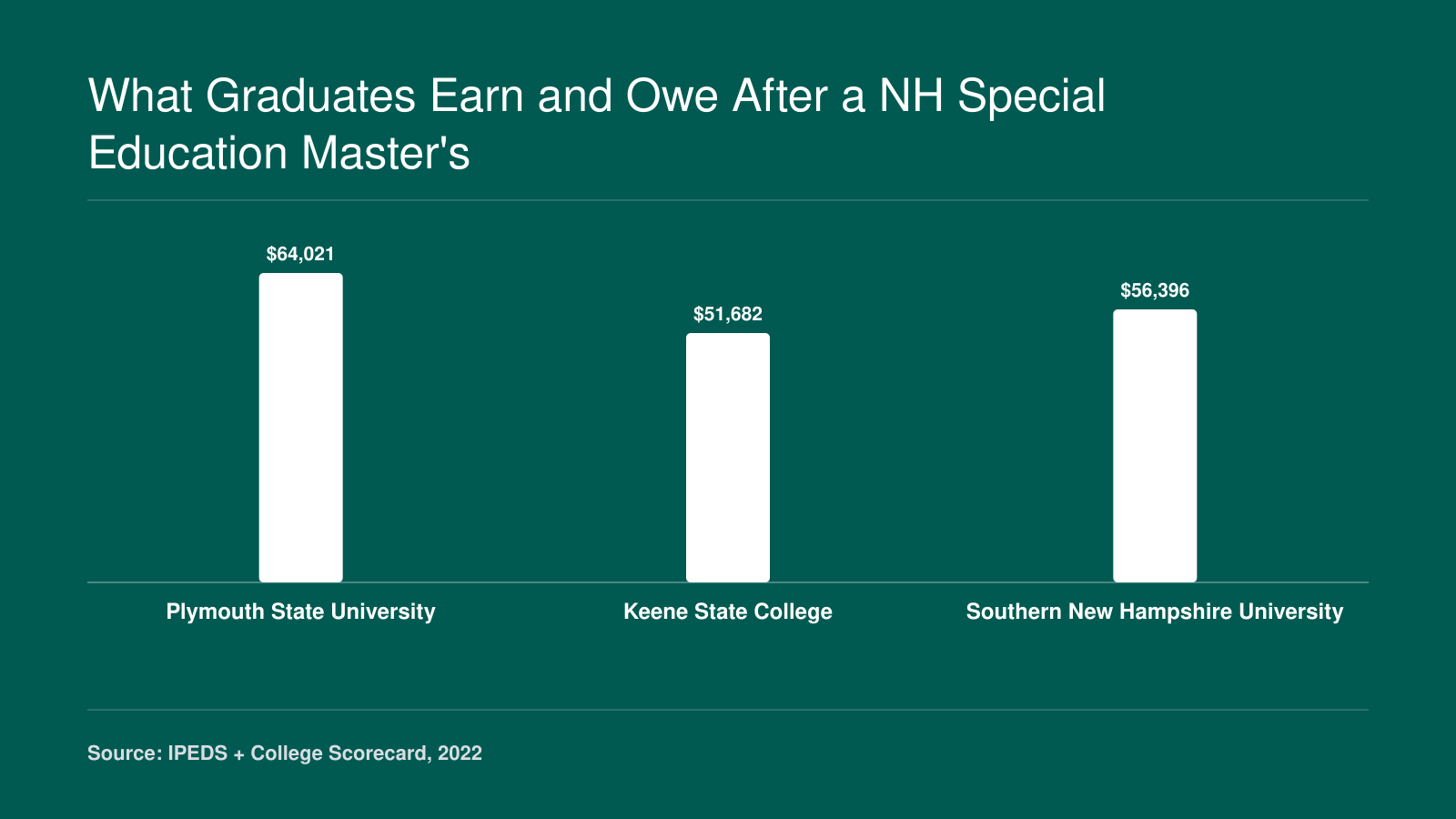
Median earnings four years after finishing are $64,021 at Plymouth State, $51,682 at Keene State, and $56,396 at Southern New Hampshire University. Program-level median debt is not published for these programs.
Student Teaching and Practicum: Paid, Unpaid, or on the Job?
Can you get paid while completing a special education internship in New Hampshire? Plymouth State publishes the clearest paid route.
Licensure-track clinical work in special education MAT programs in New Hampshire typically spans an academic year. Keene State's graduate certification requires 400 clinical hours spread across two fall and spring internships.1 Plymouth State's one-year M.Ed., an Accelerated Master's in Special Education, pairs fall and spring internships, and SNHU's on-campus M.Ed. options build in 44 weeks of clinical experience over 13 months.
Plymouth State's teacher residency with SAU #84 in Littleton has residents team-teach four days a week and take coursework on the fifth. In return they receive full tuition, a $10,000 stipend and free housing. Spots are competitive and depend on final funding approval, and 2026/27 applications were accepted through March 15. Keene State asks students to work at least half-time in an approved educational setting or hold an approved internship,1 so a current job may help.
An unpaid full-time semester means lost income, a real addition to the degree's cost. Ask admissions how placements are arranged and whether your current job counts.
Quick Answers for New Hampshire Special Education Master's Applicants
Which New Hampshire special education master's program costs the least?
Can I finish a special education master's fully online and still get licensed to teach in New Hampshire?
When are application deadlines and start terms for New Hampshire special education master's programs?
Compare Special Education programs on the data that matters
Explore more Education & Teaching specializations or browse every graduate field.
All Education & Teaching programs