Best Master's in Special Education Programs in California
Compare 33 accredited Special Education programs in California at 30 schools, with graduate earnings, cost, debt, and completion data from IPEDS and the U.S. College Scorecard.

Will a California master's in special education also earn you the Education Specialist credential? Check that first: some programs here build the Preliminary credential into the degree, while CSUN and La Verne expect you to hold it before enrolling.
Net price, an approximate institution-wide average after aid, runs from $4,564 at Cal State San Bernardino to $41,431 at the University of San Francisco.
That spread buys no better license. California issues the same Preliminary Education Specialist credential either way.
Key Points
- Cal Poly is the only ranked school with a stated GRE exemption.
- The master's degree and Education Specialist credential are often separate programs with separate fees.
- Program-level earnings for special education graduates are not yet published for California.
Ranked: The 10 Best Master's in Special Education Schools in California
Each school below earned its spot on outcomes students can verify: what they pay, whether they finish, and what graduates earn afterward. Graduation rates are institution-wide, so read them as context for schools offering this program. Program-level earnings are not yet published for these master's programs, so we do not attribute campus-wide earnings to them.
California Polytechnic State University-San Luis Obispo
#1San Luis Obispo, CA · ~$14,000/yr (est.)
Best for: Full-time students wanting in-person cohort training
Cal Poly pairs a Master of Science in Special Education with a Preliminary Education Specialist Credential in a cohort model. Year one is full-time and in person with clinical placements in San Luis Obispo and Santa Barbara county schools, and year two moves online while you teach. Schools offering this program have graduation rates of 86%, and in-state tuition is among the lowest on this list. The program reports a 100% hiring rate.
- Hybrid: full-time in-person year one, online year two
- Earns the Preliminary Education Specialist Credential with the degree
- Clinical practice in San Luis Obispo and Santa Barbara county schools
- Cohort-based, with a cooperating teacher and field supervisor
- Capstone Master's Project completed while teaching
- Starts fall; program reports a 100% job placement rate
University of San Francisco
#2San Francisco, CA · ~$30,000/yr (est.)
Best for: Aspiring teachers earning while they learn
The University of San Francisco offers a two-year cohort that combines a master's degree with a Mild/Moderate Support Needs Education Specialist Credential. Candidates work as paid intern teachers in Bay Area schools while enrolled. Schools offering this program have graduation rates of 70%, and tuition is the highest of the ten, so net price deserves a close look.
- Two-year, cohort-based, campus program
- Mild/Moderate Support Needs concentration
- Preliminary Teaching Credential earned with the master's
- Paid intern teaching in Bay Area schools
- Coursework in Explicit Instruction, Universal Design for Learning and IEP law
- Paths include special day classes and community college learning specialist roles
University of Redlands
#3Redlands, CA · $25,000 – $30,000/yr (est.)
Best for: Working adults studying online
The University of Redlands delivers its Mild to Moderate Support Needs master's through online and hybrid formats, with in-person fieldwork required. Fieldwork can be student teaching, a paid internship, or a one-year residency. Schools offering this program have graduation rates of 67%, with rolling admissions that suit working adults.
- Online and hybrid delivery with required in-person fieldwork
- Mild to Moderate Support Needs concentration
- Prepares for the California Preliminary Teaching Credential
- 2.8 GPA minimum, two recommendations, prerequisite courses
- Rolling admissions; cohort-based with a capstone
- Fieldwork options: 14-week student teaching, paid internship, or residency
Point Loma Nazarene University
#4San Diego, CA · $10,000 – $15,000/yr (est.)
Point Loma Nazarene offers fully online, asynchronous coursework with in-person fieldwork, and the program can be finished in as little as 12 months. Students choose an M.A. with an action research project or an M.S. with a thesis. Schools offering this program have graduation rates of 77%, the highest among the private schools here. Admission requires an existing Education Specialist credential, so it suits current teachers.
- M.A. (action research) or M.S. (five-chapter thesis) tracks
- 36 units, or 37 with adapted physical education authorization
- Fully online and asynchronous; fieldwork done in person
- 3.0 GPA and an Education Specialist Teaching Credential required
- Six start dates per year across spring, summer and fall
- Approved by the California Commission on Teacher Credentialing
California State University-East Bay
#5Hayward, CA · $9,000 – $19,000/yr (est.)
Cal State East Bay offers an M.S. with an Extensive Support Needs concentration, available stand-alone or with the Education Specialist credential. Hybrid and online formats are offered. Schools offering this program have graduation rates of 48%, but in-state tuition and net price are very low, which makes it a strong cost pick.
- Extensive Support Needs concentration (two options offered)
- Two-year, four-semester program
- Stand-alone or paired with the Education Specialist credential
- Hybrid and online formats, including a fully online option
- 3.0 GPA and a valid California teaching credential required
- Fieldwork, student teaching and a capstone research project
California State University-San Bernardino
#6San Bernardino, CA · ~$10,000/yr (est.)
Cal State San Bernardino stands out for concentration breadth at public-university prices, with three areas: Early Childhood Special Education, Mild to Moderate, and Moderate to Severe Support Needs. It is designed for people enrolled in or holding an Education Specialist credential. Schools offering this program have graduation rates of 55%, and net price is the lowest on this list.
- Three concentrations: early childhood, mild to moderate, moderate to severe
- Campus-based program
- Emphasis on research methodologies and evidence-based practice
- Requires concurrent enrollment in or completion of a credential program
California Lutheran University
#7Thousand Oaks, CA · ~$22,000/yr (est.)
California Lutheran offers a 36-credit M.S. with Mild to Moderate, Extensive Support Needs, and Deaf and Hard of Hearing concentrations, plus a dual-credential option. Schools offering this program have graduation rates of 70%. Free CSET test prep and Professional Development School partnerships add practical support.
- Hybrid; 36 total credit hours with a thesis required
- Concentrations: Mild to Moderate, Extensive Support Needs, Deaf and Hard of Hearing
- Dual credential option with a multiple-subject credential
- Three research courses and an Education Improvement Plan capstone
- Free CSET test prep and veteran support
Azusa Pacific University
#8Azusa, CA · ~$17,000/yr (est.)
Azusa Pacific combines a Master of Education with the Mild to Moderate Support Needs Education Specialist Credential in three semesters plus one summer. The online track meets one evening a week, with one required Saturday session on campus each semester. Schools offering this program have graduation rates of 62%.
- 51 units at $675 per unit, a $34,425 base cost
- Three semesters plus one summer session
- Synchronous online classes in eight-week sessions
- Saturday session on campus each semester
- 3.0 GPA, two recommendations and Basic Skills Requirement proof
- Rolling admissions with fall, spring and summer starts
- CAEP and California Commission on Teacher Credentialing approvals
- Serves TK-12 students up to age 22
California State University-Northridge
#9Northridge, CA · ~$9,000/yr (est.)
CSUN's M.A. builds on the Preliminary and Induction Education Specialist credential programs and is aimed at teachers moving into leadership and advocacy. Options cover Deaf/Hard-of-Hearing, Early Childhood Special Education, and Mild/Moderate and Extensive Support Needs. Schools offering this program have graduation rates of 57%, with in-state tuition among the lowest here.
- Three options: Deaf/Hard-of-Hearing, Early Childhood, Mild/Moderate and Extensive
- Campus-based program
- Builds on the Preliminary Education Specialist Credential
- Prepares for leadership, advocacy and scholarship roles
University of La Verne
#10La Verne, CA · $15,000 – $20,000/yr (est.)
The University of La Verne offers an M.Ed. with an Early Childhood Special Education concentration, one of the few early childhood focuses on this list. It requires an existing Education Specialist credential, so it is a fit for current teachers. Schools offering this program have graduation rates of 63%.
- Early Childhood Special Education concentration
- 33 semester hours ending in a project or paper
- Education Specialist credential required before admission
- Preferred GPA of 2.75, one recommendation, 500-word statement of purpose
- Up to 24 University of La Verne graduate credits transferable
- Second concentration or individualized plan possible
Cost & outcomes by school
Federal data for the highest-earning Special Education programs, independent of the ranking above. Earnings are this field's master's graduates four years after completing, where the Scorecard reports them.
| School | Earnings | Tuition / yr | Debt | Grads/yr | Format |
|---|---|---|---|---|---|
| California State University-Dominguez Hills CA | $95,089 | $8,978 | — | 12 | Campus |
| Notre Dame de Namur University CA | $94,588 | $15,300 | — | 16 | Online |
| University of San Francisco CA | $89,791 | $29,960 | — | 9 | Campus |
| Point Loma Nazarene University CA | $86,603 | $11,880 | $42,073 | 10 | Online |
| National University CA | $85,908 | $16,416 | $53,471 | 352 | Online |
| California State University-Northridge CA | $85,826 | $8,982 | — | 43 | Campus |
| San Diego State University CA | $84,034 | $10,252 | — | — | Campus |
| California State University-East Bay CA | $81,760 | $9,107 | — | 43 | Hybrid |
| California Lutheran University CA | $81,041 | $22,046 | $14,600 | 16 | Hybrid |
| University of Redlands CA | $79,819 | $25,172 | $31,125 | 19 | Online |
| Mount Saint Mary's University CA | $79,053 | $14,520 | $49,100 | — | Hybrid |
| Alliant International University-San Diego CA | $77,956 | $19,690 | $35,875 | 88 | Online |
Sources: U.S. Department of Education. Tuition and graduates: IPEDS. Earnings and debt: College Scorecard, this field's master's graduates; a dash means no figure is reported.
Cost, debt & payoff
Median earnings of this field's master's graduates (4 yrs after completing) vs. their median federal loan debt · U.S. College Scorecard
Across these programs the median graduate earns about $85,826 and finishes with roughly $45,587 in debt — a ratio that clears a common rule of thumb (keep debt below first-year salary). Tuition and debt vary widely school to school, so check the per-school figures in the table above before you shortlist.
Online and Hybrid Master's in Special Education Options in California
Look past format labels to how each program actually meets and where it places you.
- Point Loma Nazarene University: Fully online and asynchronous, with six start dates a year and a 12-month structure.
- University of Redlands: Asynchronous online cohort, with fieldwork running alongside coursework through student teaching, internship, or residency placements.
- Azusa Pacific University: Synchronous classes one night per week in eight-week sessions, plus a Saturday session on campus each semester.
- Cal State East Bay: The Education Specialist Credential/M.S. in Special Education mixes live sessions with self-paced work; fieldwork is supervised in person at approved sites three to five days a week, in a full-time two-year cohort rather than a part-time track.
- Cal Poly San Luis Obispo: Hybrid, with second-year coursework online and placements in local K-12 classrooms supported by a cooperating teacher and field supervisor.
- California Lutheran University: Hybrid, though the program does not publish its class meeting format.
Part-time completion timelines are not published by most of these programs, so ask admissions directly before assuming a slower pace is allowed.
One practical check: an online master's in special education program still requires a California classroom placement. Confirm the school has partner districts in your region before you enroll.
Related Articles
Which Ranked California Programs Waive or Skip the GRE
Special education admissions are drifting away from test scores and toward No-GRE master's programs, yet a page that never mentions the GRE has not waived it.
Cal Poly is the one ranked school with a stated exemption. Its catalog says some programs require the GRE or GMAT and that Cal Poly bachelor's graduates may be exempt. The Special Education MS page itself publishes no GRE policy, so confirm that the exemption applies. Cal State East Bay also publishes no GRE policy for its special education MS. It lists a 3.0 GPA (2.75 for the last 60 semester units), a statement of purpose, and a department application.1
Azusa Pacific and the University of La Verne both list an entrance exam as required without naming the test. Ask admissions whether that means the GRE. For USF, Redlands, Point Loma Nazarene, CSUN, Cal State San Bernardino, and Cal Lutheran, the reviewed pages state no GRE policy. Treat that as unconfirmed, not waived.
What Replaces Test Scores
GPA minimums do most of the work: 2.8 at Redlands and La Verne, 3.0 at Point Loma and Azusa Pacific. Recommendation letters and statements of purpose follow. Credential tracks add CBEST and subject-matter exam requirements, and Cal Lutheran offers free CSET prep.
Cost and California Credential Eligibility at Ranked Master's Programs
Schools are sorted from lowest to highest net price, which is an institution-wide average after aid for the whole university, not a figure for the special education program alone. Tuition columns show listed graduate tuition, and per-unit rates appear only where the school publishes one. On top of tuition, the California Commission on Teacher Credentialing charges a $100 initial application fee ($102.65 with the online service fee), $50 to upgrade a Certificate of Eligibility to Preliminary ($52.65 online), and generally $100 to add an authorization, while credential exam fees are separate and not included here.
| School | In-state tuition | Out-of-state tuition | Net price (institution-wide average after aid) | Per-unit tuition | Credential pathway |
|---|---|---|---|---|---|
| California State University-San Bernardino | $9,612 | $19,692 | $4,564 | Not available | Concentrations in Mild to Moderate Support Needs, Moderate to Severe Support Needs, and early childhood; concurrent credential enrollment required |
| California State University-Bakersfield | $9,611 | $19,691 | $5,652 | Not available | Credential courses apply toward the master's; credential area not specified |
| California State University-Northridge | $8,982 | $19,062 | $7,021 | Not available | Master's builds on the Preliminary Education Specialist Credential; options in deaf and hard-of-hearing and early childhood |
| California State University-Dominguez Hills | $8,978 | $19,058 | $8,615 | Not available | Valid special education credential required for admission; credential program recommended first |
| California State University-East Bay | $9,107 | $19,187 | $9,320 | Not available | Extensive Support Needs concentration; offered stand-alone or with a credential |
| California State University-Channel Islands | $8,683 | $18,763 | $9,849 | Not available | Special education specialization within a Master of Arts in Education; credential pathway not stated |
| California State University-San Marcos | $9,606 | $19,686 | $10,229 | Not available | Credential pathway not specified |
| California Polytechnic State University-San Luis Obispo | $13,685 | $23,765 | $16,665 | Not available | Leads to the Preliminary Education Specialist Credential; support-needs area not specified |
| University of La Verne | $15,318 | $15,318 | $20,161 | Not available | Education Specialist credential is a prerequisite; early childhood special education emphasis |
| Mount Saint Mary's University | $14,520 | $14,520 | $21,413 | Not available | Mild/Moderate Disabilities; leads to the Preliminary Education Specialist credential, with an option to add a second preliminary credential |
| Azusa Pacific University | $17,015 | $17,015 | $22,212 | $675 per credit (51 credits, $34,425 total program tuition) | Mild to Moderate Support Needs (MMSN) Preliminary Credential |
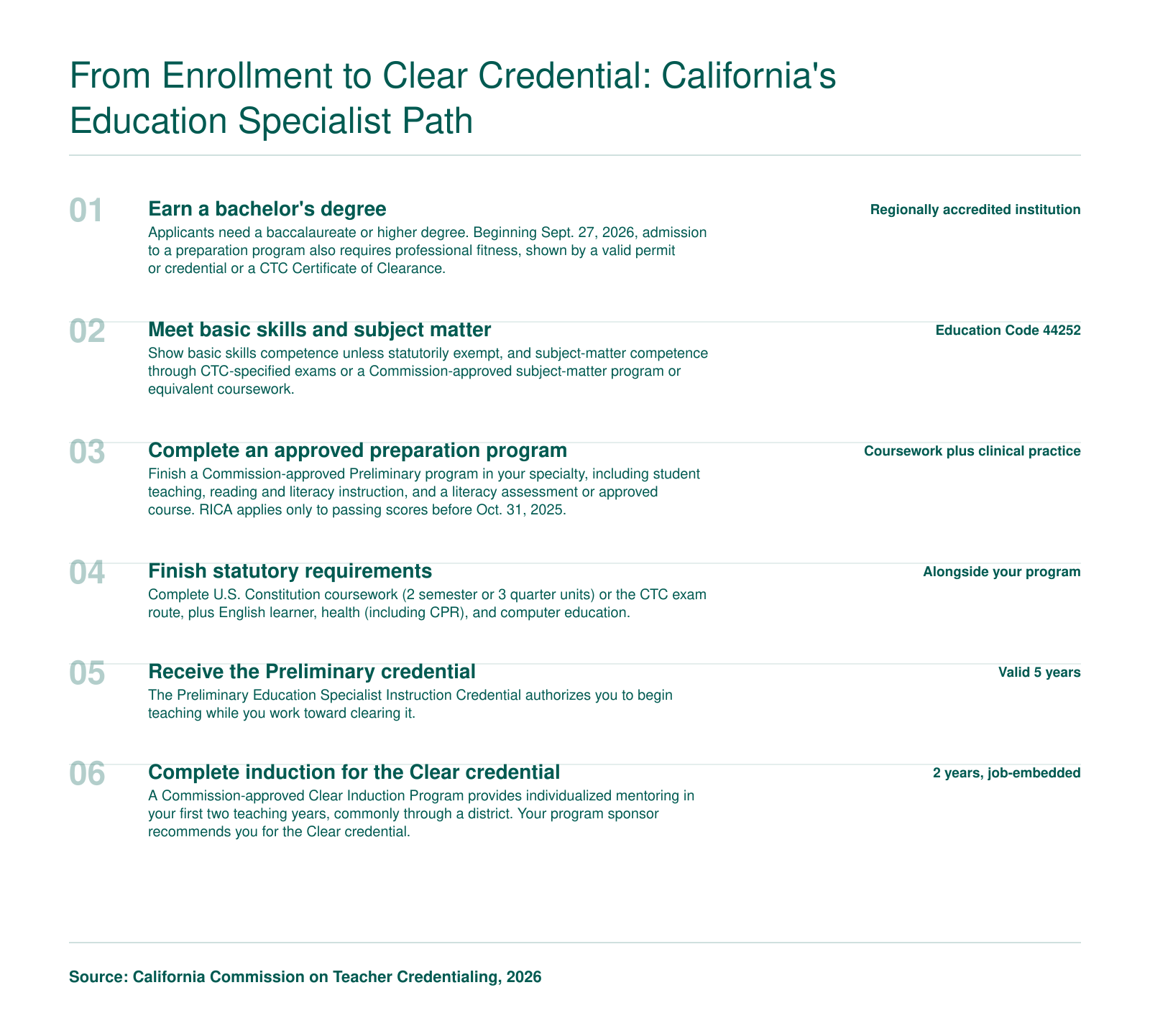
From Enrollment to Clear Credential: California's Education Specialist Path
California issues Education Specialist credentials in two stages through the Commission on Teacher Credentialing (CTC). The Preliminary credential is valid for five years, and induction leads to the Clear credential. Details below follow CTC guidance as of 2026.
What Special Education Master's Graduates Earn After Finishing
Federal earnings data now reaches down to individual programs, but special education master's cohorts are often too small to clear the privacy thresholds required for publication. That is the case in California right now. Program-level earnings and median program debt are not yet published for the schools ranked here, including Cal Poly, the University of San Francisco and Cal State East Bay. We won't fill that gap with campus-wide salary figures, which blend every major and say little about special education teachers.
Until those outcomes are published, three signals tell you the most:
- Paid internships: USF and University of the Pacific place candidates in paid intern teaching roles. UMass Global makes students intern eligible after four classes, so income can start before graduation.
- Credential attached: Programs that award a Preliminary Education Specialist Credential, such as Cal Poly and Azusa Pacific, lead directly onto a district salary schedule.
- Cost control: Cal State East Bay's lower public tuition keeps borrowing modest compared with private options.
Check your target district's salary schedule. Many California districts pay more for a master's.
How We Built This California Special Education Master's Ranking
WASC Senior College and University Commission (WSCUC) regional accreditation and California Commission on Teacher Credentialing (CTC) approval set the baseline for this Education & Teaching Master's Programs ranking. The ranking uses federal IPEDS and College Scorecard data: graduate tuition, net price, institution-wide completion rates, and program-level earnings and debt where published. Every program below appears on the CTC approved-program listing for Education Specialist preparation, meaning graduates are positioned for California credential pathways.1 Graduation rates and net price describe the whole institution, not this specific master's program, so treat them as context rather than a program-by-program measure.
Quick Answers: Timelines and Prerequisites for a California Special Education Master's
How long does a master's in special education take in California?
Do you need a teaching credential to enroll in a master's in special education in California?
Which California special education master's programs lead to a teaching credential?
Compare Special Education programs on the data that matters
Explore more Education & Teaching specializations or browse every graduate field.
All Education & Teaching programs