Best Master's in Early Childhood Education Programs
Compare 270+ accredited Early Childhood Education programs at 240+ schools, with graduate earnings, cost, debt, and completion data from IPEDS and the U.S. College Scorecard.

Prestige rarely decides whether an early childhood master's pays off. Cost, licensure, and format do. Among our top 10, listed program tuition runs from $11,524 at CUNY Brooklyn College, which teaches coursework online, to $67,626 at Boston University, and both prepare students for state teacher licensure.
We compared 29 schools and spotlight the top 10, using federal IPEDS and College Scorecard data rather than school marketing.
Some programs, like UNC Chapel Hill's, require teaching experience but not necessarily a license. Others lead to initial certification for career changers. Confirm which path you need before comparing prices, because a mismatch costs more than any tuition gap.
Key Points
- Federal data lists child care center directors at $59,300 and college faculty at $85,330.
- Net price is a sector-wide average, so compare each school's actual tuition.
- Confirm state licensure approval before enrolling, especially in online programs and ahead of 2027 deadlines.
The 10 Best Master's in Early Childhood Education Programs for 2027
This year's top early childhood education master's programs stand out for verifiable affordability, strong completion signals, and practical pathways into classrooms, special education, and family support roles. The list favors schools that combine manageable net price with field-based training and clear licensure outcomes rather than relying on name recognition alone.
University of North Carolina at Chapel Hill
#1Chapel Hill, NC · ~$13,000/yr (est.)
Best for: Experienced teachers seeking part-time licensure
UNC Chapel Hill earns the top spot with a strong balance of affordability and outcomes. In-state graduate tuition is $8,994, out-of-state is $41,203, and net price is $11,655. The school's overall graduation rate is 91%, and one year after finishing, early childhood education graduates earned a median $44,950. The Master of Education for Experienced Teachers concentration in Early Childhood Intervention and Family Support is a part-time, field-based program designed for practicing professionals with at least two years of experience.
- Part-time, field-based program for practicing professionals
- 30-to-34 credit hours completed over two years
- Hyflex format with synchronous and asynchronous options
- 50 clinical hours in an inclusive early childhood setting
- Designed for teachers with at least two years of experience
- Starts in summer; admission decisions each spring
- Curriculum includes family and interdisciplinary team practice
- Prepares for master's-level licensure
The University of Texas at Austin
#2Austin, TX · ~$12,000/yr (est.)
Best for: Aspiring researchers choosing report or coursework
UT Austin ranks near the top for its flexible degree structures and research-oriented options. In-state graduate tuition is $11,688, out-of-state is $44,908, and net price is $19,857. The school's overall graduation rate is 89%. The early childhood education master's offers M.A. and M.Ed. pathways with a report or coursework emphasis, and no GRE is required.
- 33 to 36 credit hours required
- M.A. or M.Ed. with report or coursework emphasis
- No GRE required for admission
- Campus-based with flexible scheduling
- Focus on learning theories and curriculum development
- Prepares for roles as teachers, educators, researchers
University of Washington-Seattle Campus
#3Seattle, WA · ~$19,000/yr (est.)
Best for: Educators adding special education endorsement
The University of Washington stands out for its early childhood special education focus and hybrid format. In-state graduate tuition is $12,973, out-of-state is $43,209, and net price is $14,091. The school's overall graduation rate is 85%, and one year after finishing, graduates earned a median $72,769. The M.Ed. in Early Childhood Special Education offers three pathways: initial certification with P-3 endorsement, adding a special education endorsement, or a master's-only option.
- Hybrid field-based format; 3-6 quarters full-time
- Three pathways: initial certification, added endorsement, or master's-only
- Initial certification with P-3 endorsement option
- 70 credit hours required minimum
- Cohort-based with fieldwork in local early childhood settings
- Minimum 3.0 GPA and two letters of recommendation required
- WEST-B basic skills test required
- Application deadline May 1
University of Florida
#4Gainesville, FL · ~$13,000/yr (est.)
Florida offers one of the most affordable pathways on this list; in-state tuition is $6,381, out-of-state is $28,659, and net price is $6,541. The school's overall graduation rate is 91%, and one year after finishing, early childhood education graduates earned a median $50,802. The M.Ed. emphasizes inclusive early childhood programs, child development, family engagement, and policy advocacy.
- Focus on inclusive early childhood programs
- Curriculum development, child assessment, and family engagement
- Policy advocacy and ethical professional conduct emphasized
- Classroom-based assessment and effective planning
- Cultural sensitivity and teamwork development
University of Illinois Urbana-Champaign
#5Champaign, IL · ~$19,000/yr (est.)
Illinois combines a licensure-focused M.Ed. with concentrations in Bilingual-Bicultural Education or Digital Learning. In-state tuition is $16,004, out-of-state is $35,124, and net price is $14,355. The school's overall graduation rate is 85%, and one year after finishing, graduates earned a median $53,164. The 32-credit campus program requires a 3.0 GPA and three recommendation letters, with fall-only admission.
- 32 total credit hours required
- Campus-based with fall-only admission
- Prepares for teaching licensure, birth through grade 2
- Minimum 3.0 GPA and three recommendation letters
- Financial aid includes assistantships and scholarships
- Concentration in Bilingual-Bicultural Education
- Field placement required
- TOEFL required for international applicants
- 12 hours of 500-level courses
- Statement of purpose and resume required
- Concentration in Digital Learning
- Two-year completion time
- Teaching licensure included
- 24 hours of elective courses
- Tuition waivers available
Boston College
#6Chestnut Hill, MA · ~$38,000/yr (est.)
Boston College ranks for its humanistic, developmentally appropriate approach and strong licensure preparation. Graduate tuition is $70,702 for both in-state and out-of-state students, with a net price of $41,704. The school's overall graduation rate is 91%, and one year after finishing, graduates earned a median $56,482. The 37-credit M.Ed. includes both licensure and non-licensure pathways and can be started in fall, spring, or summer.
- 37 total credits across 15 courses plus practicum
- 1.5-2 years full-time completion
- Fall, spring, or summer start options
- Licensure and non-licensure pathways
- Pre-K through 2nd grade teaching focus
- Partnerships with local schools and research centers
- Developmentally appropriate, humanistic approach
- Massachusetts licensure preparation
University of Massachusetts-Amherst
#7Amherst, MA · $15,000 – $20,000/yr (est.)
UMass Amherst offers a Child Study and Early Education M.Ed. with concentrations across early education, family services, public policy, and interdisciplinary childhood studies. In-state tuition is $17,772, out-of-state is $40,449, and net price is $22,383. The school's overall graduation rate is 83%. The program emphasizes cultural context, individual and group assessment, and a PreK-2 licensure pathway for qualified teachers.
- MEd degree with early childhood education focus
- Concentrations in infancy to eight years, family services, public policy, or interdisciplinary studies
- Cultural context emphasis in assessment and programming
- Individual and group child assessment focus
- Pathway to PreK-2 professional licensure for qualified teachers
- Prior teaching experience in diverse settings typical
- Infancy to eight years concentration
- Focus on assessment and programming skills
- Preparation for classroom teaching and educational consulting
- Diverse student backgrounds valued
- Family services concentration
- Prepares for nonprofit and early intervention roles
- Policy and interdisciplinary childhood studies options
- Careers as teachers, consultants, or family support professionals
Boston University
#8Boston, MA · $65,000 – $70,000/yr (est.)
Boston University provides a 34-credit M.Ed. with four pathways, including Massachusetts PreK-2 teacher licensure. Graduate tuition is $68,102 for both in-state and out-of-state students, with a net price of $24,402. The school's overall graduation rate is 89%, and one year after finishing, graduates earned a median $53,978. Evening coursework supports full-time or part-time students, and field experiences are built in.
- 34 total credit hours required
- Four program pathways available
- Massachusetts PreK-2 licensure option
- Full-time or part-time with evening coursework
- Field experience included
- Scholarships available
- No prior education experience required
- Prepares for roles as curriculum developers and coordinators
University of Minnesota-Twin Cities
#9Minneapolis, MN · ~$22,000/yr (est.)
Minnesota's licensure-focused M.Ed. uses hands-on work at the on-campus Child Development Laboratory School and two student teaching placements. In-state tuition is $17,214, out-of-state is $38,362, and net price is $16,778. The school's overall graduation rate is 85%, and one year after finishing, graduates earned a median $51,934. The program reports a 100% job placement rate within a year and requires no entrance exam.
- No entrance exam required
- Starts fall or spring
- 100% job placement rate within one year
- Minimum 2.8 GPA and two letters of recommendation
- Capstone project required
- Two student teaching placements: early childhood and K-3
- Hands-on experience at Child Development Laboratory School
- Prepares for Minnesota teaching licensure
CUNY Brooklyn College
#10Brooklyn, NY · $10,000 – $15,000/yr (est.)
CUNY Brooklyn College is the strongest budget pick, with in-state tuition at $7,452, out-of-state at $15,402, and a net price of $3,103. The school's overall graduation rate is 54%, and one year after finishing, graduates earned a median $59,924. The online M.S.Ed. in Early Childhood Education Teacher (Birth-Grade 2) requires 30-45 credits and includes in-person fieldwork in New York City early childhood settings, with bilingual and special education extensions available.
- Online course seminars with in-person fieldwork
- 30-45 credit hours depending on prior certification
- Minimum 3.0 GPA required
- Two letters of recommendation required
- Fall and spring start deadlines
- Prepares for New York State certification
- Bilingual extension available
- Special education extension available
Cost & outcomes by school
Federal data for the highest-earning Early Childhood Education programs, independent of the ranking above. Earnings are this field's master's graduates four years after completing, where the Scorecard reports them.
| School | Earnings | Tuition / yr | Debt | Grads/yr | Format |
|---|---|---|---|---|---|
| St. John's University-New York NY | $83,019 | $36,227 | $52,441 | 15 | Campus |
| University of Washington-Seattle Campus WA | $80,738 | $18,792 | $30,990 | 103 | Hybrid |
| CUNY Brooklyn College NY | $80,655 | $11,524 | $27,668 | 124 | Online |
| CUNY City College NY | $79,740 | $11,402 | $27,301 | 43 | Hybrid |
| Molloy University NY | $79,134 | $27,520 | $41,000 | 24 | Hybrid |
| CUNY Lehman College NY | $78,311 | $11,570 | $25,825 | 79 | Campus |
| Indiana University-Bloomington IN | $77,765 | $11,756 | — | 18 | Campus |
| San Francisco State University CA | $77,699 | $9,370 | $18,834 | — | Hybrid |
| CUNY Hunter College NY | $77,067 | $11,398 | $25,523 | 127 | Campus |
| University of Massachusetts-Boston MA | $76,298 | $20,456 | $24,000 | 100 | Campus |
| Wagner College NY | $75,353 | $24,610 | — | 15 | Campus |
| William Paterson University of New Jersey NJ | $74,359 | $16,963 | $27,245 | 62 | Online |
Sources: U.S. Department of Education. Tuition and graduates: IPEDS. Earnings and debt: College Scorecard, this field's master's graduates; a dash means no figure is reported.
Cost, debt & payoff
Median earnings of this field's master's graduates (4 yrs after completing) vs. their median federal loan debt · U.S. College Scorecard
Across these programs the median graduate earns about $59,444 and finishes with roughly $29,751 in debt — a ratio that clears a common rule of thumb (keep debt below first-year salary). Tuition and debt vary widely school to school, so check the per-school figures in the table above before you shortlist.
How We Ranked These Early Childhood Education Master's Programs
The data behind the list
Our rankings are built from federal higher education data: the Department of Education's institutional reporting system and the College Scorecard, which publishes cost, borrowing, and program-level earnings figures. No school pays for placement on mastersprograms.com, and no program can buy a higher position.
The inputs we weigh:
- Net price: What students actually pay after grant aid, not the sticker figure.
- Graduate tuition: Published per-credit and annual costs for master's study.
- Earnings and debt: Reported earnings for graduates of early childhood and teacher preparation programs, measured against typical borrowing at the same program.
- Completion and retention: Whether the institution keeps and graduates the students it admits.
- Format availability: Online, hybrid, and on-campus options, since many applicants are already teaching full time.
Check accreditation yourself before applying
Accreditation decides whether a degree counts for licensure, so verify three separate things rather than assuming one covers the others.
- Institutional accreditation: Look for a recognized regional accreditor such as the Higher Learning Commission, Middle States, NECHE, NWCCU, SACSCOC, or WSCUC. This is required for graduate study and federal aid, but it does not approve you for a teaching license.1
- Educator preparation accreditation: CAEP or AAQEP reviews educator preparation providers, including advanced-level graduate preparation.3 CAEP grants accreditation while the state education agency still approves the program, as its 2026 South Dakota agreement makes explicit. Confirm the specific program's status, not just the university's.
- NAEYC: NAEYC accredits associate, baccalaureate, and initial master's programs, not advanced-practitioner degrees.1 Reports submitted from spring 2026 forward use the 2025 Higher Education Accreditation Standards. Many programs instead align with NAEYC's professional standards, which Pennsylvania, Washington, Michigan, Missouri, Iowa, Rhode Island, and South Carolina have adopted or mirrored in licensure rules.2 Alignment is a quality signal, not accreditation.
What this method cannot tell you
Graduation rates and net price are institution-wide averages, so a small early childhood cohort may differ from the campus figure. Federal data also excludes class size, program length, and admission requirements; accreditation never replaces state exams, background checks, or required clinical hours.4
What an Early Childhood Education Master's Degree Costs: The Most Affordable Picks
The table compares the published in-state and out-of-state tuition for the most affordable early childhood education master's programs below, but those sticker prices only tell part of the story: the net price column is an institution-wide, sector-based average for all students at that school, not a personal financial aid quote. Public universities typically charge much more for out-of-state students, while many online programs use a flat per-credit rate regardless of residency, so when you search for the cheapest online master's degree in early childhood education, always check whether the published tuition is the same for in-state and out-of-state learners. Transfer credit can reduce the total cost, with typical caps of 6 to 12 graduate credits (for example, Arkansas State accepts up to 9 credits, Capella up to 12 of 46 credits, and Walden up to 25 credits), and some programs may award credit for prior professional experience or a CDA credential; the median federal debt and 10-year monthly payment below show the borrowing burden behind each option.
| School | Format | In-state tuition | Out-of-state tuition | Net price | Median federal debt | 10-year monthly payment |
|---|---|---|---|---|---|---|
| CUNY Brooklyn College | Online | $11,524 | $20,954 | $3,103 | $11,000 | $315 |
| CUNY Lehman College | Campus | $11,570 | $21,000 | $3,148 | $10,950 | $294 |
| CUNY City College | Hybrid | $11,402 | $20,832 | $3,776 | $11,990 | $311 |
Graduate Earnings and Career Paths Beyond the Classroom
An early childhood master's leads to more than lead-teacher jobs, and pay varies more by role than many applicants expect. Federal labor data puts median pay for child care center directors at $59,300 and for postsecondary teachers at $85,330, a gap that should shape which program you choose.
What Program Earnings Can and Can't Show
The most useful salary figure is a program-level median measured at a set point after graduation: one, two, four, or five years out. Always check the window. A one-year number captures new graduates in first jobs, while a four- or five-year number reflects early career growth. A school-wide average across all majors says little about early childhood graduates.
For the ten programs ranked here, program-level earnings for early childhood graduates are not yet published, so a high-to-low spread can't be reported. Be skeptical of salary claims in program marketing until those figures appear. The same applies to employment rates. When available, the one-year employment share shows how many graduates are working, rather than still enrolled or not working, a year after finishing. That outcome isn't reported for these programs either.
Roles Beyond the Classroom
- Center director: Median pay was $59,300 in 2025 across about 91,900 jobs, with a projected 3% decline through 2035. A bachelor's is the typical entry credential, so employers and state child care licensing rules often weigh administrative and regulatory experience as heavily as a master's.
- Head Start education manager or curriculum specialist: Federal standards require a bachelor's or advanced degree in early childhood education, or another degree with equivalent coursework plus early education teaching experience.13 These are minimums, and programs may add more.4
- Instructional coordinator: A master's is the typical entry credential, with median pay in the $75,000 to $99,999 range and slower-than-average growth.2
- Community college instructor: The broad postsecondary teaching occupation shows 7% projected growth and about 103,300 openings a year, but colleges set their own requirements, sometimes specifying graduate credits or teaching experience.
- Early intervention specialist, family engagement coordinator, policy or advocacy analyst: No single national standard applies. Early intervention in regulated special education or clinical services may require state licensure.
What Jobs Can You Get With a Master's in Early Childhood Education?
- Leadership roles such as center director or Head Start education manager, usually paired with supervisory experience.
- Curriculum and coaching jobs, where a master's is often the expected credential.
- Community college teaching in early childhood programs, subject to each college's faculty rules.
- Early intervention, family support, and policy work, where state credentials and experience frequently matter as much as the degree.
Related Articles
Admissions Requirements for Early Childhood Education Master's Programs
Requirements vary by program and by whether you want initial certification or an advanced degree. Published GPA minimums run from about 2.5 to 3.0. Always confirm current details on each program's own admissions page.
- Bachelor's degreeYou need a bachelor's degree from an accredited institution. An education major is not necessarily required. NYU Steinhardt's initial-certification M.A. (Birth–Grade 2) accepts uncertified applicants, but New York State content-core coursework applies: a liberal-arts major or 30 semester hours in one liberal-arts concentration, plus set credits in English, math, science, social science, and a language other than English.
- Minimum GPAPublished minimums range from 2.5 (University of Georgia M.A.T. in Elementary Education, an adjacent PK–5 program) to 3.0 (NYU's expected GPA and the University of Georgia's M.Ed. in Special Education, Birth–Kindergarten). NYU says applicants below 3.0 may still get consideration if the rest of the file is strong.
- GRE statusMost early childhood programs no longer lean on test scores. NYU Steinhardt explicitly does not require the GRE or MAT. The University of Georgia pages reviewed do not state a GRE policy, so check directly with the program.
- License or classroom experienceInitial-certification tracks like NYU's 45-credit, full-time M.A. do not publish a prior license or classroom-experience requirement. Advanced tracks differ: NYU's 30-credit Early Childhood Special Education M.A. is for applicants already certified or eligible for certification in childhood education.
- Application materials and timelineExpect a statement of purpose, resume, letters of recommendation, and a background check, though counts and rules vary by school. Programs run about 30–45 credits (the University of Georgia M.A.T. requires at least 33), and most take roughly one to two years depending on pace. Published completion times are scarce, so confirm with admissions.
Online vs. Campus Early Childhood Education Master's Programs
Is an online master's in early childhood education worth it? For most working educators, yes, as long as the program is accredited and approved for licensure in your state, because the degree and curriculum are generally comparable to campus options. Employer research is mixed, with some surveys showing a modest preference for campus or hybrid credentials and others finding no meaningful difference, so confirm state licensure eligibility before you enroll.
| Factor | Online | Campus or Hybrid |
|---|---|---|
| Flexibility and pacing | Often asynchronous, with part-time and accelerated tracks that suit working teachers | Fixed class meetings and cohort schedules, with less room to adjust your pace |
| Program length | Typically 30 to 42 credit hours | Typically 30 to 42 credit hours |
| Practicum and student teaching | Still completed in person at an approved school or childcare setting, and you may need to arrange your own placement | Completed in person at an approved site, often with placements coordinated by the university |
| Licensure eligibility across states | Varies by state. Check that the program is approved in the state where you plan to teach | Usually aligned with the home state's licensure rules, which makes it simpler if you stay local |
| Networking with local districts | Built through your placement site and virtual cohort, so it takes more effort | Easier through faculty ties, in-person cohorts, and local district partnerships |
| Cost structure | Can reduce commuting and relocation costs. Per-credit tuition and fees vary widely by school | May add commuting, housing, and campus fees, though some in-state public programs are low-cost |
| Employer perception | Studies are mixed. Some surveys show a slight edge for campus or hybrid degrees, and others find no difference | Sometimes viewed slightly more favorably in surveys, but the evidence is not consistent |
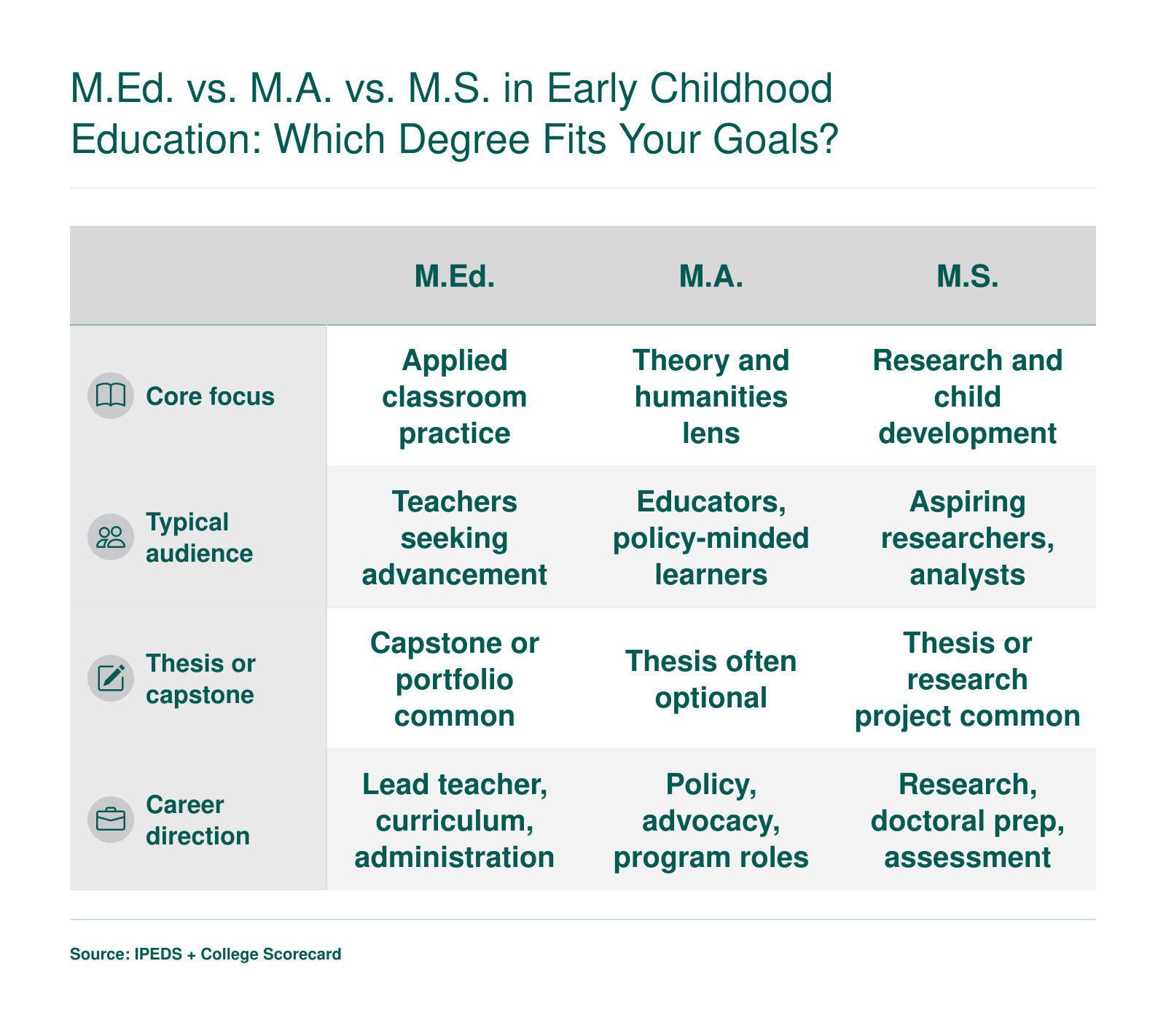
M.Ed. vs. M.A. vs. M.S. in Early Childhood Education: Which Degree Fits Your Goals?
The letters after your degree signal emphasis, not quality. Most early childhood programs offer one or two of these titles, so the choice often comes down to whether you want to refine classroom practice or build research skills. Common concentrations include special education, bilingual/ESL, leadership, and policy, and the degree title matters less than licensure alignment and accreditation.
Early Childhood Education programs by state
Frequently Asked Questions About Early Childhood Education Master's Degrees
These answers cover the questions prospective students ask most often. Program titles and licensure rules vary, so confirm details with each school and your state before you apply.
What is the difference between a master's in early childhood education and an early childhood studies degree?
How much does a master's in early childhood education cost?
What is the typical salary for someone with a master's in early childhood education?
Can a master's in early childhood special education qualify me to teach both general and special education classrooms?
Compare Early Childhood Education programs on the data that matters
Explore more Education & Teaching specializations or browse every graduate field.
All Education & Teaching programs