Accelerated Master's in Early Childhood Education Programs
Compare 270+ accredited fastest Early Childhood Education programs at 240+ schools, with graduate earnings, cost, debt, and completion data from IPEDS and the U.S. College Scorecard.

The fastest accelerated early childhood master's run on 7 or 8-week terms, packing 30 to 36 credits into roughly 12 to 15 months. Carlow University advertises completion in as few as 12 months; Wagner College and Lesley University both run one-year tracks.
The word "accelerated" carries no standard meaning. Some programs genuinely compress the calendar with year-round enrollment, while others simply offer flexible, self-paced online courses that stretch past two years.
That gap matters because tuition, licensure rules, and early-career earnings swing widely between programs that market themselves the same way.
Key Points
- Most accelerated programs below finish in 12 to 15 months.
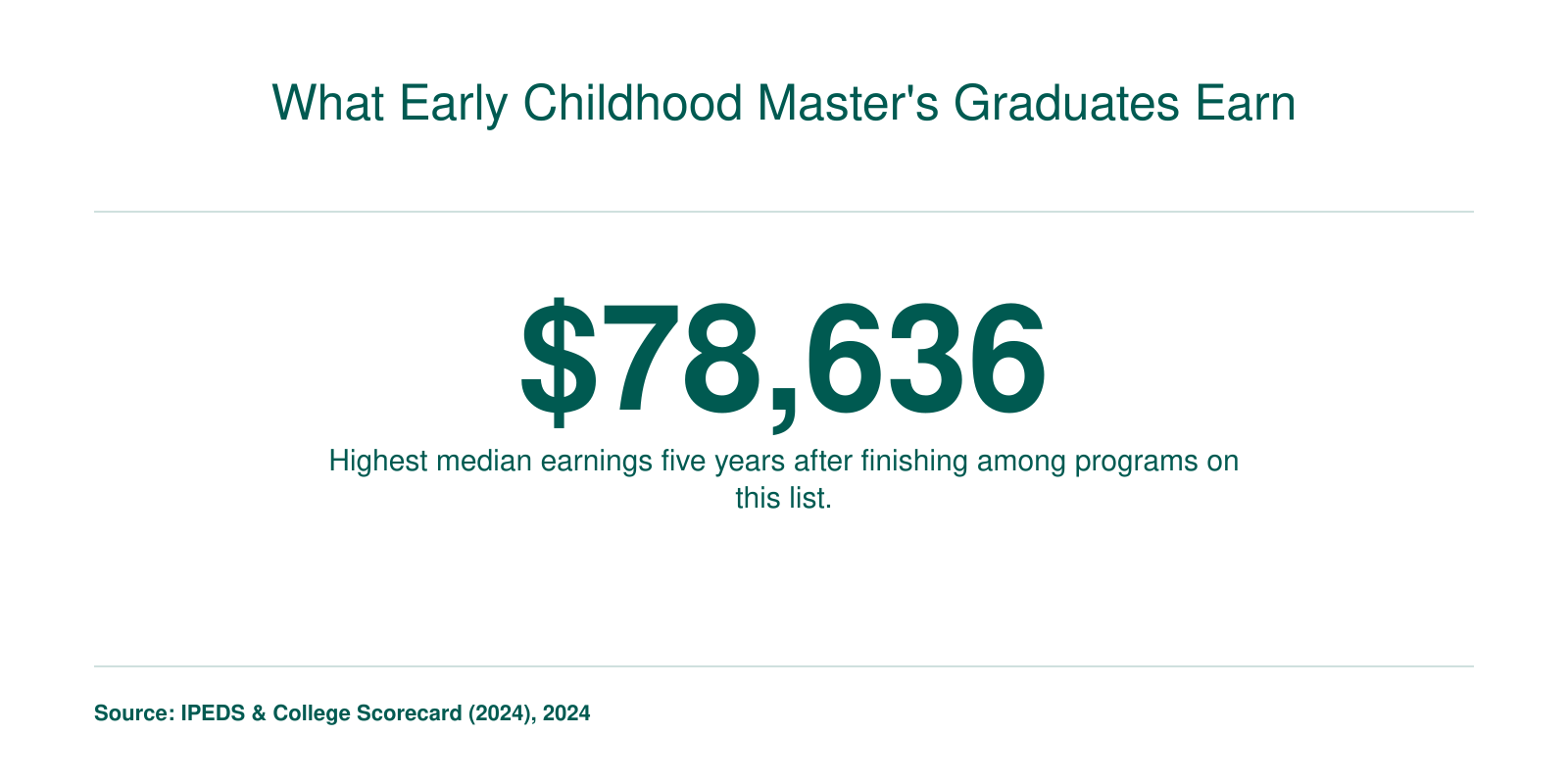
- Wagner College leads median earnings at $78,636 five years out.
- Multiply per-credit rates by credits and subtract tuition benefits before comparing.
Best Accelerated Early Childhood Education Master's Programs
This list prioritizes the shortest programs, then weighs cost and institutional outcomes such as graduation rate and early-career earnings. Use the cards below to compare the fastest routes without losing sight of program quality and affordability.
West Chester University of Pennsylvania
#1West Chester, PA · $10,000 – $15,000/yr (est.)
Best for: Working professionals balancing full-time jobs
West Chester keeps its fully online M.Ed. focused on working professionals through a cohort model and one-course-at-a-time pacing. Students finish in five consecutive semesters. The program does not lead to teacher certification, so it suits educators who already hold credentials or work in non-licensed early education settings.
- 33-credit cohort-based program
- Fully online with synchronous and asynchronous meetings
- Complete in five consecutive semesters
- One course at a time through most of the program
- Does not lead to teacher certification
- Designed for working professionals
- Capstone required
- Financial aid and scholarships available
University at Albany
#2Albany, NY · ~$14,000/yr (est.)
Best for: Career changers seeking New York certification
Albany's program is built around New York teacher certification, admitting only candidates who already hold a teaching credential and moving them toward professional certification. It runs part-time or full-time online and on campus with evening and summer options, and an accelerated 4+1 route gives current undergraduates a head start.
- Leads to New York State professional certification
- Requires existing teacher certification for admission
- 3.0 minimum GPA and three letters of recommendation
- Online or on campus, part-time or full-time
- Accelerated 4+1 option available
- Internship or field experience required
- Core courses in literacy and language acquisition
Wagner College
#3Staten Island, NY · ~$25,000/yr (est.)
Best for: Dual certification seekers in inclusive settings
Wagner's M.S.Ed. is a one-year pathway to dual certification in general and special education for birth through grade 2. The summer-start, cohort-based format is evening-friendly for working students, and B-2 candidates can add advanced certification.
- Often completed in one year
- Starts in summer and uses a cohort structure
- Leads to dual certification in general and special education
- B-2 candidates can add advanced certification
- 3.0 minimum GPA and faculty interview required
- Evening-friendly format for working professionals
- Partner schools include PS 13
Concordia University-Wisconsin
#4Mequon, WI · ~$13,000/yr (est.)
Concordia's initial licensure option pairs a master's degree with Wisconsin teaching licenses across both early childhood and elementary levels. The 52-credit plan uses accelerated eight-week online courses with scheduled Saturday Zoom lessons, and students can transfer up to half of graduate credits.
- 52 total credit hours
- $715 per credit
- Accelerated eight-week courses
- Licensure for birth to 3rd grade and 4K-9th grade
- Up to 50% of graduate credits can transfer in
- Saturday real-time Zoom lesson required
- Licensure-only route available
- $150 to $500 scholarships per three-credit course
Carlow University
#5Pittsburgh, PA · $20,000 – $25,000/yr (est.)
Carlow's M.Ed. combines online eight-week courses with in-person student teaching and can be completed in as few as 12 months. The 36-credit program prepares students for initial PreK-4 certification in Pennsylvania, and rolling admissions support a fast start.
- 36 total credit hours
- $618 per credit
- Complete in as few as 12 months
- Online courses in eight-week accelerated format
- In-person student teaching required
- Prepares for initial PreK-4 certification
- Rolling admissions with two letters of recommendation
- Preferred 3.0 undergraduate GPA
Holy Family University
#6Philadelphia, PA · ~$16,000/yr (est.)
Holy Family offers an accelerated M.Ed. for students who already hold a bachelor's degree outside education and want Pennsylvania Pre K-4 certification. The blended and online eight-week courses use a cohort structure, and graduates may add Grade 5 and Grade 6 certification through further testing.
- Accelerated degree program
- Blended and online eight-week courses
- Designed for non-education bachelor's degree holders
- Prepares for Pre K-4 certification
- Graduates may add Grade 5 and Grade 6 certification
- Cohort-based structure
- School district employment partners
Missouri State University
#7Springfield, MO · ~$8,000/yr (est.)
Missouri State's early childhood and family development degree is fully online and can be finished in four semesters. Students can also start the master's while finishing a bachelor's through the accelerated option, and electives may cover up to one-third of the program.
- Complete in four semesters
- Fully online option available
- Accelerated master's option for current bachelor's students
- Electives can make up one-third of classes
- Core areas in early childhood, child and family development
- One-on-one faculty research guidance
- Take one course per semester option
Mount Saint Mary College
#8Newburgh, NY · ~$20,000/yr (est.)
Mount Saint Mary's MSEd offers dual certification in childhood and early childhood education for candidates without prior teaching certification. The 46-credit program uses eight-week asynchronous online or hybrid terms, but most students finish in 2 to 2.5 years.
- 46 total credit hours
- No prior teaching certification required
- Eight-week accelerated terms
- Asynchronous online or hybrid courses
- Student teaching placement required
- Leads to recommendation for New York State certification
- Graduates usually finish in 2 to 2.5 years
- Alumni receive 20% off graduate tuition
Lesley University
#9Cambridge, MA · ~$20,000/yr (est.)
Lesley's M.Ed. can be completed in a year or paced slowly, with full-time and part-time residency options that guarantee field placements. The 36-credit program leads to initial licensure and provisional teaching support, with a one-year intensive path for current students.
- 36 total credit hours
- Finish in a year or at your own pace
- Full-time and part-time cohort options
- Field placements guaranteed upon acceptance
- Leads to initial licensure and provisional license support
- One-year intensive residency pathway
- Seven concentration options
Saint Xavier University
#10Chicago, IL · ~$14,000/yr (est.)
Saint Xavier's online MAT is a 12-to-15-month route to an early childhood teaching license for birth through grade 2. The program includes mentorship from site-based coaches, a cohort structure, and an accelerated 15-month alternative option.
- $575 per credit hour
- Complete in 12 to 15 months
- Fully online format
- Prepares for birth through grade 2 licensure
- Mentorship from site-based coaches and coordinators
- Accelerated 15-month alternative option
- Cohort-based learning
Cost & outcomes by school
Federal data for the highest-earning Early Childhood Education programs, independent of the ranking above. Earnings are this field's master's graduates four years after completing, where the Scorecard reports them.
| School | Earnings | Tuition / yr | Debt | Grads/yr | Format |
|---|---|---|---|---|---|
| Wagner College NY | $75,353 | $24,610 | — | 15 | Campus |
| William Paterson University of New Jersey NJ | $74,359 | $16,963 | $27,245 | 62 | Online |
| Wayne State College NE | — | $5,784 | — | — | Online |
| Monroe University NY | — | $14,558 | — | — | Hybrid |
Sources: U.S. Department of Education. Tuition and graduates: IPEDS. Earnings and debt: College Scorecard, this field's master's graduates; a dash means no figure is reported.
Cost, debt & payoff
Median earnings of this field's master's graduates (4 yrs after completing) vs. their median federal loan debt · U.S. College Scorecard
Across these programs the median graduate earns about $59,444 and finishes with roughly $29,751 in debt — a ratio that clears a common rule of thumb (keep debt below first-year salary). Tuition and debt vary widely school to school, so check the per-school figures in the table above before you shortlist.
Truly Accelerated or Just Flexible? Realistic Timelines and Weekly Workload
How fast can you really finish an accelerated early childhood education master's degree? Genuinely accelerated programs pair 7 or 8-week terms with year-round enrollment, so 30 to 36 credits for an online master's in early childhood education can fit into roughly 12 to 15 months. Emporia State (30 credits, 7-week sessions) and the University of North Texas (30 credits, 8-week sessions, five starts a year) publish 12 months. Merrimack lists 13 months for full-time students, while part-time takes two to three years. A program with 8-week courses can still be slow: American International College lists 24 months.
Weekly workload
Guidance varies by school. Arizona State figures about 45 hours per credit, so a 3-credit, 8-week course runs about 18 hours a week. Two at once roughly doubles that. Thomas Edison State says a 3-credit, 4-week course demands 48 hours weekly. Lancaster Bible notes that most working educators take one or two courses per term and finish in about two to three years.
What slows completion
- Practicum: Merrimack's is a full 15-week semester requiring 450 hours.
- Capstone or thesis: these can add a term beyond the coursework.
- Fixed cohort starts: missing one can cost months.
A quick test
For any program page, check total credits, term length, courses per term, and whether the practicum can be completed at your current job. If the page won't state all four, the 12-month claim is a best case, not a plan.
Comparing Costs: Lowest-Priced Accelerated ECE Master's Programs
The table below lists the lowest-cost accelerated early childhood education master's programs in this ranking, showing graduate in-state and out-of-state tuition and each institution's net price after aid. Net price is an institution-wide average after grant or scholarship aid, not a quote for any individual student. Where a school publishes a per-credit rate or a fee-inclusive total, that detail appears in the last column; many online programs also charge one flat tuition rate regardless of residency, which can narrow the out-of-state gap.
| Program | Graduate In-State Tuition | Graduate Out-of-State Tuition | Institution-Level Net Price | Published Program Cost Details |
|---|---|---|---|---|
| Saint Xavier University | $37,940 | $37,940 | $10,970 | $575 per credit |
| Texas Woman's University | $8,640 | $18,480 | $11,963 | $15,000 total program tuition; 31 credit hours |
| Holy Family University | $35,330 | $35,330 | $13,143 | N/A |
Licensure Pathways: Initial, Advanced, and Non-Licensure Options
A career changer entering a Master's in Early Childhood Education With No GRE Required program and a licensed teacher adding a specialty need different programs. Sort any accelerated option into one of three buckets before you apply.
Three Program Types
- Initial licensure: Built for career changers with no teaching credential. These include supervised clinical practice and align to a state's certification requirements.
- Advanced or professional: Designed for teachers who already hold a license and want deeper expertise or a salary bump, not a first credential.
- Non-licensure: Aimed at childcare directors, curriculum developers, and policy roles that do not require classroom certification.
Portability Is Not Automatic
An affordable master's in early childhood education program approved in its home state does not automatically qualify you to teach elsewhere. Before enrolling, read the program's state professional licensure disclosure, which will say it "meets," "does not meet," or has "no determination" for your state.1 "Meets" usually covers coursework only.
New York is a useful example. The relevant credential is Early Childhood Education (Birth-Grade 2)2, issued through the NYSED Office of Teaching Initiatives after a paid application, transcript review, and required exams.3 Coursework cannot be pre-approved3, and an out-of-state degree does not confer the certificate on its own.1
NASDTEC interstate agreements ease movement between states, but they are a reciprocity framework, not nationwide licensure. A receiving state may still require testing, added coursework, experience, or fingerprint clearance. Confirm the exact conditions with your target state's education department.
Related Articles
What You'll Need to Apply to an Accelerated ECE Master's
- Degree and GPAAn accredited bachelor's is standard. Minimum GPAs commonly land between 2.75 and 3.0, with some programs offering lower conditional admission.
- License or experienceAdvanced and licensure-oriented tracks often require a valid teaching certificate; initial licensure tracks generally do not.
- Application materialsExpect transcripts, letters of recommendation, a personal statement, and a résumé. Field placements may add background clearance steps.
- Transfer and start datesTransfer caps vary, Arkansas State allows up to 9 credits. Louisville, Ole Miss, and North Dakota list multiple start deadlines.
- GRE policyDo not assume the GRE is required. ASU Online and Louisville waive it; Ole Miss treats it as one optional qualifying route.
What Early Childhood Master's Graduates Earn
Program-level median earnings five years after finishing vary across this list. Wagner College reports $78,636, Mount Saint Mary College $74,968, West Chester University $64,770, Lesley University $60,443, Saint Xavier University $58,838, and Holy Family University $58,544. National BLS medians for preschool teachers, kindergarten teachers, and childcare center directors are not available in the May 2025 release available here, so use district salary schedules for context.
Early Childhood Education programs by state
Accelerated Early Childhood Education Master's FAQs
Most accelerated early childhood education master's students finish in 12 to 18 months, but speed depends on pacing and practicum timing. These answers cover common questions.
How fast can I complete an accelerated early childhood education master's?
Can I complete an early childhood education master's fully online, including student teaching?
Are accelerated early childhood education master's programs worth it?
Can I keep working full time in an accelerated program?
Compare Early Childhood Education programs on the data that matters
Explore more Education & Teaching specializations or browse every graduate field.
All Education & Teaching programs