Master's Programs in Rhode Island
Every master's program reported by a school in Rhode Island: 200+ programs at 12 graduate schools, with the online options, costs and outcomes behind each one.

Rhode Island is small enough that a public, a private, and an Ivy League graduate campus can sit within a 30-minute drive of each other, and the price gap between them is enormous. Rhode Island College charges roughly $580 per credit for in-state graduate students in 2025-2026; a private research seat in Providence can run several times that for the same 30-to-36 credit degree.
Most of those degrees take about two years full-time, though 12-month and 4+1 tracks exist for the right background, and a few University of Rhode Island Master's Programs run fully online. The deciding variables here are usually funding and licensure rules, not reputation.
Key Points
- Most Rhode Island master's degrees take about two years, though 12-month and 4+1 options exist.
- Rhode Island College charges roughly $580 per credit in-state for 2025-2026, far below private research universities.
- Fully online options exist at URI, and licensure fields like counseling require 60 graduate credits.
Popular degrees in Rhode Island
Master's programs in Rhode Island by field
Business & Management
- Management10 programs
- Accounting9 programs
- Organizational Leadership8 programs
- Analytics8 programs
- General Business6 programs
- Public Administration5 programs
- Healthcare Management5 programs
- Marketing5 programs
Education & Teaching
- Teaching14 programs
- STEM Education or Science Education or Mathematics Education6 programs
- Special Education4 programs
- Library Science or Library and Information Science or Library Media4 programs
- Art Education2 programs
- Reading & Literacy2 programs
- Secondary Education2 programs
- Mathematics Education1 program
Healthcare
- Public Health5 programs
- Nutrition4 programs
- Health Administration3 programs
- Health Informatics2 programs
- Speech Pathology2 programs
- Health Education1 program
Computers & IT
- Data Analytics4 programs
- Cybersecurity4 programs
- Information Security & Assurance2 programs
- Machine Learning2 programs
Nursing
- Family Nurse Practitioner (FNP)4 programs
- Psychiatric Mental Health Nurse Practitioner3 programs
- Public Health2 programs
- Clinical Nurse Specialist1 program
- Adult Gerontology Primary Care Nurse Practitioner1 program
- Adult Gerontology Acute Care Nurse Practitioner1 program
Psychology
- Industrial Organizational Psychology2 programs
- General Psychology2 programs
- Educational Psychology or School Psychology1 program
- Forensic Psychology1 program
- School Psychology1 program
- Addiction Psychology1 program
- Applied Behavior Analysis1 program
- Counseling Psychology1 program
Arts & Design
- Creative Writing7 programs
Communications & Media
- Communication4 programs
- Organizational Communication1 program
- Communication Disorders1 program
- Speech Pathology1 program
Science & Engineering
- Sustainability or Environmental Management5 programs
- Environmental Science1 program
Counseling
- Clinical Mental Health Counseling3 programs
- School Counseling1 program
- Marriage and Family Therapy or Marriage and Family Counseling1 program
- Addiction Counseling1 program
Criminal Justice & Law
- Public Policy2 programs
- Legal Studies1 program
Social Work & Social Sciences
- Social Work1 program
- Political Science, Government1 program
- Social Work Advanced Standing1 program
Religion & Theology
- Theology1 program
How Long a Master's Takes in Rhode Island, and Where One-Year Options Exist
Most Rhode Island master's degrees take about two years of full-time study, but a handful of 12-month and 4+1 options can cut that roughly in half if your background fits.
Standard Timelines
A typical 30 to 36 credit master's runs about 1.5 to 2 years full-time and 2.5 to 4 years part-time. The University of Rhode Island reports that its online master's students average about 1.5 years and in-person students about two, with a general five-year limit to finish. Licensure tracks run longer by design: counseling and social work programs often require 48 to 60 credits plus supervised field hours.
Where One-Year Programs Exist
- URI: The Professional M.S. in Supply Chain Management and Applied Analytics (30 credits, seven-week modules) and the 30-credit M.S. in Pharmaceutical Sciences are promoted as 12-month programs. The accelerated online MPA, one of the best mpa programs online, lets some students finish in as little as a year.
- Brown: The ScM in Data Science can be completed in as little as 12 months, with 16 to 24 month paths also available.
- Providence College: The 30-credit M.S. in Business Analytics takes one year full-time or two years part-time.
- Roger Williams University: The M.A. in Special Education runs one calendar year full-time, starting in the Summer II session in late July.
The materials we reviewed don't consistently say whether a business or quantitative undergraduate degree is required, so ask admissions; missing foundation courses can add a semester. We could not verify 12-month programs at Rhode Island College, Bryant or Johnson & Wales, so confirm timelines with them directly.
The 4+1 Shortcut
For current undergraduates, Accelerated Master's Programs are the fastest route. URI runs an Accelerated Bachelor's to Master's program; check its current list of participating degrees. Roger Williams' Open 4+1 stands out because it accepts undergraduates in good standing from any regionally accredited U.S. college. Options include a one-year MBA with an internship or study abroad component, an M.S. in Criminal Justice (two online courses in senior year, then one year hybrid or online), and Special Education, where eligible education majors earn six graduate credits as seniors and finish the remaining eight courses (nine for secondary certification) in one graduate year.
What Speeds You Up or Slows You Down
Summer enrollment and approved transfer credits shorten the clock. Practicum and internship hour requirements rarely compress, and a thesis track can add a semester compared with a non-thesis capstone or exam option.
What Rhode Island Master's Programs Cost: Tuition by School
A public in-state seat and a private research university seat are not variations on the same price. They are different orders of magnitude. Rhode Island College charges roughly $580 per credit for in-state graduate students in 2025-2026, mandatory fees included.1 Brown bills most master's coursework per course rather than per credit, at $8,962 for a standard course in the same academic year, with some programs priced higher (Computer Science at $10,606 and Data Science at $9,851, for instance).2 A 30-credit degree at RIC lands near $17,400. A Brown master's built on eight courses sits well past $70,000.
The public options
The University of Rhode Island's part-time graduate rates run about $951 per credit in-state and $1,852 out-of-state. On a 30-credit program, that is roughly $28,500 versus $55,600 before fees, books, or living costs. Scale those figures up for a 36-credit degree and the in-state total approaches $34,000.
RIC remains the cheapest route in the state for Rhode Island residents, and the gap compounds over a full program. Note that RIC publishes more than one tuition schedule depending on the page and program (its nursing doctorate carries its own rates), so confirm the figure that applies to your specific degree before budgeting.
The New England Tuition Break
Residents of Connecticut, Maine, Massachusetts, New Hampshire or Vermont should check whether their intended program qualifies for the New England Board of Higher Education's Regional Student Program. Eligible graduate programs at URI and RIC charge a discounted rate that sits between in-state and full out-of-state pricing: about $1,427 per credit at URI and roughly $844 at RIC.1 On a 36-credit URI program, that discount is worth more than $15,000 against the out-of-state rate. Eligibility is program-specific, not automatic by state of residence, so verify before you assume it applies.
Private schools and published estimates
Private institutions charge one rate regardless of where you live. Roger Williams University lists graduate rates in the $1,452 to $1,952 per-credit range for 2026-2027, depending on the rate category. A Rhode Island graduate programs tuition comparison puts Johnson & Wales near $12,312 a year and Bryant near $26,832 for Rhode Island residents, but those are annual tuition-and-fee estimates rather than official per-credit schedules, and they are not clean matches to the 2025-2026 year.
Online programs, including online MSW programs, frequently carry their own flat per-credit price that ignores residency entirely, which can make an out-of-state applicant's cheapest option a distance program rather than a campus one.
Every figure here reflects the academic year noted beside it. Tuition schedules change annually, so treat these as planning estimates and pull the current rate from the registrar or bursar before you commit.
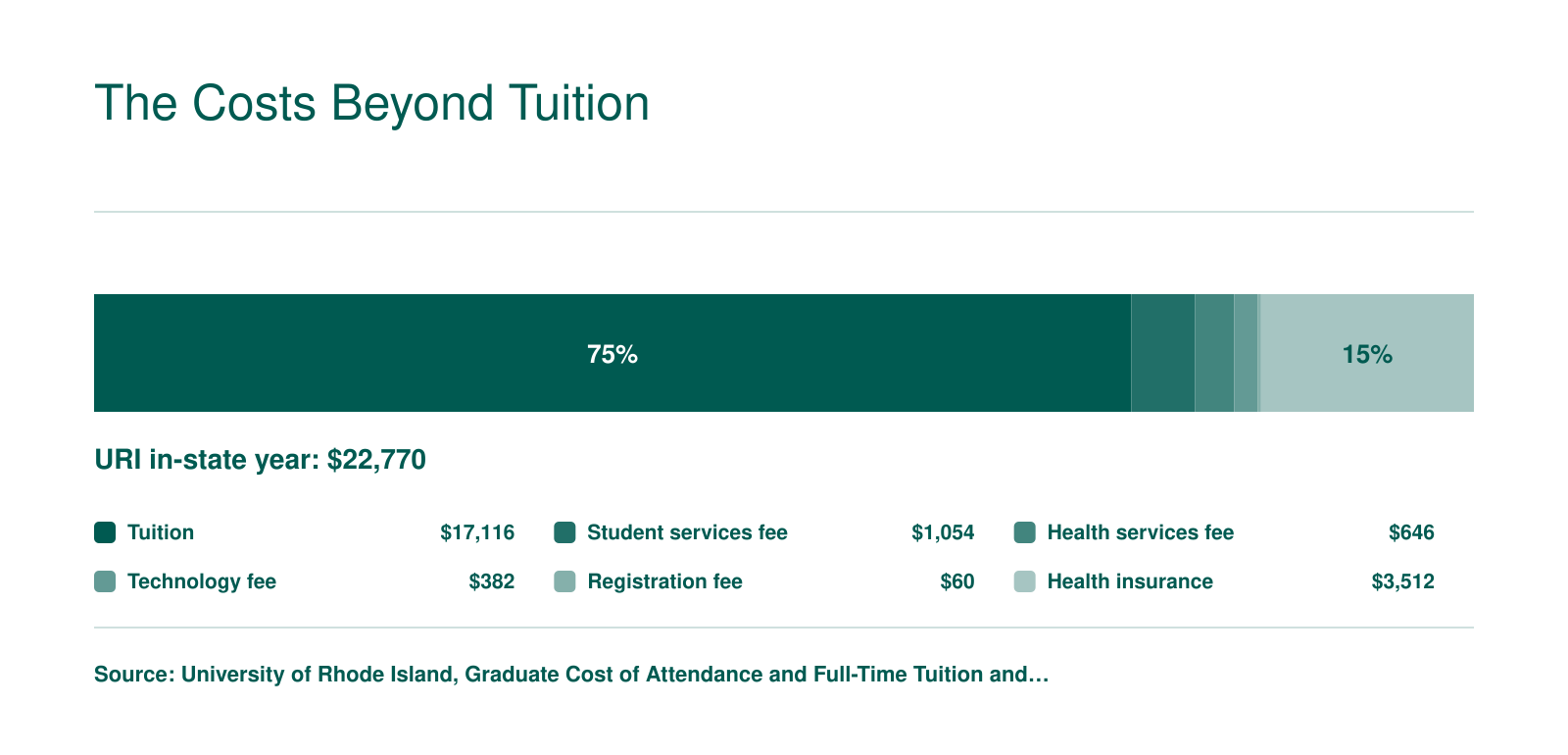
The Costs Beyond Tuition
This sample is a full-time, in-state year at the University of Rhode Island for 2026-2027, built from the school's published figures. Student health insurance is included but may be waived, and URI publishes no separate graduate books-and-supplies figure, so none is counted. Rhode Island College bills by the credit ($580 in-state for general degree programs in 2025-2026) plus institutional fees, and does not publish a separate insurance or books amount. Caption: practicum, lab, or online course fees may apply in some programs and are not in these lines, so check your program's own schedule.
Online, Hybrid, and In-Person: How Delivery Formats Differ
Yes, fully online options with no identified campus visits exist in Rhode Island: the University of Rhode Island's Master of Professional Studies, its Professional M.S. in Supply Chain Management and Applied Analytics, and its M.A. in Adult Education. Format labels can mislead, though, so check each program for in-person sessions, clinicals or practicum placements before you enroll. If you live outside Rhode Island and are pursuing a licensure-track program, also confirm with the school that it is authorized to serve students in your state.
| Format | What it means | Rhode Island examples | Campus visits to expect |
|---|---|---|---|
| Fully online, asynchronous | Coursework is completed on your own schedule with no set meeting times. | URI Master of Professional Studies; URI Professional M.S. in Supply Chain Management and Applied Analytics (seven-week modules); Johnson & Wales online asynchronous graduate courses | None identified. Johnson & Wales states that its online asynchronous courses have no required on-campus activities or mandatory face-to-face sessions. |
| Online, synchronous | Fully online, but with scheduled live sessions you must attend at set times. | URI M.A. in Adult Education combines synchronous and asynchronous online activities | None identified in the program description, but expect fixed log-in times. |
| Hybrid with campus sessions | Part of the instruction is in person and part is online. | Rhode Island College M.A. in Justice Studies (mostly hybrid, evening classes); Johnson & Wales hybrid courses | Required. Rhode Island College does not state a fixed number of visits. Johnson & Wales hybrid courses meet in person, including the first and last class. |
| Evening or weekend on-campus | Classes meet after work hours or on weekends so students can keep a job. | URI M.S. in Management, Leadership for Sports Management (evening, weekend or fully online sections); most Johnson & Wales graduate courses run 6:00 to 8:45 p.m. | Regular campus attendance unless you choose a fully online section. |
| Traditional full-time | Daytime, on-campus study with a full course load. | URI's sports management master's lists full-time and part-time enrollment options | Frequent. Confirm daytime scheduling with the program. |
| Online with placements (verify) | Coursework is online, but fieldwork, clinicals or practicum hours must be completed in person, often in state. | None identified in the sources reviewed. Ask any licensure-track program about this directly. | Site-based hours. Ask about placement help and state authorization for your home state. |
Admissions Requirements and Deadlines at Rhode Island Graduate Schools
Graduate admission in Rhode Island is a package of documents, test policies, and deadlines that usually gets set program by program, not school-wide. Check the specific program page before you plan your timeline.
The Common Baseline
Most programs ask for the same core materials:
- An accredited bachelor's degree, with transcripts from every undergraduate institution that granted you credit
- A minimum GPA, often 3.0
- Letters of recommendation
- A statement of purpose
- A resume, especially for professional programs
Rhode Island College sets a general 3.00 cumulative undergraduate GPA, though applicants between 2.00 and 3.00 may be admitted with other evidence. Brown's School of Professional Studies treats 3.0 as advisory and suggests extra supporting evidence if you fall below it.1 Johnson & Wales sets minimums program by program.
GRE and GMAT Policies
Test rules vary widely here, and some No-GRE master's programs sit alongside test-flexible options.
- Rhode Island College: An official GRE or Miller Analogies Test is required for most programs, so confirm yours.
- University of Rhode Island: The College of Business waives the GMAT or GRE for several groups, including URI or AACSB business graduates with a 3.30 GPA, applicants with five or more years of full-time work, and those who already hold a master's or Ph.D.
- Brown: Master's test requirements differ by program, and the School of Professional Studies requires neither exam.1 Fifth-year applicants get a GRE waiver.2
- Bryant and Roger Williams: Standardized tests are generally not required, though Roger Williams faculty may request one, and its School of Law is an exception.
- Johnson & Wales: The GMAT or GRE is required for certain programs when your GPA falls short of that program's minimum.3
Deadlines, Start Terms, and Rolling Admission
Rhode Island College has no single calendar. Most programs set fall and spring deadlines, and some review applications continuously. Johnson & Wales uses rolling admission with no application deadline for most programs, which suits career changers who decide late.3 Where a program does set a deadline, a complete file is due by then. Summer starts are less common, so confirm availability with the program.
Transfer credit is tight. Rhode Island College normally accepts up to 6 hours, rising to 20% of a program with approval, and grades must be a B or better. Brown's blended online programs accept no transfer credit.1
Licensure Programs Run on Tighter Clocks
Counseling, MSW programs, and MSN programs often have earlier fixed deadlines and may require an interview. If you're aiming for a credential, start your file months ahead of what a general master's would need.
How to Pay for a Master's in Rhode Island, Including Low-Cost and Free Routes
A funded assistantship and a loan-financed degree end at the same diploma, but one leaves you with a modest cushion and the other with a balance that follows you for a decade. In Rhode Island, the order you try funding sources in matters more than the total number you apply to.
Start with assistantships: the most realistic path to near-free
A graduate assistantship is the single best deal available to most students here, and it is where you should spend your first hours of effort.
At the University of Rhode Island, a full-time appointment means 20 hours of work per week. For 2026-27, that carries a stipend of $23,846 at the entry level, a full tuition waiver at your applicable residency rate, a 40 percent waiver of standard fees, and coverage of health and vision fees. You must register for 6 to 12 credits each semester, and appointments normally run one academic year with renewal not guaranteed. Half-time appointments pay a proportional stipend and waiver, and benefits are prorated if you resign early, so read the appointment letter closely.
Rhode Island College structures it differently: the stipend is smaller ($3,150 for a full-time 2026-27 assistantship, half that for half-time), but the tuition waiver covers RIC courses for the academic year plus one summer term. The waiver, not the stipend, is where the money is. Note that RIC's financial aid pages have listed different stipend figures for the prior year, so confirm the number attached to your start term. Applications are due April 10, positions fill quickly, and accepted degree candidates, including international students enrolled full time, are eligible.
Employer benefits and service awards
If no assistantship materializes, employer tuition assistance is the next most common route. Large Rhode Island hospital systems, state government, and the universities themselves have historically offered benefits to employees, but terms, caps, and service commitments change year to year. Ask HR for the current plan document rather than relying on a recruiting page. AmeriCorps service can also produce an education award applied toward graduate tuition. Fully funded master's seats at Brown exist only in select departments; ask the program coordinator directly instead of assuming.
Scholarships, then loans last
Institutional graduate scholarships are competitive and modest. RIC's merit tuition awards for 2026-27 range from $375 to $1,500, with priority given to applications filed before mid-March. File the FAFSA regardless of income: it is the gateway to Federal Direct Unsubsidized loans, Grad PLUS, and some campus aid. Confirm current federal borrowing limits before budgeting around them, and treat Grad PLUS as the last dollar you borrow, not the first.
Licensure and Accreditation: Which Programs Lead to a Credential
Which Rhode Island master's programs actually lead to a state license, and which accreditor tells you they will? The answer depends on the field, and the wrong choice can cost extra coursework or leave you ineligible for licensure.
Accrediting bodies that matter by field
For clinical mental health counseling, CACREP is the standard. Rhode Island College's Clinical Mental Health Counseling program holds CACREP accreditation through 2033. For social work, CSWE accreditation is the usual path to an LICSW. RIC's MSW is CSWE-accredited.1 For nursing, CCNE or ACEN accreditation matters for advanced practice. RIC's MSN and DNP carry CCNE accreditation, and URI's master's nurse practitioner programs were in a CCNE reaccreditation review in February 2026, so a final decision should be confirmed directly. For teaching and school administration, look for CAEP or Rhode Island Department of Education program approval. RIC's teacher preparation programs and school psychology program hold RIDE approval through 2027, with school psychology cited as accredited with distinction. For business, AACSB accreditation matters for MBA credibility; URI's College of Business holds AACSB accreditation, last reaffirmed in 2024. For public administration, NASPAA is the relevant body, but none of the programs surfaced in available sources clearly lists NASPAA accreditation, so verify directly.
Private colleges are less uniformly documented. Providence College's CSWE listing is baccalaureate-level, not a master's in social work, and program-level accreditation for Salve Regina, Roger Williams, and Bryant is not consistently published. If you are considering a licensure-bound field at one of these schools, ask the program to show its current accreditor letter.
Accreditation is not the license
A fully accredited degree alone does not satisfy the requirement. In Rhode Island, independent licensure as an LMHC or LICSW still requires supervised post-master's clinical experience and a passing exam. The specific hour totals and application rules are set by RIDOH and can change, so do not assume your degree transcript is enough. A non-accredited program may leave you with coursework that a licensing board will not accept, forcing you to repeat training or switch programs.
Check your own state before enrolling online
If you are an out-of-state student in Online Master's Programs, your home state's licensing board controls whether the program meets its standards. Accreditation does not transfer automatically. Before committing to tuition, request the program's accreditation letter and compare it with your state board's educational requirements.
Rhode Island Licensing at a Glance
Career Outcomes and Return on Investment
Return on investment for a master's degree comes down to one comparison: what you will earn afterward against what you pay and borrow to get there. Rhode Island's public and private schools sit at opposite ends of that comparison, and the available outcome data is uneven, so treat the figures below as directional.
Lower-Cost Public Programs
For affordable master's degrees, College Scorecard figures for Rhode Island College graduates are the strongest in the state on a cost-to-earnings basis. Master's graduates in registered nursing show median earnings of about $138,536 with median debt near $41,000. Education graduates (other education fields) show about $78,105 in earnings against roughly $6,000 in debt. Clinical, counseling and applied psychology graduates show about $71,898. The reporting interval for these medians is not specified, so confirm current numbers before relying on them.
At the University of Rhode Island, third-party figures citing Scorecard put graduates of its MBA programs near $78,037 and management information systems graduates near $113,214. The reporting year and cohort are not stated.
Higher-Cost Private Programs
Brown and Bryant do not have field-specific master's earnings published. Their headline figures, about $93,487 and $90,008, measure a broader group of former students ten years after entry, not master's graduates alone, so they say little about any one degree. Brown's Master of Arts in Teaching is the clearest case with usable data: the school reports that 93% of graduates land teaching jobs within three months, and 80% are still teaching after five years. Published 2025-2026 cost is roughly $71,696. Without program-level earnings, you have to test that price against a teaching salary yourself.
Placement Rates
School-reported rates are useful but come without full methods. Rhode Island College reports 100% employment for school psychology and counseling graduates, with no stated cohort or timing. URI's College of Business reports about 93% placement within six months, though sources differ and the scope is unclear. Its reported average salary of $58,766 likely reflects a broader pool than master's students alone.
A Simple Rule
Subtract your likely salary gain from your total cost, then compare total borrowing with expected first-year earnings. Aim to keep debt below that first-year figure. Under that rule, the low-debt Rhode Island College education and nursing numbers clear it easily. A high-priced private degree needs a documented salary jump, scholarships, or employer support to do the same.
A master's degree is worth it when the salary gain clearly outweighs the total cost of the program, including tuition, fees, and lost income, not simply when the school has the bigger name.
Graduate schools in Rhode Island with the most master's programs
| School | City | Type | Master's programs | Online | Grad tuition / yr |
|---|---|---|---|---|---|
| University of Rhode Island | Kingston | Public | 42 | 18 | $18,028 |
| Rhode Island College | Providence | Public | 31 | 8 | $10,112 |
| Johnson & Wales University | Providence | Private nonprofit | 28 | 19 | $15,156 |
| Brown University | Providence | Private nonprofit | 24 | 10 | $69,948 |
| Salve Regina University | Newport | Private nonprofit | 16 | 14 | $13,365 |
| Johnson & Wales University | Providence | Private nonprofit | 16 | 15 | $15,156 |
| Providence College | Providence | Private nonprofit | 12 | 2 | $13,440 |
| Bryant University | Smithfield | Private nonprofit | 11 | 2 | $49,860 |
| Roger Williams University | Bristol | Private nonprofit | 10 | 3 | $21,305 |
| New England Institute of Technology | East Greenwich | Private nonprofit | 6 | 5 | $16,500 |
| Rhode Island School of Design | Providence | Private nonprofit | 3 | 0 | $62,688 |
| Roger Williams University School of Law | Bristol | Private nonprofit | 2 | 0 | $19,216 |
Program counts are the verified master's listings in our directory; tuition is the school-wide average for a full-time graduate student (IPEDS).
Frequently Asked Questions About Master's Programs in Rhode Island
These answers cover the questions prospective students ask most often about cost, formats, funding and credit. Where a policy is set by individual schools or programs, we say so rather than guess, and we suggest confirming details with the program before you apply.
What is the cheapest master's degree in Rhode Island?
Are there online master's programs in Rhode Island with no campus visits?
Can out-of-state students pay less at URI or RIC through the New England Regional Student Program?
Can I transfer graduate credits from one Rhode Island school to another, or apply credits from a graduate certificate toward a master's?
Does Brown fund its master's students the way it funds PhD students?
Compare programs nationwide
Many Rhode Island residents study online. Every ranked list above has an online lens, or browse every field.
Online master's programs Browse all fields