Best MSN Programs in Rhode Island
Compare 12 accredited Nursing (MSN) programs in Rhode Island at 4 schools, with graduate earnings, cost, debt, and completion data from IPEDS and the U.S. College Scorecard.
The FNP tracks at the University of Rhode Island, Salve Regina University, and New England Institute of Technology each require 750 clinical hours, so a master's in nursing here is as much a scheduling decision as an academic one. In-state choices are few, which makes format, cost, and FNP focus the real filters.
School-wide average net prices run from $9,478 at Rhode Island College to $41,219 at Bryant University, so affordable MSN programs are concentrated at the low end, and delivery spans campus-based to hybrid.
Timelines flex accordingly: URI allows 2.5 to 5 years to finish.
Key Points
- University of Rhode Island's FNP concentration is campus-based, not fully online.
- For 2027 admission, GPA near 3.0 is common; no cited GRE requirement.
- Salve Regina's total program cost divided by 48 credits yields per-credit tuition.
Best Master's in Nursing (MSN) Programs in Rhode Island for 2027
These Rhode Island master's in nursing programs are ranked for working nurses comparing accreditation, clinical preparation, and format. The first four entries are CCNE- or ACEN-accredited MSN tracks; the final three entries are graduate health programs that surface in the same dataset but are not MSN degrees and should not be compared as nurse practitioner pathways.
University of Rhode Island
#1Kingston, RI · ~$18,000/yr (est.)
Best for: Working RNs seeking multiple NP specialties
University of Rhode Island's College of Nursing offers the state's broadest MSN portfolio in this group, with Family Nurse Practitioner, Adult-Gerontology Primary Care Nurse Practitioner, and Psychiatric Mental Health Nurse Practitioner tracks. The programs are CCNE-accredited and can be paced full-time or part-time. Admission generally expects a BSN, a 3.0 GPA, an RN license, and one year of clinical experience, with credit loads from 42 to 47 hours depending on the concentration.
- 42 credit hours with 750 clinical hours
- Full-time and part-time pacing from 2.5 to 5 years
- Requires BSN, 3.0 GPA, and three recommendation letters
- One year of RN clinical experience expected
- Prepares for ANCC or AANPCB FNP certification
- Fall start with a February 15 deadline
- 42 credit hours with full-time or part-time options
- One annual fall start date
- Requires BSN, 3.0 GPA, and three recommendation letters
- Prepares for AANPCB A-GNP certification
- One-to-one preceptorship with nurse practitioners
- 47 credit hour curriculum
- Full-time and part-time study over 2.5 to 5 years
- Requires BSN, 3.0 GPA, and RN licensure eligibility
- One year of clinical experience required
- Psychiatric experience preferred
- Basic statistics prerequisite and three recommendation letters
Rhode Island College
#2Providence, RI · ~$10,000/yr (est.)
Best for: Adult-gerontology nurses needing flexible Hyflex delivery
Rhode Island College's Zvart Onanian School of Nursing holds CCNE full accreditation through 2033 and concentrates its MSN on high-need advanced practice and public health roles. The adult/gerontology acute care nurse practitioner, clinical nurse specialist, and population/public health nursing tracks use a Hyflex model with synchronous remote options and up to 100% online coursework. The program is designed for working BSN-prepared nurses, with full- and part-time pacing and a certificate of graduate study pathway for some specialties.
- 45 credit hours for BSN-prepared nurses
- Up to 100% online coursework through Hyflex
- Full-time and part-time pacing options
- Prepares for AACN or ANCC AGACNP exams
- Certificate of Graduate Study option available
- Hybrid classes with up to 100% online options
- Synchronous sessions meet in person or remotely
- Also available as a Certificate of Graduate Study
- Focus on acute, critical, and complex chronic care
- 42 credit hours with full-time or part-time study
- Hybrid model with up to 100% online coursework
- Requires a BSN for admission
- Focus on disease prevention and health equity
- CCNE accredited
Salve Regina University
#3Newport, RI · ~$13,000/yr (est.)
Best for: Psychiatric mental health nurses prioritizing online learning
Salve Regina University offers MSN tracks in Family Nurse Practitioner and Psychiatric Mental Health Nurse Practitioner, with synchronous and asynchronous learning and a required on-campus colloquium. The FNP track requires 48 credits and 750 clinical hours; the PMHNP track is structured for online learners and typically runs 28 to 32 months. Salve's nursing programs list CCNE as the accrediting body, though a current decision date and next review date are not published.
- 48 credit hours with 750 clinical hours
- Synchronous and asynchronous learning options
- Three-day on-campus colloquium required
- Minimum grade of B- with one repeat allowed
- Prepares for national FNP certification
- Online format with seven-week modules
- 48 to 51 credits with 750 clinical hours
- Average completion in 28 to 32 months
- Requires BSN, 3.0 GPA, and RN license
- Some live sessions and an on-campus colloquium
New England Institute of Technology
#4East Greenwich, RI · ~$17,000/yr (est.)
New England Institute of Technology offers an ASN-to-MSN Family Nurse Practitioner pathway and a Psychiatric Mental Health Nurse Practitioner MSN, both built for working RNs. The FNP program runs 66 quarter credits over eight terms with hybrid sessions and clinical immersion weekends; the PMHNP adds 780 clinical hours and a capstone. NEIT's nursing program holds ACEN continuing accreditation through Spring 2034.
- 66 quarter credit hours over eight terms
- Can be completed in 24 months
- 750 direct patient care clinical hours
- Online courses with hybrid sessions and immersion weekend
- Requires 3.0 GPA and active unencumbered RN license
- Prepares for ANCC or AANP FNP exam
- 66 quarter credit hours over eight terms
- Rolling admissions with a winter start
- Requires 3.0 GPA and BSN from accredited program
- 780 clinical hours and a capstone
- Prepares for PMHNP board certification
- Clinical immersion weekends in Rhode Island
Brown University
#5Providence, RI · $65,000 – $70,000/yr (est.)
Brown University appears in this group for its online Master of Public Health, not an MSN, so it should not be compared as a nursing-practice degree. The program is relevant only if you are considering a public health master's as an alternative graduate path. For MSN-specific training in Rhode Island, use the nursing schools ranked above.
- No GRE required; statistics coursework recommended
- Three recommendation letters and personal statement
- Professional work experience expected
- Spring, summer, and fall start dates
- $150 application fee
Bryant University
#6Smithfield, RI · ~$50,000/yr (est.)
Bryant University's graduate health offering in this dataset is a STEM-designated Master of Science in Health Informatics and AI, not an MSN. It may suit nurses moving toward informatics, but it is not a direct pathway to advanced practice registered nursing or nurse practitioner certification.
- 30 credit hours across 10 courses
- Complete in 12 or 18 months
- No GMAT or GRE required
- One recommendation letter and a resume
- $31,350 total program tuition
- STEM-designated with an internship or capstone
Johnson & Wales University
#7Providence, RI · ~$15,000/yr (est.)
Johnson & Wales University's Providence campus offers a hybrid Master of Public Health rather than an MSN. The program is an applicant for CEPH accreditation and is not a nursing licensure pathway, so MSN-focused applicants should compare the CCNE- and ACEN-accredited nursing programs instead.
- 45 credit hours across 15 courses
- Full-time two-year or 12-month accelerated option
- Hybrid format with 12 in-person and 3 online courses
- $572 per credit for 2026-27
- No GRE required; two recommendation letters
- CEPH accreditation applicant
Cost & outcomes by school
Federal data for the highest-earning Nursing (MSN) programs, independent of the ranking above. Earnings are this field's master's graduates four years after completing, where the Scorecard reports them.
| School | Earnings | Tuition / yr | Debt | Grads/yr | Format |
|---|---|---|---|---|---|
| Rhode Island College RI | — | $10,112 | — | 618 | Hybrid |
| Salve Regina University RI | — | $13,365 | — | 518 | Hybrid |
| New England Institute of Technology RI | — | $16,500 | — | 132 | Hybrid |
| University of Rhode Island RI | — | $18,028 | — | 1,290 | Campus |
Sources: U.S. Department of Education. Tuition and graduates: IPEDS. Earnings and debt: College Scorecard, this field's master's graduates; a dash means no figure is reported.
Online and Hybrid MSN Options in Rhode Island
Can you finish a Rhode Island MSN without living near campus? Partly, but almost no program is fully remote once clinicals begin.
How delivery breaks down
- Campus-based: The University of Rhode Island lists its FNP programs in Rhode Island as campus-based, with part-time and full-time study. Its program notes say a car is necessary to reach clinical sites.
- Hybrid: Salve Regina's FNP concentration offers synchronous and asynchronous options but requires a 3-day on-campus colloquium. Rhode Island College's acute care nurse practitioner MSN is hybrid, with synchronous online classes and a fully online option.
- Mostly online: New England Institute of Technology runs its MSN-FNP mostly asynchronously, with some hybrid sessions. It requires one on-campus weekend (three days) in NUR 555 Clinical Immersion, plus 750 clinical hours.
Preceptors and out-of-state programs
The sources reviewed do not establish whether each Rhode Island school arranges preceptors or expects students to find their own, or which sites qualify. Treat that as unconfirmed until a school answers.
Out-of-state online MSN programs require extra caution. Rhode Island eligibility is program-specific, and some online nursing programs are restricted for Rhode Island residents. A school's participation in NC-SARA, as URI's is, does not guarantee it can enroll you or place you at Rhode Island sites.
Before applying, ask admissions in writing who secures clinical placements and whether they stay in Rhode Island.
GRE Waivers and Admission Requirements for Rhode Island MSN Programs
Admission requirements vary by school, but the programs below share a similar academic floor. Across the schools shown, a minimum GPA near 3.0 is the most common admission pattern, and no cited source states a GRE score requirement.
| School | GRE Policy | Minimum GPA | RN License / Experience | Application Deadline |
|---|---|---|---|---|
| University of Rhode Island | No published policy | 3.0 GPA | Eligibility for RN licensure in Rhode Island; one year of clinical nursing experience required before enrollment, two years preferred | February 15 for fall start |
| Rhode Island College | No published policy | 3.00 on a 4.00 scale | N/A | Deadlines vary by program; most programs have fall or spring deadlines, while some review applications on a continuing basis |
| Salve Regina University | No published policy | 3.0 cumulative GPA | Current RN license in good standing; graduation from an accredited program required; years of RN experience not specified | Not stated in cited official admissions material |
Related Articles
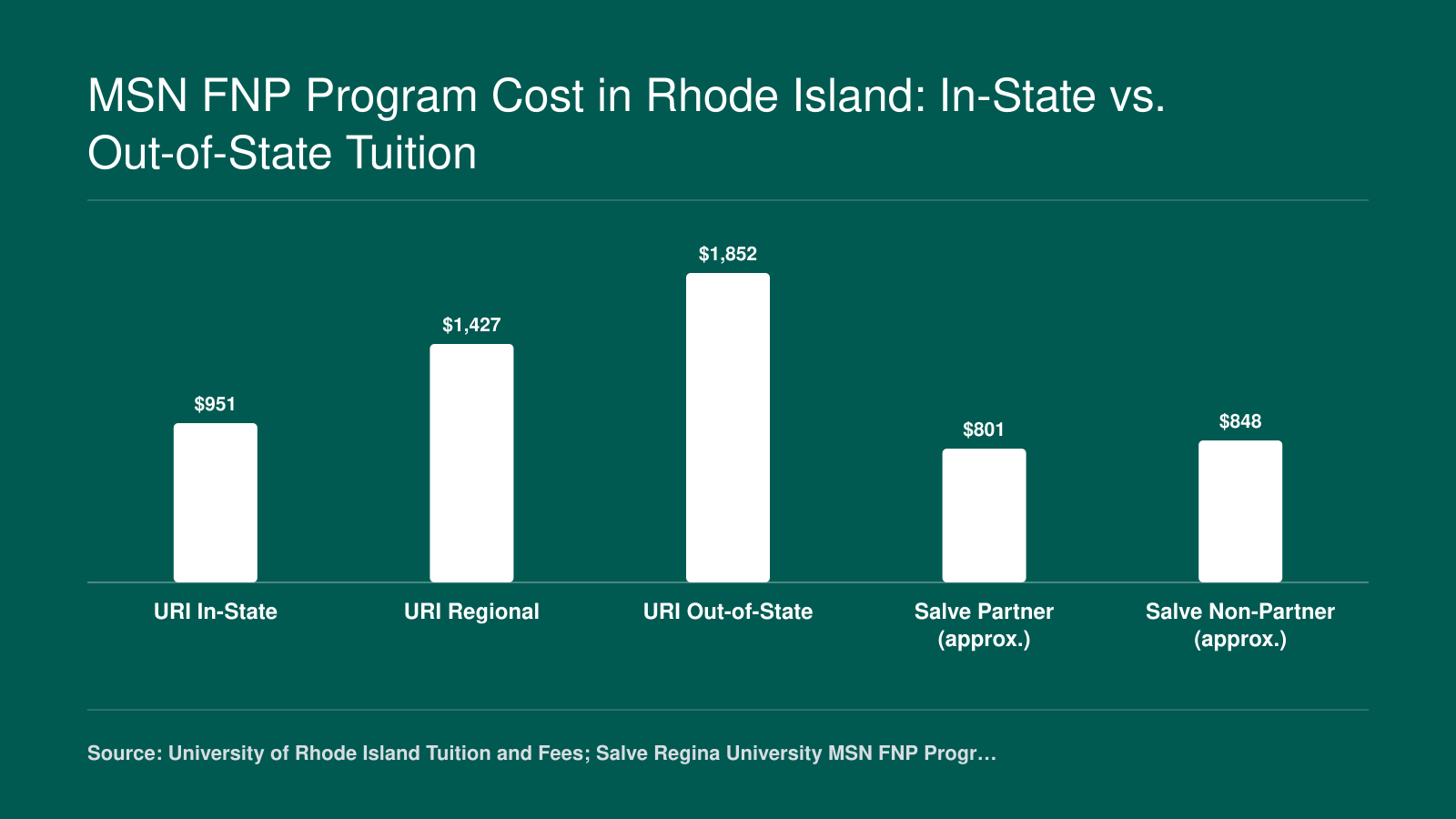
MSN FNP Program Cost in Rhode Island: In-State vs. Out-of-State Tuition
This chart compares published per-credit tuition for the University of Rhode Island and Salve Regina University. URI rates are official 2026-2027 figures; Salve figures are approximate averages from the total program cost divided by 48 credits. The chart omits URI's $111 nursing differential fee and other per-credit fees, plus costs like clinical fees, background checks, technology fees, certification exam fees, and travel to clinical sites. URI publishes a regional rate, but that is separate from the New England Regional Student Program, and current sources do not confirm whether URI's MSN qualifies for NERSP.
Rhode Island FNP Licensure and Certification Pass Rates
A strong exam record matters, but the licensing steps decide how quickly you can start working, so plan for both.
The Path to Practice
First, earn an MSN from one of the accredited FNP programs in Rhode Island with advanced pathophysiology, advanced health assessment, and advanced pharmacology coursework. Second, pass an FNP certification exam through ANCC or AANPCB. Third, apply online to the Rhode Island Department of Health. Your school sends transcripts directly, the certifier sends verification directly, and you complete a fingerprint-based background check. You also need an active Rhode Island RN license or a multistate RN license.
Rhode Island grants APRNs full practice authority, conditioned on that required coursework and practicing within your role and population focus. Prescriptive authority covers over-the-counter, legend, and controlled substances. Controlled substances require both a Rhode Island CSR and DEA registration, and the CSR needs a Rhode Island business address. Out-of-state telemedicine prescribing is not allowed.
Pass Rates
The 2025 first-time FNP pass rate was 81% for AANPCB, and ANCC reported 82%. The two bodies may define their rates differently, so treat them as rough context rather than a head-to-head contest.
The University of Rhode Island reports FNP certification pass rates of 86.76% for 2025, 97.16% for 2024, and 93% for 2023. Confirm with the school whether these are first-time or overall rates before comparing them with national figures. Rhode Island College publishes no FNP pass rate that we could find, so we offer no estimate.
Frequently Asked Questions About MSN Schools in Rhode Island
Are there CCNE-accredited MSN-FNP programs in Rhode Island?
What is the difference between an MSN and a post-master's certificate in Rhode Island?
Can I enter a Rhode Island MSN program as an RN without a BSN?
Compare Nursing (MSN) programs on the data that matters
Explore more MSN specializations or browse every graduate field.
All MSN programs