Master's Programs in Texas
Every master's program reported by a school in Texas: 2,450+ programs at 100+ graduate schools, with the online options, costs and outcomes behind each one.

A master's degree in Texas means choosing among more than 100 public and private universities, from flagships like UT Austin and Texas A&M to regional campuses that charge far less per credit. Sticker prices, program formats, and admission rules differ sharply, sometimes between departments at the same school.
Four questions drive most decisions: where to study, what it costs, whether you can finish online, and whether you need the GRE. Timing matters too. Applications for fall 2027 are opening now, in October 2026, and some competitive programs and funding pools close months before spring.
The cheapest degree is not always the best value, and the best-known name rarely guarantees the best return.
Key Points
- Texas A&M-Kingsville advertises a 30-credit graduate offer at $9,000, among the lowest published totals.
- Texas A&M sets a $1,826 monthly minimum for half-time master's assistants, plus tuition support.
- Many Texas programs now waive the GRE, but policies are set by each department.
Popular degrees in Texas
Master's programs in Texas by field
Business & Management
- Accounting80 programs
- Healthcare Administration74 programs
- Analytics59 programs
- Management58 programs
- Marketing56 programs
- Finance51 programs
- Public Administration49 programs
- Healthcare Management47 programs
Education & Teaching
- Educational Leadership66 programs
- Curriculum & Instruction61 programs
- Special Education55 programs
- Teaching44 programs
- Reading & Literacy44 programs
- Higher Education or Adult Education30 programs
- STEM Education or Science Education or Mathematics Education28 programs
- Music Education28 programs
Healthcare
- Health Administration37 programs
- Public Health34 programs
- Speech Pathology28 programs
- Exercise Science24 programs
- Nutrition23 programs
- Health Education16 programs
- Health Informatics10 programs
- Clinical Research Management2 programs
Nursing
- Family Nurse Practitioner (FNP)31 programs
- Nursing Education or Nurse Educator28 programs
- Nurse Administrator21 programs
- Psychiatric Mental Health Nurse Practitioner19 programs
- Pediatric Nurse Practitioner8 programs
- Adult Gerontology Acute Care Nurse Practitioner7 programs
- Adult Gerontology Primary Care Nurse Practitioner7 programs
- Nurse Executive Leader6 programs
Communications & Media
- Communication44 programs
- Speech Pathology30 programs
- Communication Disorders23 programs
- Strategic Communication11 programs
- Technical Communication10 programs
- Organizational Communication10 programs
- Journalism8 programs
- Media Communication7 programs
Psychology
- Counseling Psychology32 programs
- Educational Psychology or School Psychology22 programs
- General Psychology18 programs
- Clinical Psychology18 programs
- Applied Behavior Analysis15 programs
- Industrial Organizational Psychology11 programs
- School Psychology11 programs
- Applied Psychology9 programs
Counseling
- Clinical Mental Health Counseling48 programs
- School Counseling42 programs
- Marriage and Family Therapy or Marriage and Family Counseling28 programs
- Christian Counseling5 programs
- Addiction Counseling1 program
Social Work & Social Sciences
- Social Work35 programs
- Sociology30 programs
- Social Work Advanced Standing25 programs
- Political Science, Government19 programs
- Human Services5 programs
Computers & IT
- Data Analytics32 programs
- Cybersecurity27 programs
- Information Security & Assurance14 programs
- Machine Learning13 programs
Religion & Theology
- Christian Ministry23 programs
- Theology23 programs
- Divinity20 programs
- Christian Leadership6 programs
- Youth and Family Ministry5 programs
- Urban Ministry1 program
Science & Engineering
- Environmental Science27 programs
- Sustainability or Environmental Management26 programs
- Geography8 programs
Arts & Design
- Creative Writing31 programs
- Fine Arts16 programs
- Interior Design2 programs
Criminal Justice & Law
- Public Policy12 programs
- Homeland Security10 programs
- Master of Laws6 programs
- Legal Studies5 programs
- Business Law4 programs
- Fire Science or Fire Administration or Fire Leadership1 program
Major Texas Universities for Master's Degrees: UT Austin, Texas A&M, UT Dallas, UNT, SMU, Texas State and More
Public flagships and private research universities take different approaches to master's programs by degree and field in Texas, and the value comparison starts with scale, cost, and online access before you narrow down a program.
Snapshot of Major Texas Graduate Schools
- UT Austin | Public: No single master's-only count is published. Standout 2026 fields include engineering, computer science, and nursing. Online options vary by school and program.
- Texas A&M University | Public: More than 300 combined graduate, professional, and certificate programs, so the master's-only total is lower.2 Online and hybrid options are available.
- UT Dallas | Public: 93 graduate degree programs across seven schools, not master's-only. Known for computer science, cybersecurity, and speech-language pathology.5 Select programs are online.
- University of North Texas | Public: Approximately 87 master's programs.3 A complete list of standout fields is not published in one place, but the graduate catalog covers many disciplines, with online options available.
- Texas State University | Public: More than 130 combined graduate programs, not master's-only.4 Online and hybrid delivery varies by program.
- SMU | Private: No single 2026 master's count is published. Graduate schools cover MBA programs, law, engineering, humanities, and the arts. Online options are limited.
- University of Houston | Public: 150 combined graduate, doctoral, and professional degree programs, including 15 fully online master's. Standout fields include engineering, nursing, and higher education.
- Rice University | Private: No total master's count published. Known for civil and environmental engineering, architecture, and mechanical engineering.1 Online options are limited.
- University of Texas at San Antonio | Public: More than 140 graduate programs overall, not master's-only.6 Many fields are available, with some online options.
Because universities update catalogs yearly, treat these numbers as approximate and check the specific program before applying.
How These Institutions Differ
Flagship universities such as UT Austin and Texas A&M pair large research ecosystems with broad graduate catalogs, but they are not automatically cheaper or more flexible for working students. Emerging research universities like UT Dallas, UNT, Texas State, UH, and UTSA often mix focused graduate strengths with more online and part-time routes. Private schools like SMU and Rice offer smaller cohorts and specific professional networks at a higher tuition point, so the fit depends on whether you value scale, convenience, or close faculty contact.
Tuition for Master's Programs in Texas: Per-Credit Costs at Public and Private Schools
Graduate rates for 2025-26 and 2026-27 vary by program, residency, and fee schedule, so mastersprograms.com does not list per-credit figures that could be out of date or leave out mandatory fees. For each school below, open the bursar, student accounting, or tuition calculator page, select graduate level, resident or nonresident status, term, and program, then read the fee schedule footnotes to see what the rate includes. Before you commit, also check the university's net price calculator, BLS.gov for salary and career outlook in your field, and any professional association that publishes funding, licensure, or certification costs.
| University | Resident Cost per Credit | Nonresident Cost per Credit | Est. 30-Credit Total (Resident) | Notes |
|---|---|---|---|---|
| UT Dallas | Confirm on Bursar page | Confirm on Bursar page | Calculate after confirming rate | The Bursar Office lists a Variable Tuition Plan for 2026-27 (fall 2026 through summer 2027). Ask whether the rate shown includes mandatory fees. |
| UT Austin | Flat rate by college, not per credit | Flat rate by college, not per credit | Use your college's flat rate for the term | The Fall 2026 schedule charges graduate students a flat rate by college that includes tuition, mandatory fees, and incidental fees. International fees and independent study fees are excluded. Doctoral students past 99 hours are charged the nonresident rate. |
| Texas A&M | Confirm on bursar page | Confirm on bursar page | Calculate after confirming rate | Use the university's tuition calculator and select your specific graduate program. |
| University of North Texas | Confirm on bursar page | Confirm on bursar page | Calculate after confirming rate | Check the student accounting fee schedule footnotes for program-specific or course-specific fees. |
| Texas State University | Confirm on bursar page | Confirm on bursar page | Calculate after confirming rate | Select graduate level and your term, and confirm whether online courses carry different fees. |
| SMU | Confirm on bursar page | Not applicable (private rate, no residency split) | Calculate after confirming rate | Private tuition is often set by school or program. Ask the program office for the current rate and any added fees. |
| University of Houston | Confirm on bursar page | Confirm on bursar page | Calculate after confirming rate | Use the bursar's tuition calculator and read the fee footnotes for your college. |
| Texas Tech University | Confirm on bursar page | Confirm on bursar page | Calculate after confirming rate | Confirm the rate for your program and whether it is a fully online or on-campus rate. |
| UTRGV | Use the official Tuition Estimator | Use the official Tuition Estimator | Calculate after running the estimator | The estimator warns that all fees are subject to change because of economic conditions, board action, or legislative requirements. |
The Cheapest Master's Programs in Texas and How to Cut Your Bill
Texas' most affordable master's degrees have shifted toward regional public universities and flat-rate online programs, leaving many flagship campuses behind on sticker price.
Where the lowest published totals are
Texas A&M-Kingsville advertises a 30-credit, 10-course graduate offer at $9,000 to $10,000 for eligible Texas residents or waiver holders, with tuition and mandatory fees covered for selected programs.1 Lamar University's online Master of Arts in Teaching lists a published total of $10,802 for 30 credits at $360 per credit, including distance-learning and university fees.2 Other Lamar online master's programs start at $14,340.3
UT Permian Basin stands out for out-of-state students because its online graduate rate is the same as in-state. The 2026-2027 schedule shows $390.99 per credit and $1,102.97 for three credits4, with advertised program costs starting around $10,0005 but many landing between $13,000 and $16,000. UTRGV is often cited near $450 per credit, which would suggest about $13,500 for 30 credits, but that figure is not a published total for a specific master's and may exclude fees or reflect one residency category.
Cost levers that change the real price
Published per-credit rates only tell part of the story. Online MBA and engineering programs frequently add differential tuition on top of base graduate rates. Mandatory fees can add hundreds per semester, so a program with a low per-credit rate can still cost more than expected once university, online, distance-learning, and student-service fees are included. Accelerated 7-week terms are another lever: finishing in fewer semesters can reduce the number of times you pay fixed semester fees and can shorten the time you are in school before earning a post-master's salary.
A quick cost comparison
Take Lamar's online MAT: 30 credits for $10,802 with fees already counted.2 A comparable teaching or special education master's at a larger Texas flagship is likely to carry a higher per-credit rate plus separate mandatory fees, and often a differential charge for education or professional programs. The difference can be several thousand dollars before housing, books, or lost income are considered. For students who do not need the flagship's residency network, regional publics and flat-rate online options are often the clearest path to a cheaper degree.
Online Master's Programs in Texas: Fully Online and Hybrid Options
The table below lists online and hybrid master's programs at UT Arlington, Texas Tech, and Texas A&M where published details are available. Totals for Texas Tech programs are our estimates, calculated as credit hours multiplied by the published online per-credit rate, and they exclude fees. Programs using Texas Tech's asynchronous Online+ format let you complete coursework on your own schedule, while synchronous courses meet at set times. Many programs use accelerated 5 to 10 week terms, and some programs add in-person residencies or practicum requirements, so confirm both before enrolling. Out-of-state students should check whether the school is authorized in their home state through NC-SARA and whether online tuition is the same for nonresidents. This table does not include UNT, Lamar, or East Texas A&M, because we could not confirm program details for them here, so check those schools directly.
| University | Example Online Programs | Format | Term Length | Est. Total Cost |
|---|---|---|---|---|
| University of Texas at Arlington | MSN, Family Nurse Practitioner | Online | 32-36 months total | $30,084 |
| University of Texas at Arlington | MSN, Nursing Education | Online | 21-25 months total | $17,510 |
| University of Texas at Arlington | MSN, Nursing Administration | Online | 5 to 10 week terms; 19-22 months total | $17,800 |
| University of Texas at Arlington | M.Ed. Curriculum and Instruction, Literacy Studies (30 credits) | Fully online | As few as 18 months total | N/A |
| Texas Tech University | M.Ed. Higher Education Administration (30 credits) | Online | 8-week terms; 2 to 4 years | About $12,450 to $15,000 ($415-500 per credit) |
| Texas Tech University | M.Ed. Curriculum and Instruction, STEM Education (36 credits) | Online | 15-week and 8-week classes | About $14,940 to $18,000 ($415-500 per credit) |
| Texas Tech University | M.Ed. Higher Education (30 credits) | Online | N/A | About $12,450 to $15,000 ($415-500 per credit) |
| Texas Tech University | M.Ed. Higher Education (30-33 credits) | Hybrid | N/A | About $12,450 to $16,500 ($415-500 per credit) |
| Texas Tech University | M.Ed. Educational Leadership (36 credits) | Online | N/A | About $14,940 to $18,000 ($415-500 per credit) |
| Texas Tech University | M.A./M.S. Interdisciplinary Studies (30 credits) | Online+ asynchronous | 8-week terms; 2 to 4 years | About $12,450 to $15,000 ($415-500 per credit) |
| Texas Tech University | M.S. Leadership Studies | Online+ asynchronous | 8-week terms; 2 to 4 years | N/A ($415-500 per credit) |
| Texas Tech University | M.S. Family and Consumer Sciences (38-41 credits) | Online | Three-year period | About $23,180 to $25,010 ($610 per credit) |
| Texas A&M University | M.Ed. Educational Administration, Higher Education Administration emphasis (36 hours) | Online | About two years | N/A |
No-GRE Master's Programs in Texas and Other Admission Requirements
The GRE is now the exception, not the default, in many Texas master's programs. No-GRE master's programs in Texas are increasingly common, including MBA Programs With No GRE Required, but they are not a universal guarantee; policies are set at the department or program level, so two degrees at the same university can have completely different rules.
Where several Texas universities have dropped the GRE
UT Austin describes graduate admission as program-specific, with the GRE not required unless a specific program imposes it. Its Computer and Data Science Online master's does not require GRE scores, and submitted scores are considered without a published minimum.1 The mathematics master's likewise does not require the GRE, though the math subject GRE is highly recommended and no minimum score is set.2
Texas A&M is mixed. English has stopped requiring GRE tests, though applicants may still submit scores.4 The Bush School makes the GRE optional for its MPSA, MIA, and MIP programs but encourages testing if an applicant's cumulative GPA is below 3.2.5 UNT moved to GRE-optional admissions for engineering graduate programs starting Fall 2026.7
UT Dallas and Texas Tech remain program-specific.6 Texas State says some programs require the GRE or GMAT, and scores must be from within five years of applying. Texas Tech uses the same five-year window where programs require scores.
Where the GRE is still required or waivable
Among Texas A&M's Science & Engineering Master's Programs, engineering requires the GRE for most industrial and systems engineering graduate programs, with exceptions for the MS in Engineering Management and the Industrial Data Analytics Certificate.3 Current or former Texas A&M engineering students are exempt. UT Arlington offers a waiver for high-achieving UTA graduates applying to a master's program if they earned a 3.0 in their last 60 credit hours and all UTA undergraduate coursework within the last three academic years. SMU and University of Houston GRE policies were not available from the sources used here, so verify directly with the program.
Standard requirements beyond the test
Most Texas master's applications ask for an accredited bachelor's degree, a statement of purpose, two or three recommendations, a résumé, and TOEFL or IELTS scores for international applicants. A 3.0 GPA in the last 60 credit hours is a common benchmark, but it is not a university-wide rule at UT Austin, Texas A&M, UT Dallas, or Texas Tech. Some programs review GPA holistically or set their own floor.
Because requirements differ even within one university, check the department's graduate admissions page before building an application plan.
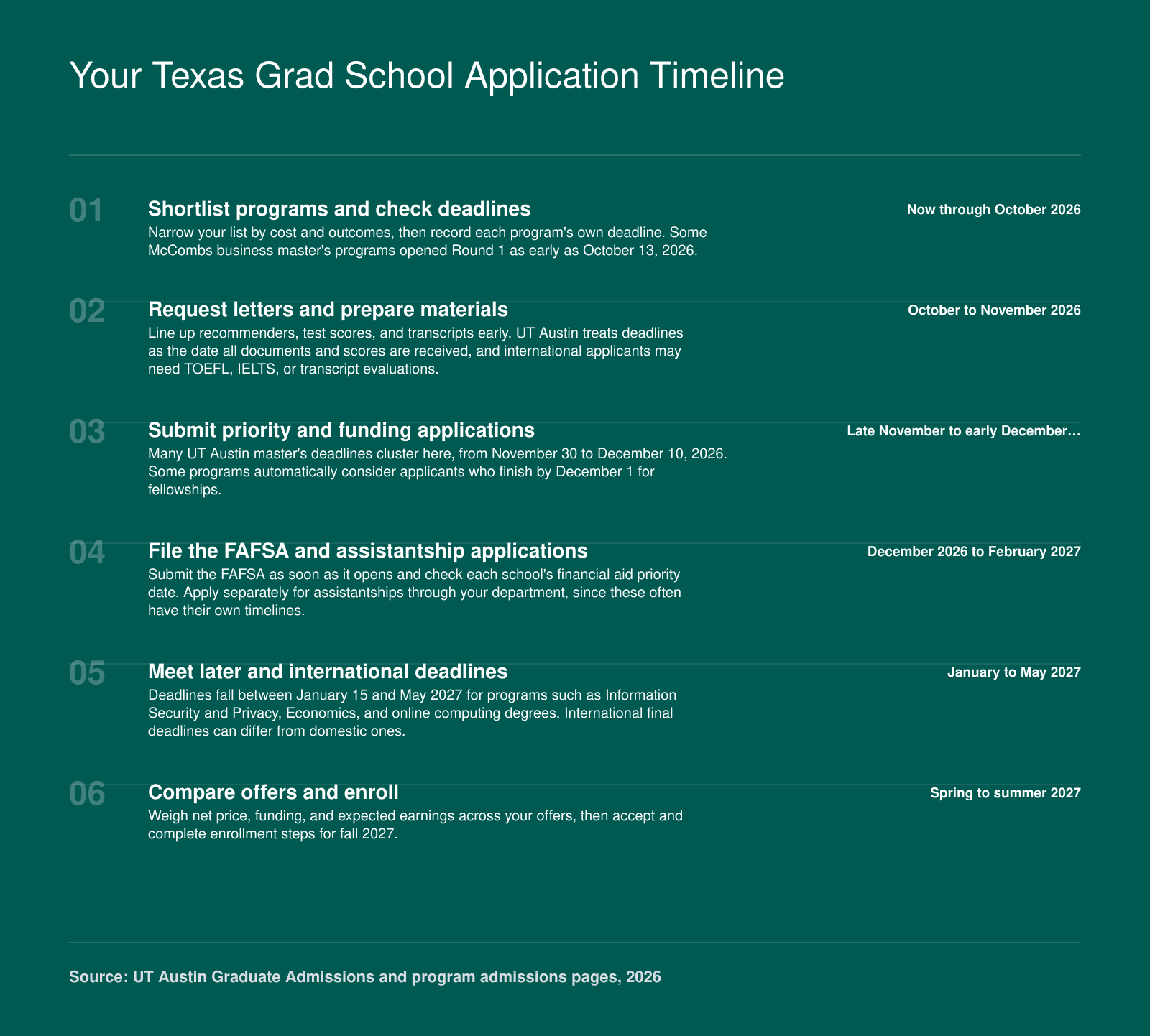
Your Texas Grad School Application Timeline
For fall entry, the deadlines that matter most often arrive long before the final one. Dates below are drawn from UT Austin programs for fall 2027 and vary by program, so confirm each one on your target program's admissions page. Check Texas A&M, UNT, and Texas State directly, since their dates were not verified here.
STEM-Designated Master's Programs in Texas and OPT for International Students
STEM designation is a classification, not a ranking. A program is STEM-designated when its CIP code appears on the U.S. Department of Homeland Security STEM Designated Degree Program List. For F-1 students, that classification matters because graduates of eligible programs may apply for a 24-month OPT extension after the initial 12 months of post-completion OPT, for up to 36 total months of work authorization. The extension is not automatic; eligible students still need to apply through U.S. Citizenship and Immigration Services and meet reporting requirements.
Technology and Analytics Programs in Texas
Texas universities offer STEM-designated master's degrees across engineering, computing, statistics, and business analytics. At UT Dallas, STEM-designated options include the MS in Computer Science, MS in Software Engineering, MS in Data Science and Statistics, and MS in Actuarial Science. UT Austin lists its MS in Computer Science as STEM-designated and also carries STEM designation across many business-oriented specialized master's programs at McCombs, including the MS in IT and Management, MS in Business Technology and AI, MS in Finance, MS in Marketing, MS in Technology Commercialization, Master in Professional Accounting, and MS in Business Analytics, a focus area for students comparing best master's in business analytics programs.
Other confirmed options include the University of Houston Bauer College MS in Management Information Systems, UNT's MS in Engineering Technology with a concentration in Engineering Management1, Texas A&M University-Texarkana's MS in Computer Science (available beginning Fall 2026)2, UT San Antonio's MS in Statistics and Data Science3, a master's in data analytics option, and East Texas A&M's MS in Technology Management4 and MS in Engineering5.
Business and Finance Degrees Can Be STEM, Too
The STEM label is not limited to engineering. UT Austin's McCombs School of Business describes all of its specialized master's programs as STEM-designated, including finance, marketing, and accounting tracks, with finance options compared in best master's in finance programs. For SMU, check the specific master's program page because STEM designation can vary.
Verify the CIP Code Before You Enroll
"STEM-designated" and "eligible for the DHS STEM OPT extension" are related but not always identical in how universities present them. UT Dallas notes that some STEM-designated programs are not currently eligible for UT Dallas I-20 issuance. International students should confirm the CIP code on the program page or I-20 and check with the university's international office about current I-20 and OPT eligibility before committing.
Funding Your Degree: Assistantships, Fellowships, and Scholarships at Texas Universities
Texas A&M sets a university-wide minimum of $1,826 per month for master's teaching, research, and lecturer assistants at 50% time, plus $21 per hour for non-teaching assistants, according to its University Minimum Graduate Assistant Stipend Rates page. Both are prorated by FTE. Those assistantships also come with tuition and fee coverage and health insurance, as detailed on the Graduate Assistant Tuition and Stipend Support page, which is what makes them worth far more than the stipend alone.
How Assistantships Work
A graduate assistant works part-time for a department, grading, teaching a lab section, or supporting a faculty member's research. In return, the university pays a stipend and, at many publics, covers tuition. Treat the A&M figures as a floor, not a typical offer. Some colleges pay more: Anthropology Graduate Funding cites $22,500 for a nine-month appointment beginning in 2026, and Chemical Engineering Graduate Funding describes assistantships with a minimum of $2,350 per month. Packages vary by department and by year, so ask each program for its current terms in writing.
Fellowships and Scholarships
Texas A&M's graduate merit fellowships set a minimum stipend of $24,000 for master's students, with tuition and required fees covered for full-time enrollment.1 Second-year master's Merit Fellows also receive insurance.1 These awards are competitive and usually tied to admission strength, and criteria differ by college.
UT Austin, UNT, Texas State, UT Dallas, and the University of Houston all publish graduate funding information, but we could not confirm specific stipend ranges or named master's fellowships for them. Check each graduate school's funding page and ask your department about internal awards before assuming anything.
Other Funding Sources
- Texas Public Educational Grant: A state-supported, need-based grant that Texas public universities administer. Award amounts and eligibility are set by each school's financial aid office.
- Employer tuition assistance: Many employers reimburse part of tuition, often with a work-commitment clause. Confirm annual caps and tax treatment with HR.
- Federal loans: Direct Unsubsidized Loans and Grad PLUS loans are available to eligible graduate students after you file the FAFSA. Compare current interest rates and borrowing limits before accepting, since these rules have changed recently.
Who Actually Gets Funded
Be realistic. Funded positions are far more common in thesis-based and STEM master's programs, where faculty need research labor. Professional, course-based, and online master's programs rarely offer assistantships, so students in them usually pay tuition through savings, employer aid, or loans. If funding matters, apply to thesis tracks and ask admissions how many master's students receive support.
Out-of-state students can sometimes pay Texas resident tuition. Under Texas Education Code Section 54.212, a graduate teaching or research assistant employed at least half-time in a role related to their degree qualifies, with no minimum Texas residency period. Spouse and children qualify too, which can save thousands of dollars a year.
How to Choose a Master's Program in Texas
Choose a Texas master's program by working from your career goal backward, not from brand names forward. The right degree is the one that qualifies you for the job you want, at a total cost you can repay, in a format you can actually finish.
A Five-Step Decision Framework
Work through these in order:
- Career goal and licensure: Decide what the degree must do. A clinical mental health counseling, social work, or nursing role carries licensure requirements that dictate which programs even count. A career-change into data or management has far more flexibility.
- Format: Pick online, hybrid, or campus based on whether you can relocate or keep working. Format often matters more than prestige for finishing on time.
- Total cost after funding: Compare net price, not sticker price. Factor in assistantships, in-state residency, and employer tuition benefits.
- Admissions fit: Check GPA minimums and whether the GRE is required or waived. A strong file at a regional public can beat a borderline file at a flagship.
- Location and networks: Austin, Dallas-Fort Worth, Houston, and San Antonio each concentrate different industries. Proximity to the employers you want shapes internships and hiring.
Verify Accreditation Before Anything Else
Every legitimate Texas university should hold regional accreditation through SACSCOC. For licensure-track and professional fields, confirm the specific programmatic accreditor too: AACSB for business, ABET for engineering and computing, CACREP for counseling, CSWE for MSW programs, and CCNE for nursing. A degree without the right programmatic accreditation can block you from sitting for a license or passing employer screens.
Compare Across Tiers, Then Go Deeper
Before you commit, line up at least three options: one flagship (UT Austin or Texas A&M), one regional public (UNT or Texas State), and one strong online program. Comparing across tiers exposes where the extra money actually buys better outcomes and where it does not. For side-by-side detail, consult our school-specific pages for UT, A&M, UNT, SMU, and Texas State.
Earning a License-Track Master's in Texas
Graduate schools in Texas with the most master's programs
| School | City | Type | Master's programs | Online | Grad tuition / yr |
|---|---|---|---|---|---|
| University of North Texas | Denton | Public | 80 | 33 | $9,091 |
| Texas State University | San Marcos | Public | 79 | 37 | $8,997 |
| University of Houston | Houston | Public | 71 | 28 | $10,051 |
| The University of Texas at Austin | Austin | Public | 70 | 6 | $12,006 |
| The University of Texas Rio Grande Valley | Edinburg | Public | 65 | 44 | $8,589 |
| The University of Texas at Arlington | Arlington | Public | 64 | 33 | $11,249 |
| The University of Texas at El Paso | El Paso | Public | 63 | 31 | $7,166 |
| Baylor University | Waco | Private nonprofit | 63 | 7 | $43,578 |
| Lamar University | Beaumont | Public | 63 | 51 | $8,642 |
| Texas Tech University | Lubbock | Public | 61 | 39 | $9,518 |
| Texas Woman's University | Denton | Public | 61 | 51 | $8,520 |
| The University of Texas at Tyler | Tyler | Public | 59 | 46 | $8,480 |
| Texas A&M University-College Station | College Station | Public | 55 | 26 | $11,748 |
| Southern Methodist University | Dallas | Private nonprofit | 50 | 15 | $37,278 |
| Texas Christian University | Fort Worth | Private nonprofit | 49 | 7 | $38,658 |
Program counts are the verified master's listings in our directory; tuition is the school-wide average for a full-time graduate student (IPEDS).
Frequently Asked Questions About Master's Programs in Texas
These answers summarize the main points from this guide. Policies change by program and year, so confirm details with each department before you apply.
How much do master's programs in Texas cost?
Which Texas master's programs do not require the GRE?
Can out-of-state students qualify for in-state tuition at Texas public universities?
How long does a master's degree in Texas take, and do Texas schools offer accelerated 4+1 options?
Compare programs nationwide
Many Texas residents study online. Every ranked list above has an online lens, or browse every field.
Online master's programs Browse all fields