Best Master's in Sustainability Programs in Texas
Compare 26 accredited Sustainability programs in Texas at 23 schools, with graduate earnings, cost, debt, and completion data from IPEDS and the U.S. College Scorecard.

Rice University runs a Master of Energy Transition and Sustainability built for scientists and engineers, a pointed signal of where Texas sits in the sustainability job market. The state's energy sector is pivoting toward wind, solar, and carbon management, and its large public systems have built environmental science master's programs to supply that workforce.
The practical tension is cost. Graduate tuition across the programs here ranges from under $10,000 a year at some public universities to well above $37,000 at private ones, with in-state and out-of-state rates often differing by more than half.
Few sustainability titles require a state license, so the degree itself carries the weight.
Key Points
- Texas Tech offers an online professional science master's in environmental sustainability and natural resource management.
- STEM designation can stretch F-1 work authorization from 12 months to 36 months.
- Texas does not license general sustainability professionals, so voluntary industry credentials and your master's carry the weight.
Top 10 Master's in Sustainability Programs in Texas for 2027
These ten programs span campus, hybrid, and online formats across Texas, from Houston's energy transition degree to Lubbock's online professional science master's. Tuition and net price figures on each card are drawn from federal data, and net price is an institution-wide average after aid, not a program-specific cost. Graduation rates describe the whole university, not the sustainability program, so confirm program details with each admissions office.
Rice University
#1Houston, TX · ~$57,000/yr (est.)
Best for: Engineers pursuing energy transition careers
Rice's Master of Energy Transition and Sustainability is a professional, non-thesis degree based in Houston and built for scientists and engineers. It draws on both engineering and natural sciences, with coursework on renewable power, hydrogen, and carbon capture, which makes it a natural fit for readers interested in energy transition and sustainability in Houston. The university graduates about 95% of its students, an institution-wide figure, and it is regionally accredited by SACSCOC.
- 31-credit-hour professional degree
- No thesis or capstone required
- Designed for scientists and engineers
- Covers hydrogen, carbon capture, wind, solar, and geothermal
- Team-based interdisciplinary research on energy systems
- Spans engineering and natural sciences faculty
The University of Texas at Austin
#2Austin, TX · ~$12,000/yr (est.)
Best for: Interdisciplinary researchers focused on cities and water
UT Austin's Sustainable Systems program sits within its engineering strength and looks at how cities, water, and energy connect. Students shape coursework and research around their own interests, with faculty drawn from across the university. The university graduates about 89% of its students (institution-wide) and holds SACSCOC accreditation, though no sustainability-specific capstone or thesis requirement was confirmed in our research.
- M.S. and Ph.D. tracks available
- Focus on cities, water, and energy systems
- Flexible course and research selection
- Faculty from across disciplines
- Technical grounding with interdisciplinary breadth
Texas A&M University-College Station
#3College Station, TX · ~$12,000/yr (est.)
Best for: Aspiring natural resource managers seeking fieldwork
Texas A&M's Master of Natural Resources is an applied, non-thesis degree with a concentration in sustainability and natural resource management. It emphasizes rangeland, wildlife, fisheries, and ecosystem management, with hands-on fieldwork and ties to regional and national organizations. The university graduates about 84% of students (institution-wide), and the degree is described as available in face-to-face and distance formats.
- Concentration in sustainability and natural resource management
- Non-thesis professional program
- No thesis or capstone required
- Hands-on fieldwork component
- Housed in the College of Agriculture and Life Sciences
- Faculty and industry experts teach
Southern Methodist University
#4Dallas, TX · ~$37,000/yr (est.)
SMU's M.A. in Sustainability and Development is a Dallas program that can be taken in person or online, full or part time, with most classes in the evening. It is built around project-based work with stakeholders and aims at roles in sustainability management, consulting, planning, and ESG or climate policy. The university graduates about 84% of students (institution-wide) and is SACSCOC accredited.
- Blends engineering, community participation, and design thinking
- Individual degree plan in your specialty
- Capstone required
- Fully online option available
- Can be completed in about two years
- Concentration on climate-smart inclusive economic development
- Prepares for ESG, climate policy, and corporate sustainability
- Research with stakeholders throughout
- Evening format for working students
- Environmental justice concentration
- Site-based, project-based model
- Careers in sustainability, consulting, policy, and planning
- Small classes with faculty mentorship
Texas Christian University
#5Fort Worth, TX · $35,000 – $40,000/yr (est.)
TCU's Master's in Environmental Management in Fort Worth is a two-year professional degree that links science, business, and policy, run alongside the Neeley School of Business. It accepts a range of undergraduate majors, though prerequisite science coursework is expected, and the GRE is not required. The university graduates about 86% of students (institution-wide) and is SACSCOC accredited.
- Two-year professional degree
- No entrance exam required
- Optional internship available
- Prerequisite courses required
- Partnered with the Neeley School of Business
- Careers in consulting, engineering, and government
The University of Texas Rio Grande Valley
#6Edinburg, TX · $5,000 – $10,000/yr (est.)
UTRGV's M.S. in Agricultural, Environmental, and Sustainability Sciences is an on-campus, multidisciplinary degree in Edinburg connecting agriculture, natural resources, and sustainability. Topics include food systems, watersheds, biodiversity, and ecosystem services. The university graduates about 51% of students (institution-wide), and it offers one of the lower tuition levels on this list.
- Multidisciplinary degree offered through the College of Sciences
- Focus on sustainable agriculture and ecosystem services
- Covers food systems, watersheds, and biodiversity
- Financial aid and scholarships available
- Careers in conservation, environmental science, and agriculture
Texas Tech University
#7Lubbock, TX · $5,000 – $10,000/yr (est.)
Texas Tech's Professional Science Master's in Environmental Sustainability and Natural Resource Management is offered online from Lubbock, with some courses possibly requiring a campus visit. It pairs science training with teamwork, finance, marketing, and communication skills for business, government, or nonprofit careers. The university graduates about 69% of students (institution-wide) and is SACSCOC accredited.
- Ecology and Environmental Sustainability track in Biological Sciences
- Second track in Natural Resources Management
- Offered online, some campus visits may be required
- Credit hours vary by plan
- Bachelor's degree required for admission
The University of Texas at Arlington
#8Arlington, TX · ~$11,000/yr (est.)
UT Arlington's M.S. in Environmental and Earth Sciences is a 30-credit-hour campus program covering water and soil science, environmental planning, resource conservation, and energy geoscience. Students choose thesis, non-thesis, or professional pathways, and the Dallas-Fort Worth location supports internship options. The university graduates about 54% of students (institution-wide) and is SACSCOC accredited.
- 30 total credit hours
- Thesis, non-thesis, or professional pathways
- Concentrations include Environmental Science and Geoscience
- Professional tracks in Environmental Science and Energy Geoscience
- Faculty welcome students into research labs
- Dallas-Fort Worth employers support internships
Baylor University
#9Waco, TX · ~$44,000/yr (est.)
Baylor's Master of Environmental Studies in Waco is a non-thesis degree for students who want to work where science meets policy. Instead of a thesis, students complete a semester-long practicum supervised by a working professional. The university graduates about 80% of students (institution-wide) and is SACSCOC accredited.
- Non-thesis degree with no capstone required
- Semester-long practicum, paid or volunteer, with three practicum credit hours
- Four concentration options, including water resources and natural resource management
- Core work in data analysis, toxicology, and risk assessment
- GIS and water quality lab facilities
University of Houston-Clear Lake
#10Houston, TX · $5,000 – $10,000/yr (est.)
University of Houston-Clear Lake's M.S. in Environmental Management serves working professionals in the Houston area, with up to 80% of coursework online and most remaining classes hybrid on one evening a week. It covers compliance, sustainability, risk, and GIS, with hands-on opportunities through the Environmental Institute of Houston. The university graduates about 52% of students (institution-wide), and it is among the lower-tuition options here.
- Up to 80% of coursework online
- Hybrid evening classes meet one night a week
- Internships and community outreach available
- Environmental Institute of Houston involvement
- Open to any undergraduate major
- Electives from coastal resilience to environmental risk
Cost & outcomes by school
Federal data for the highest-earning Sustainability programs, independent of the ranking above. Earnings are this field's master's graduates four years after completing, where the Scorecard reports them.
| School | Earnings | Tuition / yr | Debt | Grads/yr | Format |
|---|---|---|---|---|---|
| Texas A&M University-Kingsville TX | — | $6,157 | — | — | Campus |
| Texas A&M University-Central Texas TX | — | $6,242 | — | — | Online |
| Sul Ross State University TX | — | $6,661 | — | — | Campus |
| Texas A & M University-Corpus Christi TX | — | $7,179 | — | — | Campus |
| Tarleton State University TX | — | $7,527 | — | — | Hybrid |
| Prairie View A & M University TX | — | $7,993 | — | — | Campus |
| Texas Southern University TX | — | $8,328 | — | — | Campus |
| Lamar University TX | — | $8,642 | — | — | Hybrid |
| The University of Texas Rio Grande Valley TX | — | $8,589 | — | — | Campus |
| Texas Tech University TX | — | $9,518 | — | — | Online |
| University of Houston-Clear Lake TX | — | $9,762 | — | — | Hybrid |
| The University of Texas at San Antonio TX | — | $10,116 | — | — | Campus |
Sources: U.S. Department of Education. Tuition and graduates: IPEDS. Earnings and debt: College Scorecard, this field's master's graduates; a dash means no figure is reported.
Online and Hybrid Sustainability Master's Programs in Texas
Can you earn a master's in sustainability online in Texas without relocating? Yes, though the options are narrow. Texas Tech's Professional Science Master's in Environmental Sustainability and Natural Resource Management is listed as online. Its credit hours vary by track, and the program notes that some campus visits may be required. SMU's M.A. in Sustainability and Development is hybrid, with a fully online option and evening classes. It is 30 credits and can be finished within two years, full-time or part-time. The University of Houston-Clear Lake's M.S. in Environmental Management is hybrid, with up to 80% of coursework online in evening classes. Its credit total was not confirmed.
None of these publishes a roughly 12-month path, so plan on about two years. Synchronous requirements are not clearly stated, so ask each program directly. Among Master's Programs in Texas, Rice, UT Austin, Texas A&M-College Station, TCU, UT Rio Grande Valley, UT Arlington, and Baylor are campus-only.
GRE Requirements: Which Texas Sustainability Master's Programs Waive the GRE?
Standardized testing is one of the few admissions hurdles you can plan around, but only if the school tells you where it stands, and several here do not.
Texas Tech is clear on this point: its online environmental sustainability and natural resource management master's is one of the master's programs with no GRE required, and admission instead rests on undergraduate performance, typically a 3.0 overall GPA or a 3.0 across the final 60 hours of coursework. Texas Christian University's environmental management master's also advertises no entrance exam requirement, though its program materials reference the GRE elsewhere, so confirm before you pay for a test date.
For the remaining programs ranked here, including those at Rice, UT Austin, Texas A&M, SMU, UT Rio Grande Valley, UT Arlington, Baylor, and University of Houston-Clear Lake, we could not verify a current, publicly stated GRE policy on official admissions pages. That does not mean the GRE is required. It means the policy is not published in a form we can stand behind.
No program here publishes a work-experience waiver. Email the graduate coordinator directly and ask for the policy in writing before you register for an exam.
Top Early-Career Earnings for Texas Sustainability Master's Graduates
Among the programs here with reported program-level earnings, one stands out for early-career pay.
STEM-Designated Sustainability Master's Programs in Texas
Not every sustainability master's carries the same immigration benefit. A program without the federal STEM designation caps F-1 Optional Practical Training at 12 months; a STEM-designated program can extend that to 36 months total through the 24-month STEM OPT extension. That extra time often matters for building U.S. work experience after graduation.
Among the schools ranked here, UT Austin's Master of Science in Sustainable Design is the program confirmed as STEM-designated, according to the Texas Higher Education Coordinating Board, and is eligible for the 24-month STEM OPT extension.1 Texas State's Sustainability Studies master's tracks do not state a STEM designation on the program page. Rice University determines STEM OPT eligibility by the six-digit CIP code on a student's I-20, so its status depends on the specific program.2 International applicants should confirm the exact CIP code with the program before enrolling, especially where the designation is not published.
Related Articles
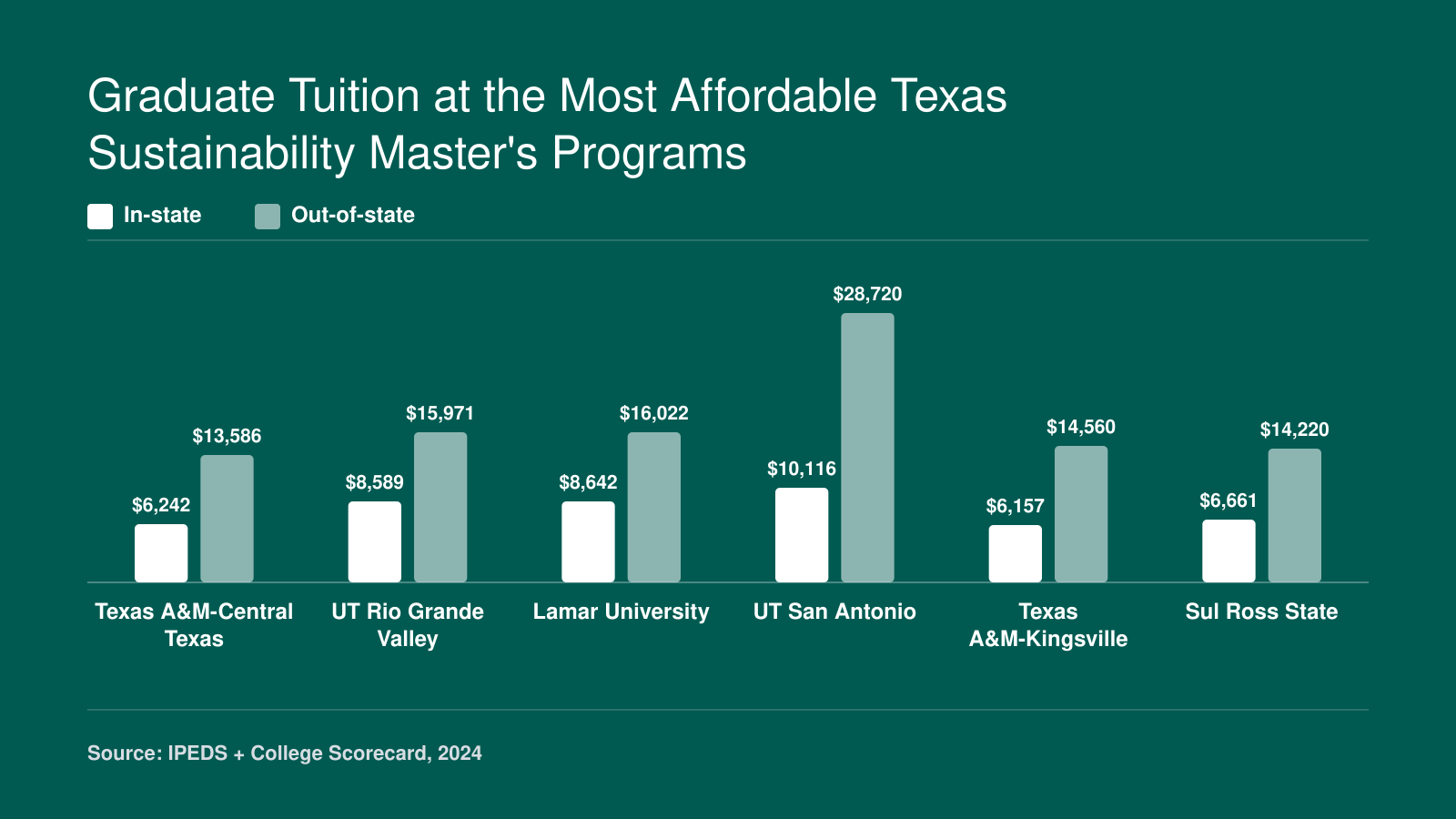
Graduate Tuition at the Most Affordable Texas Sustainability Master's Programs
Graduate tuition and fees at the lowest-cost programs here vary by residency. Texas residents save the most at public universities: at The University of Texas at San Antonio, in-state tuition is less than half the out-of-state rate. Figures are program-level graduate rates, not undergraduate tuition, so confirm current rates with each bursar before budgeting.
Cost, Licensure, and Certification for Texas Sustainability Master's Graduates
Sustainability careers in Texas run on voluntary, industry-issued credentials rather than state licenses. Texas does not license a general "sustainability professional," "manager," or "analyst," so your master's is the core qualification for those titles. That gap does not extend to regulated fields like engineering, architecture, or surveying.
LEED Credentials
- LEED Green Associate: Open to all, with no education or work prerequisite.1 The two-hour, 100-question multiple-choice exam requires 170 of 200 to pass.1 Fees run $250 standard, $200 for USGBC member employees, and $100 for verified students.2 Each registration covers one attempt and stays usable for 12 months.3 Maintenance is 15 continuing education hours every two years, 3 of them LEED-specific.1
- LEED AP with Specialty: Requires age 18 or older and an active Green Associate.4 Choose BD+C, O+M, or ID+C.4 Stand-alone exams cost $350 ($250 member) and combined exams $550 ($400 member),4 with no student discount.5
Other Credentials and the PE
Planners often pursue AICP, energy-focused graduates consider AEE's Certified Energy Manager, and ISSP offers practitioner credentials. Confirm current eligibility and fees directly with each body. Engineering-track graduates, including some from Rice's energy transition program, may need a Texas PE if they seal plans or take responsible charge of engineering work. Verify current rules with the Texas Board of Professional Engineers and Land Surveyors.
Admissions Checklist for Texas Sustainability Master's Programs
Requirements vary by school, so confirm each program's current graduate admissions page. Texas State University and The University of Texas at Dallas publish the clearest details.
- Degree and GPAAn accredited bachelor's degree is expected, and a relevant field is preferred at UT Dallas. Texas State's Sustainability Studies program sets a 3.0 GPA. UT Dallas treats 3.0 as typical, not a hard cutoff, because review is holistic.
- Core documentsPlan on official transcripts, a statement of purpose, and a resume. Texas State asks for three recommendation letters. UT Dallas pages list one to two, so check which applies. Neither requires the GRE.
- English proficiencyInternational applicants need test scores. Texas State accepts IELTS Academic 6.5, PTE 52, or TOEFL iBT (minimum depends on test date). UT Dallas lists a TOEFL iBT minimum of 80, with scores under two years old.
- DeadlinesTexas State has priority and standard dates by term and reviews on a rolling basis afterward, while UT Dallas lists May 1 for fall and October 1 for spring. Dates vary by applicant type, so verify before applying.
- Prerequisite courseworkNeither school's admissions pages clearly list required statistics or science courses. Ask the program office whether foundation coursework is expected.
Frequently Asked Questions About Master's in Sustainability Programs in Texas
Which Texas sustainability master's programs can be completed in one year?
How much does a master's in sustainability in Texas cost in total?
Do I need a science or engineering undergraduate degree to apply?
What is the difference between sustainability studies and sustainable design master's programs in Texas?
Compare Sustainability programs on the data that matters
Explore more Science & Engineering specializations or browse every graduate field.
All Science & Engineering programs