Best Master's in Science Education Programs in Texas
Compare accredited Science master's programs by earnings, cost, and outcomes.
Sample layout — live rankings and program data appear here once the data source is connected.

Texas districts typically pay teachers with a master's degree on a higher salary lane, but the size of that bump varies by district, and the degree alone does not change your certificate. Teachers weighing a science education master's are usually after a raise, an added endorsement, or a path into curriculum or instructional leadership roles.
The programs here span campus, hybrid, and fully online formats. In-state tuition runs from about $10,000 to more than $19,000 a year.
The tradeoff is cost against the actual role you want, since a degree built for classroom practice differs from one aimed at leadership.
Key Points
- In-state tuition ranges from $10,051 at University of Houston to $19,254 at Our Lady of the Lake University.
- UT Arlington's M.Ed. in Curriculum and Instruction - Science Education suits working teachers who want online flexibility.
- Initial Texas certification needs a TExES science exam, the PPR exam, and an approved preparation program.
Best Master's in Science Education Schools in Texas: 2027 Rankings
Four Texas universities offer a master's in science education that appears in our federal data, spanning fully online, hybrid, and campus formats. Each card shows in-state graduate tuition and the institution-wide average net price after aid, so you can compare cost directly. Graduation rates describe the whole school, not the science education program.
Texas A&M University-College Station
#1College Station, TX · ~$12,000/yr (est.)
Best for: Educators seeking inquiry-based science research training
Texas A&M University in College Station offers its science education emphasis through a 36-credit, non-thesis M.Ed. or M.S. in Curriculum and Instruction, delivered online for working professionals. In-state graduate tuition is $6,885, and the institution-wide average net price after aid is $21,315. The school's overall graduation rate is 84%, the strongest of the four ranked schools. The program does not lead to teacher certification, so it suits educators who are already licensed.
- 36 credit hours, no thesis or capstone required
- Concentration in Science Education
- Four inquiry strands, including teacher preparation and engagement with scientists
- Individualized plan of study built with an advisor
- Online delivery; out-of-state applicants accepted
- Does not lead to teacher certification
- Application deadline listed as March 20, 2026
- Financial aid and scholarships available
The University of Texas at Arlington
#2Arlington, TX · ~$11,000/yr (est.)
Best for: Certified teachers seeking accelerated online study
The University of Texas at Arlington runs an accelerated, fully online Master of Education in Curriculum and Instruction with a science education focus. It covers physical, earth, and life sciences through problem-based, inquiry-driven teaching. In-state graduate tuition is $9,189, and the institution-wide average net price after aid is $13,951, the lowest of the four. The school's overall graduation rate is 54%. The degree does not lead to initial Texas certification, so it fits teachers who are already licensed.
- 30 credit hours, completable in as few as 18 months
- Fully online coursework with six start dates per year
- Non-thesis; no capstone required
- Problem-based learning approach
- Two letters of recommendation minimum
- Unconditional admission asks for 3.0 GPA and two years of experience
- Does not lead to initial teacher certification
- TEACH grant of up to $3,772 per year noted
Our Lady of the Lake University
#3San Antonio, TX · ~$19,000/yr (est.)
Best for: Local K-12 employees wanting hybrid flexibility
Our Lady of the Lake University in San Antonio offers a hybrid Master of Education in Curriculum and Instruction with an Integrated Science Teaching concentration. Students pair education coursework with electives in biology, chemistry, mathematics, physics, and geology. In-state graduate tuition is $17,838, and the institution-wide average net price after aid is $16,442. The school's overall graduation rate is 46%. K-12 employees receive a 20% tuition discount, and there is no application fee.
- Concentration in Integrated Science Teaching
- Hybrid delivery
- Electives drawn from biology, chemistry, math, physics, and geology
- Start dates in fall, spring, and summer
- 20% tuition discount for K-12 school employees
- No application fee; two letters of recommendation minimum
- Foundation courses in multicultural education, research methods, and assessment
University of Houston
#4Houston, TX · $10,000 – $19,000/yr (est.)
The University of Houston delivers its M.Ed. in Curriculum and Instruction with a Science Education specialization on campus, with evening and summer classes for working teachers. In-state graduate tuition is $9,019, and the institution-wide average net price after aid is $14,276. The school's overall graduation rate is 65%. The program also points toward informal science roles at museums, zoos, and environmental centers.
- Campus-based with evening and summer courses
- Completion in as few as 14 months at nine hours per semester
- Choice of a capstone project or master's thesis
- Focus on inquiry-based science instruction
- Prepares for museum, zoo, and environmental center education roles
- Portfolio demonstrates program objectives
Online and Hybrid Master's in Science Education Options in Texas
For working Texas teachers comparing master's programs in Texas, the real choice is fully online versus hybrid. One format removes the commute entirely. The other keeps some face time with faculty and classmates.
UT Arlington describes its M.Ed. in Curriculum and Instruction - Science Education as 100% online and lists no on-campus or residency requirement. It runs in UTA's accelerated online format, where courses typically last 5 to 8 weeks. Classes can be synchronous (set meeting times) or asynchronous depending on the course, but the program page doesn't say which courses use which format. Completion can take as few as 18 months, and students build a semester-by-semester plan with an advisor. UTA doesn't publish a formal part-time track, so ask how slowly you can move while teaching full time.
Our Lady of the Lake University offers its M.Ed. with an Integrated Science Teaching concentration in a hybrid format. It has spring, summer, and fall starts and a 20% tuition discount for K-12 employees. The materials we reviewed don't specify the online and in-person split or any required campus sessions, so confirm those details before applying.
If you want labs and an in-person cohort, Texas A&M and the University of Houston run campus programs. Houston offers evening and summer courses that can fit around a teaching day.
Which Texas Master's in Science Education Programs Waive the GRE?
Most science education master's programs weigh your GPA and classroom or related experience more heavily than a standardized test score. Policies and deadlines change from one admissions cycle to the next, so confirm the current GRE rule and your term's deadline with each program's admissions office before you apply. Where a school does not publish a policy, the table says so.
| School | GRE Policy | Application Deadline(s) | Other Key Requirements |
|---|---|---|---|
| University of Texas at Austin (STEM Education M.Ed.) | Not required (waived for all STEM Education applicants) | Fall: December 15 on the program page; December 31 for college and department fellowships. No spring or summer deadline is published. | Department prefers a minimum 3.0 GPA, especially over the last two years of college and in any prior graduate study. Applicants with lower GPAs may be considered and are asked for an explanation document after applying. |
| Texas A&M University (M.Ed. in Curriculum and Instruction, Science Education emphasis) | Not published | A March 20, 2026 deadline is listed, but the page does not name the admission term. Check the next cycle's date with the department. | Applicants must apply to both the Teaching, Learning and Culture department and Texas A&M University. The master's admissions page gives step-by-step instructions. |
Related Articles
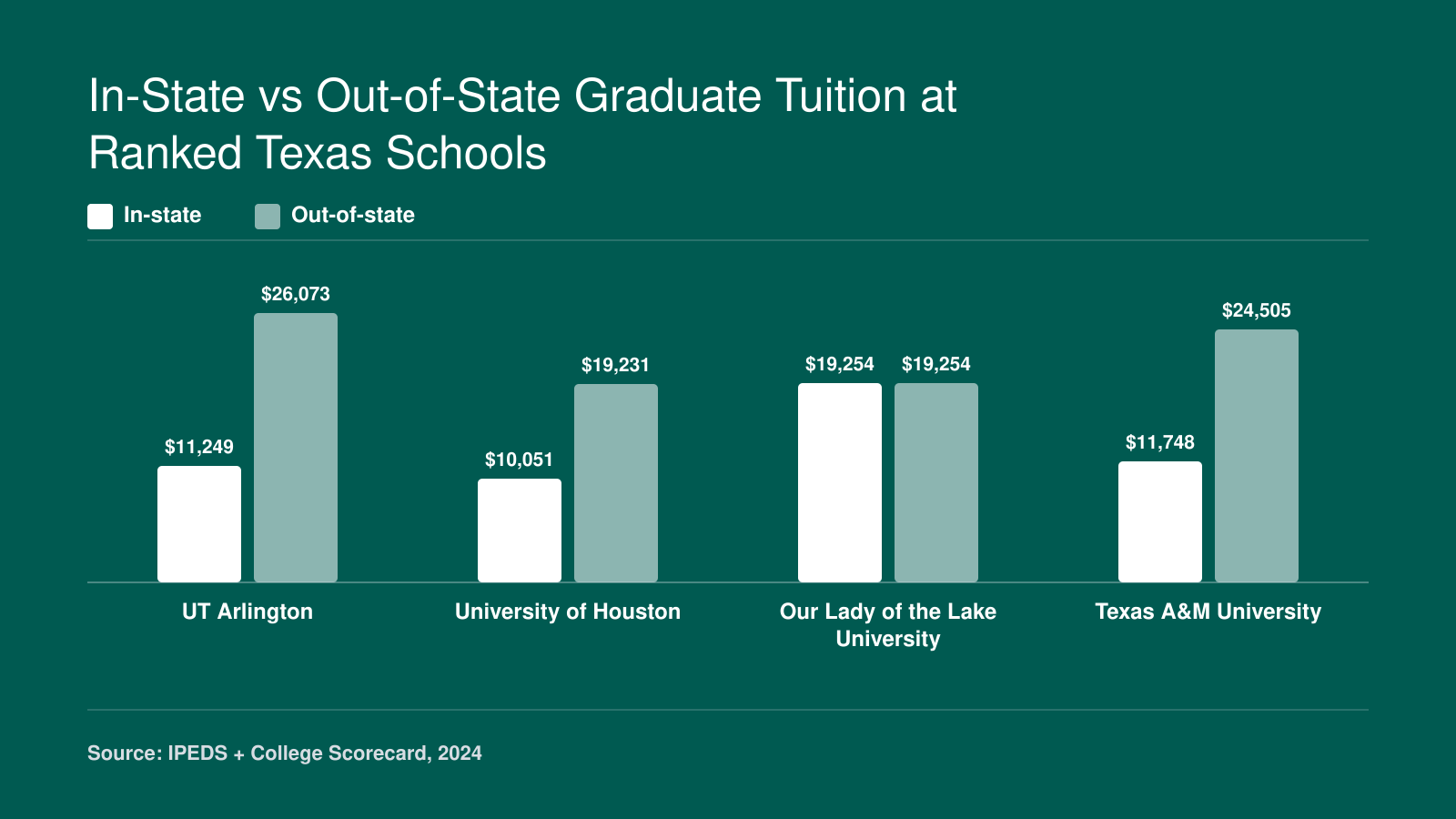
In-State vs Out-of-State Graduate Tuition at Ranked Texas Schools
In-state tuition runs from $10,051 at University of Houston to $19,254 at Our Lady of the Lake University. The out-of-state premium at the public schools ranges from $9,180 at University of Houston to $14,824 at The University of Texas at Arlington, while Our Lady of the Lake University, a private school, charges every student the same rate. These are annual published figures, not total program cost, so multiply by your program's length and add fees and living expenses.
Tuition, Cost, and Texas Certification for Master's in Science Education Graduates
Estimating Total Program Cost
The real price of a master's in science education is the tuition rate multiplied by the credits you need, plus any fees for online or teacher-preparation coursework. Using published annual in-state program tuition as a guide, rough totals look like this:
- UT Arlington: about $11,249 a year for a 30-credit, 18-month online program, or roughly $17,000 total.
- Texas A&M University: about $11,748 a year for 36 credits. Two years puts you near $23,500. Online courses can carry distance-education differential tuition, set by department and ranging from $40 to $550 per credit, charged on top of regular tuition.1
- University of Houston: about $10,051 a year. Finishing in 14 months to two years suggests roughly $12,000 to $20,000.
- Our Lady of the Lake: about $19,254 a year, the same rate for in-state and out-of-state students, with a 20% discount for K-12 employees.
Treat these as estimates and confirm current rates and fees with each school. Institution-wide net price after aid, roughly $14,000 to $21,000 a year at these schools, is a campus average, not a program quote for the total cost of a master's degree.
What the Degree Does Not Do
A master's alone does not earn an initial Texas teaching certificate. These programs are geared mostly toward practicing teachers, and none of their program pages highlights an initial-certification route, so ask before enrolling. Certification comes through an educator preparation program and state exams in areas such as Science 7-12 or Life Science 7-12.
Texas Science Teacher Certification at a Glance
Master's in Science Education Salary and Career Outcomes in Texas
A master's in science education, one of the Education & Teaching Master's Programs, is often a financial bet in Texas: the added tuition should pay off through a higher salary lane, a leadership role, or a district-level position. No program-level median earnings or debt figures are reported for the schools ranked here yet, so we cannot compare graduates' pay at a fixed point such as four years after finishing or show monthly loan payments tied to program-level debt. Prospective students should rely on the posted tuition and available financial aid when weighing cost, and check with each program about typical graduate placements.
Common career paths for these degrees include secondary science teacher on a higher salary step, science department lead, instructional coach, district curriculum specialist, and informal science education roles at museums, zoos, or science centers. These positions usually require or strongly prefer a master's, and they often come with higher pay bands than a first-year classroom teaching job, though exact salaries vary by district and region.
Compare Science programs on the data that matters
Explore more Education & Teaching specializations or browse every graduate field.
All Education & Teaching programs