Best M.Ed. Programs
Compare 6,600+ accredited Education (M.Ed.) programs at 1,050+ schools, with graduate earnings, cost, debt, and completion data from IPEDS and the U.S. College Scorecard.

Tuition for a master's in education runs from about $12,000 for Texas residents at UT Austin to roughly $58,000 at Columbia's Teachers College, for degrees that often move a teacher the same step on a district salary schedule.
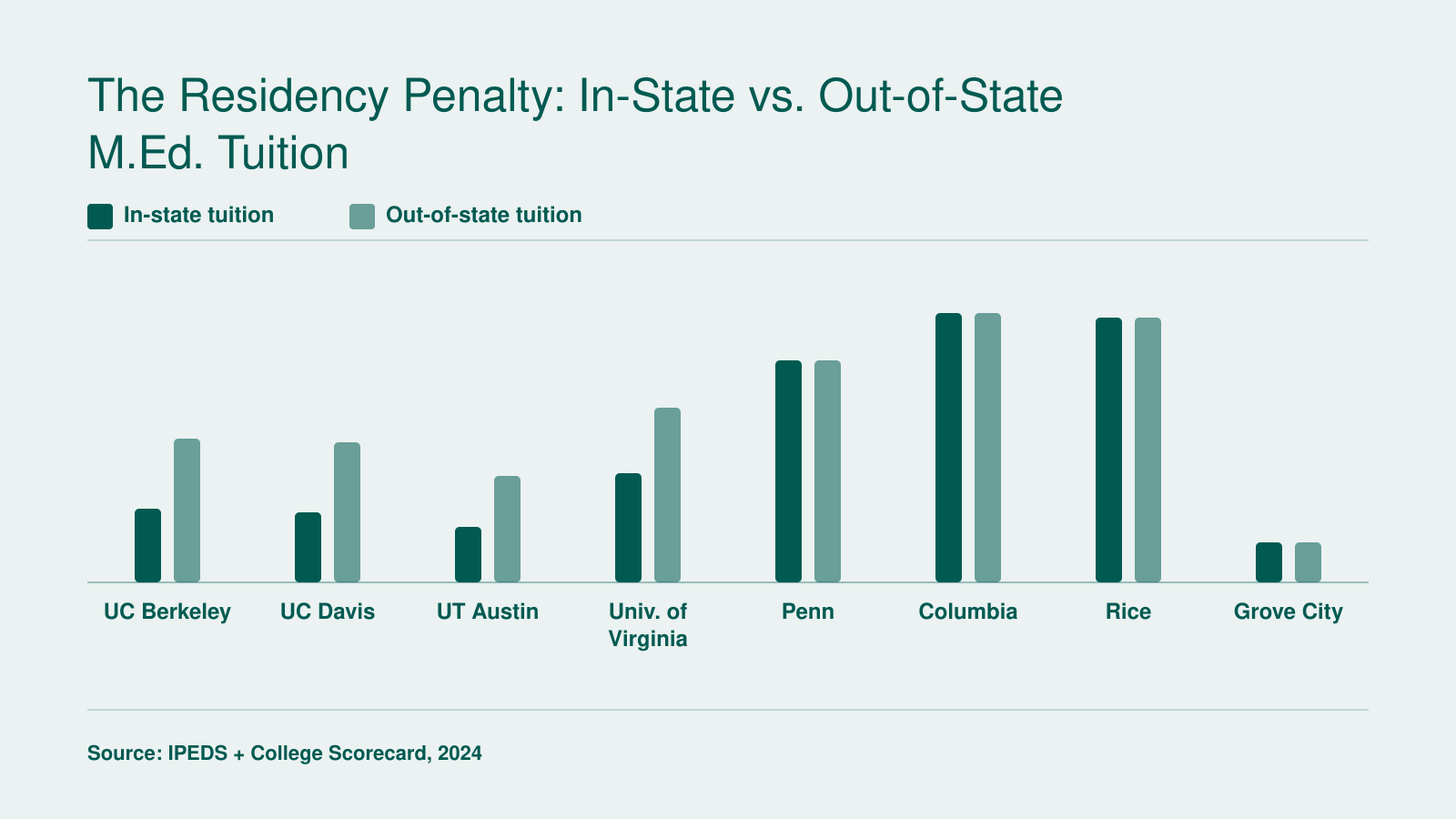
Residency alone can swing the bill: at UC Berkeley and UC Davis, nonresidents pay about $15,100 more than in-state students. The highest-ranked programs appear directly below.
What the degree qualifies you to do is a separate question from what it costs. Licensure is governed by state boards, and an M.Ed. completed online from another state does not automatically satisfy them.
Key Points
- UC Berkeley and UC Davis charge nonresidents $15,102 more than in-state students.
- Net price is a federal institution-wide average, so your own cost will differ.
- Most programs here are campus-based, and licensure eligibility depends on your state's board.
The 10 Best M.Ed. Programs for 2027
This list weighs cost, graduate outcomes, and format flexibility to help working teachers and career changers compare M.Ed. options. We prioritize in-state value, online availability, and program-level earnings where the data supports it, not prestige alone.
University of Virginia
#1Charlottesville, VA · ~$24,000/yr (est.)
Best for: Working teachers needing online flexibility
The University of Virginia is the clearest M.Ed. fit on this list, with a fully online curriculum and instruction master's that can be completed in as little as one year. Nine emphasis areas include ESL, gifted education, literacy, and social-emotional learning, so working teachers can tailor the degree without stepping away from the classroom. The school's overall graduation rate is 95.6%, and the program offers a Virginia alternate licensure pathway.
- 9 concentration options
- 1 year full time or 2 to 3 years part time
- Fully online asynchronous format
- No GRE required
- Starts fall, spring, and summer
- Virginia alternate licensure pathway
- Transfer up to 6 credits
- Optional dual MBA and M.Ed.
- 8 concentration options
- Educational innovation focus
- Capstone required
- Online asynchronous delivery
- Nine emphasis areas include ESL
- English as a Second Language concentration
- Online, asynchronous classes
- Capstone required
- Guaranteed admission for UVA B.S.Ed. graduates
- CACREP accredited
- 2 concentration options
- 61 total credit hours
- 700 clinical hours
- In-person in Charlottesville
- Eligible for LPC licensure in Virginia
- Part-time online evening classes
- Four to five semesters
- Embedded administrative internship
- Prepares for School Leaders Licensure Assessment
- Discounted tuition for Virginia educators
- 1 year
- 34 total credit hours
- Cohort model of 40 students
- Over 50 internship sites
- Paid internships
- 1 year
- Full time
- Cohort model
- Leads to Virginia ESL preK-12 initial licensure
- Internships in elementary and secondary classrooms
- 30 credit hours
- 10 courses
- Science-based reading instruction
- Prepares for Reading Specialist Praxis
- Summer practicum experience
- School mental health leadership emphasis
- Placement in high-need schools
- 61 total credit hours
- CACREP accredited pathway
- 1 year
- Initial Virginia licensure
- Cohort model
- Internships in diverse schools
- Praxis preparation
- 1 year
- Full time
- Initial Virginia licensure
- Internships in different schools
- Capstone project required
- 4 endorsement options
- 1 year
- Initial Virginia licensure
- Robert Noyce Scholarship available
- Endorsements in biology, chemistry, earth science, physics
- Part-time online format
- Initial Virginia licensure
- Prepares for Praxis Teaching Reading
- Practicum and student teaching included
- No GRE required
- Clinical mental health counseling focus
- 61 credit hours
- 700 clinical hours
- Prepares for LPC licensure in Virginia
- Trauma-informed care emphasis
University of Pennsylvania
#2Philadelphia, PA · ~$48,000/yr (est.)
Best for: Aspiring higher ed administrators
The University of Pennsylvania brings strong completion metrics and several one-year, campus-based M.S.Ed. options in higher education and learning sciences. Students can access paid graduate assistantships, interdisciplinary electives, and a broad alumni network. The school's overall graduation rate is 96.5%, and the higher education program reports median earnings of $85,500 at four years.
- 6 concentration options
- 1 year
- 10 courses
- Paid graduate assistantships available
- Comprehensive exam required
- Alumni at Stanford, RAND, Harvard
- Four-year median earnings $85,500
- 1 year
- 10 courses
- STEM OPT extension eligible
- Cognitive science focus
- Video games and virtual worlds study
- Doctoral study pathway
- 10 courses
- 2.7 GPA minimum
- Thesis or capstone option
- Weekly MSE seminars
- Up to two transfer course units
- 4 concentration options
- 4 semesters
- Cohort-based structure
- Capstone required
- Internship opportunities
- Career paths in clean tech and energy consulting
Columbia University in the City of New York
#3New York, NY · ~$58,000/yr (est.)
Best for: K-12 educators seeking leadership credentials
Columbia's Teachers College houses one of the widest education-master's menus in the United States, with more than a dozen M.Ed. and M.A. paths across leadership, instructional technology, subject-area education, and music. Most programs are campus-based and offer full-time or part-time study. The school's overall graduation rate is 96.1%, and several paths lead to New York State certification.
- 2 concentration options
- NY State SBL certification option
- LA ELC certification option
- Two summer intensive format
- Full academic year format
- 2 year
- 60 credit hours
- AI, VR, and game design
- Transfer up to 30 credits
- Careers in ed tech startups and museums
- 3 concentration options
- 60 credit hours
- Capstone required
- Academic writing sample required
- Advanced degree for experienced professionals
- 60 credit hours
- Spring, summer, and fall starts
- Prerequisite: 24 undergraduate math credits
- Professional certification pathway
- 60 credit hours
- Capstone required
- Science content and education coursework
- 12 points of optional studies
- Advisor-guided program planning
- Largest graduate program of its kind
- Cutting-edge historical research
- Dynamic global learning community
- 60 credit hours
- Thesis required
- Transfer up to 30 credits
- Bridges theory-practice gap
- 4 concentration options
- M.S. and M.Ed. options
- Leads to Initial Certification, Grades 7-12
- Programs from master's to doctoral
- 32 credit hours
- 6 outside-program credits
- Pedagogy, research, musicianship
- B average required
- Fieldwork at Rita Gold Center
- 34 credit hours
- 100 clinical hours
- Capstone required
- Leads to NY PreK-12 music teacher certification
- Two semesters guided student teaching
University of California-Berkeley
#4Berkeley, CA · ~$16,000/yr (est.)
UC Berkeley runs a focused education school with two standout paths: the Principal Leadership Institute for school leaders and the BTEP teacher credential plus M.A. The campus-based programs are selective, with strong Bay Area fieldwork and administrative credential preparation. The school's overall graduation rate is 92.8%, and BTEP graduates report a four-year median salary around $75,800.
- Administrative credential preparation
- Offered through Principal Leadership Institute
- Multiple administrative career paths
- Focus on school improvement
- 5 concentration options
- 15-month program
- Starts summer
- 3 letters of recommendation minimum
- Student teaching in Bay Area schools
- No GRE required
- Four-year median earnings $75,848
- MA project on own teaching
The University of Texas at Austin
#5Austin, TX · ~$12,000/yr (est.)
UT Austin offers one of the most affordable and flexible M.Ed. portfolios on this list, with in-state tuition around $11,700 and online, hybrid, and campus options. Specializations include special education, school counseling, literacy, STEM, and principal leadership. The school's overall graduation rate is 88.9%.
- 33 to 36 credit hours
- Master of Arts or Education options
- GRE not required
- Fall start only
- On-campus program delivery
- Focus on early childhood theories
- Multiple credit-hour options
- Teacher certification specialization available
- Requires teaching or related experience
- Annual review by faculty
- 24 months
- Prepares for LPC licensure
- Supervised clinical training
- Graduate assistantship opportunities
- Full-time strongly encouraged
- 12 months
- Hybrid online and campus
- 160 clinical hours
- Requires principal nomination
- Prepares for Principal as Instructional Leader exam
- Cohort of working educators
- 24 months
- 36 credit hours
- Full-time or part-time
- Required internship
- Career paths in student life, advising, and policy
- 12 months
- 36 credit hours
- Synchronous online classes
- BCBA certification track
- Three practical experiences
- Assistive technology emphasis
- 42 credit hours
- Teacher certification track
- No thesis or capstone
- Work experience required
- Seven concentration areas
- Bilingual/bicultural education focus
- Research in local schools
- Perry-Castañeda Library access
- 42 credit hours
- 2 years
- No GRE required
- Earns Texas teaching certificate
- ESL endorsement included
- Urban school teaching focus
- 36 credit hours
- Must be certified teacher
- Fall start only
- Partnership with Heart of Texas Writing Project
- Literacy research and theory focus
- 33 credit hours
- Prepares for SOA and CAS exams
- Teaching assistantships cover tuition
- Small program with funded positions
- GRE Quantitative score minimum 151
- 36 credit hours
- Three degree options: MA thesis, MA report, MEd
- Career paths: teacher, coach, professor
- Independent research project required
- 42 credit hours
- 2 years
- Grants Texas Teaching Certificate
- ESL endorsement included
- Student teaching internship
- Full-time enrollment
- Hybrid online and in-person
- BCBA certification preparation
- Naturalistic Developmental Behavioral Interventions
- Caregiver-implemented interventions
- 1 year
- 36 credit hours
- Starts summer
- Prepares for Texas teacher certification
- ESL endorsement
- Priority deadline December 15
- 2 concentration options
- 24 months
- Designed for current educators
- Thesis or capstone option
- M.Ed. pathway for certified educators
- Application deadline December 15
- 7 concentration options
- Cultural studies in education focus
- Master of Arts and Master of Education options
- Research in local schools
- Seven concentration areas
- Early childhood education focus
- Master of Arts and Master of Education options
- Department email contact available
Rice University
#6Houston, TX · ~$57,000/yr (est.)
Rice University compresses teacher training into a 30-credit Master of Arts in Teaching with paid Houston-area internships and Texas certification. Distinct pathways serve current Rice undergraduates, new teachers, and experienced teachers pursuing principal certification. The school's overall graduation rate is 94.6%.
- 30 credit hours
- 10 courses
- Fifth-year option
- SAT or ACT required
- Paid teaching internship
- Prepares for TExES
- 30 credits
- 10 courses
- For experienced teachers
- Prepares for Texas principal certification
- Two-semester principal practicum
- Instructional leadership focus
- 30 credit hours
- 10 courses
- 75 clinical hours
- Paid teaching internship
- Two-semester supervised teaching
- Prepares for Texas Teacher Certification
- Culturally responsive pedagogy
Grove City College
#7Grove City, PA · ~$9,000/yr (est.)
Grove City College stands out for below-average graduate tuition and an online M.S. in Education Reading Specialist that emphasizes the science of reading. The asynchronous format works well for certified teachers who need reading certification while staying in the classroom. The school's overall graduation rate is 83.2%.
- 30 total credit hours
- Rolling admissions
- Asynchronous online classes
- Prepares for Reading Specialist Certification Exam
- Emphasis on science of reading
- Prepares for one-on-one interventions
- Literacy coaching skills
- Career: literacy coach or consultant
- 1 year
- 30 credits
- Full-time and part-time options
- Starts fall
- Technical leadership preparation
- Tuition below state and national averages
University of Notre Dame
#8Notre Dame, IN · ~$65,000/yr (est.)
Notre Dame offers high institutional completion rates and a one-year, campus-based STEM plus entrepreneurship master's. It is not an M.Ed., so education-focused applicants should treat this as an adjacent option rather than a licensure or curriculum degree. The school's overall graduation rate is 95.2%.
- No entrance exam required
- GRE or GMAT test optional
- 1-year program
- 3 letters of recommendation minimum
- For STEM and tech-savvy students
- One semester minimum residency
- Translates technologies into commercial ventures
University of California-Davis
#9Davis, CA · $15,000 – $20,000/yr (est.)
UC Davis combines public university tuition advantages with a strong graduation rate, but its listed graduate offering is the online Master of Management, not an M.Ed. It is a 15-month, part-time business degree grounded in data-driven decision making and Silicon Valley connections.
- No entrance exam required
- GMAT or GRE test optional
- 15-month program
- 36 credit hours
- 9 courses
- Part-time available
- Starts spring and fall
- Personalized career plan
Santa Clara University
#10Santa Clara, CA · ~$32,000/yr (est.)
Santa Clara University offers a hybrid STEM-designated master's in artificial intelligence, not an education degree. Located in Silicon Valley, it suits students targeting machine learning, robotics, or AI ethics careers. The school's overall graduation rate is 87.9%.
- 2 track options: CSEN and ECEN
- $1,254 per credit
- 2 years
- 46 credit hours
- 3 start dates per year
- STEM-designated
- AI Innovation Hub industry mentors
- Hands-on AI practicum
Cost & outcomes by school
Federal data for the highest-earning Education (M.Ed.) programs, independent of the ranking above. Earnings are this field's master's graduates four years after completing, where the Scorecard reports them.
| School | Earnings | Tuition / yr | Debt | Grads/yr | Format |
|---|---|---|---|---|---|
| Western Governors University UT | — | $9,320 | — | 50,258 | Online |
| Wiley University TX | — | $6,552 | — | — | Online |
| University of Virginia's College at Wise VA | — | $8,352 | — | — | Online |
| Grand Canyon University AZ | — | $10,015 | — | 24,308 | Hybrid |
| Liberty University VA | — | $8,730 | — | 19,236 | Online |
| Walden University MN | — | $10,885 | — | 16,946 | Online |
| University of the Cumberlands KY | — | $3,195 | — | 8,772 | Campus |
| Arizona State University AZ | — | $10,843 | — | 14,144 | Online |
| American College of Education IN | — | $6,600 | — | 9,876 | Online |
| University of North Texas TX | — | $9,091 | — | 9,932 | Campus |
| Capella University MN | — | $15,092 | — | 14,818 | Online |
| Southern New Hampshire University NH | — | $21,387 | — | 19,416 | Online |
Sources: U.S. Department of Education. Tuition and graduates: IPEDS. Earnings and debt: College Scorecard, this field's master's graduates; a dash means no figure is reported.
How We Ranked These M.Ed. Schools
Ranking M.Ed. programs means comparing what the degree costs, how likely students are to finish, and what graduates earn and owe afterward. We built the list from federal data and program details, not from prestige.
What Went Into the Ranking
- Tuition: Degree-aware graduate tuition, shown separately for in-state and out-of-state students.
- Net price: The average amount students pay after grant aid.
- Graduation rate: The share of students who finish at the institution.
- Earnings and debt: College Scorecard program-level figures for graduates of that specific field of study.
- Delivery format: Whether the program is online, on campus, or hybrid.
What the Numbers Can't Tell You
Graduation rate and net price are institution-wide averages. They reflect the whole school, including undergraduates, not only M.Ed. students, so read them as context rather than a promise. Earnings figures are narrower: they come from federal Scorecard data for completers of that program's classification code, which means they describe a field of study at a school, not an individual's likely paycheck.
Why Outcomes Beat Reputation
The M.Ed. is a practitioner degree. Most students are working or future teachers, counselors, and administrators who need a credential, a salary bump, or a leadership license, and a school's name rarely changes any of that. Cost, debt, and completion tell you more about whether the degree will pay off than a reputation survey does.
When Data Is Missing
Programs without published emergency nurse practitioner salary data were ranked on the remaining factors. We did not estimate or fill in numbers, and no program was penalized for a gap in federal reporting.
Most Affordable M.Ed. Programs and What You'll Actually Pay
Three of the lowest-cost options here show how residency shapes the bill: Baruch College, the University of Florida, and UNC Chapel Hill list in-state tuition from about $6,400 to $9,000, while out-of-state tuition can top $41,000. Average net price is far lower at each, but it is an institution-wide approximation after grant aid, not a personal quote. Sticker price is still not the full bill, since technology, practicum, student-teaching, graduation, and licensure exam fees are often billed separately. Some online programs, such as Pittsburg State's $416 per-credit resident rate for all students, charge a flat e-tuition regardless of residency.
| School | In-State Tuition | Out-of-State Tuition | Average Net Price |
|---|---|---|---|
| CUNY Bernard M Baruch College | $7,464 | $15,414 | $3,033 |
| University of Florida | $6,381 | $28,659 | $6,541 |
| University of North Carolina at Chapel Hill | $8,994 | $41,203 | $11,655 |
The Residency Penalty: In-State vs. Out-of-State M.Ed. Tuition
Listed program tuition for several top-ranked schools shows how much residency can matter. The largest gap here is $15,102, at both UC Berkeley and UC Davis, where nonresidents pay roughly double the in-state price. Private schools such as Penn, Columbia, Rice, and Grove City charge everyone the same rate, while public schools can nearly double the cost for students from out of state.
Online vs. Campus M.Ed. Programs: Can You Finish While Teaching Full Time?
Flexibility is the reason most teachers consider a master's in education online, but the word "online" promises less than it sounds like. Among the schools here, most programs are campus-based, including Berkeley, Columbia, Penn, Rice and UT Austin. Grove City, UC Davis and UVA deliver online, and Santa Clara offers a hybrid format. Whether any of them works around a full-time classroom depends on three details.
What Makes Online Truly Flexible
- Live sessions: Asynchronous courses, like the ones at UVA and Grove City, let you work after the school day. UC Davis includes live online classes, so your evenings need to be predictable. Lincoln University's online M.Ed. mixes asynchronous and synchronous work.
- Residencies: Some programs add in-person time. Antioch's summer sessions run the first two weeks of July, but attendance there is optional rather than universally required.2 Always confirm whether a residency is optional or mandatory.
- Practicum hours: "100% online" usually describes coursework, not field experience. Lincoln requires 300 hours at an approved school,1 and UNT's online M.Ed. in educational leadership requires a 16-week practicum in a school that meets Texas requirements.
Realistic Pacing for Working Teachers
Most working teachers take one or two courses per term and use summer sessions to catch up. That pace stretches a degree well past the full-time timeline. UVA's curriculum and instruction M.Ed., for example, can be finished in one year full time or in two to three years part time. UC Davis lists a 15-month program that expects roughly 15 to 20 hours of work per week, which is a heavy load on top of a teaching job.
Practicum Is the Make-or-Break Detail
Programs differ sharply here. Antioch builds its work around your own teaching context, and Cincinnati's online curriculum and instruction M.Ed. allows the 75-hour clinical experience to be completed in your current work setting. Many other programs allow an approved placement without saying it can be your own school. Counseling and administration tracks often require placements outside your regular classroom.
Before you apply, ask admissions directly whether practicum hours can be completed in your current classroom, and get the answer in writing.
Related Articles
Before you enroll, confirm with your state's licensing board that the program meets its requirements for the credential you want. An M.Ed. alone does not guarantee eligibility for licensure, especially if you study online from another state.
M.Ed. Application Checklist
Requirements vary by school and specialization, so confirm each program's current terms before you apply. These are the items you will most often need to prepare.
- Bachelor's degree and GPAExpect to need a bachelor's degree from a regionally accredited institution. Minimum GPAs typically fall between 2.5 and 3.0. Tennessee State and Liberty use 2.5, while University of Portland and William Paterson's online educational technology program use 3.0. Applicants below the cutoff may still be considered case by case or conditionally.
- Teaching license or experienceThis depends on the track. National University's M.Ed. requires no license or classroom experience. University of Portland's listed route requires a current license, and its Principal License option asks for three or more years as a licensed educator. Liberty's identified programs ask for a current license plus two years of experience.
- Application materialsPlan on official transcripts, a resume, a statement of purpose, and recommendation letters. Request transcripts and line up recommenders early, since both can slow down a submission.
- GRE statusPolicies are program-specific, and many M.Ed. programs no longer lead with the GRE. Tennessee State asks for the GRE or MAT only from applicants whose GPA falls below its threshold. Check whether your target program requires a test.
- DeadlinesMany programs use fixed cohort dates. Tennessee State closes July 1 for fall, November 1 for spring, and April 1 for summer. University of Portland's dates are July 31, December 7, and May 30. Lynchburg's are July 31 for fall, November 30 for spring, and May 1 for summer.
- Transfer creditLimits differ by school. Tennessee State accepts up to 12 graduate credits that match program requirements, and Liberty allows up to 50% of the degree for its identified M.Ed. programs. Ask for a written credit evaluation before you enroll.
Education (M.Ed.) programs by state
Frequently Asked Questions About M.Ed. Programs
These answers draw on federal data for the schools ranked here and on general figures for the field. Costs and earnings vary widely by specialization, state, and format, so use them as starting points and confirm details with each program.
What is the difference between an M.Ed., M.A.T., and M.S.Ed.?
Which M.Ed. programs offer the best return on investment?
What is the average cost of an accredited M.Ed. program?
Which M.Ed. specializations have the highest salary outcomes?
Compare Education (M.Ed.) programs on the data that matters
Explore more MEd specializations or browse every graduate field.
All MEd programs