Best M.Ed. Programs in Maryland
Compare 145 accredited Education (M.Ed.) programs in Maryland at 20 schools, with graduate earnings, cost, debt, and completion data from IPEDS and the U.S. College Scorecard.

Maryland's best M.Ed. programs run from one-year certification routes to online leadership and literacy degrees, and the cost gap is wide. Institution-wide average net price after grant aid spans roughly $15,678 at University of Maryland-College Park to $30,574 at Loyola University Maryland. Those are campus-level figures, not program quotes.
Campus, online, and hybrid M.Ed. programs are ranked together here, because format rarely settles the decision. Certification does. Some tracks lead straight to a Maryland certificate; others, including well-regarded concentrations, deliberately do not.
Key Points
- Salisbury University's Educational Leadership M.Ed. lists $10,785 in-state tuition and leads to Maryland's Administrator I certificate.
- Loyola University Maryland's hybrid early childhood track costs $20,070 and offers no direct Maryland teacher certification.
- Hopkins' Learning Design and Technology M.Ed. needs only a 3.0 GPA, with no GRE required.
Best M.Ed. Schools in Maryland: Our 10 Top Picks
These ten Maryland schools cover campus, hybrid, and online master's in education options, from one-year teacher-certification routes to online leadership and literacy degrees. Graduation rates in each card are institution-wide, so read them as the share of students that schools offering these programs graduate, not a figure for any single M.Ed. Pay attention to whether a program leads to Maryland certification, since several degrees here do not.
Johns Hopkins University
#1Baltimore, MD · ~$65,000/yr (est.)
Best for: Career changers entering funded STEM teaching
Johns Hopkins runs a funded, cohort-based Master of Education for Teaching Professionals that pairs coursework with a paid residency in partner schools, mostly aimed at STEM teaching. Online options include learning design and technology and applied behavior analysis for students who are not heading to a classroom. Schools offering these programs graduate 94% of students, but price is among the highest on this list outside the funded tracks, so confirm what aid applies to your program.
- Prepares middle and secondary STEM teachers
- Tuition and educational expense support provided
- Four-year teaching commitment in a partner district
- Post-graduation mentorship as you enter the classroom
- 39 credit hours, 4 semesters, cohort-based, starts summer
- Full-tuition support and living stipend for residents
- Year-long internship; placements with Baltimore City Public Schools
- Meets Maryland certification requirements
- Noyce Scholarship stipends of $10,000 listed
- 39 credit hours, full-time, starts summer
- Paid residency during the second year
- Prepares for Secondary Mathematics certification
- Full-tuition support and four years of career support
- Seven concentration options in the program
- Prepares for Biology certification (grades 7 to 12)
- Residency in approved Maryland school districts
- Focus on environmental issues and climate change
- 39 credit hours, cohort-based, starts summer
- Residency model with a paid teaching year
- Homewood campus in Baltimore
- Four-year career support after graduation
- 30 credit hours, 1 to 2 years
- Fully online option, full-time or part-time
- Fall start; three concentration options
- Careers in education, business, government, nonprofits
- 36 credit hours, two years, part-time available
- Synchronous online classes; optional practicum electives
- Practicum limited to the Baltimore-D.C. area
- Meets BACB Pathway 2 coursework requirements
- No F-1 visa sponsorship
- Housed in the School of Education
- Educational Studies concentration also offered
- Online Digital Age Learning and Ed Tech track available
- 33 credit hours over six semesters, online
- Capstone and gifted education practicum
- Meets NAGC and CEC standards
- Prepares for gifted education specialist certification
- 38 credit hours, four semesters
- Maryland K-12 teaching certification included
- Elementary and secondary practica plus a full-semester internship
- 3.0 GPA minimum; no entrance exam required
University of Maryland-College Park
#2College Park, MD · ~$18,000/yr (est.)
Best for: Educators wanting broad specialization choices
The University of Maryland, College Park pairs a flagship public price with the widest range of education specializations here, from certification M.Ed. tracks to counseling, TESOL, and special education. It runs district-designed cohorts when a school system recruits at least 12 participants, and its CITE initiative supports conditionally licensed teachers in several counties. Schools offering these programs graduate 89% of students.
- Concentrations can lead to teacher certification
- Route to certified teaching for career changers
- Starts fall, spring, or summer
- Three letters of recommendation minimum
- Internships and field experiences in Washington, D.C.
- 60 credit hours, two years, full-time, starts fall
- 100-hour practicum and two 300-hour internships
- Prepares for K-12 school counselor roles
- Apply by 2026-12-01
- 30 credit hours, 10 courses; full-time or part-time
- Classes meet once a week after school
- Earn a STEM Instructional Leader endorsement
- Aligned with MSDE and NGSS standards
- 39 credit hours, two years, starts fall
- Leads to PK-12 ESOL certification
- Year-long teaching internship; prepares for Praxis
- Hybrid with on-campus and internship components
- Only for Prince George's County educators
- 30 credit hours, 10 courses, cohort-based
- Blended in-person and online courses
- Add-on TESOL certification for Maryland
- 30 credit hours, 2 to 3 years, capstone required
- $878 per credit listed
- On-campus and hybrid options
- Two-year program, eight concentration options
- Year-long internship in inclusive classrooms
- Prepares for two special education certifications
- Entrance exam required (Praxis); 3.0 GPA minimum
- 30 credit hours, 1 to 1.5 years
- Requires a valid special education certificate
- Hybrid delivery combining online and campus
- 36 credit hours, non-thesis, certification track
- Internship in education; prepares for Praxis
- 30 credit hours, about 2.5 years, part-time available
- Hybrid model with Summer Reading Clinic practicum
- Requires teaching certification for admission
- Prepares for MSDE reading specialist certification
- 36 credit hours, no thesis or capstone
- 8-credit internship in education
- Prepares for Praxis II
- One-year program, 36 credit hours, capstone required
- Mentored internships in partner schools
- Requires edTPA teaching portfolio
- Entrance exam required (Praxis)
- 20 concentration options across EDCI
- Three start dates per year
- Concentrations lead to teacher certification
- Three letters of recommendation minimum
- ALA accredited; accreditation next reviewed in 2028
- 36 credit hours, fully online option
- Seven concentration options, thesis or capstone option
- Full-time and part-time options
Loyola University Maryland
#3Baltimore, MD · ~$20,000/yr (est.)
Best for: Future principals studying online with internship
Loyola University Maryland offers a one-year MAT with initial licensure, plus online and hybrid M.Ed. options in leadership, literacy, and special education. It has a formal partnership with Baltimore City Public Schools covering teacher and administrator development. Schools offering these programs graduate 79% of students. Note that the Montessori-linked early childhood M.Ed. does not lead directly to Maryland teacher certification.
- 30 credit hours, synchronous online with in-person internship
- Licensure eligibility for Maryland leadership roles
- Starts fall, spring, or summer
- Faculty are current or former superintendents
- One year (summer to spring), full-time or part-time
- Initial teacher licensure provided
- Clinical experiences in partnership schools
- Evening classes offered
- 39 credit hours; elementary licensure grades 1 to 6
- Part-time route takes 2 to 5 years
- Fast-Track admission for Loyola seniors
- 34 credit hours, one year, starts summer
- Initial teacher licensure included
- Greater Baltimore clinical placements
- Cohort-based; starts summer; rolling admissions
- Teaching internship in a high-need Baltimore school
- Two-year teaching commitment required
- Stipend and award support listed
- 39 credit hours, as little as one year
- Prepares for Maryland teacher licensure
- Online synchronous with in-person internship
- Three start dates per year
- 30 credit hours, five semesters, online
- 3.0 GPA minimum; capstone required
- Prepares for Praxis II Reading Specialist
- Eight-week course terms
- 33 credit hours; hybrid with off-site AMI pedagogy courses
- Dual enrollment with an AMI partner institute required
- No direct Maryland teacher certification
- May lead to a Montessori Professional Certificate
- 36 credit hours over four successive summers
- In-person three-week sessions each July
- Thesis required; Kodály certification after Level III
University of Maryland-Baltimore County
#4Baltimore, MD · $15,000 – $20,000/yr (est.)
UMBC is a public research university in Baltimore with a 12-month MAT built for career changers and recent graduates seeking secondary certification. Its 100-day internship in a Professional Development School is the centerpiece, and the program lists 13 concentration options. Schools offering these programs graduate 70% of students.
- 36 credit hours, completed within a calendar year
- 100-day internship; starts summer
- Meets Maryland certification requirements
- Admissions exams listed: Praxis, GRE; 3.0 GPA minimum
- Intake interview required
- 37 credit hours with Phase I and Phase II internships
- Three pathways to teaching certification
- Accelerated Bachelor's/Master's option
- 36 credit hours, 12 months, starts summer
- Certification in grades 7 to 12 or PreK-12
- Prerequisite courses required
- 36 credit hours, cohort-based
- Earns Maryland teacher certification
- Tailored to Baltimore City teachers
- Praxis exam support included
- Professional Development School partnerships
- Teacher certification in Maryland and 30 other states
- Baltimore-Washington corridor placements
Towson University
#5Towson, MD · ~$13,000/yr (est.)
Towson University is a public option with deep education offerings across early childhood, special education, reading, and secondary teaching, with several fully online paths for working teachers. Its Early Childhood Education M.Ed. publishes no entrance exam requirement but does not lead to initial certification, so career changers should look at the MAT instead. Schools offering these programs graduate 69% of students.
- No entrance exam required; 3.0 GPA minimum
- No initial teacher certification
- Starts spring, summer, or fall
- Statement of purpose and resume required
- One-year program; five concentration options
- Eligible for initial teacher licensure in Maryland
- Designed for career changers and recent graduates
- Requires a substantial daytime internship
- 42 credit hours, one year
- 18-week full-time teaching internship
- Prepares for edTPA and Maryland initial licensure
- 37 credit hours; math, science, and world language tracks
- Requires 24 units in a content area
- edTPA required for licensure
- Two concentration options, 2 to 3 years
- 100% online option with evening classes
- School district cohort option
- Prepares for Praxis II
- 100% online, synchronous and asynchronous options
- Late afternoon and evening classes plus Saturday sessions
- Reduced tuition for Maryland school employees
- 33 credit hours; thesis or non-thesis option
- Specializations in ELL, technology, family outreach, research
- Aligned with MSDE standards
- Six concentration options; thesis or capstone option
- Administrator I certification pathway
- Evening and online classes
- 30 credit hours, 100% online
- Full-time and part-time options
- Reduced tuition for eligible public school employees
- 34 credit hours; thesis or capstone option
- Online and face-to-face summer courses
- Project options: paper, recital, composition
Salisbury University
#6Salisbury, MD · ~$11,000/yr (est.)
Salisbury University serves the Delmarva region with a cohort-based Educational Leadership M.Ed. that prepares experienced educators for Maryland Administrator I certification, and a collaborative MAT with UMES for secondary licensure. It is a practical pick for Eastern Shore teachers who want local clinical placements. Schools offering these programs graduate 68% of students.
- 33 credit hours, 11 courses, cohort-based
- Prepares for Administrator I certificate
- Internship and comprehensive qualifying exam
- 3.0 GPA, three recommendations, work experience required
- Two-year program with rolling admissions
- Full-time with graduate assistantship or part-time
- Post-master certificate available
- Careers in student services, residence life, admissions
- Prepares for Maryland reading specialist certification
- Clinical practicum with students
- ILA recognized program
- 16 months, cohort-based, starts winter
- Ten concentration options; concurrent certification and master's
- Clinical placements in middle and secondary schools
- Offered in collaboration with UMES
- 100-day clinical internship, cohort-based
- 3.0 GPA and three recommendations required
- Prepares for secondary licensure
- 100-day clinical internship
- Praxis II and edTPA exams required
- Portfolio exam required for completion
- One-year program; 36 to 39 graduate credits
- Leads to secondary math teaching license
- Graduate coursework begins senior year
Stevenson University
#7Owings Mills, MD · ~$8,000/yr (est.)
Stevenson University's online Master of Arts in Teaching with a STEM focus is a career-changer route for people with a science or math bachelor's degree. It lists $515 per credit over 33 credits and includes a 100-day teaching internship, with eligibility for Maryland certification in six secondary STEM subjects. Schools offering this program graduate 68% of students.
- 33 credit hours at $515 per credit
- Online with eight-week courses; includes 100-day internship
- Eligible for Maryland certification in six STEM subjects
- Science or math bachelor's and 3.0 GPA required
- Portfolio review and action research project required
- Up to 15 transfer credits
McDaniel College
#8Westminster, MD · ~$10,000/yr (est.)
McDaniel College in Westminster offers flexible, working-adult formats with three start dates a year and many online or hybrid options in teaching, leadership, and school librarianship. Its teaching and education master's programs list $563 per credit. Schools offering these programs graduate 63% of students, the second lowest rate on this list.
- 36 credit hours, 24 months, fully online
- Six start dates per year; eight-week sessions
- Practicum and digital portfolio course
- Entrance exam listed (Praxis)
- 33 credit hours; 3.0 GPA minimum
- Prepares for Administrator I licensure
- Active teaching license required
- Synchronous and asynchronous options
- 36 credit hours at $563 per credit, about 2.5 years
- One-semester full-time teaching internship
- Certification in Elementary, Secondary, or PreK-12
- Hybrid format with online courses
- 33 credit hours; nine concentration options
- Capstone required; self-designed course of study
- Add endorsements to your teaching certificate
- 33 credit hours; designed for certified teachers
- Adds Administrator I endorsement path
- 33 credit hours; designed for certified teachers
- Curriculum development and differentiated instruction
- 33 credit hours; ten concentration options
- Add Administrator I or GATES endorsements
- Five-year BA to MS pathway available
- 33 credit hours; adds Administrator I endorsement
- Courses in-person and online
- 33 credit hours; capstone required
- Add endorsements to certificate; courses for working adults
Mount St. Mary's University
#9Emmitsburg, MD · $10,000 – $15,000/yr (est.)
Mount St. Mary's University in Emmitsburg runs most of its education master's through Mount Online, with rolling admissions and employer reimbursement support on several programs. Options range from an online MAT leading to Maryland certification to instructional design and reading. Schools offering these programs graduate 65% of students.
- 36 credit hours; 3.0 GPA minimum
- Eight-week hybrid course format, year-round sessions
- Two-semester practicum; capstone required
- Administrator I certification recommended
- $635 per credit; 36 to 63 credits required
- Rolling admissions; five start dates per year
- Synchronous online classes; two internships
- Leads to Maryland teaching certification
- 36 credit hours at $620 per credit
- Asynchronous online; rolling admissions
- 2.8 GPA minimum; $0 application fee
- Includes a practicum experience
- 36 credit hours at $620 per credit, online
- Prepares for K-12 reading specialist certification
- Practicum with a mentor reading specialist
- Eight-week course format; capstone required
- Offered online through Mount Online
- Synchronous and asynchronous options
- Grades P-12 teacher preparation
Hood College
#10Frederick, MD · ~$9,000/yr (est.)
Hood College in Frederick offers two fully online master's programs for working teachers, Curriculum and Instruction and Educational Leadership, both listed at $520 per credit. Schools offering these programs graduate 57% of students, the lowest rate among the ten schools here, so ask about completion timelines before committing. Both are built for educators who already hold certification.
- 36 credit hours, 18 to 24 months, fully online
- Four concentrations: elementary, secondary, elementary STEM, special education
- Capstone research project required
- Evening and summer classes; National Board support
- 36 credit hours, 12 courses; rolling admissions
- Synchronous online classes; three start dates per year
- MSDE-approved administrator certification pathway
- Administrative internship; work experience required
Cost & outcomes by school
Federal data for the highest-earning Education (M.Ed.) programs, independent of the ranking above. Earnings are this field's master's graduates four years after completing, where the Scorecard reports them.
| School | Earnings | Tuition / yr | Debt | Grads/yr | Format |
|---|---|---|---|---|---|
| University of Maryland Global Campus MD | — | $9,882 | — | 7,086 | Online |
| University of Maryland Eastern Shore MD | — | $8,010 | — | 106 | Campus |
| Stevenson University MD | — | $8,460 | — | 476 | Online |
| Coppin State University MD | — | $8,514 | — | 58 | Online or campus |
| Hood College MD | — | $9,470 | — | 408 | Online |
| Morgan State University MD | — | $9,981 | — | 536 | Campus |
| McDaniel College MD | — | $10,044 | — | 596 | Online |
| Salisbury University MD | — | $10,785 | — | 554 | Hybrid |
| Bowie State University MD | — | $10,854 | — | 418 | Hybrid |
| Frostburg State University MD | — | $11,498 | — | 464 | Campus |
| Towson University MD | — | $12,636 | — | 1,696 | Hybrid |
| University of Maryland-College Park MD | — | $18,276 | — | 5,672 | Campus |
Sources: U.S. Department of Education. Tuition and graduates: IPEDS. Earnings and debt: College Scorecard, this field's master's graduates; a dash means no figure is reported.
How We Vetted Maryland's Master's in Education Programs
Accreditation now functions as a gatekeeper: it determines whether Maryland M.Ed. programs can lead to certification and federal aid. Every school we considered for Master's Programs in Maryland had to clear an institutional bar before outcomes and price counted. Middle States Commission on Higher Education accreditation is the baseline for many Maryland universities and matters for federal financial aid.1 For licensure, we looked for Maryland State Department of Education program approval or recognized national accreditation such as CAEP where applicable, because a traditional licensure-leading M.Ed. needs MSDE approval before candidates enroll.2 We then compared net price, institution-wide graduation rate, program-level earnings where published, and format availability. If certification is your goal, confirm the program's current MSDE-approved status before enrolling.3
Most Affordable M.Ed. Schools in Maryland
These schools have the lowest average net price among the Maryland options ranked here, using IPEDS and College Scorecard data from 2024. Net price is an institution-wide figure after grant aid, not the cost of a specific master's program, so check each program's per-credit tuition before you apply. The listed program is the one our ranking tracks at each school.
| School | City | Program | Format | Average Net Price |
|---|---|---|---|---|
| Coppin State University | Baltimore | Master's in Educational Leadership (Contemporary Educational Leadership) | Campus | $9,977 |
| University of Maryland Eastern Shore | Princess Anne | Master's in Counselor Education (Clinical Mental Health Counseling) | Campus | $13,338 |
| Morgan State University | Baltimore | MS in Educational Administration and Supervision | Campus | $14,985 |
| University of Maryland-College Park | College Park | Master of Library and Information Science | Hybrid | $15,678 |
| University of Maryland-Baltimore County | Baltimore | Master of Arts in Teaching (MAT) | Campus | $16,467 |
We rank Maryland M.Ed. programs on verifiable graduate earnings, net price, and debt, not prestige, and we say plainly when a bigger name isn't the better value.
Online and Hybrid Master's in Education Options in Maryland
Online flexibility only helps if the in-person pieces fit your life, so the real question is what each program still requires you to show up for. Fully online M.Ed. programs include Hood College's curriculum and instruction degree, Stevenson University's STEM education master's program, and McDaniel College's school librarianship track, which still requires a practicum. Loyola University Maryland, Salisbury University, and Mount St. Mary's University use hybrid formats, while Johns Hopkins and UMBC list campus-based programs.
Delivery style can vary within a single school. Loyola describes its Learning Design and Technology M.Ed. as self-paced, with a few live online meetings each semester.1 Its Educational Leadership M.Ed. mixes live and self-paced classes and places the two-semester internship in your own school.2 That internship cannot be completed in summer, and its seminar typically meets on Saturdays.3
Out-of-state students should confirm authorization before applying. Johns Hopkins participates in NC-SARA but points students to their own state agency,4 and Loyola cites licensure reciprocity in many states without guaranteeing it.3
Working teachers should look at the eight-week, year-round hybrid courses at Mount St. Mary's or the evening and summer classes at Hood.
Related Articles
Which Maryland M.Ed. Programs Waive or Make the GRE Optional?
Across these M.Ed. Programs With No GRE Required, the GRE has largely faded from M.Ed. admissions. Johns Hopkins University's Learning Design and Technology M.Ed. requires no GRE score, only a cumulative 3.0 GPA across prior undergraduate and graduate work.1 At the University of Maryland, College Park, the Special Education M.Ed. does not require the GRE2; it requires a Maryland Basic Skills exam instead, with a 3.0 undergraduate GPA and 3.5 in prior graduate work. Towson University's Reading Education M.Ed. lists no GRE requirement; full admission needs a 3.0 GPA, with conditional review possible at 2.75. Loyola University Maryland's Educational Leadership M.Ed. publishes no GRE threshold, but unconditional admission requires a 3.0.3
UMBC evaluates GRE waivers case by case and directs applicants to program pages.4 Several of the other schools here do not publish a clear GRE policy on the pages reviewed. Where a program publishes no testing policy, do not assume a waiver. In place of test scores, applications usually rely on recommendation letters, personal statements, and proof of an existing teaching certificate for advanced tracks.
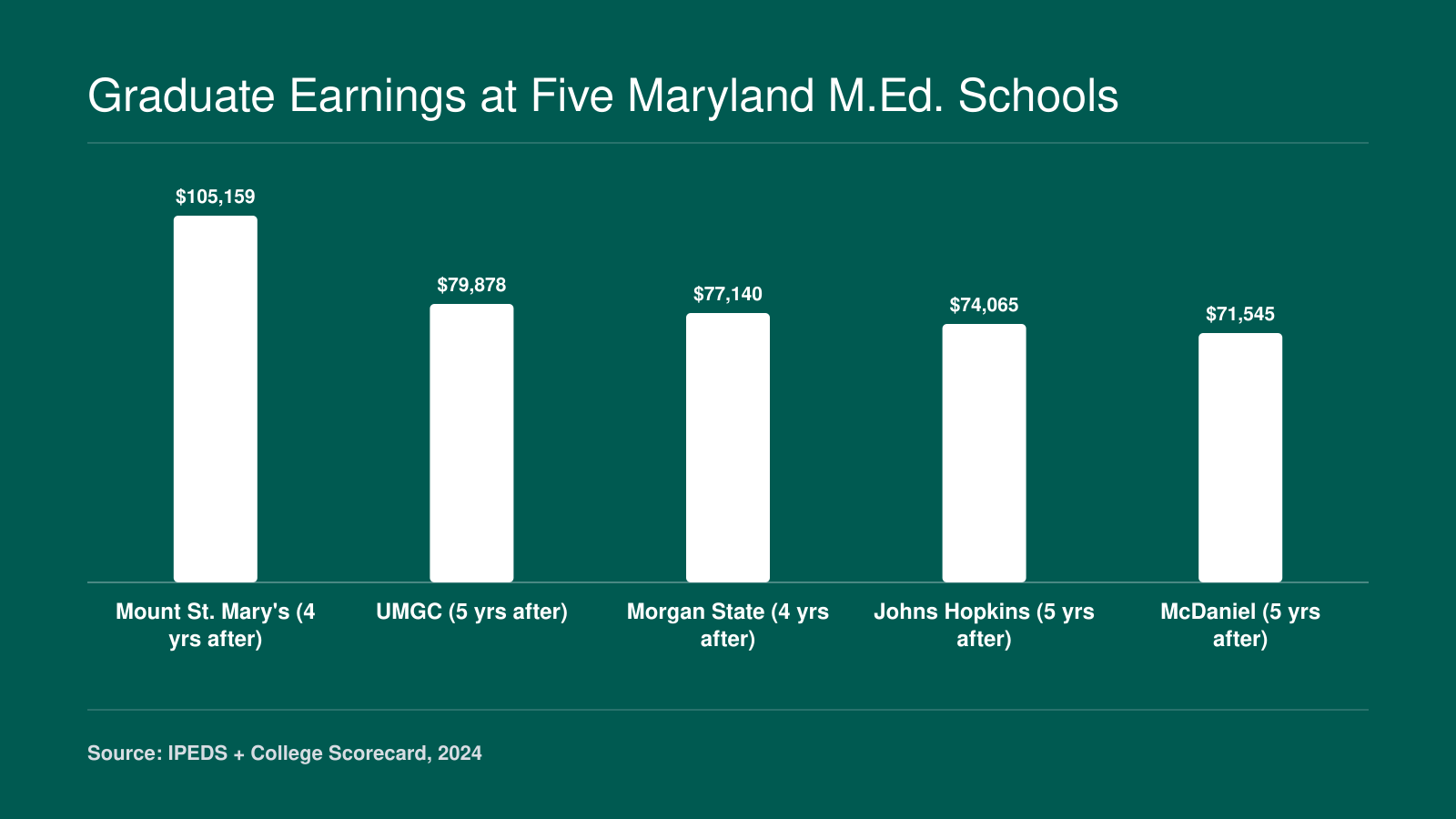
Graduate Earnings at Five Maryland M.Ed. Schools
Median earnings of master's graduates in each school's education field, measured four or five years after finishing as labeled. These are field-level figures for each school's graduates, not results for one named program. Because the windows differ, compare them with care.
What a Master's in Education Costs in Maryland and Where Certification Fits
What does a Maryland M.Ed. actually cost? At the lowest end, the Most Affordable M.Ed. Programs in Maryland are Coppin State University, University of Maryland Eastern Shore, Morgan State University, University of Maryland-College Park, and University of Maryland-Baltimore County. Their institution-wide average net prices run about $9,977, $13,338, $14,985, $15,678, and $16,467. Those are approximations across each school, not M.Ed. quotes. In-state program tuition for the listed programs ranges from about $8,010 to $18,276.
Per-credit pricing and total cost
University of Maryland-College Park charges $913 per credit for Maryland residents and $1,916 per credit for nonresidents in Fall 2026/Spring 2027, plus mandatory fees of $382.50 per semester for 1 to 8 credits or $738 for 9 or more.1 A 30 to 36 credit degree at the resident rate would be roughly $27,000 to $33,000 before fees. Rates for other public and private schools, and any program-specific fees, were not confirmed, so check each bursar page.
Certification versus advancement
Initial teaching certificates come from MSDE-approved tracks, usually a Master of Arts in Teaching (MAT) in Maryland. UMBC's 12-month MAT, for example, includes a 100-day internship and meets Maryland certification requirements. Mount St. Mary's describes an MSDE-approved Master's in Elementary Education in Maryland for bachelor's holders.3 Many M.Ed. degrees instead serve teachers who are already certified.
A master's can also help toward the Advanced Professional Certificate, which requires a master's degree or equivalent plus three years of experience.2 Holders then complete 6 credits during each validity period.2 A master's alone does not guarantee eligibility.
Maryland Educator Certification at a Glance
Choosing a Maryland M.Ed.: Matching Cost, Specialization, and Career Goals
Salisbury University's Educational Leadership M.Ed. lists $10,785 in in-state tuition and prepares students for Maryland's Administrator I certificate. Loyola University Maryland's hybrid early childhood track runs $20,070 and offers no direct Maryland teacher certification. That contrast captures the three trade-offs to settle first: whether you need licensure or an advanced-only degree, public in-state pricing or private flexibility, and online M.Ed. programs or campus delivery.
Then match a concentration to your goal:
- Teacher leader: Hood College's online curriculum and instruction program.
- Specialist: McDaniel College's online school librarianship degree or Towson University's early childhood M.Ed.
- Administrator: Leadership programs at Salisbury or Mount St. Mary's University.
Before committing, ask your district about tuition reimbursement and the salary-lane increase a master's degree earns. Then shortlist three schools ranked here and confirm GRE policy, deadlines, and MSDE approval on each program's site.
Maryland M.Ed. Questions Answered
These answers draw on admissions pages from the University of Maryland, College Park and Loyola University Maryland. Requirements change by program and by year, so confirm details with the program before you apply.
What is the cheapest M.Ed. program in Maryland?
Can I get a Maryland M.Ed. without a teaching license?
How many months or semesters does a typical Maryland M.Ed. take?
When do Maryland M.Ed. programs accept applications?
Can international students enroll in a Maryland M.Ed.?
Compare Education (M.Ed.) programs on the data that matters
Explore more MEd specializations or browse every graduate field.
All MEd programs