Master's Programs in Montana
Every master's program reported by a school in Montana: 100+ programs at 9 graduate schools, with the online options, costs and outcomes behind each one.

Nearly all of Montana's graduate degrees run through the Montana University System, which means the big decisions (resident tuition, assistantship terms, thesis versus professional tracks) tend to rhyme from one campus to the next. The flagship rules are similar enough that students often assume the choice barely matters.
It does. Departments, not graduate schools, set deadlines, funding, and whether a degree drops you straight onto a licensure path or leaves an exam and supervised hours ahead. A nurse practitioner credential, a forestry thesis, and a teaching endorsement all answer to different timelines and different payoffs.
That tension, a common system with program-specific stakes, is what makes comparing the details worth the effort.
Key Points
- Both flagship universities set a 30-credit baseline for most master's degrees.
- Assistantship deadlines often arrive before general admission deadlines, so apply early.
- Montana's average starting teacher salary was $36,682 in 2024-2025, 51st nationally.
Popular degrees in Montana
Master's programs in Montana by field
Education & Teaching
- School Counseling or Educational Counseling4 programs
- Curriculum & Instruction4 programs
- Educational Leadership3 programs
- Special Education3 programs
- Reading & Literacy3 programs
- Teaching2 programs
- Elementary Education2 programs
- Secondary Education2 programs
Business & Management
- Accounting4 programs
- Public Administration4 programs
- Management3 programs
- Healthcare Management2 programs
- Healthcare Administration2 programs
- Analytics1 program
- Finance1 program
- Organizational Leadership1 program
Social Work & Social Sciences
- Social Work5 programs
- Social Work Advanced Standing2 programs
- Sociology2 programs
- Political Science, Government1 program
Counseling
- Clinical Mental Health Counseling4 programs
- School Counseling4 programs
- Marriage and Family Therapy or Marriage and Family Counseling1 program
Healthcare
- Public Health2 programs
- Exercise Science2 programs
- Health Administration2 programs
- Speech Pathology1 program
- Nutrition1 program
Psychology
- Counseling Psychology4 programs
- Educational Psychology or School Psychology1 program
- School Psychology1 program
- General Psychology1 program
Science & Engineering
- Environmental Science3 programs
- Geography2 programs
- Sustainability or Environmental Management2 programs
Communications & Media
- Speech Pathology2 programs
- Journalism1 program
- Communication1 program
- Public Relations1 program
- Communication Disorders1 program
Arts & Design
- Fine Arts2 programs
- Creative Writing2 programs
Nursing
- RN to MSN2 programs
- Adult Gerontology Primary Care Nurse Practitioner1 program
- Clinical Nurse Leader1 program
Computers & IT
- Cybersecurity2 programs
- Information Security & Assurance1 program
What Master's Programs Cost in Montana
For a Montana resident, the cheapest realistic master's path is usually a public campus in the Montana University System at the in-state rate, with credits spread to avoid paying for more than you need. Published 2026 graduate rates are not uniform across schools, so treat any single number as a starting point.
Per-Credit vs. Flat-Rate Tuition
The University of Montana's Summer 2026 schedule for online-only graduate students shows how both models can appear in one table. In-state tuition is $328 per credit, and it stops climbing at 12 credits, where the total is $3,936. Taking 12 credits or more costs the same tuition, so a heavier load can lower your cost per credit.
Fees sit on top of that. The same schedule lists a $30 registration fee and a $10 per-credit online fee (applied to 1 through 12 credits). A single three-credit online course therefore runs $984 in tuition plus $60 in fees, or $1,044. At 12 credits, fees add about $150 to the $3,936 tuition, roughly 4 percent. That is Summer 2026 only. Fall and spring rates, and the rates at Montana State University, Montana Tech, MSU Billings and MSU Northern, are not confirmed here. Check each school's current tuition page before you budget.
The In-State vs. Out-of-State Gap
Every student in the system is classified as in-state or out-of-state, and the classification governs tuition, fees and admission to limited-enrollment programs.1 Out-of-state rates are higher at each campus, so classification can change your total more than any other choice you make. Compare the nonresident line on each school's schedule rather than assuming the gap is the same everywhere.
Montana's Residency Rule
Board of Regents Policy 940.1 requires 12 consecutive months of documented Montana domicile, meaning physical presence plus intent to stay.1 The clock does not start until you take an act showing that intent, and one act alone may not be enough. You must also sever ties to your previous residence at least 12 months before the term in which you want in-state status.
This is why full-time graduate students rarely reclassify mid-program. Anyone enrolled for more than half of a full-time load, online credits from any institution included, is presumed to be in Montana primarily for education. Overcoming that presumption takes clear and convincing evidence of a non-education reason for the move. Each case is decided on its facts, and the policy includes exceptions, so contact the registrar before you assume either outcome.
Online Rates
Online pricing can differ from on-campus pricing, as UM's per-credit online fee shows. Some online programs charge one rate regardless of residency, which can matter a great deal to an out-of-state student. Ask each program whether that applies, and confirm the academic year attached to any rate you are quoted.
Online, Hybrid, and On-Campus Master's Formats in Montana
Fully Online vs. Hybrid
A master's program's format is simply where and how you take classes. Fully online means every course can be completed remotely. Hybrid mixes online coursework with required campus time, often a summer residency or short intensive. On-campus means regular in-person attendance. An "online" label does not always mean you will never travel to Bozeman, Missoula, Butte, or Billings.
Montana State University's graduate online program list for 2025-26 designates several master's degrees as online, including M.Ed. curriculum and instruction, M.Ed. educational leadership, the M.A. in Teaching (elementary and secondary), the M.S. in Science Education, the M.S. in Family Financial Planning, and the M.S. in Land Resources and Environmental Sciences. The list confirms online delivery but doesn't say whether any require campus visits.
Montana Tech offers distance-learning versions of its M.S. in Industrial Hygiene (built for working industry professionals), M.S. in Project Engineering and Management, and Master of Engineering. Its distance page also leaves residency requirements unstated. MSU Billings advertises 100% online programs1, but its public pages don't clearly identify which master's degrees qualify. For the University of Montana, current online pages don't give a clear program-level picture of which master's degrees are fully online or hybrid, so go department by department.
Where Online Delivery Is Common, and Where It Isn't
Education stands out in MSU's online offerings, which makes sense in a rural state where working teachers and principals can't easily relocate. Healthcare administration, nursing, clinical mental health counseling, and public administration are other fields where online or hybrid delivery tends to appear. Lab-heavy sciences, research-focused engineering, and thesis tracks in forestry and ecology generally stay campus-based, because the work depends on labs, field sites, and close faculty supervision.
Out-of-State Students: Check Authorization and Placements
Montana participates in SARA, the reciprocity agreement that lets its public universities enroll distance students from other member states. SARA does not cover professional licensure, though. Out-of-state students planning to study nursing or counseling online should confirm the program meets licensure requirements in their state and that the school can arrange clinical or practicum placements near them. Some programs limit which states they accept online students from for exactly this reason.
How to Verify a Program's Format
- Program page: Look for an "online" or "distance" designation on the program's own page, not just a university-wide list.
- Handbook: Search for "residency," "intensive," or "on-campus requirement."
- Coordinator: Ask whether orientation, exams, or thesis defenses require travel.
- Licensure disclosure: Out-of-state students should request the program's licensure disclosure for their state.
Montana State vs. University of Montana vs. Montana Tech
These three campuses are best compared on fit rather than prestige: the right choice depends on your field, how you want to study, and whether you want a research thesis or a professional credential. Details below come from each graduate school's published program pages. Online availability and thesis rules vary by program, so confirm them with the department before you apply. In short, Montana State suits students heading into engineering, education, or applied research who want a choice of thesis and non-thesis tracks. The University of Montana suits students who want flexible, individually designed study or a field tied to the region's landscape, and who are comfortable studying in person. Montana Tech suits students aiming at hands-on technical careers in mining, petroleum, or engineering. Its graduate details are the ones to verify most carefully, since we could not confirm current program-level requirements for this page.
| Factor | Montana State University (Bozeman) | University of Montana (Missoula) | Montana Tech (Butte) |
|---|---|---|---|
| Setting | Bozeman campus with a strong research orientation and a mountain-town setting. | Missoula campus with a broad, interdisciplinary academic mix in western Montana. | Butte campus with a compact, technically focused identity rooted in the city's mining history. |
| Distinctive graduate strengths | Engineering, education, agricultural education, and mathematical sciences. Some engineering degrees, such as the Manufacturing Engineering M.Eng., are coursework-only and aimed at practicing engineers. | Flexible, individually designed study such as the Master of Interdisciplinary Studies, plus social science fields like political science. UM is also widely known for forestry and conservation, so check that college's current offerings. | Generally known for mining, petroleum, and engineering. Specific graduate program details were not confirmed for this page, so check the graduate school directly. |
| Online options | No university-wide policy. Agricultural Education lists both online and in-person pathways; other programs vary. | The Master of Interdisciplinary Studies is in person only. Check other programs individually. | Not confirmed here. Ask the program about online or hybrid delivery. |
| Thesis norms | Research master's programs generally require a thesis. Mechanical Engineering and Mathematical Sciences offer thesis and non-thesis tracks, though Mathematical Sciences generally advises non-thesis. Agricultural Education makes the thesis optional. | Interdisciplinary Studies offers a 30-credit thesis option or a 36-credit non-thesis option. Political Science offers a thesis or a comprehensive-study option built on three research papers. | Not confirmed here. Verify thesis and non-thesis requirements by program. |
| Best fit | Engineers, educators, and researchers who want a choice of formats. | Students who want a customized or interdisciplinary degree and can study on campus. | Students pursuing technical, industry-oriented careers who verify program details first. |
How Long Does a Master's Degree Take in Montana?
Finishing quickly and keeping your job pull in opposite directions, and Montana's credit minimums and time limits shape how far you can stretch a degree.
Credits and Calendar
The baseline at both flagship universities is 30 credits. Montana State University's 2026-2027 catalog sets 30 as the master's minimum but says individual programs may require more. At that pace, full-time students typically finish in about 1.5 to 2 years. Part-time students taking one or two courses a term should plan on 3 years or more. The University of Montana says at least 2 years of graduate study is normally necessary.
Your Ceiling as a Part-Time Student
University of Montana sets a standard 5-year limit to complete all requirements, including transfer and non-degree credits. The College of Education gets 6 years. The Montana State catalogs I reviewed don't set one university-wide cap, so limits can be program-specific. The Ecology M.S., for example, expects the thesis defense and graduation within 6 years of first enrollment. Ask your program for its clock before you enroll.
Thesis or Non-Thesis
The thesis route usually carries 9 to 10 thesis credits at Montana State, plus a defense and often a comprehensive exam. Research is open-ended, so this is where timelines slip. Experiments, fieldwork, and committee revisions can add a semester or more.
Non-thesis tracks tend to finish more predictably, but they can require more total credits. University of Montana sets 30 credits for thesis or professional-paper plans and 36 for non-thesis. Montana State requires at least 30 coursework credits for non-thesis, and thesis credits can't count toward that minimum. Capstones, professional papers, and comprehensive exams or portfolios replace the thesis. Not every program offers all of these choices.
Practicum-Heavy Programs
Programs built around supervised fieldwork, such as counseling psychology, MSW programs, and education leadership, often add practicum or internship requirements on top of coursework. Those placements are scheduled around site availability, which can lengthen the timeline beyond the 30-credit baseline. Check the program's published credit total and placement sequence, not just the headline minimum.
Admission Requirements and Application Deadlines
Montana's two flagship graduate schools set a few baseline rules, but departments control most of what matters, including fall deadlines and funding. Treat any single date below as program-specific and confirm it with the department.
- Bachelor's degree and GPABoth Montana State University and the University of Montana expect a bachelor's degree from a regionally accredited institution and a 3.0 GPA. Applicants below 3.0 may be admitted provisionally, but only at the program's or Graduate School's recommendation. At UM, applicants cannot apply directly for provisional status.
- Test requirementsMSU stopped requiring or considering the GRE in 2021 and has no university-wide GMAT rule. UM has no universal policy, so GRE or GMAT requirements vary by program and some have been dropped. Check science, engineering, and business programs individually.
- Recommendations and statementsPlan on up to three letters of recommendation if the department requires them. UM requires that recommenders submit their letters directly. Most programs also ask for a resume or CV, or a letter of intent or statement of purpose.
- Thesis advisorFor thesis tracks, contact potential faculty advisors before you apply. Some departments, such as UM Wildlife Biology, expect a professor to be willing to take you on, and that can shape both admission and funding.
- Deadline patternNeither school sets one university-wide fall deadline. Assistantship priority dates cluster from January to mid-February: Physics at MSU is January 5, Mechanical and Industrial Engineering at MSU is February 1, Wildlife Biology at UM is January 15, Communication Studies at UM is February 1, and Teaching and Learning at UM is February 15. Programs without funding, and many online programs, usually run later or rolling deadlines. MSU's domestic floor is receipt by the first day of classes, but departmental dates govern admission and funding.
- International applicantsMSU's university minimums are TOEFL iBT 80, IELTS 6.5, or Duolingo 120, and departments may set higher bars, especially for assistantships. UM's minimums differ by test date: for exams taken before January 21, 2026, TOEFL iBT 80, IELTS 6.5, MET 58, or Duolingo 125. After that date, UM uses TOEFL iBT 4.5 or TOEFL Essentials 9. UM asks for applications at least 120 days before the term. MSU guidance on timing is inconsistent, with roughly 100 days cited on one page and about 75 days for the I-20 on another, so apply as early as possible.
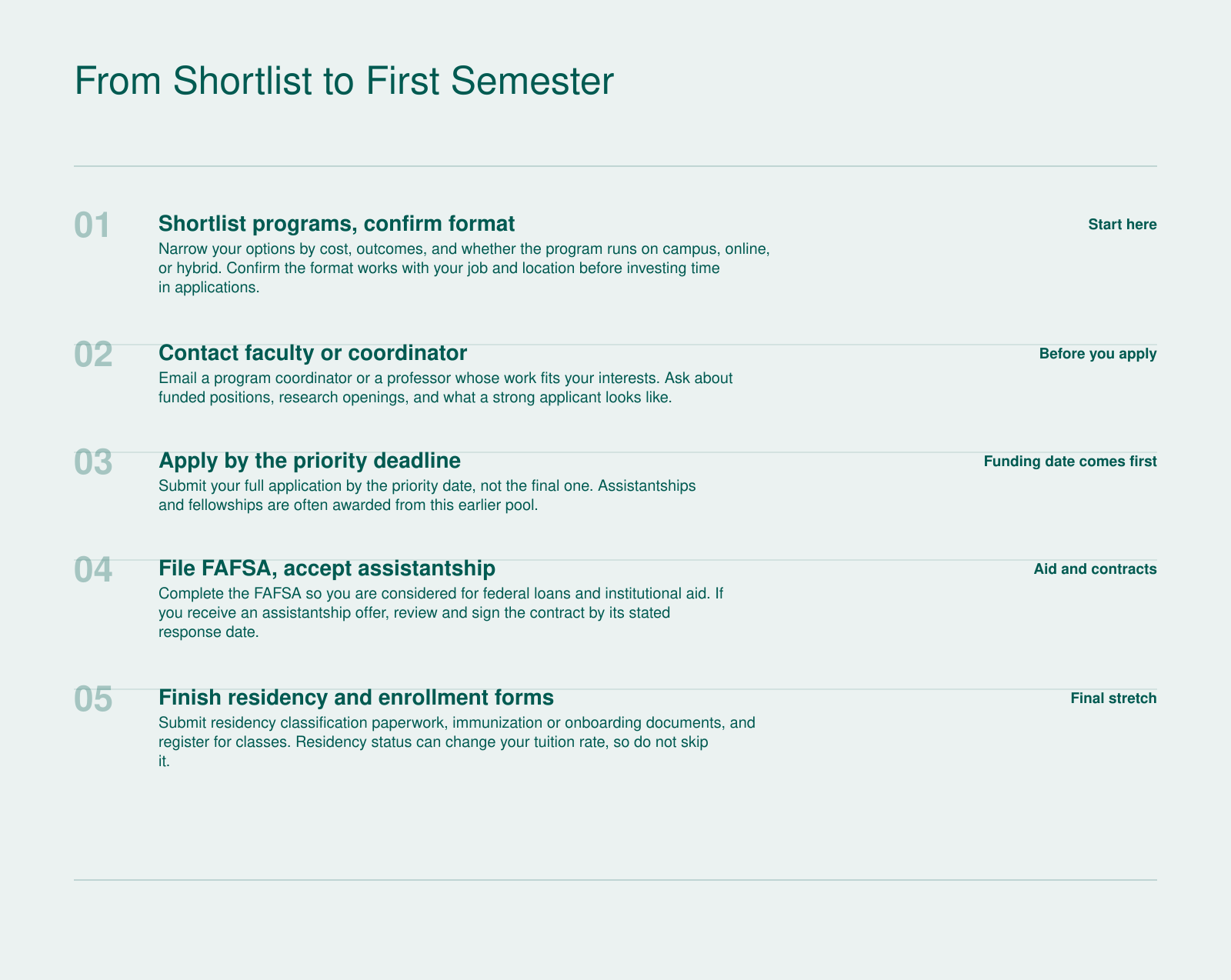
From Shortlist to First Semester
Getting into a Montana master's program works best as a sequence, because the funding deadline usually arrives well before the general admission deadline. Follow these steps in order and you protect your shot at an assistantship or tuition waiver.
Funding Your Degree: Assistantships, Fellowships, and Aid
A graduate assistantship is a part-time campus job, usually teaching or research, that pays a stipend and cuts or waives tuition. In Montana it is the main way thesis-track master's students lower the price of a degree, and the terms differ sharply between the two flagship campuses.
University of Montana Assistantships
UM sets a campus-wide minimum for master's assistantships in 2026-2027: $5,700 per semester for a 0.475 FTE appointment, roughly 19 hours a week. A further $1,000 per semester is added regardless of funding source, so the floor is $6,700 per semester, or $13,400 over two semesters. Summer is not included. Full tuition is waived for the contracted semester, but other fees are not, and health insurance is not waived.
University of Montana TA and RA positions are awarded by individual departments, not by a central office. Most go to thesis-track students, so ask the program directly. Recipients must be degree-seeking, enrolled in at least 6 credits, and hold a 3.0 graduate GPA, though new students without one can qualify under program standards.
Montana State Varies by Department
MSU has no campus-wide stipend, so check the department. Education assistantships list $1,100 a month for 10 months (about $11,000) with tuition waivers up to 10 credits, while the Department of Education describes waivers of up to 12 credits. Economics typically pays $1,500 to $1,800 a month and waives 7 tuition credits. Mandatory fees and health insurance are often not covered. The MSU-sponsored plan costs $2,623 for Fall 2026, and insurance is required at 6 or more credits.
Fellowships, Waivers, and Loans
- UM SIGP: Competitive supplemental awards of up to $20,000 for master's students.
- Native American Graduate Fellowships: Up to $30,000 depending on other funding, renewable for up to 3 years with satisfactory progress.
- MSU McNair and AmeriCorps waivers: Up to 12 credits per term for the first two semesters, with eligibility rules and fees still owed.
Federal Direct Unsubsidized loans are the fallback. Graduate borrowing rules have been changing, including limits on Grad PLUS, so confirm current caps with the financial aid office before relying on them.
Online and Professional Programs
Online and professional master's programs rarely offer assistantships, since there is often no lab or classroom to staff. Budget for full tuition, fees, and insurance, and treat any funding as a bonus.
Which Montana Master's Programs Lead to Licensure or Certification
A master's degree can sit directly on the path to a Montana license, or it can be a general credential that still leaves supervised practice and an exam ahead of you. In Montana, the difference usually comes down to the specific program track and its programmatic accreditation, not the university name alone.
Licensure-track fields to watch
Several fields routinely lead to state licensure or certification. A Master of Education in educational leadership or school counseling is the typical route for administrator or K-12 school counselor endorsement. Clinical mental health counseling master's programs prepare students for the Licensed Clinical Professional Counselor, or LCPC, credential. MSN programs, including APRN preparation, require nursing accreditation and often lead to advanced practice licensure. An MSW is the standard path toward clinical social work licensure. In engineering, a master's degree does not by itself create a Professional Engineer license, but an ABET-accredited graduate program can support the education and experience steps Montana requires for the PE.
Accreditation is the first checkpoint
For these fields, the accreditor matters more than general university reputation. Look for CAEP in education, CCNE or ACEN in nursing, CACREP in counseling, CSWE in social work, and ABET in engineering where relevant. The clearest Montana example is Montana State University, whose three counseling master's programs are listed as CACREP-accredited as of 2026.6 For other fields and campuses, accreditation status can vary by track and cohort, so verify the current listing with the accreditor before assuming a program qualifies for licensure.
The degree is not the finish line
Montana's LCPC requirements show why students should read past the diploma. The state uses a 3,000-hour supervised experience standard.1 At least 1,500 of those hours must come after the degree, though up to 1,500 pre-degree hours may be allowed if the graduate program approves them.2 Within that total, at least 1,000 post-degree hours must be direct client contact, and no more than 250 may be group or co-facilitative therapy.1 Supervision must come from an LCSW, LCPC, LMFT, licensed psychologist, or licensed and board-certified psychiatrist.3 The 2026 materials also describe a 20:1 client-contact-to-supervision ratio and at least 40 face-to-face supervision hours, with at least 38 individual.4 A candidate license is required before post-degree hours accrue5, and supervised work experience generally must fall within five years before applying for licensure.4
Check before you enroll
Out-of-state online students should review the program's professional licensure disclosure page before enrolling. A nationally delivered curriculum may meet academic content standards but not Montana's specific supervision, fieldwork, or endorsement rules, and every state sets its own requirements.
In the NEA 2024-2025 Teacher Salary Benchmark Report, Montana's average starting teacher salary was $36,682, ranking 51st nationally, below the $48,112 national average. That gap is a big reason many Montana teachers pursue a master's degree, which moves them up the district salary schedule.
What Master's-Level Jobs Pay in Montana
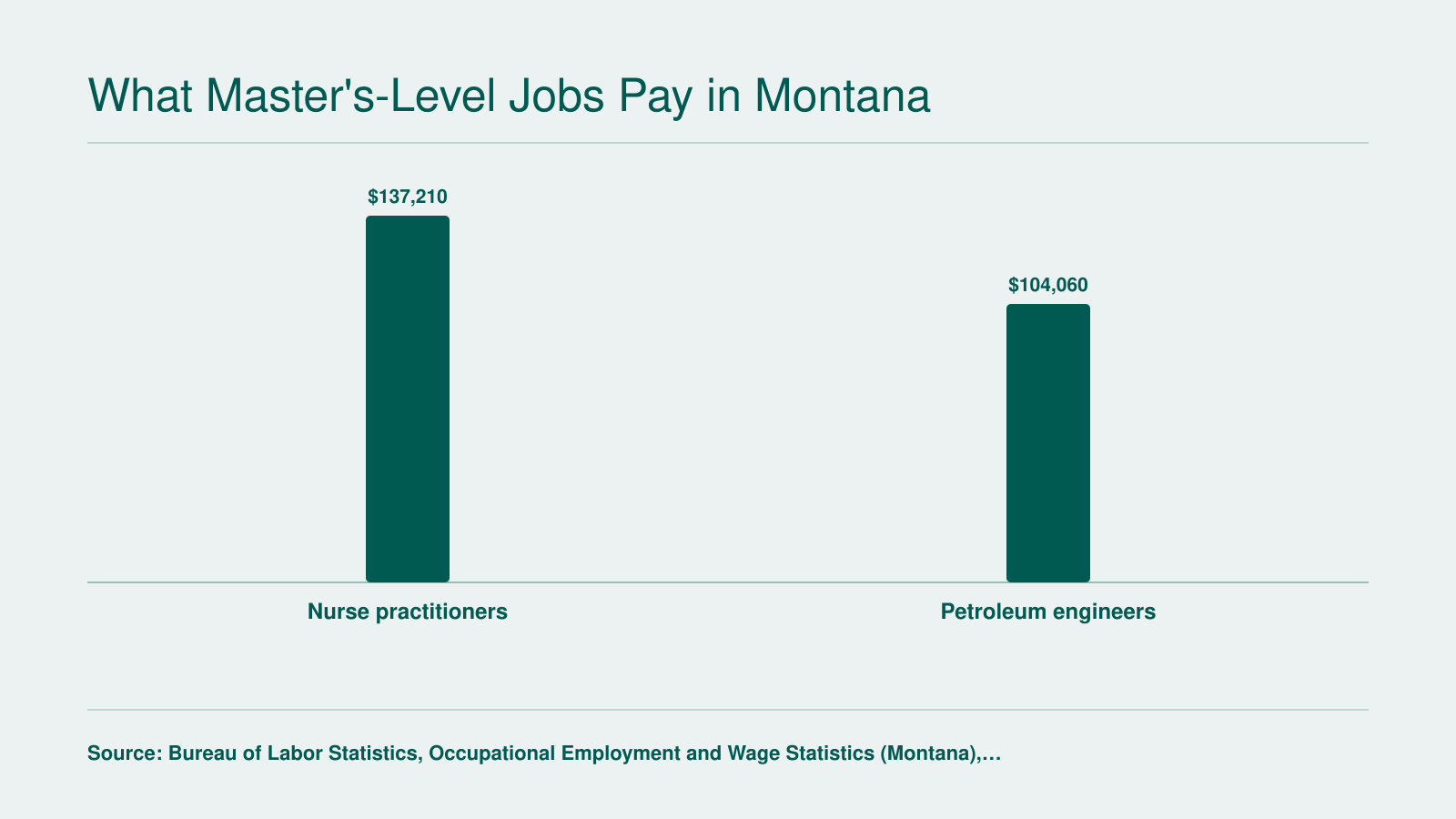
Only two master's-linked occupations have a Montana median we can confirm from the latest BLS release: nurse practitioners and petroleum engineers. Medians for school counselors, mental health counselors, healthcare social workers, and education administrators sit in the BLS state data file, so check those rows before you commit to a program. Petroleum engineering often starts at the bachelor's level, so the master's premium there is less certain than in advanced nursing practice.
The Master's Earnings Premium in Montana
A single Montana figure comparing graduate and bachelor's earnings isn't published in one place, so here is how to build your own.
Graduate schools in Montana with the most master's programs
| School | City | Type | Master's programs | Online | Grad tuition / yr |
|---|---|---|---|---|---|
| Montana State University | Bozeman | Public | 34 | 13 | $7,661 |
| The University of Montana | Missoula | Public | 34 | 9 | $10,039 |
| Montana State University Billings | Billings | Public | 12 | 9 | $8,899 |
| University of Providence | Great Falls | Private nonprofit | 10 | 10 | $24,528 |
| Montana State University-Northern | Havre | Public | 5 | 4 | $8,324 |
| Carroll College | Helena | Private nonprofit | 4 | 4 | $17,912 |
| Salish Kootenai College | Pablo | Public | 3 | 1 | $5,376 |
| Montana Technological University | Butte | Public | 2 | 2 | $6,802 |
| Rocky Mountain College | Billings | Private nonprofit | 2 | 1 | $38,974 |
Program counts are the verified master's listings in our directory; tuition is the school-wide average for a full-time graduate student (IPEDS).
Common Questions About Montana Master's Programs
What are the cheapest master's programs in Montana?
Can I complete a Montana master's degree fully online?
Can I establish Montana residency for in-state tuition after I start grad school?
Will an online Montana program qualify me for licensure in another state?
Compare programs nationwide
Many Montana residents study online. Every ranked list above has an online lens, or browse every field.
Online master's programs Browse all fields