Master's Programs in Tennessee
Every master's program reported by a school in Tennessee: 990+ programs at 40+ graduate schools, with the online options, costs and outcomes behind each one.

Tennessee's public universities keep in-state graduate tuition comparatively low, but the sticker price is rarely the final bill. Per-credit rates, fees, and online e-rates vary across the University of Tennessee System, the Locally Governed Institutions, and private schools such as Vanderbilt and Belmont.
Master's programs are already listed by degree and field on this page, so the sections here take up cost, formats, admissions, funding, licensure, and earnings, in that order.
For counseling, nursing, and education, state licensure often depends more on a program's approval status than on the school's name.
Key Points
- Tennessee's LPC-MHSP requires 60 graduate hours and 3,000 supervised clinical hours.
- TN eCampus and UT Online let students earn degrees without relocating.
- Assistantships can bring tuition waivers plus stipends, and early deadlines matter most for funding.
Popular degrees in Tennessee
Master's programs in Tennessee by field
Business & Management
- Accounting36 programs
- Healthcare Administration33 programs
- Management31 programs
- Analytics25 programs
- General Business24 programs
- Healthcare Management21 programs
- Public Administration20 programs
- Organizational Leadership17 programs
Education & Teaching
- Teaching46 programs
- Special Education24 programs
- Educational Leadership19 programs
- Elementary Education17 programs
- Secondary Education16 programs
- Reading & Literacy15 programs
- Curriculum & Instruction13 programs
- Music Education9 programs
Nursing
- Family Nurse Practitioner (FNP)21 programs
- Psychiatric Mental Health Nurse Practitioner20 programs
- Nursing Education or Nurse Educator12 programs
- Adult Gerontology Acute Care Nurse Practitioner9 programs
- RN to MSN9 programs
- Nurse Administrator8 programs
- Family Nurse Practitioner6 programs
- Pediatric Nurse Practitioner4 programs
Healthcare
- Health Administration13 programs
- Nutrition11 programs
- Public Health11 programs
- Speech Pathology9 programs
- Exercise Science8 programs
- Health Informatics5 programs
- Health Education3 programs
Counseling
- Clinical Mental Health Counseling29 programs
- School Counseling18 programs
- Marriage and Family Therapy or Marriage and Family Counseling4 programs
- Addiction Counseling3 programs
Psychology
- Counseling Psychology18 programs
- Applied Behavior Analysis7 programs
- General Psychology6 programs
- Educational Psychology or School Psychology6 programs
- Industrial Organizational Psychology3 programs
- School Psychology3 programs
- Clinical Psychology3 programs
- Forensic Psychology2 programs
Communications & Media
- Communication12 programs
- Speech Pathology11 programs
- Communication Disorders7 programs
- Media Communication6 programs
- Strategic Communication5 programs
- Journalism4 programs
- Technical Communication1 program
- Health Communication1 program
Social Work & Social Sciences
- Social Work17 programs
- Sociology11 programs
- Social Work Advanced Standing10 programs
- Political Science, Government3 programs
- Human Services1 program
Religion & Theology
- Theology15 programs
- Divinity10 programs
- Christian Ministry10 programs
- Christian Leadership4 programs
- Youth and Family Ministry2 programs
- Urban Ministry1 program
Computers & IT
- Cybersecurity9 programs
- Data Analytics8 programs
- Information Security & Assurance5 programs
- Machine Learning4 programs
Arts & Design
- Creative Writing20 programs
- Fine Arts4 programs
Science & Engineering
- Sustainability or Environmental Management6 programs
- Environmental Science5 programs
- Geography2 programs
Criminal Justice & Law
- Public Policy4 programs
- Legal Studies2 programs
- Business Law2 programs
- Master of Laws2 programs
- Homeland Security1 program
What a Master's Degree Costs at Tennessee Public and Private Universities
The per-credit rates below come from each school's published graduate tuition page, and Tennessee Tech, Vanderbilt, and Belmont figures are for 2026-27. Austin Peay and Memphis figures are the most recent published rates and may not match 2026-27 exactly. Multiplying in-state rates across a 30 to 36 credit degree puts tuition alone at roughly $16,000 to $27,000 at the public schools shown, versus about $25,000 to $90,000 at private schools depending on the program. Austin Peay is the cheapest option here, followed by the Memphis business college and Tennessee Tech. Mandatory fees are not included, and program-specific tuition for MBA, nursing, and similar degrees can add thousands, so treat the 30-credit column as a simple rate-times-credits estimate. Current rates for UT Knoxville, UT Chattanooga, UT Martin, ETSU, MTSU, Tennessee State, and Lipscomb were not confirmed for this table, so check each school's bursar page before budgeting.
| University | Type | In-State Per Credit | Out-of-State Per Credit | Online/E-Rate | Est. 30-Credit Tuition |
|---|---|---|---|---|---|
| Austin Peay State University | Public | $533 | $821 | N/A | About $15,990 |
| University of Memphis (general graduate) | Public | N/A | $880 | N/A | N/A |
| University of Memphis (Fogelman College of Business) | Public | $697 | $943 | N/A | About $20,910 |
| Tennessee Tech University | Public | $742 | $882 | $817 | $22,260 |
| Vanderbilt University (Engineering) | Private | $2,486 | Same rate | N/A | About $74,580 |
| Vanderbilt Peabody College | Private | $2,492 | Same rate | N/A | About $74,760 |
| Vanderbilt School of Nursing | Private | $2,119 | Same rate | N/A | About $63,570 |
| Vanderbilt College of Arts and Science | Private | $1,243 | Same rate | N/A | About $37,290 |
| Vanderbilt Divinity School | Private | $1,236 | Same rate | N/A | About $37,080 |
| Belmont University (MBA and MAcc) | Private | $1,645 | Same rate | N/A | About $49,350 |
| Belmont University (MS Applied Analytics) | Private | $865 | Same rate | N/A | About $25,950 |
| Belmont University (MAT) | Private | $850 | Same rate | N/A | About $25,500 |
Online, Hybrid, and On-Campus Options for Tennessee Graduate Degrees
Tennessee students can finish a master's degree without relocating. TN eCampus offers online programs through the state's Locally Governed Institutions, and UT Online delivers programs from the University of Tennessee system. The label "online" covers very different commitments, though, so check each program's requirements before you apply.
Fully Online Programs
A few programs are built to run without campus visits:
- UT Knoxville MS in Computer Science: The Data Mining concentration is fully online with no in-person attendance.
- ETSU online MSN: Coursework is asynchronous with no campus visits. Students still complete three practicum courses with a preceptor near home.1
- Belmont MAT: Coursework is fully online and asynchronous. Student teaching, residency, internship, or job-embedded work happens in schools, not on campus.2
- MTSU Online: Many degrees can be completed remotely, but the university lists Florida and California as states where it cannot enroll students.3
Hybrid and Intensive Formats
Hybrid programs mix remote coursework with required time on campus. MTSU's MS in Data Science and MS in Information Systems are both hybrid. ETSU separates "online" from "mostly online,"4 and some of its mostly online degrees require an on-campus intensive each semester.5 Belmont's MS in Applied Analytics is asynchronous online but ends with an in-person capstone presentation.
The UT Knoxville Online MBA requires a three-day orientation. Confirm with the program whether it is held on campus before you treat that degree as visit-free. The same caution applies to M.Ed. programs, which can include residencies or field experiences.
On-Campus Programs
Some of the strongest brand names are fully in person. Vanderbilt's MS in Data Science is a 30-credit, nine-month program taught in Nashville. It suits full-time students who can leave their jobs, not working professionals.
Questions for Working Professionals
Ask three things before you commit:
- Live or on your own time: Belmont's MAT and ETSU's MSN are asynchronous. For most other programs, confirm whether sessions meet at set times.
- Course load: Ask whether you can enroll part-time and how that affects time to finish.
- Start dates: Ask how many terms per year admit new students, and whether a missed deadline means a long wait.
State Authorization
Students outside Tennessee should confirm that a program is authorized to enroll residents of their state. This matters most for licensure-track degrees in teaching, counseling, or nursing. Required clinical placements may also need to be arranged near you. Ask the program for written confirmation before you pay a deposit.
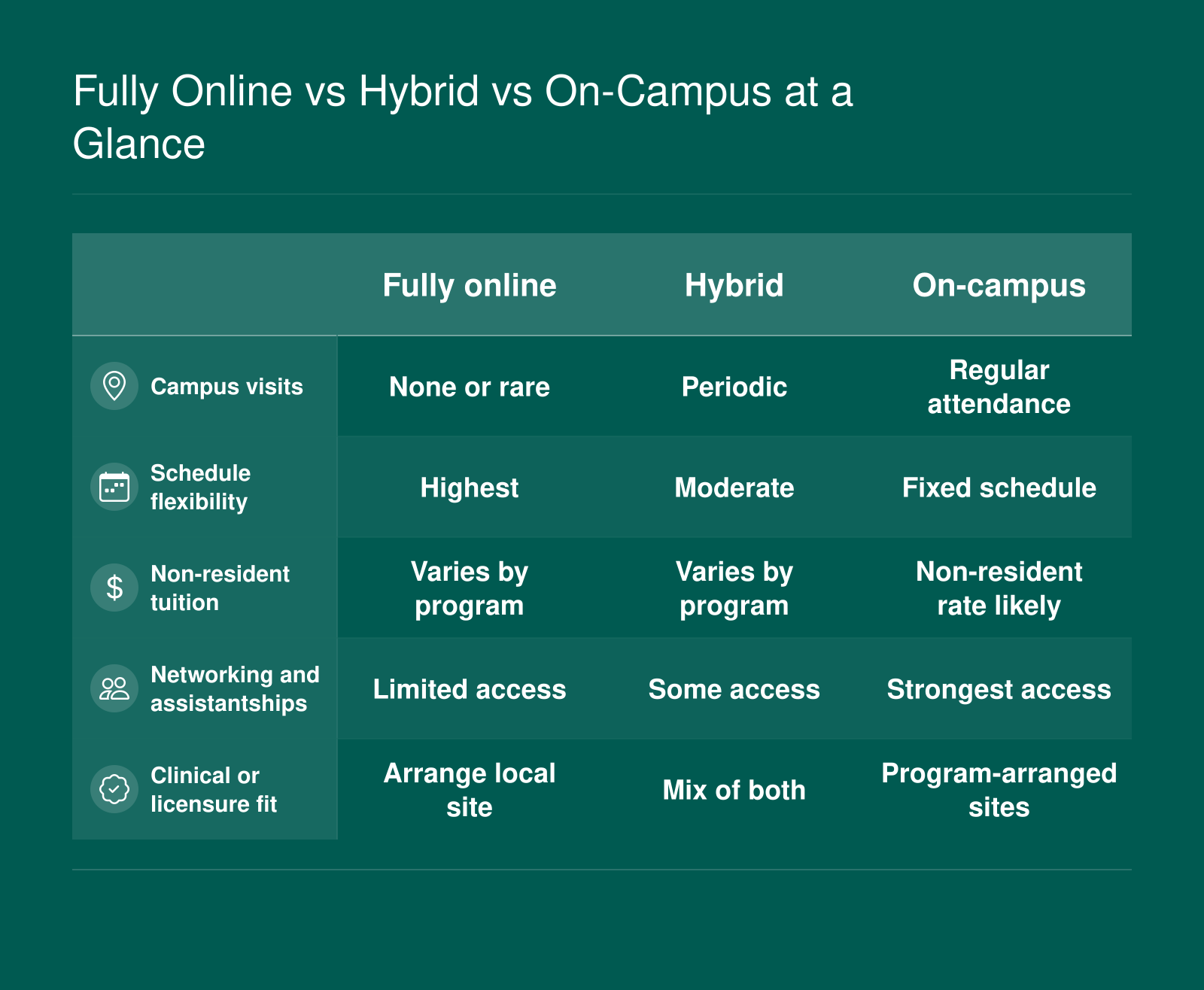
Fully Online vs Hybrid vs On-Campus at a Glance
Fully online suits working professionals who need to study around a job. Hybrid fits students who want some in-person contact without relocating full time. On-campus works best for students who want assistantships, close faculty access, and program-arranged placements. Confirm tuition and placement details with each program, since policies differ by school.
Admission Requirements and GRE/GMAT Policies at Tennessee Graduate Schools
Tennessee graduate admission is set program by program, so the university-wide minimum is only a starting point. Read the department page before you decide whether you qualify.
GPA Minimums
Every program expects a bachelor's degree from a school with regional accreditation. Middle Tennessee State University sets a general floor of 2.75 on a 4.00 scale. Applicants with prior graduate work elsewhere need at least a 3.00 cumulative graduate GPA plus the 2.75 undergraduate average, and individual programs may ask for more.1
UT Knoxville shows how much the numbers vary:
- Biomedical Engineering: 3.00, with some exceptions.2
- Chemical and Biomolecular Engineering: 3.00.4
- Anthropology: 3.30 overall.3
- Educational Leadership and Policy Studies: 2.75 undergraduate for some tracks, or 3.30 on prior graduate work.5
- Electrical Engineering and Computer Science: generally 2.70 overall or 3.00 in the senior year for U.S. degree holders.6
Do You Need the GRE or GMAT?
Often not; several fit the broader pattern of master's programs with no GRE required. UT Knoxville's Biomedical Engineering, Chemical and Biomolecular Engineering, and Educational Leadership programs list the GRE as optional,245 and Anthropology and Electrical Engineering and Computer Science do not require it.36 Electrical Engineering and Computer Science does call a quantitative score above 158 competitive,6 so a strong score can still help.
Other programs keep tests in play. MTSU lets programs require the GRE, GMAT, or MAT and points applicants to a test-waiver process.1 At the University of Memphis, Fogelman College Specialized Program Admissions lists a GRE of 300, a GMAT of 450, or a GMAT Focus of 455, though the page does not make clear which programs those apply to. The same page shows that the MSIS waives testing for a bachelor's degree with a 3.25 GPA, a postgraduate degree with a 3.0, or five years of IT work with a bachelor's at 2.75 or higher. I could not confirm current MBA waiver rules at UT Knoxville or UT Chattanooga, so ask the MBA office directly.
Prerequisites, Materials, and Provisional Options
Career changers should expect prerequisite work. UT Knoxville Anthropology may require a minor or the equivalent of five upper-division anthropology courses,3 and Chemical and Biomolecular Engineering may require preparatory coursework for applicants without a chemical engineering degree.4 Most programs also ask for recommendation letters, a statement of purpose, and often a resume. Licensure-track programs in counseling, education, or nursing may add background checks or interviews, so confirm with the department.
I found no general conditional admission policy for 2026. UT Knoxville Anthropology admits below its threshold only in rare cases, after a full-faculty vote and documented extenuating circumstances.3 If your GPA is short, contact the program before you apply.
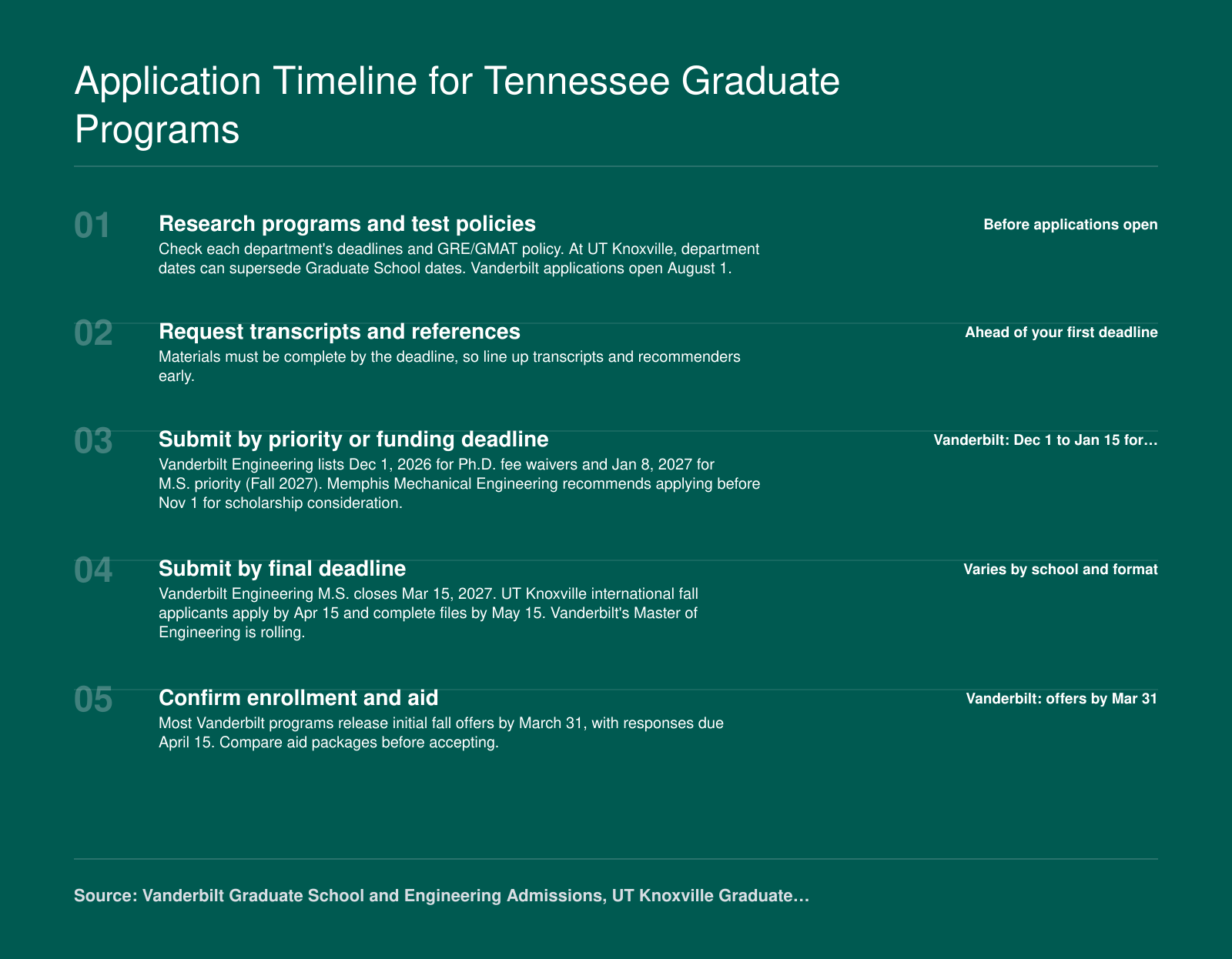
Application Timeline for Tennessee Graduate Programs
Graduate deadlines in Tennessee are set mostly by department, so confirm both the program deadline and the start date. Early deadlines matter most for funding.
Funding Your Master's Degree in Tennessee: Assistantships, Scholarships, and Employer Aid
Graduate Assistantships Come First
The most valuable funding a Tennessee master's student can land is a graduate assistantship: part-time teaching, research, or administrative work in exchange for a tuition waiver plus a stipend. Under University of Tennessee System policy, assistants receive a fee waiver for fall and spring, with summer covered only if they hold a summer appointment.1 At UTK, first-year M.A. and M.F.A. teaching assistants in fully funded mfa programs receive a stipend and a waiver covering fall, spring, and summer.1
Stipends are modest and vary by school. MTSU cites a 12-month figure of $9,144 (about $762 a month, or $3,048 a semester) for some College-funded assistantships, but it sets stipends by market and available funds, and doctoral students earn more than master's students.2 MTSU's package covers graduate tuition, maintenance, debt service, and technology access; other fees stay with you.2 Out-of-state assistants are billed at in-state rates during the semesters they hold the appointment, and they must carry at least 6 graduate hours with a 3.0 GPA.3 ETSU's 2025-26 minimum stipends were $3,500 for a full assistantship and $1,750 for a half, though 2026-27 rates may differ.4 ETSU's waiver covers in-state tuition for program-of-study credits only, not course or program-service fees, and it excludes winter session.4
What State and Federal Aid Actually Covers
The HOPE Scholarship can carry over to graduate study only under specific conditions, while Tennessee Promise is an undergraduate award and does not pay for graduate study. For a master's degree, your options are federal Direct Unsubsidized loans, departmental scholarships, and field-specific aid such as federal TEACH Grants for eligible accredited M.Ed. programs and nurse faculty or teacher incentive programs. Federal law enacted in 2025 phases out Grad PLUS loans for new borrowers starting with the 2026-27 year, so confirm with each school's financial aid office what federal borrowing is still available to you before you count on it.
Employer Tuition Benefits
Full-time state employees with at least six months of service can take courses at Tennessee's state-supported colleges and universities under a tuition waiver, capped at four courses per year (some state summaries describe it as one course per semester).5 The waiver generally covers tuition and maintenance fees but not books, application, parking, lab, online, or special course fees.5 The separate 25% dependent discount for children of state employees and public school teachers applies to undergraduate study only.6 Many large private employers in Nashville, Knoxville, and Chattanooga also offer tuition reimbursement, so check your HR benefits before enrolling.
One Practical Tip
Email each department's graduate coordinator directly about assistantships. Many positions are filled within the department and never appear on a central university listing.
Master's Degrees That Lead to Tennessee Licensure
Licensure in Tennessee increasingly turns on one question: does the specific master's program, not just the university, meet state board and accreditor standards? A regionally accredited degree through SACSCOC is the baseline, but it is not the same as approval to sit for a license.
Education and Nursing
For educators, the operative approval is the Tennessee State Board of Education. A master's-level educator preparation program must be state-approved; CAEP is a separate national accreditation and not universally required in Tennessee. Completing an approved program can lead to an initial teacher or administrator license.1 For nursing, a master's or higher, typically earned through MSN programs, is the prerequisite for APRN roles: Nurse Practitioner, Nurse Anesthetist, Nurse Midwife, or Clinical Nurse Specialist.2 Tennessee requires a national specialty certification, and APRN preparation typically includes 3 quarter hours of pharmacology.3 CCNE or ACEN accreditation is common, but the governing requirement is Board of Nursing approval plus certification before licensure.2
Counseling and Social Work
Professional counselor licensure in Tennessee is credit- and hour-heavy. The LPC path requires a counseling master's or doctoral degree with at least 60 graduate semester hours.4 The LPC-MHSP designation adds 9 graduate semester hours covering diagnosis, assessment, treatment planning, psychopathology, and DSM, plus 500 clock hours and 3,000 direct clinical hours over 2-4 years.4 Tennessee recognizes SACS, CACREP, or a comparable accrediting body; UT Martin's M.S.Ed. in Clinical Mental Health Counseling is CACREP-accredited and meets Tennessee requirements.5 Social work is more explicit: the LMSW requires an MSW from a CSWE-accredited MSW program. The LCSW builds on that with 3,000 supervised clinical hours over at least 2 years, including 100 face-to-face supervisor contact hours, and the ASWB Clinical exam.6
Baseline Rule and Out-of-State Caution
Public administration master's programs, including the MPA, are not licensure tracks in Tennessee; NASPAA accreditation is a professional quality signal, not a license requirement. For everything else, regional accreditation through SACSCOC is the baseline, but licensure always depends on program-level accreditation and state approval. Do not assume an institution's accreditation transfers to a license. If you are an out-of-state online student, check your home state's licensure disclosure before enrolling; a Tennessee-approved program may not meet another state's requirements.
Tennessee Counselor Licensure Path
Career Outcomes and Earnings for Tennessee Master's Graduates
What the Earnings Data Shows
College Scorecard publishes earnings by institution, field of study, and credential level, but not every program has a figure. Small graduate cohorts are often suppressed2, and the earnings point (one year out versus later) and cohort year vary by listing. For that reason, we can't give a verified master's-completer comparison for nursing, MBA programs, or computer science at every Tennessee university. Check the Scorecard page for the specific program you're considering.
One University of Tennessee, Knoxville field-of-study listing shows median earnings of $67,631, against a four-year-college midpoint of $60,377. The listing does not clearly identify the credential level, so read it as an illustration of how the data is presented rather than a master's benchmark.
Occupational wage data is firmer. Nurse practitioners in Tennessee earned a median of $117,590 a year ($56.54 an hour) in May 2025, according to BLS.1 That is about 11.1% below the national median of $132,300, while Memphis came in higher at $124,600.
Lower Pay, Still Worth It
Education and social work master's degrees rarely top the earnings charts. Nationally, educational, guidance, and career counselors and advisors had a median of $71,430 in May 2025.1 These degrees are often worth it for a different reason: the license or salary schedule is the point. Many school districts publish pay schedules that reward a master's degree, and clinical social work and counseling roles require a state license that the degree makes possible. Ask each district or employer what the master's supplement is worth before you enroll.
Tennessee Demand
Health care anchors hiring in Nashville, Memphis, Knoxville, and Chattanooga, and nurse practitioner roles are the clearest master's-level example in the state wage data. Business, technology, and public-sector jobs add to demand in these metros, though specific openings vary by year.
Whatever the field, set the earnings against what you'd pay. Compare a program's likely first-job pay with its total cost in the table above before committing.
Nurse Practitioner Pay in Tennessee
Nurse practitioners in Tennessee earn a median of
Thesis, Non-Thesis, Capstone, and Internship Pathways
The culminating requirement you choose shapes how long the degree takes and what doors it opens afterward, and those two things often pull in opposite directions. A thesis adds time; skipping it can quietly close off a research career.
Thesis vs non-thesis
Thesis tracks make sense if you are aiming at doctoral study or a research-heavy role in a lab, agency, or analytics group. You design a question, collect or analyze data, defend the work before a committee, and in most cases add a semester to your timeline because the defense schedule rarely lines up neatly with coursework. Non-thesis tracks swap that effort for additional seminars, a comprehensive exam, or both. Students who already know they want to practice rather than publish usually finish sooner and with fewer scheduling surprises.
Capstones in professional programs
Professional and online degrees in Tennessee typically end with a capstone instead. MBA students may run a consulting project for a real company, students in MPA programs often tackle a policy or budget problem for a local government, and M.Ed. candidates in curriculum and instruction build an applied project tied to their own classroom or school. The work is graded on application, not original scholarship, which is exactly the point.
Field hours and placements
Licensure-track degrees run on a different clock. Counseling, social work, nursing, and teaching programs all require supervised hours: practicum and internship in counseling, field placements in social work, clinical rotations in nurse practitioner programs, and student teaching for educators. If you are enrolling online from Jackson, Johnson City, or out of state, ask the program directly who secures the site, whether students find their own preceptor, and how many Tennessee partnerships already exist near you. A program that leaves placement entirely to the student can stall your graduation by a full year.
Choose by destination, not speed. PhD ambitions point to a thesis, licensure points to the supervised-hours track, and a promotion at your current employer points to a capstone.
Graduate schools in Tennessee with the most master's programs
| School | City | Type | Master's programs | Online | Grad tuition / yr |
|---|---|---|---|---|---|
| University of Memphis | Memphis | Public | 83 | 32 | $11,628 |
| Vanderbilt University | Nashville | Private nonprofit | 80 | 23 | $57,868 |
| East Tennessee State University | Johnson City | Public | 72 | 36 | $11,366 |
| The University of Tennessee-Knoxville | Knoxville | Public | 70 | 28 | $15,972 |
| Middle Tennessee State University | Murfreesboro | Public | 50 | 25 | $11,718 |
| Tennessee Tech | Cookeville | Public | 46 | 33 | $12,386 |
| Austin Peay State University | Clarksville | Public | 44 | 33 | $10,518 |
| Belmont University | Nashville | Private nonprofit | 41 | 14 | $27,810 |
| The University of Tennessee-Chattanooga | Chattanooga | Public | 38 | 15 | $11,110 |
| Lipscomb University | Nashville | Private nonprofit | 37 | 21 | $17,334 |
| Lincoln Memorial University | Harrogate | Private nonprofit | 36 | 32 | $22,154 |
| Tennessee State University | Nashville | Public | 36 | 15 | $11,188 |
| South College | Knoxville | Private for-profit | 30 | 28 | $28,849 |
| Strayer University-Tennessee | Nashville | Private for-profit | 25 | 25 | $15,135 |
| Trevecca Nazarene University | Nashville | Private nonprofit | 24 | 20 | $10,537 |
Program counts are the verified master's listings in our directory; tuition is the school-wide average for a full-time graduate student (IPEDS).
Frequently Asked Questions About Graduate School in Tennessee
These answers cover the questions students ask most about cost, admissions, aid, and transferring credit. Policies change, so confirm details with the program before you apply.
Are there fully online master's programs in Tennessee that out-of-state students can take at in-state rates?
Do Tennessee master's programs require the GRE or GMAT?
Does the Tennessee HOPE Scholarship or Tennessee Reconnect cover a master's degree?
Can I transfer graduate credits from one Tennessee university to another?
Compare programs nationwide
Many Tennessee residents study online. Every ranked list above has an online lens, or browse every field.
Online master's programs Browse all fields