Best Pediatric Nurse Practitioner (PNP) MSN Programs in Tennessee
Compare 4 accredited Pediatric Nurse Practitioner programs in Tennessee at 3 schools, with graduate earnings, cost, debt, and completion data from IPEDS and the U.S. College Scorecard.

Pediatric nurse practitioner training splits into two credentials, primary care and acute care, and that choice gets made at admission rather than after graduation. Few Tennessee schools publish a PNP master's track at all, so even among the best nurse practitioner programs in Tennessee, the realistic comparison set is small and every option deserves a look.
Your RN background and schedule do most of the sorting. A primary care clinic track and a pediatric ICU pathway demand different clinical hours, different preceptors, and different licensure planning. Tuition runs at private-college rates across master's programs in Tennessee, with no in-state discount to fall back on.
Key Points
- Vanderbilt offers both primary care and acute care pediatric NP master's tracks, each four full-time semesters.
- Vanderbilt reports a 100% first-time PNCB pass rate for acute care graduates in 2024 and 2025.
- Every school here is private, so in-state and out-of-state students pay the same tuition.
Best Pediatric Nurse Practitioner Master's Programs in Tennessee, Ranked
Only a handful of Tennessee schools publish a pediatric nurse practitioner pathway, so this list is short and we flag the gaps. Graduation rates below are institution-wide, not the PNP program's own completion rate. Confirm each program's current enrollment status and accreditation with the school before you apply.
Vanderbilt University
#1Nashville, TN · ~$58,000/yr (est.)
Best for: Experienced RNs targeting pediatric acute care
Vanderbilt in Nashville offers both acute care and primary care pediatric NP tracks in a hybrid format that pairs online coursework with on-campus sessions. The School of Nursing's MSN is CCNE accredited and currently admitting, though you should confirm intake for each pediatric track directly. The institution-wide graduation rate is about 94 percent, and a full-time clinical placement team helps arrange local acute and primary care rotations.
- Hybrid format with on-campus simulation sessions
- 560 clinical hours in pediatric ICUs, EDs, and specialty clinics
- Four-semester plan with full-time and part-time options
- Work experience required for admission
- Prepares for the PNCB acute care certification exam
- CCNE accredited
- Hybrid online and in-person format
- 630 clinical practice hours
- Four semesters full-time, part-time plans available
- Prepares for CPNP-PC certification
- Post-master's certificate also available
- CCNE accredited
King University
#2Bristol, TN · ~$16,000/yr (est.)
Best for: Working nurses wanting one-day-a-week classes
King University, based in Bristol, lists an MSN with a pediatric nurse practitioner concentration, offered on site at multiple locations or online. Most graduate students take one course at a time and attend one day or evening a week, which suits working nurses. Its current MSN page lists other nurse practitioner concentrations, so verify that the PNP option is open and confirm its accreditation before applying. The institution-wide graduation rate is about 48 percent.
- On-site or online graduate delivery, with hybrid options
- One course at a time, one day or evening weekly
- Major coursework can be done in as little as 16 months
- Five MSN concentration options at the school
- Published MSN admission: 3.0 GPA and unencumbered RN license
- Accreditation not confirmed in our data, verify with the school
South College
#3Knoxville, TN · ~$29,000/yr (est.)
South College in Knoxville lists a CCNE-accredited, online Pediatric Nurse Practitioner Primary Care post-graduate certificate. It is for nurses who already hold a master's degree, not a standalone MSN entry point. Our sources flag it as not accepting new students, so check whether enrollment has reopened, and ask about restrictions for non-Tennessee residents. The institution-wide graduation rate is about 42 percent.
- Online delivery with clinical practicums and a residency
- 44 total credits
- Requires an unencumbered RN license and a nursing master's degree
- Cumulative GPA of 3.00 required
- Up to three courses may transfer
- Flagged as not accepting new students, confirm status
- Students cover clinical practice costs
- CCNE accredited
Cost & outcomes by school
Federal data for the highest-earning Pediatric Nurse Practitioner programs, independent of the ranking above. Earnings are this field's master's graduates four years after completing, where the Scorecard reports them.
| School | Earnings | Tuition / yr | Debt | Grads/yr | Format |
|---|---|---|---|---|---|
| Vanderbilt University TN | $118,826 | $57,868 | $90,637 | 389 | Hybrid |
| King University TN | $102,808 | $16,073 | $51,124 | 48 | Online |
| South College TN | — | $28,849 | $41,000 | 69 | Online |
Sources: U.S. Department of Education. Tuition and graduates: IPEDS. Earnings and debt: College Scorecard, this field's master's graduates; a dash means no figure is reported.
Cost, debt & payoff
Median earnings of this field's master's graduates (4 yrs after completing) vs. their median federal loan debt · U.S. College Scorecard
Across these programs the median graduate earns about $118,826 and finishes with roughly $70,881 in debt — a ratio that clears a common rule of thumb (keep debt below first-year salary). Tuition and debt vary widely school to school, so check the per-school figures in the table above before you shortlist.
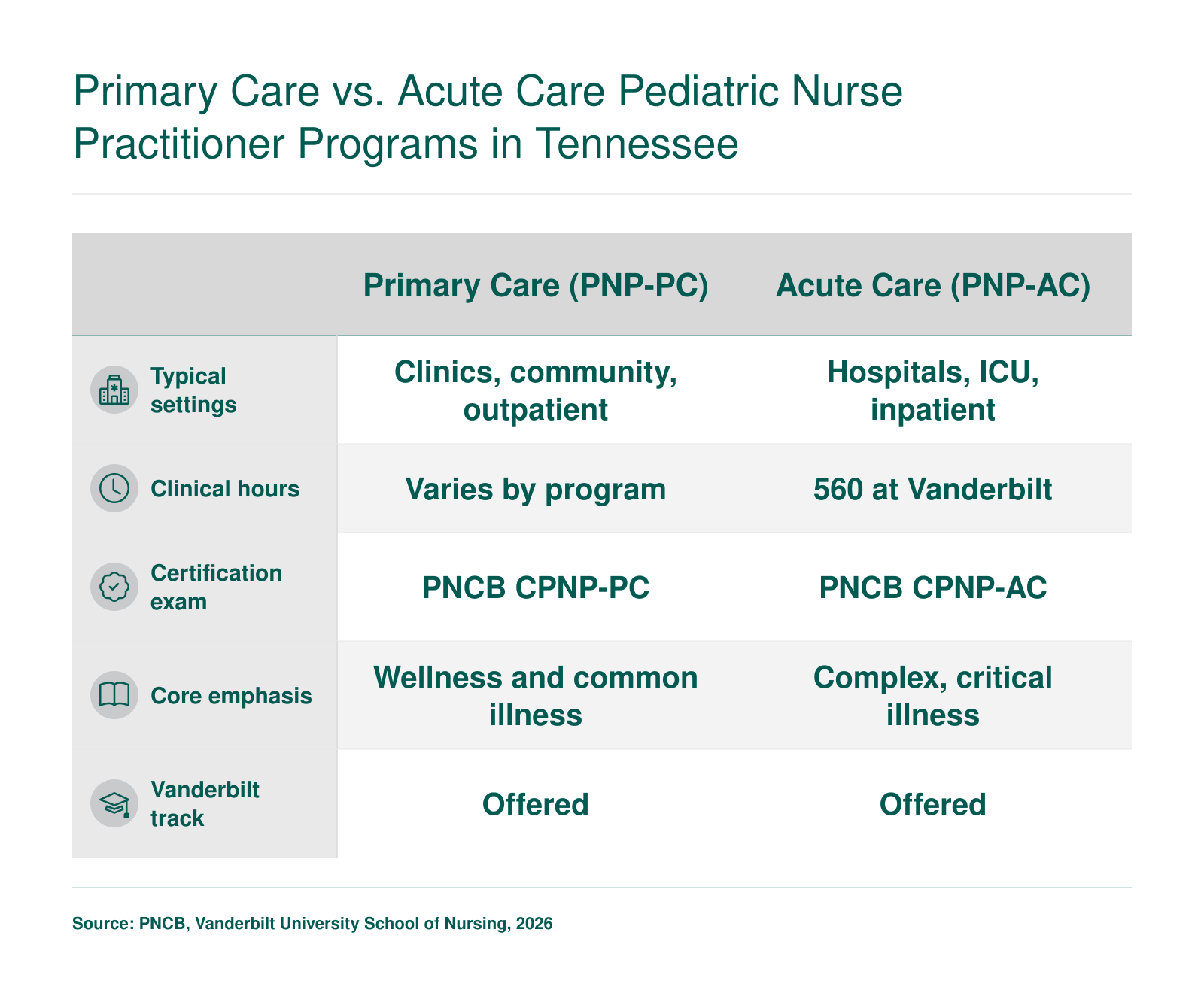
Primary Care vs. Acute Care Pediatric Nurse Practitioner Programs in Tennessee
Vanderbilt offers both a PNP-PC and a PNP-AC master's track, each four full-time semesters. Confirm track availability on the King University and South College program pages before you apply. If you want both credentials, look for a dual-track option or a post-master's certificate, and check the current hour requirement with each school.
Online and Hybrid Pediatric NP Master's Options in Tennessee
Online pediatric nurse practitioner MSN programs rarely mean fully remote. For working nurses comparing MSN programs in Tennessee, the practical question is less about the label and more about how many campus trips are required and who arranges clinical rotations.
How online actually works here
Vanderbilt's PNP tracks are hybrid: online classes plus seven required on-campus sessions for primary care and five to six for acute care. Primary care requires 630 clinical hours; acute care requires 560. King University and South College list online delivery, but South College's catalog currently notes the PNP program is not accepting new students, so confirm availability before applying. That mix of web coursework and in-person skill checkpoints is typical for advanced practice nursing.
Clinical placement support
Vanderbilt states that placement is school-supported or school-facilitated, with a team helping arrange sites near your geographic preference. King and South College do not publish clear placement policies, so ask directly whether the school assigns a preceptor or expects you to find your own.
Out-of-state applicants
Anyone applying from outside Tennessee should confirm state authorization before enrolling. South College's catalog flags possible restrictions for non-Tennessee residents.
Related Articles
Which Tennessee PNP Master's Programs Waive the GRE?
Does a Pediatric Nurse Practitioner (PNP) MSN program in Tennessee still require the GRE? Across the schools here, no pediatric-specific testing policy is spelled out clearly enough to treat as settled, so the test is a question for an admissions counselor rather than an assumption you can make from a website listing master's programs with no GRE required.
What each school publishes
- Vanderbilt University: Applications open August 1, and fall deadlines vary by department, generally falling between December 1 and January 15. General graduate guidance points applicants toward sitting the GRE by November if they are targeting a fall start, but whether the pediatric pathway requires, waives, or simply ignores the score is not stated. Confirm with the School of Nursing.
- South College: Pediatric primary care is offered as a post-graduate certificate rather than a master's, runs 44 credits, allows up to three transferred courses, and is not currently accepting applications. No testing policy is published for it.
- King University: No GRE policy is published for a pediatric track, so contact nursing admissions directly.
Prerequisites worth confirming in writing
Graduate nursing admissions typically expect a BSN and an unencumbered RN license, a minimum undergraduate GPA near 3.0, and an undergraduate statistics course. Acute care pediatric tracks commonly expect prior pediatric or critical care bedside experience. Ask each program to confirm its own figures before applying.
Vanderbilt reports a 100% first-time PNCB pass rate for its Pediatric Acute Care NP MSN graduates in both 2024 and 2025. Nationally, PNCB's most recent reported first-time rate for the primary care exam (CPNP-PC) was 80.69% in 2024, among 1,318 candidates.
Pediatric NP Master's Costs and Tennessee APRN Licensure
Private tuition versus public tuition is the usual graduate school dividing line, but every school ranked here is private, so in-state and out-of-state students pay the same published rate. What varies is the size of the bill among the Most Affordable Pediatric Nurse Practitioner MSN Programs.
What the programs cost
- Vanderbilt University: $2,057 per credit for 2025-2026, a rate the university resets annually. Third-party listings put the master's pediatric NP tracks at roughly 38 to 42 credits and $78,000 to $86,000 total, which should be treated as an estimate rather than a quote. Required student health insurance adds about $4,074 a year.
- South College: A 44-credit online pediatric primary care master's, estimated near $28,849 in total tuition, plus a $245 quarterly nursing fee. No current per-credit rate is published, and the program is not currently accepting new students.
- King University: Graduate nursing tuition is published at the program level rather than as a pediatric-specific schedule.
Net price figures (roughly $15,800 at Vanderbilt, $17,900 at South College, $22,300 at King) are approximate institution-wide averages across all students, not a personalized estimate. Typical graduate borrowing runs from around $14,000 at Vanderbilt to about $22,800 at King.
The Tennessee licensure path
You need an active RN license, a master's from an accredited program, national PNCB certification in your pediatric role, and Tennessee APRN licensure in the form of an APRN certificate from the Tennessee Board of Nursing. Initial licensure is $150 on or after April 8, 2026; renewal is $110 before that date and $150 after.
Prescribing requires a separate certificate of fitness, which hinges in part on completing at least three quarter hours of pharmacology. Applicants who do not meet it receive an APRN certificate without prescriptive authority.
One planning note: adding acute care certification after finishing a primary care master's means a post-graduate certificate, more clinical hours, and more tuition. Decide early if both populations interest you.
Nurse Practitioner Pay Across Tennessee Metro Areas
The 2025 Occupational Employment and Wage Statistics from the U.S. Bureau of Labor Statistics returned no metro-area rows for nurse practitioners in Tennessee, so this table shows statewide figures instead. We therefore cannot say which Tennessee metro pays the most. BLS also groups pediatric NPs with all nurse practitioners, so these are NP-wide numbers, not PNP-specific ones. Statewide, the middle half of nurse practitioners earn between $102,640 and $130,330 a year, a useful benchmark when you weigh program cost against likely pay.
| Occupation | Tennessee Employment | Mean Annual Wage | 25th Percentile | Median Annual Wage | 75th Percentile |
|---|---|---|---|---|---|
| Nurse Practitioners | 12,150 | $115,510 | $102,640 | $117,590 | $130,330 |
| Nursing Instructors and Teachers, Postsecondary | 1,150 | $82,240 | $65,480 | $80,050 | $98,160 |
| Registered Nurses | 72,200 | $85,390 | $75,460 | $81,500 | $95,250 |
Compare Pediatric Nurse Practitioner programs on the data that matters
Explore more Nursing specializations or browse every graduate field.
All Nursing programs