Master's Programs in North Dakota
Every master's program reported by a school in North Dakota: 140+ programs at 11 graduate schools, with the online options, costs and outcomes behind each one.

North Dakota State University's 2026-27 resident graduate rate of $473.44 per credit keeps a master's within reach, but the draw is modest public tuition, small cohorts, and strong online options through NDSU and the University of North Dakota.
The directories to find the best master's programs, by field and school, sit elsewhere on this page, so the analysis here turns on cost, format, admissions, funding, licensure, and earnings. The concrete questions: cheapest public option, online fit for a working schedule, GRE or GMAT rules, and time to degree.
North Dakota's small graduate market concentrates the highest salaries in licensed clinical practice and engineering, where an advanced credential changes the job title and the pay band.
Key Points
- NDSU's base resident graduate rate is $473.44 per credit for 2026-2027, before fees.
- Neither NDSU nor UND sets one GRE rule, so departments decide testing requirements.
- Check specialized accreditation, such as CACREP for counseling, before comparing tuition across North Dakota programs.
Popular degrees in North Dakota
Master's programs in North Dakota by field
Education & Teaching
- Special Education9 programs
- Physical Education4 programs
- Teaching4 programs
- Mathematics Education3 programs
- Elementary Education3 programs
- Curriculum & Instruction3 programs
- STEM Education or Science Education or Mathematics Education2 programs
- Reading & Literacy2 programs
Business & Management
- General Business5 programs
- Accounting3 programs
- Analytics2 programs
- Organizational Leadership2 programs
- Healthcare Administration2 programs
- Management Information Systems2 programs
- Management2 programs
- JD/MBA or MBA/JD or Juris Doctor/MBA or MBA/Juris Doctor1 program
Nursing
- Nursing Education or Nurse Educator3 programs
- Health/Nursing Informatics2 programs
- Nurse Educator1 program
- Nurse Administrator1 program
- Public Health1 program
- Direct Entry MSN (MENP) or (DEMSN)1 program
- Adult Gerontology Acute Care Nurse Practitioner1 program
- MSN/MBA1 program
Healthcare
- Speech Pathology3 programs
- Nutrition2 programs
- Health Informatics2 programs
- Health Administration2 programs
- Public Health2 programs
- Exercise Science1 program
- Clinical Research Management1 program
Communications & Media
- Communication4 programs
- Media Communication2 programs
- Organizational Communication2 programs
- Communication Disorders2 programs
- Speech Pathology2 programs
Social Work & Social Sciences
- Sociology4 programs
- Social Work Advanced Standing3 programs
- Social Work3 programs
Science & Engineering
- Environmental Science6 programs
- Sustainability or Environmental Management2 programs
- Geography1 program
Computers & IT
- Cybersecurity6 programs
- Information Security & Assurance2 programs
Counseling
- Clinical Mental Health Counseling5 programs
- School Counseling2 programs
Religion & Theology
- Theology2 programs
- Divinity1 program
- Christian Leadership1 program
Psychology
- Applied Behavior Analysis1 program
- Forensic Psychology1 program
- Counseling Psychology1 program
Arts & Design
- Fine Arts1 program
Criminal Justice & Law
- Public Policy1 program
What a Master's Degree in North Dakota Really Costs
At North Dakota State University, the standard resident graduate rate runs $473.44 per credit for 2026-2027, but that figure is only the starting number. Mandatory student fees, program differential fees, and distance-learning charges all stack on top, and they vary enough to reshape your total bill.
Per-Credit Tuition Is Only the Base
Treat the advertised per-credit rate as a floor, not a final price. At the University of North Dakota, graduate students pay $560.06 per credit plus a student fee of $79.59 per credit (capped at $955.08), a one-time graduate enrollment fee of $185, and, for online enrollment, a separate application fee. Minot State charges $434 per credit with fees of $67, for a combined $501 per credit, and publishes a full-time graduate figure of $5,752.92 per semester.12 Some fields carry differential pricing: NDSU lists higher per-credit rates for business ($717.89), healthcare administration ($675.00), and architecture ($629.86), the last capped at 13 credits.
Residency, Online Rates, and Reciprocity
North Dakota University System schools often flatten the resident/nonresident gap for online study. NDSU's approved online-only programs charge the same rate regardless of where you live, with online tuition listed at $430.47 per credit plus a $71.70 per-credit fee. That single-rate approach can make distance study cheaper for out-of-state students than campus attendance.
Two discounts may help nonresidents. NDSU publishes a Minnesota reciprocity rate ($601.33 per credit standard, higher in some fields) under the ND-MN agreement, and it extends its resident-level rate to students qualifying through WICHE's Western Regional Graduate Program for listed programs. Whether these apply to a specific degree is worth confirming directly with the school.
The Cheapest Option
Among the rates we verified, Minot State's $434 per credit is the lowest sticker figure.1 But the cheapest degree depends on total credits required: a 30-credit program at a higher rate can still cost less than a 36-credit program at a lower one. Always multiply rate by credits, then add fees. Current graduate tuition for Valley City State was not available for this comparison.
North Dakota Graduate Tuition Comparison by School
The per-credit rate on a tuition page is the number most students compare, but the price you actually pay depends on fees, delivery format, and how many credits your degree requires. A low sticker rate on a 36-credit program can cost more than a higher rate on a 30-credit one. The official rates below come from each school's own tuition pages. Where a school's current graduate figures could not be confirmed, we say so rather than guess.
What the Official Rate Pages Show
- University of North Dakota (online rate differs): Enroll Anytime online graduate tuition is $560.06 per credit for 2026-27, and every online student pays the in-state rate regardless of residency. Online tuition is charged per credit with no 12-credit cap, unlike UND's semester-based on-campus tuition. Expect a $185 graduate enrollment fee in your first semester. The mandatory student fee is $79.59 per credit below 12 credits, capped at $955.08.
- University of Mary (program-specific pricing): Mary sets a rate by program rather than by residency. Published master's rates include $525 per credit for the MSN, $610 for the MEd, $695 for MS Counseling, and $775 for the MBA and the MA in Applied Catholic Theology. Clinical programs are billed by full-time semester: $8,275 for Athletic Training and $9,610 for Speech-Language Pathology and Occupational Therapy. Some programs carry additional course or program fees.
Schools Still to Verify
We could not confirm official 2026-27 graduate resident, nonresident, or online rates for Valley City State, Dickinson State, or the University of Jamestown. Jamestown's published schedule of charges covers 2025-26 and does not display graduate amounts. Ask each graduate office for the current per-credit rate and whether online students pay a different one.
How Credit Count Changes the Total
At UND's online rate, a 30-credit master's runs about $16,987 including the $185 enrollment fee, and a 36-credit program rises to roughly $20,347, also including that fee, before any per-credit student fees. According to University of Mary's graduate tuition and costs page, a 30-credit MSN at $525 per credit comes to $15,750, versus $18,900 at 36 credits. A $775-per-credit general MBA or theology degree reaches $23,250 at 30 credits and $27,900 at 36. Those six extra credits add $3,000 to $4,650, so check the credit requirement before comparing rates.
Confirm Before You Budget
UND labels its 2026-27 figures as estimates, and Mary's program rates can change from year to year. Treat every number here as a starting point and confirm the final rate, fees, and billing method with each school's bursar's office before you commit.
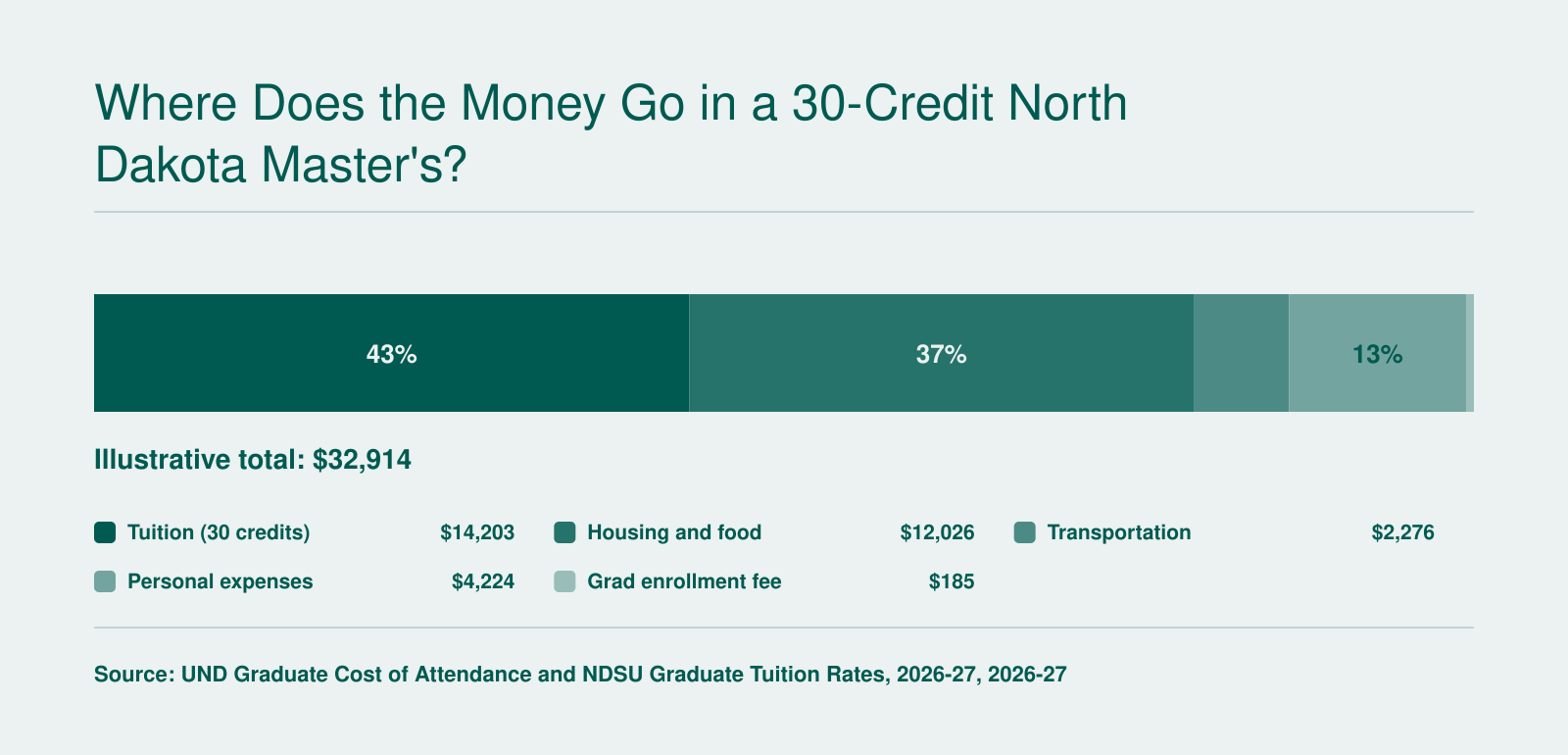
Where Does the Money Go in a 30-Credit North Dakota Master's?
This is an illustrative estimate, not a quote. Tuition uses NDSU's 2026-27 base resident graduate rate of $473.44 per credit across 30 credits, while the living slices use the University of North Dakota's graduate budget for Fall and Spring combined. Per-semester student fees and books are left out because neither school publishes a graduate-specific total, and program rates run higher (NDSU's range from $521 to $877 per credit in the programs listed). Online students who keep their current housing can drop the housing, food, and transportation slices, which leaves tuition as the main cost.
Online, Hybrid, and On-Campus Master's Formats in North Dakota
Fully online and fully in-person are the two ends of the spectrum, and most North Dakota graduate programs now live somewhere along it. The short answer to the most common question: yes, you can earn an entire master's online from a North Dakota university, without ever setting foot on campus.
Where the Fully Online Catalogs Are
The University of North Dakota runs the state's largest distance catalog, with 135 online programs and 70 certificates in 2026 spanning bachelor's, master's, and doctoral levels. Its online coursework is asynchronous, so working teachers and professionals log in on their own schedule. Fully online master's at UND include Space Studies, Forensic Psychology, and most online master's in special education concentrations.
NDSU delivers several master's entirely online, including Human Development and Family Science, Community Development, Clinical Research, and Data Science. Valley City State offers three online master's (teaching, education, and business information systems), and Minot State lists seven online master's, including speech-language pathology and sports management.
What Hybrid Means in Practice
Hybrid here usually blends asynchronous online coursework with some scheduled live element rather than frequent campus trips. Minot State's Cognitive Science master's, for example, pairs asynchronous core courses with scheduled online classes. In education and clinical fields, hybrid can also mean fieldwork in your own community. UND's Special Education Resident Teacher M.Ed. is a clear example: coursework is online and the field component happens on the job in a local district, with no travel to Grand Forks required.
In-Person Requirements and Pacing
Even when coursework is online, some fields still demand hands-on work: supervised clinical hours, labs, practicums, and internships are common in nursing, clinical mental health counseling, and speech-language pathology. Minot State's speech-language pathology master's, for instance, runs part-time across eight semesters, and programs of this kind typically involve supervised clinical preparation.
Timing varies by program and load. NDSU's Human Development and Family Science master's, for example, typically takes two to three years. Full-time students generally finish a master's in about 1.5 to 2 years; part-time timelines stretch to 2 to 3.
One caution for out-of-state applicants: before enrolling in an online program, confirm the school's state authorization (NC-SARA status) for your state and ask directly about any in-person residency or placement, since catalog delivery labels do not always capture clinical requirements.
Admissions, GRE and GMAT Policies, and Application Deadlines
Do North Dakota master's programs require the GRE? Often they don't; No-GRE master's programs exist, but neither NDSU nor UND has a single rule. Both universities leave testing decisions to individual departments, so the answer depends on the program you choose.
GRE and GMAT Policies Vary by Department
NDSU's graduate school says GRE and GMAT requirements are set program by program. Where scores are required, they must be official and no more than five years old. Its Master of Public Health is one test-free MPH program: no entrance exam is required, though applicants may submit GRE, GMAT, MCAT or similar scores if they have them. UND also notes that not every program requires an admission test. When one does, scores must come directly from the testing service (UND's GRE code is 6878), and photocopies are not accepted. Neither university publishes a blanket policy for its MBA, engineering, or counseling programs. Confirm whether scores are required, optional, or waivable before you book a test date.
Baseline Requirements at NDSU and UND
The GPA floors differ. For full standing, NDSU generally expects a bachelor's degree with a cumulative GPA of at least 3.0, plus a $35 nonrefundable application fee, and individual programs may set a higher bar. UND requires a bachelor's from a regionally accredited institution and a minimum 2.75 cumulative GPA, or 3.0 across your junior and senior years. Its Master of Engineering lists a 2.5 minimum. Most programs ask for transcripts, recommendation letters, and a statement of purpose, and international applicants should plan on proving English proficiency.
How Application Deadlines Work
NDSU uses general dates (May 1 for fall, October 1 for spring, March 1 for summer) only when a program has not set its own. Its MBA admits on a rolling basis. Biomedical, Civil, and Mechanical Engineering list February 15 for fall, and Electrical and Computer Engineering lists February 28. Clinical Mental Health Counseling admits for fall only, with a February 1 deadline, and Educational Leadership uses a December 1 priority date.
If you want funding, apply early. NDSU's 2026 Graduate Handbook sets assistantship priority dates of February 15 for fall and September 15 for spring. International deadlines are often earlier and vary by program. UND has no universal deadline. For fall entry, cutoffs in late fall or early spring are most common.
Test rules and dates change each cycle, so treat the department's own admissions page as the final word.
Funding Your Master's: Assistantships, Scholarships, and Aid
The cheapest way to fund a master's in North Dakota usually comes with the most work attached. Assistantships can cut tuition sharply, but they trade your time for it, while loans keep your schedule free and leave you with debt.
Graduate Assistantships at UND and NDSU
At the University of North Dakota, assistantship pay and benefits depend on the college, department, and appointment percentage. UND's funding guidance lists a quarter-time stipend of $8,500 with a waiver for 3 credits per semester, and a half-time stipend of $17,000 with a 6-credit waiver. Assistants must carry at least 6 graduate credits, and pay and benefits end with the appointment or graduation, whichever comes first. The M.P.H. program waives 1 to 9 credits per semester for assistants working 10 to 20 hours a week, though fees are not covered. Biomedical sciences research assistants earn about $29,706, with full tuition waivers while in good standing.
At North Dakota State University, the waiver covers base tuition for regular graduate credits only. Assistants still pay differential tuition, fees, and charges for distance or continuing education credits. A waiver requires at least 160 hours of work per semester, and there is no partial waiver below that. In Health, Nutrition, and Exercise Sciences, master's stipends run from $6,000 to $12,000. Neither school's published material establishes a university-wide health insurance subsidy, so ask each department what it covers.
Scholarships, Fellowships, and Employer Help
Both universities offer institutional scholarships and fellowships, usually through the graduate school or your department. Ask about employer tuition assistance early if you intend to study online while working. It is often the largest funding source for part-time students, and it is worth asking before you borrow.
Federal Aid and State Loan Repayment
Graduate students generally cannot receive Pell Grants. Federal aid comes mainly as Direct Unsubsidized Loans and Grad PLUS loans, and both accrue interest while you are enrolled. Fill out the FAFSA even if you expect assistantship funding.
North Dakota's Healthcare Professional Loan Repayment Program rewards service after you graduate.1 Registered nurses, clinical psychologists, and licensed addiction counselors in areas of need may qualify.1 Behavioral health awards reach $20,000 with a required $2,000 employer match, and the program asks for a five-year service contract1 and U.S. citizenship.2 The 2026 cycle ran January 5 to February 28, so plan for next year's window.2
A Practical Tip
Apply by the assistantship priority deadline, not the general admission deadline. Funded positions often fill before admission closes, so a late application can mean admission without money.
Median Pay for Master's-Level Work in North Dakota
Master's graduates in allied health diagnostic, intervention, and treatment professions at North Dakota State University
Which North Dakota Master's Degrees Pay the Most
The master's degrees that pay the most in North Dakota are the ones tied to licensed clinical practice and engineering, where an advanced credential leads directly to a higher-wage job title. The state's wage data points to advanced nursing and engineering at the top, with education and counseling psychology well behind.
What the Wage Data Shows
BLS Occupational Employment and Wage Statistics (May 2024 estimates) give these North Dakota medians:
- Nurse practitioners: $121,200, with about 1,260 employed.1
- Electrical engineers: $108,800, with about 260 employed.1
- Engineers, except computer: $101,220, though only about 50 workers are counted, so treat it cautiously.1
- Educational, guidance, and career counselors and advisors: $62,500, with about 770 employed.1
- Preschool and daycare education administrators: $58,700, with about 290 employed.1
For context, the statewide median across all occupations was $52,480 in the 2025 estimates.2 That comes from a different reporting year, so use it only as a rough yardstick.
We do not have North Dakota wage figures for CRNAs, computer science, business administration, or healthcare administration. Check each program's own earnings page before assuming those fields follow the same pattern.
Scorecard Figures Versus BLS Figures
These two sources measure different things. College Scorecard reports earnings for people who completed a specific program at a specific school. BLS reports wages for everyone working in an occupation, including people with decades of experience and people who entered through other routes.
Scorecard lists $90,3325 for an NDSU entry and $69,5636 for UND. The figures we have do not say which fields, degree levels, or graduating cohorts they cover, so do not read them as master's averages. Look up the specific program you are considering in Master's Programs by Degree and Field.
Demand Versus Pay
Job Service North Dakota's in-demand list is built from state employment projections and updated annually.3 It focuses on jobs requiring up to a bachelor's degree, with examples such as surveyors, web developers, electricians, and paralegals.4 It is a useful signal for the local job market, but it is not a guide to master's-level pay.
Teaching, school counseling, and education administration offer steady local work but pay modestly. If you borrow heavily for one of these degrees, the debt can take years to pay down on a $58,000 to $63,000 salary. A nurse practitioner or engineering graduate at twice that pay recovers the same tuition much faster. Compare each program's total cost, covered earlier, against the realistic wage for the job you want, not the average for the field.
Educator Licensure in North Dakota
Licensure and Accreditation for Professional Master's Programs
Does a North Dakota master's program need specialized accreditation for you to get licensed? Often it matters a great deal, but we could not confirm which programs at the University of North Dakota, NDSU, Minot State, or University of Mary hold CACREP (counseling), CCNE or ACEN (nursing), CEPH (public health), CSWE (social work), AACSB (business), or ABET (engineering) status. Check each program's own accreditation page before you apply.
Counseling: LPC and LPCC
The North Dakota Board of Counselor Examiners sets degree content rather than naming CACREP outright, though a CACREP clinical mental health counseling program is the easiest way to be sure you meet it. For the LPC, the Board's reciprocity material calls for a 60-hour master's in counseling or a closely named field, a supervised practicum of at least 100 hours, and a 600-hour internship. You must pass the National Counselor Examination, then complete 100 hours of post-master's supervision over two years.1
The LPCC goes further: 60 graduate semester hours, 700 clinical training hours, and two years and 3,000 hours of supervised clinical work.2 That includes 100 hours of direct supervision from a board-certified clinical supervisor. The application fee is $150.2 Exam and session-submission details should be confirmed with the Board directly.
Nursing: APRN
The North Dakota Board of Nursing requires an active, unencumbered North Dakota RN license, or a multistate compact license if North Dakota is not your primary residence. APRN applicants, including nurse practitioners, apply through the Nurse Portal4, pass a background check, and have national certification sent directly from the certifying organization.3 Their certification must match their role and population focus. The Board also requires 30 contact hours of pharmacotherapy3, and transcripts must come straight from the school.
If You Live Outside North Dakota
Online students should not assume North Dakota coursework satisfies their home state. Find the program's professional licensure disclosure page, then compare it against your state board's rules on degree content, practicum hours, and accreditation.
Do this before applying. A mismatch found after graduation can cost you a year of supervised hours or a second set of courses.
How to Choose the Right North Dakota Master's Program for You
CACREP, the accreditor for counseling programs, covers 969 programs nationally, and whether a North Dakota counseling program is among them can matter more to your career than a few thousand dollars in tuition. That is why four questions, asked in order, sort most master's decisions.
The Four-Part Framework
- Total cost after aid: Net out assistantships, tuition waivers, and scholarships from the total cost of a master's degree, then add fees and living costs.
- Format fit: Match online, hybrid, or on-campus delivery to your job, family, and commute.
- Licensure and accreditation: Confirm the program qualifies you for the credential your target career requires.
- Expected earnings: Compare realistic pay in your field against what you will owe.
How the Factors Interact
The factors pull against each other, so weigh them together. A low-priced online counseling program without CACREP accreditation can cost more over time if it leaves you ineligible for licensure or forces extra coursework later. A pricier accredited program that shortens your path to licensure often wins on lifetime value.
Format and cost also cross. Online Master's Programs look cheaper on paper, but a funded assistantship can make an on-campus degree cost less out of pocket than an online one, since it may cover tuition and pay a stipend. If you can relocate for two years, price both routes before you assume online is the budget choice.
Next Steps
- Multiply each program's per-credit rate by its required credits, then add mandatory fees to get a comparable sticker price.
- Email the graduate coordinator and ask three things: whether the program waives the GRE or GMAT, what assistantships are open to new admits, and how many students typically receive funding.
- Find the program's licensure disclosure page, which federal rules require for programs leading to a license, and check that it lists approval for North Dakota and for any state where you may work.
- Look up graduate earnings for the field, then compare the first-year pay with your total cost after aid.
Do this for two or three finalists and the right choice usually becomes plain. North Dakota's mix of moderate tuition, funded graduate roles, and strong in-state demand for licensed professionals makes it a place where a master's degree can pay for itself without a heavy debt load.
Graduate schools in North Dakota with the most master's programs
| School | City | Type | Master's programs | Online | Grad tuition / yr |
|---|---|---|---|---|---|
| University of North Dakota | Grand Forks | Public | 48 | 41 | $13,677 |
| North Dakota State University | Fargo | Public | 33 | 14 | $8,786 |
| University of Mary | Bismarck | Private nonprofit | 22 | 18 | $12,372 |
| Minot State University | Minot | Public | 10 | 8 | $10,886 |
| Mayville State University | Mayville | Public | 9 | 9 | $11,159 |
| University of Jamestown | Jamestown | Private nonprofit | 7 | 7 | $15,984 |
| Valley City State University | Valley City | Public | 7 | 7 | $8,075 |
| Sitting Bull College | Fort Yates | Public | 5 | 2 | $6,710 |
| Dickinson State University | Dickinson | Public | 4 | 4 | $6,576 |
| Trinity Bible College and Graduate School | Ellendale | Private nonprofit | 2 | 2 | $13,526 |
| Turtle Mountain College | Belcourt | Private nonprofit | 1 | 1 | $3,938 |
Program counts are the verified master's listings in our directory; tuition is the school-wide average for a full-time graduate student (IPEDS).
Common Questions About North Dakota Master's Programs
These answers cover the questions prospective students ask most about timelines, residency pricing, working while enrolled, and funding. Details vary by school and program, so confirm specifics with the program you are considering.
How long does it take to complete a master's degree in North Dakota?
Can out-of-state students get in-state tuition for a North Dakota master's program?
Can I work full time while earning a master's in North Dakota?
Do assistantships cover the full cost of a master's degree?
Compare programs nationwide
Many North Dakota residents study online. Every ranked list above has an online lens, or browse every field.
Online master's programs Browse all fields