Best Online Master's in Special Education Programs
Compare 520+ accredited online Special Education programs, with graduate earnings, cost, debt, and completion data from IPEDS and the U.S. College Scorecard.

The single biggest variable in an online special education master's isn't the school: it's whether the degree leads to an initial teaching license or assumes you already hold one. Programs built for career changers include supervised student teaching; advanced tracks for licensed teachers do not. Enroll in the wrong one and the credential won't match your situation.
Ten online and hybrid programs are ranked here, drawn from 28 eligible schools. Cost and structure vary sharply: institution-wide net price after aid runs from roughly $3,000 to over $24,000, credit loads cluster between 30 and 36, and some tracks require local K-12 placement while others are fully asynchronous.
State licensure boards, not universities, decide who gets to teach, which makes where you plan to work as consequential as where you enroll.
Key Points
- Credit loads run 30 to 36, from UT Arlington (30) to Lamar (36).
- Your teaching license comes from the state where you plan to teach, not your school's.
- Program-level earnings are not yet published, so compare net price and verify accreditation yourself.
10 Online Master's in Special Education Programs for 2027
These are online-delivery-eligible special education master's programs, whether fully online or hybrid, listed in order of a blended quality composite that weighs affordability, completion, and graduate outcomes. Net price is an institution-wide average after grant and scholarship aid, and the graduation rate shown is for the school as a whole rather than this single program: schools offering this program may graduate a high share of students overall even if the program's own rate is not reported. Use these cards to compare cost and completion, then confirm each program's licensure status, field placements, and state eligibility before applying.
Purdue University
#1West Lafayette, IN · ~$10,000/yr (est.)
Best for: Working educators seeking non-licensure special education
Purdue's online non-licensure MSED or MS pathway with a special education concentration focuses on legal and ethical frameworks, differentiated instruction, and adaptive curriculum. The program ends with a portfolio and capstone rather than a teaching credential, so it suits educators who already hold or do not need certification and want to lead in classrooms, administrative roles, or service settings.
- 30 total credit hours
- Capstone and portfolio required
- Fully online delivery
- Non-licensure focus on inclusive education
- Courses in reading difficulties and behavior analysis
- Prepares for classroom, administrative, or service roles
The University of Texas at Austin
#2Austin, TX · ~$12,000/yr (est.)
Best for: Aspiring autism behavior specialists
UT Austin's online Master of Education in Special Education offers an Autism and Developmental Disabilities concentration built around applied behavior analysis and evidence-based practices. Students complete synchronous online coursework and three practical experiences, and the program satisfies the Behavior Analysis Certification Board coursework requirements for BCBA certification. The 12-month full-time schedule is unusually direct for autism-focused educators and clinicians.
- 36 total credit hours
- 12-month full-time format
- Synchronous online classes
- Meets BACB coursework requirements
- Three practical experiences
- No entrance exam required
- Rolling admissions
University of Georgia
#3Athens, GA · ~$11,000/yr (est.)
Best for: Early-childhood professionals seeking certification
The University of Georgia's online M.Ed. in Special Education emphasizes Birth Through Kindergarten/Preschool Special Education and includes core courses, research hours, and applied practice. The program culminates in an applied project and a final comprehensive exam, and it prepares graduates for a clear renewable Georgia teaching certificate while noting that it does not lead to initial certification.
- 36 total credit hours
- 21 core credit hours plus research and applied practice
- Applied project and comprehensive exam required
- 3.0 undergraduate GPA minimum
- Three letters of recommendation and statement of purpose
- Field work across three grade bands
- Summer, fall, and spring starts
Johns Hopkins University
#4Baltimore, MD · ~$65,000/yr (est.)
Johns Hopkins offers a part-time online MS in Special Education with an applied behavior analysis emphasis, pairing fully online special education courses with synchronous ABA coursework. The 36-credit program can be completed in two years, or three with optional practicum electives that meet BACB fieldwork requirements in the Baltimore-Washington, D.C. area. Graduates commonly move into behavior specialist, program coordinator, or ABA consultant roles.
- 36 total credit hours
- Part-time, two-year schedule
- Five special education courses fully online
- Seven ABA courses taught synchronously online
- Meets BACB Pathway 2 coursework requirements
- Optional practicum limited to Baltimore-D.C. area
- No F-1 visa sponsorship
Auburn University
#5Auburn, AL · $13,000 – $34,000/yr (est.)
Auburn's Master of Education in Early Childhood/Elementary Special Education is built for teachers who want advanced preparation for working with infants through elementary students with or at risk for disabilities. The curriculum emphasizes child development, family collaboration, and inclusive strategies, and students can choose a pathway based on whether they are already certified in special education or in another teaching area. The program is offered both on campus and online for working educators.
- Offered on campus and online
- Prepares for P-6 settings
- Pathways for certified or non-special-education teachers
- Emphasis on evidence-based practices
- Supports infants through elementary age groups
Binghamton University
#6Vestal, NY · $10,000 – $15,000/yr (est.)
Binghamton's advanced MSEd in Special Education is designed for teachers who already hold New York State initial certification and want eligibility for Students with Disabilities All Grades PK-12 certification. The fully online, asynchronous 36-credit program includes fieldwork, an internship, and a capstone, with fall, spring, and summer entry points. Coursework centers on special education law and policy, instruction, assessment, and collaboration for diverse learners.
- 36 total credit hours
- Fully online and asynchronous
- Requires initial New York State certification
- Eligibility for Students with Disabilities All Grades PK-12
- Fieldwork, internship, and capstone required
- B- or better required in all courses
- Fall, spring, and summer starts
Clemson University
#7Clemson, SC · $10,000 – $15,000/yr (est.)
Clemson's online Master of Education in Special Education offers a 33-credit, fully online option focused on Multi-Tiered Systems of Support, applied behavior analysis, and advanced classroom management. Some concentration listings also prepare experienced teachers for South Carolina certification in emotional or behavioral disorders, learning disabilities, or intellectual and developmental disabilities. The online format uses asynchronous eight-week terms, and South Carolina teachers may qualify for a tuition incentive.
- 33 total credit hours
- GRE required
- 24-month completion
- 100% online and asynchronous
- ABAI Verified Course Sequence
- Focus on MTSS and applied behavior analysis
- Does not lead to teaching licensure
- South Carolina teacher incentive available
- 36 total credit hours
- GRE required
- Prepares for South Carolina certification
- Practicum in emotional or behavioral disorders
- Final comprehensive exam required
- Valid teaching certificate required
- Includes applied behavior analysis coursework
- 36 total credit hours
- GRE required
- Fulfills South Carolina certification requirements
- Practicum in learning disabilities
- Focus on research-validated interventions
- Final comprehensive exam required
- 36 total credit hours
- GRE required
- Prepares for South Carolina teaching certification
- Practicum in intellectual disabilities and autism
- Research-validated intervention strategies
- Final comprehensive exam required
Saint Joseph's University - Philadelphia
#8Philadelphia, PA · ~$20,000/yr (est.)
Saint Joseph's University offers a fully online Master of Science in Special Education with fieldwork woven into each course, and the credit load varies by certification status. Candidates who already hold initial teaching certification can complete 31 credits toward Pennsylvania PK-12 special education certification, while those without certification complete 36 credits with a full-time student teaching placement. Tuition discounts for K-12 teachers, Catholic school staff, and alumni can meaningfully reduce the cost.
- 30-36 total credits
- 100% online with fieldwork in every course
- PK-12 Pennsylvania certification pathway
- 31 credits for currently certified teachers
- 36 credits with full-time student teaching for non-certified
- 20% tuition discount for K-12 teachers
- Meets International Dyslexia Association standards
Indiana University-Bloomington
#9Bloomington, IN · $12,000 – $33,000/yr (est.)
Indiana University Bloomington's online M.S.Ed. in Special Education prepares educators and aspiring specialists to work with students with mild to high-incidence disabilities. Students can choose a non-licensure degree, a license addition for current teachers, or an initial licensure path through the Community of Teachers program. The 36-credit program ends in a capstone or thesis and offers multiple start dates.
- 36 total credit hours
- Three track options, including initial licensure
- Online delivery
- Fall, spring, and summer starts
- Thesis or capstone option
- Focus on mild to high-incidence disabilities
- Fellowships and employer reimbursement available
University of South Carolina
#10Columbia, SC · ~$14,000/yr (est.)
The University of South Carolina's online Master of Education in Special Education offers concentration options in multi-categorical special education and severe and multiple disabilities. The program is designed for current certified teachers seeking add-on South Carolina certification, with coursework in assessment, instructional planning, and implementation. South Carolina teachers may also qualify for reduced tuition.
- 100% online option
- Prepares for add-on South Carolina certification
- Special tuition for South Carolina teachers
- Focus on assessment and instructional planning
- Prepares for PK-12 special education roles
- Add-on South Carolina certification available
- Reduced tuition for South Carolina teachers
- Prepares to teach PK-12 students with disabilities
- Focus on severe and multiple disabilities
Cost & outcomes by school
Federal data for the highest-earning Special Education programs, independent of the ranking above. Earnings are this field's master's graduates four years after completing, where the Scorecard reports them.
| School | Earnings | Tuition / yr | Debt | Grads/yr | Format |
|---|---|---|---|---|---|
| CUNY City College NY | $94,601 | $11,402 | $23,914 | 127 | Hybrid |
| CUNY Hunter College NY | $88,978 | $11,398 | $30,530 | 316 | Hybrid |
| Point Loma Nazarene University CA | $86,603 | $11,880 | $42,073 | 10 | Online |
| National University CA | $85,908 | $16,416 | $53,471 | 352 | Online |
| CUNY Queens College NY | $85,359 | $11,612 | $21,433 | 54 | Hybrid |
| California State University-East Bay CA | $81,760 | $9,107 | — | 43 | Hybrid |
| California Lutheran University CA | $81,041 | $22,046 | $14,600 | 16 | Hybrid |
| Touro University NY | $80,111 | $14,979 | $24,332 | 743 | Hybrid |
| University of Hawaii at Manoa HI | $78,627 | $16,502 | $30,092 | 29 | Online |
| University of West Georgia GA | $74,278 | $6,046 | $22,800 | 149 | Online |
| George Mason University VA | $72,192 | $17,964 | $23,695 | 242 | Hybrid |
| Ball State University IN | $71,550 | $12,342 | $27,000 | 990 | Hybrid |
Sources: U.S. Department of Education. Tuition and graduates: IPEDS. Earnings and debt: College Scorecard, this field's master's graduates; a dash means no figure is reported.
Cost, debt & payoff
Median earnings of this field's master's graduates (4 yrs after completing) vs. their median federal loan debt · U.S. College Scorecard
Across these programs the median graduate earns about $62,401 and finishes with roughly $27,917 in debt — a ratio that clears a common rule of thumb (keep debt below first-year salary). Tuition and debt vary widely school to school, so check the per-school figures in the table above before you shortlist.
Initial Licensure or Advanced Track? Matching the Program to Your Teaching Status
You can earn a special education master's online without a teaching license, but only through the right track. Initial licensure programs are built for people without a license and include student teaching. Advanced tracks generally assume you already hold a license or do not need one. Non-licensure degrees, such as Liberty University's online M.Ed. in Special Education, do not lead to a teaching license in any state, so career changers who want to teach should avoid them.
| Factor | Initial Licensure Track | Advanced or Endorsement Track | Non-Licensure M.S./M.A. Path |
|---|---|---|---|
| Who it is for | Career changers and aspiring teachers with a bachelor's degree in any field, such as those in University of Texas at Arlington's initial-certification option or Arkansas State University's MAT | Licensed teachers adding special education or deepening expertise, such as Western Illinois University's tracks for general education teachers seeking an LBS1 endorsement | Advocates, policy-minded professionals, private-school staff, and educators who do not need certification, such as those in Liberty University's non-licensure M.Ed. |
| License required at admission | No. Arkansas State University designs its program for people without a current license or an education degree | Usually yes. Western Illinois University directs applicants seeking initial licensure to its separate MAT program | Typically no, since the degree does not lead to a license |
| Student teaching or practicum | Required. Western Governors University requires full-time supervised student teaching of 12 to 20 weeks at minimum, and Purdue University's Clinical Practice II is 16 weeks | Varies by program and state. Check whether your endorsement requires a field component | Often none. Purdue University's master's-only option requires no practicum and substitutes an elective |
| Typical credit load | Heavier, because licensure coursework and clinical work are added. At University of Illinois Chicago, students without a license complete 13 additional credits that include an internship and student teaching | Lighter, since the licensure-related requirements are already met | Often the lightest, because there is no clinical component. Confirm exact credits with each program |
| Outcome | Master's degree plus initial teacher certification, as in University of Cincinnati's online MAT and University of Hartford's initial certification M.Ed. | Master's degree plus an added special education endorsement, or advanced skills in an existing role | Master's degree with no credential. Boston University's general, non-licensure EdM track, for example, builds advanced expertise without a Massachusetts license |
| Typical prerequisites | Bachelor's degree, plus fieldwork. Grand Canyon University's track includes roughly 100 hours of observation and fieldwork before a full-time 15-week practicum | Bachelor's degree plus a current initial license in elementary or secondary content, as in Boston University's licensure track for already-licensed teachers | Bachelor's degree. Licensure is not a condition of admission, but confirm with the program |
Will Your Online Degree Qualify You to Teach in Your State?
If you enroll in an online special education master's based in one state but plan to teach in another, which state determines if you can get licensed? The answer is simple and often overlooked: your teaching credential comes from the state where you intend to work, not the state where the university operates.2 A program can legitimately advertise that it "leads to licensure" in its home state while falling short of your state's requirements. Because the state education agency issues the license, you have to confirm the program is approved for your location before you enroll.1
How to Read Federal Licensure Disclosures
Under federal rules in effect since July 1, 2024, institutions must determine whether a distance program meets the educational requirements for licensure in the state where you're located when you start.2 These disclosures apply whether or not you take federal aid3, and they sort each state into one of three buckets: meets, does not meet, or not determined.2 If your state falls into the last two, the school must tell you directly, by email or letter, before you enroll.2 Read these carefully. "Meets" covers coursework only; the state can still require exams, background checks, supervised experience, fees, or added coursework.
Reciprocity Has Real Limits
The NASDTEC Interstate Agreement helps credentialed teachers move between states, but it does not swap one license for another automatically.4 The receiving state compares your preparation, tests, and credential against its own, and out-of-state completers commonly face a basic-skills, content, pedagogy, or special education exam, state-specific coursework, a background check, and an application fee.5 There is no single national special education credential, so a degree that qualifies you in one state may not in the next.4
A Three-Step Verification Routine
- Check the school's published licensure disclosure page for your specific state.
- Check your state education department's requirements for the credential, grade span, and disability area you want.
- Confirm in writing with an admissions officer that the program qualifies you for licensure where you plan to teach.
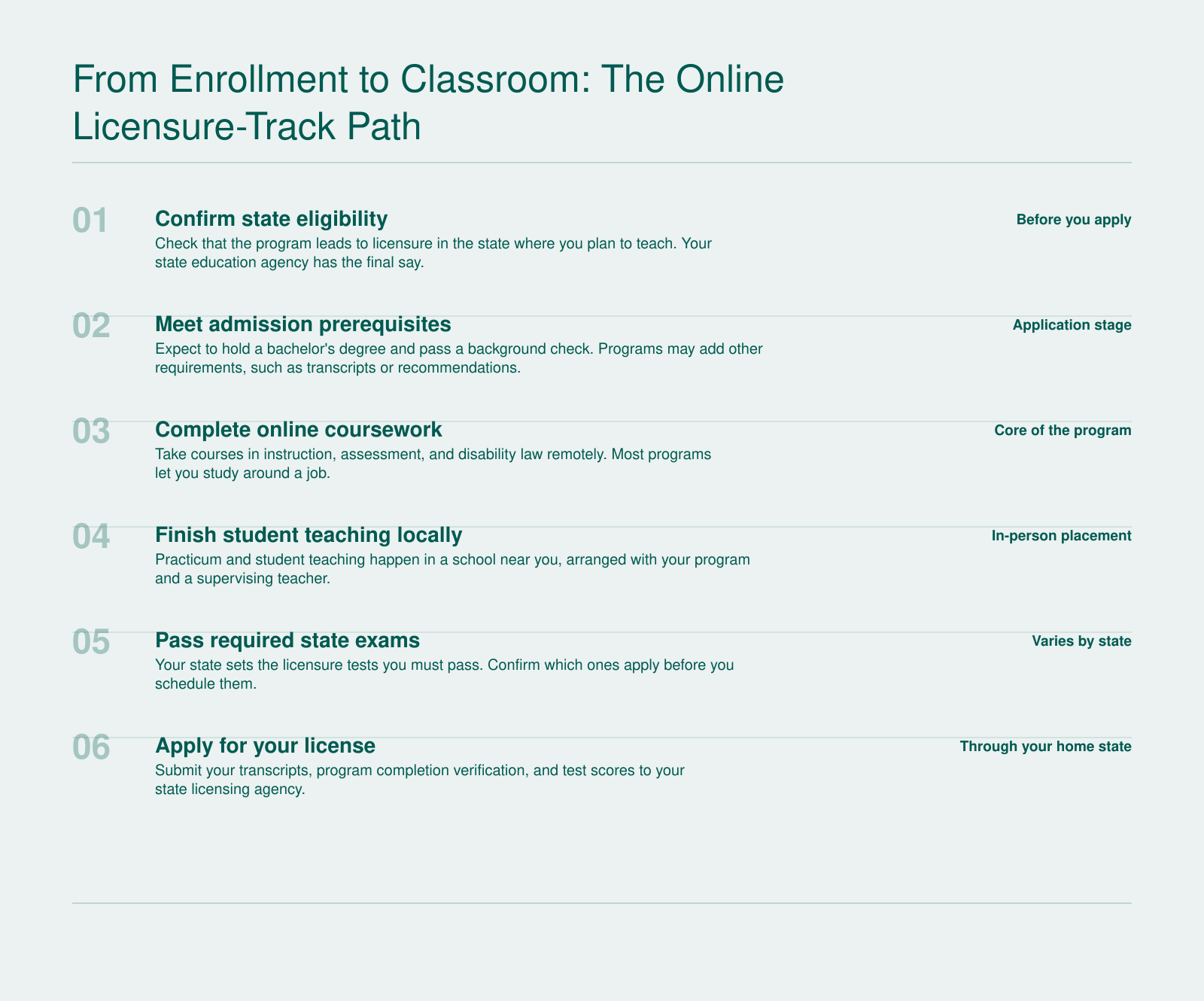
From Enrollment to Classroom: The Online Licensure-Track Path
This is the typical sequence for a career changer pursuing an online licensure-track master's in special education. Exact requirements vary by state and program, so treat it as a framework. Students on an advanced track who already hold a license usually skip student teaching, though some programs still require a supervised practicum.
Related Articles
Online Format, Completion Time, and How Student Teaching Works Remotely
How long does it take to complete an online master's in special education? Credit loads usually fall between 30 and 36, as at the University of Texas at Arlington (30)1, Lamar University (36), and the University of Hartford (36). Hartford is the only program here that states an overall timeline: just over two years. Licensure tracks run longer. Arcadia's non-certification track is 33 credits, while its certification track is 55.2 Most schools don't publish firm finish times, so ask an advisor how pace changes with part-time or accelerated enrollment.
Asynchronous vs. Synchronous Delivery
Asynchronous courses let you complete work on your own schedule, which suits full-time teachers. Synchronous courses require set meeting times, which can clash with a school day. Confirm which format each course uses before you enroll. Clinical terms can add constraints too. Purdue's Clinical Practice I and II run only in fall and spring, not summer.3
How Remote Fieldwork Gets Arranged
There is no national rule, and the arranger is often unstated. Practices differ by school:
- University-coordinated: Temple's online MEd in Special Education coordinates placements.
- Student-arranged: Mount Saint Vincent expects you to find your own site, and it warns non-New York residents to check certification rules first.
- Job-embedded: Rowan's MA in Special Education and Inclusive Practices requires an initial or standard certificate plus a district role, such as paraprofessional or teacher, with weekly access to the same students, including those with IEPs.
- Remote supervision: Purdue accepts students outside Indiana and supervises electronically.3 It encourages working in a school, even as a paraprofessional or on a provisional license, to speed placement.
Current teachers should ask whether their own classroom counts. Only some programs, Rowan among them, are built around that model.
States Where Placement May Not Work
Degree-only tracks may skip supervised practicum. Liberty's online Master of Arts in Teaching (MAT), which requires 90+ clinical hours, does not lead to licensure. Licensure tracks are stricter. Arcadia's certification track uses home-state sites (7 to 9 hours weekly for 12 weeks).2 Hartford's full-day, 14-week student teaching takes place in Connecticut and is not generally portable. UTA's Texas certification requires in-person clinical teaching with a licensed special education teacher at a TEA-approved site.4 Before applying, ask in writing whether the school can place you in your state.
Lowest-Cost Online Special Education Master's Options
The schools below are the lowest-cost options in this set. Net price is an institution-wide average after aid, so it is a comparison point rather than a quote for the special education program. For program-level totals, multiply the published per-credit rate by required credits and add mandatory fees: Dordt lists a 30-credit program at $405 per credit plus a $100 technology fee, and Penn State World Campus lists 33 credits at $1,048 per credit for a published total of $34,584. This credit-and-fee math is more accurate than annual tuition figures because graduate programs are priced by credit and vary in length.
| School | Graduate Tuition, In-State (Annual) | Graduate Tuition, Out-of-State (Annual) | Published Program Tuition | Net Price After Aid (Institution-Wide) |
|---|---|---|---|---|
| Florida Atlantic University | $4,879 | $17,324 | $14,000 | $8,752 |
| University of Mississippi | $9,772 | $28,600 | N/A | $13,314 |
| University of Georgia | $11,450 | $31,688 | $15,516 | $13,936 |
Typical Admission Requirements for Online Special Education Master's Programs
Requirements vary by program, and they depend mostly on whether the degree is for already-licensed teachers or leads to initial licensure. Confirm every item with your program, since the figures below come from published 2026 requirements at representative online options.
- Bachelor's degreeEvery program expects a bachelor's degree from an accredited institution. The major is generally not specified in the sources reviewed.
- Minimum GPAMinimums run from 2.5 to 3.0. Southern Maine sets 2.5, Ohio University 2.8, and Cincinnati, George Fox, and Augustana 3.0. Some programs, including Arizona State and George Fox, apply the cutoff to your last 60 semester credits rather than your full record. ASU considers provisional admission for GPAs of 2.75 to 2.99 when the rest of the file is strong.
- Current teaching licenseThis is the main split between tracks. Cincinnati's online M.Ed. and Augustana require one, which makes them advanced-track programs. The sources reviewed do not establish a license requirement for Ohio University, ASU, Cal State East Bay, Southern Maine, UT Arlington, UW-Whitewater, or George Fox, so licensure-track applicants should check each one.
- GRESouthern Maine and UT Arlington do not require an exam. Cincinnati treats scores as optional, and its separate online M.A.T. does not require them. UT Arlington asks certain applicants for TOEFL or IELTS.
- Teaching experience and background checkPrior classroom experience is not a published requirement at most programs reviewed. Ohio University is the one program whose admissions information mentions a background check. Expect fingerprinting somewhere before field placements or licensure either way.
- Recommendations and statement of purposeOhio University asks for three letters of recommendation. Plan on a statement of purpose and references elsewhere, but verify the exact count.
- Deadlines and start termsThese are program-specific. Ohio University lists April 13 for summer and August 3 for fall 2026. Augustana's fall deadline is August 21, and Southern Maine's fall session begins August 12. George Fox lists December 1, 2026 for spring. UW-Whitewater offers spring, summer, and fall starts. Cincinnati's M.A.T. deadlines are July 1 for fall, November 15 for spring, and April 1 for summer.
Special Education programs by state
Compare Special Education programs on the data that matters
Explore more Education & Teaching specializations or browse every graduate field.
All Education & Teaching programs