Best Master's in Special Education Programs in Alaska
Compare 3 accredited Special Education programs in Alaska, with graduate earnings, cost, debt, and completion data from IPEDS and the U.S. College Scorecard.

Alaska's special education vacancies cluster in rural and remote districts, where one teacher may serve several grade levels and a caseload spread across hundreds of road-less miles. Within Education & Teaching Master's Programs, a master's gives licensed teachers an added endorsement and gives career-changers a route into the classroom.
Choices here are narrow. The University of Alaska system anchors every option, with Fairbanks, Anchorage, and Southeast each offering a program, and online delivery is central for teachers who cannot relocate.
The real constraint is licensure: some tracks assume you already hold an Alaska certificate.
Key Points
- University of Alaska Southeast graduates earn a median $72,044 five years later.
- University of Alaska Fairbanks ignores GRE scores entirely for its M.Ed.
- Some tracks add an endorsement only, not initial Alaska certification.
Alaska's Top Master's in Special Education Programs, Ranked
Here is how Alaska's graduate special education options stack up when you weigh price, delivery format, and specialization depth. The three ranked programs are all delivered online and tied to Alaska licensure pathways, but they differ in who they are designed for: certified teachers, working paraprofessionals, or educators who want expertise without changing their certification status first.
University of Alaska Fairbanks
#1Fairbanks, AK · ~$13,000/yr (est.)
Best for: Professionals seeking expertise without certification
The University of Alaska Fairbanks offers a Master of Education in Special Education designed for K-12 special education teachers and professionals who want to deepen their expertise without seeking teacher certification first. The program covers disabilities, assessment, intervention, special education law, and IEP development, paired with synchronous meetings, asynchronous modules, and local fieldwork. UAF holds NWCCU institutional accreditation reaffirmed in 2021, and its special education certification postbaccalaureate is CAEP-accredited, which supports licensure portability and federal aid eligibility. Options to add initial teacher certification or an endorsement make the degree versatile for career advancement.
- Rolling admissions with summer, fall, and spring starts
- Synchronous weekly meetings plus asynchronous modules
- Fieldwork in local K-12 classrooms
- First QM Exemplary Program in the nation
- Alaska DEED and CAEP accredited
- Options to add initial teacher certification or endorsement
- Almost 100% job placement rate
University of Alaska Anchorage
#2Anchorage, AK · ~$11,000/yr (est.)
Best for: Certified teachers adding endorsement online
The University of Alaska Anchorage offers an online Master of Education in Special Education for certified teachers who want to add a special education endorsement. The program blends research-based strategies with Alaska-focused applications and includes concentrations in elementary and secondary special education. UAA holds NWCCU institutional accreditation reaffirmed in 2019, and its Advanced Teacher Licensure Programs are CAEP-accredited, which matters for licensure portability and access to federal financial aid.
- Concentrations in elementary and secondary special education
- Synchronous and asynchronous online sessions
- Approved by Alaska Department of Education
- Research-based strategies with Alaska focus
- Individualized instruction for diverse learners
- Prepares educators to lead change
- Meets Alaska licensure requirements
- CAEP-accredited Advanced Teacher Licensure Programs
University of Alaska Southeast
#3Juneau, AK · ~$12,000/yr (est.)
Best for: Alaska educators pursuing embedded certificate
The University of Alaska Southeast offers a Master of Education in Special Education focused on culturally responsive services for Alaska Native, rural, and urban communities. Students complete coursework in inclusive education, assessment, low- and high-incidence strategies, transition planning, and student engagement, along with a practicum and a Master's Research Project or Portfolio. UAS holds NWCCU institutional accreditation, and its School of Education is CAEP-accredited, which supports Alaska licensure and financial aid eligibility.
- 39 total credit hours
- 3.0 GPA minimum
- 2 letters of recommendation minimum
- Thesis or capstone option
- Evening virtual classes year-round
- Embedded Graduate Certificate in Special Education
- Focus on Alaska Native communities and culturally responsive services
- Requires Alaska teaching certificate
Cost & outcomes by school
Federal data for the highest-earning Special Education programs, independent of the ranking above. Earnings are this field's master's graduates four years after completing, where the Scorecard reports them.
| School | Earnings | Tuition / yr | Debt | Grads/yr | Format |
|---|---|---|---|---|---|
| University of Alaska Southeast AK | $72,044 | $12,033 | — | 6 | Online |
| University of Alaska Anchorage AK | — | $10,532 | — | 1 | Online |
| University of Alaska Fairbanks AK | — | $13,040 | — | 5 | Online |
Sources: U.S. Department of Education. Tuition and graduates: IPEDS. Earnings and debt: College Scorecard, this field's master's graduates; a dash means no figure is reported.
Online and Hybrid Special Education Master's Options for Rural Alaska Teachers
Alaska's geography has made virtual delivery the norm for online master's in special education programs, but "online" can still mean showing up at a set time. Across these University of Alaska graduate programs, delivery is fully online rather than hybrid. University of Alaska Anchorage meets weekly in a live virtual classroom. University of Alaska Fairbanks calls its special education M.Ed. 100% online for working professionals and gives enrollment priority to rural degree and licensure students. University of Alaska Southeast runs courses in the evenings through virtual platforms for remote, rural, and urban candidates.
Fieldwork takes place in special education classrooms across Alaska, including approved K-12 public schools, but placement in your own district or classroom is not automatic. These programs list no campus residency, which reduces travel costs in communities off the road system. Before enrolling, confirm the specific live-session day and time, especially if you teach full time.
Special Education Master's Tuition and Alaska Licensure Pathways Compared
The clearest published details for these Alaska programs are credit totals and licensure outcomes. Initial certification is for a first Alaska teaching license, while an endorsement adds special education to an existing license; UAS lists a 45-credit M.A.T. for initial certification, and UAA offers a 25-credit graduate certificate for teachers adding an endorsement. Alaska DEED requires Praxis Core basic competency scores for teacher certification (Reading 5713: 156, Writing 5723: 162, Mathematics 5733: 150), and although UAA's certificate materials list Praxis II in Special Education as DEED-required, Alaska DEED's current content-area page does not list a special education content exam, so confirm that requirement before you apply. Per-credit tuition and total program cost are not consistently published for 2026, so no cheapest path can be identified from current data.
| Program | Tuition per Credit | Total Credits | Estimated Total Cost | Licensure Outcome | Praxis Exams Required |
|---|---|---|---|---|---|
| University of Alaska Southeast, M.A.T. in Special Education | N/A | 45 | N/A | Initial teacher certification | Praxis Core and CASE |
| University of Alaska Anchorage, Graduate Certificate in Special Education | N/A | 25 | N/A | Special education endorsement on an existing Alaska certificate | Praxis II Special Education |
Related Articles
Which Alaska Special Education Master's Programs Waive or Make the GRE Optional?
Across M.Ed. programs in Alaska, GRE requirements are uneven: Fairbanks does not require or consider the test, while the other named programs publish no test policy. University of Alaska Fairbanks states that official GRE scores are neither required nor considered for its M.Ed. in Special Education, so no waiver is needed, making it a true Master's in Special Education With No GRE Required. University of Alaska Anchorage lists no GRE requirement or waiver policy, but its M.Ed. is admission suspended and requires proof of current teaching certification. University of Alaska Southeast also publishes no GRE policy; its admissions materials emphasize a bachelor's degree, a 3.00 minimum cumulative GPA, recommendation letters, and a current Alaska teaching certificate. In place of test scores, UAA expects current certification and UAS relies on GPA plus certification. Where a policy is not published, treat the absence as a confirmation question: contact the graduate admissions office directly before preparing for any standardized test.
What You Need to Apply: Requirements and Deadlines
- University of Alaska FairbanksBachelor's degree, 3.0 GPA, one year of teaching or administrative experience (alternatives may be considered), three letters, and a 4–5 page goals statement. GRE not required or considered. Deadlines: Oct 15 spring, May 1 summer, June 1 fall; applications accepted year-round.
- University of Alaska SoutheastBachelor's degree, 3.00 GPA, current Alaska teaching certificate, two recommendations on UAS forms, and a 3–5 page essay (max 1,500 words). $60 application fee. No deadline published in catalog materials.
- University of Alaska AnchorageM.Ed. admission is currently suspended. Catalog describes requirements for currently certificated teachers adding endorsement; applications reviewed year-round, fall cohort start. Practicum deadlines are Feb/Sep, not admission deadlines.
- Background checkNone of the three programs list a background check or fingerprinting requirement in catalog materials.
What Special Education Master's Graduates Earn After Finishing
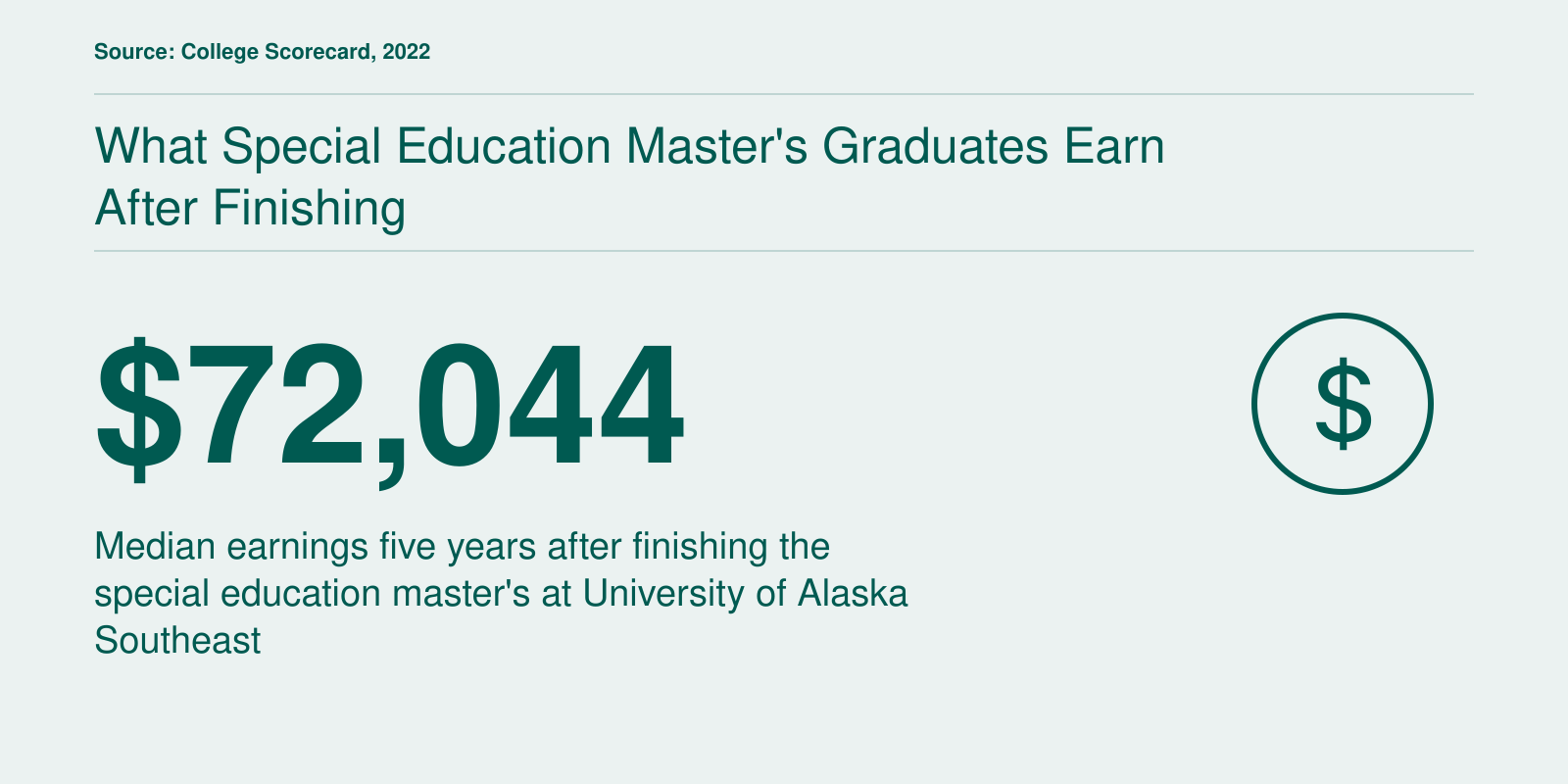
The clearest program-level earnings figure in the federal data comes from University of Alaska Southeast. Its special education master's graduates earn a median of $72,044 five years after finishing.
Scholarships, Loan Forgiveness, and Aid for Alaska Special Ed Teachers
Federal Teacher Loan Forgiveness can cancel up to $17,500 of eligible Direct or Stafford loans for highly qualified special education teachers. To qualify, you must complete five consecutive full-time years at a qualifying low-income school or educational service agency. Teachers outside the qualifying subject areas receive up to $5,000.
The TEACH Grant carries a $4,000 statutory annual maximum and an $8,000 lifetime limit for graduate study. Awards first disbursed before October 1, 2026 were reduced 5.7%, to $3,772, so confirm this year's amount with your financial aid office. Recipients must teach full time in a high-need field at a school serving low-income students.
The University of Alaska points teachers to PITAAS (Preparing Indigenous Teachers & Administrators for Alaska Schools). It also notes that most rural Alaska schools qualify for some federal forgiveness. Awards range from $5,000 to full cancellation, depending on loan type, certification area and years taught.
Next step: file the FAFSA, ask your district about tuition support, and weigh total cost against the table above, including master's in education tuition cost in Alaska.
Your Questions About Special Education Master's Degrees in Alaska, Answered
What is the cheapest master's in special education program in Alaska?
How long does a special education master's take in Alaska for full-time and part-time students?
Do I need a teaching license to enroll in a special education master's in Alaska?
Does the University of Alaska offer online special education master's programs?
What is the job outlook for special education teachers in Alaska?
Compare Special Education programs on the data that matters
Explore more Education & Teaching specializations or browse every graduate field.
All Education & Teaching programs