Master's Programs in Kentucky
Every master's program reported by a school in Kentucky: 590+ programs at 30+ graduate schools, with the online options, costs and outcomes behind each one.

A master's degree in Kentucky is a 30-credit graduate credential, often earned part-time, and priced very differently depending on which public university issues it. EKU's qualifying education programs run $437 per credit hour, while the University of Kentucky's out-of-state rates sit far above its in-state ones. Cost is only one variable. Format (fully online, hybrid, or on campus) and licensure eligibility can matter as much, especially for counseling psychology and nursing, where the degree must meet state board standards.
The verified earnings data is thin outside a few fields. Business graduates from UK show a median salary of $110,670 five years out, but most programs have no comparable figure. Price, accreditation, and the job you are targeting should drive the choice, not the name on the diploma.
Key Points
- Eastern Kentucky University charges $437 per credit hour for qualifying education programs, among the lowest rates in the state.
- University of Kentucky business and commerce master's graduates report a median salary of $110,670 five years after completing.
- Counseling licensure requires a CACREP-accredited master's for anyone who began a degree in Summer 2015 or later.
Popular degrees in Kentucky
Master's programs in Kentucky by field
Business & Management
- Healthcare Administration17 programs
- Information Technology Management16 programs
- Management16 programs
- Public Administration15 programs
- Accounting15 programs
- General Business13 programs
- Marketing12 programs
- Finance11 programs
Education & Teaching
- Teaching33 programs
- Library Science or Library and Information Science or Library Media10 programs
- Special Education9 programs
- STEM Education or Science Education or Mathematics Education8 programs
- Educational Leadership5 programs
- Secondary Education5 programs
- Reading & Literacy5 programs
- Music Education5 programs
Nursing
- Family Nurse Practitioner (FNP)10 programs
- Psychiatric Mental Health Nurse Practitioner9 programs
- Nursing Education or Nurse Educator8 programs
- Nurse Administrator5 programs
- Adult Gerontology Acute Care Nurse Practitioner3 programs
- Adult Gerontology Primary Care Nurse Practitioner2 programs
- MSN/MBA2 programs
- Nurse Executive Leader2 programs
Healthcare
- Health Administration10 programs
- Exercise Science6 programs
- Public Health6 programs
- Health Education6 programs
- Speech Pathology6 programs
- Nutrition4 programs
- Health Informatics1 program
Social Work & Social Sciences
- Social Work18 programs
- Social Work Advanced Standing9 programs
- Sociology3 programs
- Political Science, Government2 programs
- Human Services1 program
Religion & Theology
- Christian Ministry9 programs
- Divinity8 programs
- Theology6 programs
- Christian Leadership4 programs
- Youth and Family Ministry4 programs
Communications & Media
- Communication10 programs
- Communication Disorders7 programs
- Speech Pathology7 programs
- Media Communication3 programs
- Organizational Communication2 programs
- Public Relations1 program
Counseling
- Clinical Mental Health Counseling10 programs
- School Counseling9 programs
- Marriage and Family Therapy or Marriage and Family Counseling3 programs
- Addiction Counseling3 programs
- Christian Counseling1 program
Psychology
- Clinical Psychology7 programs
- Applied Behavior Analysis7 programs
- General Psychology4 programs
- Industrial Organizational Psychology3 programs
- Counseling Psychology3 programs
- Sports Psychology1 program
- Educational Psychology or School Psychology1 program
Computers & IT
- Cybersecurity10 programs
- Information Security & Assurance6 programs
- Data Analytics4 programs
- Machine Learning1 program
Arts & Design
- Creative Writing14 programs
- Fine Arts1 program
- Interior Design1 program
Science & Engineering
- Environmental Science7 programs
- Sustainability or Environmental Management5 programs
- Geography3 programs
Criminal Justice & Law
- Legal Studies2 programs
- Public Policy2 programs
- Homeland Security1 program
Kentucky Master's Tuition Comparison: UK, Uofl, WKU, EKU and More
Rates below are the general graduate per-credit tuition figures published in the schools' current 2026 schedules. Estimated totals multiply each school's in-state per-credit rate by 30 credits. University of Kentucky has the widest in-state to out-of-state gap among the schools shown, while WKU, EKU, and NKU are much closer across residency categories; MBA, nursing, counseling, and other professional programs often carry separate higher per-credit rates, and UK Online program-specific rates apply to Kentucky residents and nonresidents alike.
| School | In-State Per Credit | Out-of-State Per Credit | Online Per Credit | Est. 30-Credit Tuition |
|---|---|---|---|---|
| University of Kentucky | $841.50 | $2,100.50 | $806.00 | $25,245 |
| Western Kentucky University | $607 | $917 | $707 | $18,210 |
| Eastern Kentucky University | $607 | $829 | $676 | $18,210 |
| Northern Kentucky University | $605 | $928 | $718 | $18,150 |
Where to Find the Cheapest Master's Degree in Kentucky
The cheapest master's degrees in Kentucky are at the regional public universities, not the flagship, and education programs sit at the bottom of the price list. Eastern Kentucky University charges $437 per credit hour for qualifying programs in its College of Education and Applied Human Sciences, and extends that same rate to active Kentucky teachers.1 On the published 2026 rates, that is the lowest figure available, though it does not cover every Kentucky public university and fee inclusions differ by school.
Among broader online rates, Murray State lists $631 per credit plus a $50 per credit online course fee2, Northern Kentucky University posts $718 for online graduate work3, and Western Kentucky University charges $707 per credit for distance learning courses. EKU's catch-all online graduate rate is $676.1 Note that professional programs cost more almost everywhere: EKU's MBA programs, applied behavior analysis and MSN programs run $733 per credit.1
The three levers that move your total
- Residency: The spread is real. WKU charges $607 per credit in-state versus $917 for domestic nonresidents and $953 for international students. NKU's nonresident rate is $928 against $605 in-state.3
- Online flat rates: WKU's distance learning rate applies regardless of residency, which can make online cheaper than campus for out-of-state students. NKU also offers a Graduate Metro rate of $735, though geographic eligibility should be confirmed.3
- Credit count: A 30-credit program at $676 costs roughly $20,280; a 36-credit program at the same rate adds about $4,000. Always multiply, never compare per-credit prices alone.1
The Academic Common Market
Kentucky participates in the SREB Academic Common Market, which lets residents of the 15 member states pay in-state tuition at approved out-of-state public programs.4 Admission is not competitive, but the program must be approved for Kentucky and at least 50 percent distinct from anything a Kentucky public university offers.5 Expect a course-by-course review taking six weeks or more, plus residency documentation and tax returns.5 First professional doctoral degrees are excluded, and approval does not guarantee a flat online rate.4
When you compare, add mandatory fees, program-specific fees and the income you give up while enrolled. Sticker tuition is only part of what you pay.
Online, Hybrid and Campus Master's Formats in Kentucky
Kentucky's public universities have moved a growing share of their professional master's degrees online, including online MSW programs, but the format label on a program page often hides how much of the degree still happens in person.
Are there fully online master's programs in Kentucky?
Yes. The University of Kentucky offers its Master of Social Work fully online, and also in a hybrid version.1 The University of Louisville's Kent School delivers its Master of Science in Social Work online.2 Western Kentucky University lists a range of online degrees, including Social Work (MSW), though its page does not say whether that program is fully online or hybrid. For other schools, such as EKU, Murray State and NKU, confirm the current delivery format with the program directly before you rely on a listing.
Four formats, and who each suits
- Asynchronous online: Coursework is completed on your own schedule within weekly deadlines. It suits students with unpredictable shifts or long commutes.
- Synchronous online: Live virtual class meetings at set times. It suits students who want discussion and cohort contact but cannot relocate.
- Hybrid: WKU defines hybrid as at least one required in-person campus commitment, with more than half the coursework online. Its Clinical Mental Health Counseling and Nursing (MSN) master's are listed this way. It fits students within driving distance who want some face time.
- Traditional campus: Best for full-time students who want assistantships, labs or research access.
Program pages do not always say which online style a course uses, so ask before you enroll.
Online still means in-person fieldwork
Nursing, counseling, MSW programs, and education degrees all require supervised practice. At UofL, online and campus MSSW students alike complete a hands-on agency placement with weekly scheduled hours, usually in person near home.4 Generalist practicum runs about 16 hours a week and the specialized practicum about 18.2 Remote placements are a rare exception.4 UK's MSW practicum courses are 300 hours each over a 16-week term, and the number you need depends on whether you enter with regular or advanced standing. UK's curriculum pages give conflicting totals, so confirm yours with an advisor.
Accelerated terms
Shorter terms help working adults finish sooner. UK's MSW, for example, runs 16-week courses in fall and spring but eight-week courses in summer.3 Eastern Kentucky University runs seven-week terms in fall and spring and six-to-seven-week terms in summer, but other schools vary, so ask each school about its term calendar and how many courses you can take at once.
What Kentucky Graduate Schools Typically Require
Requirements vary by school and program, so treat the figures below as typical benchmarks and confirm details with each graduate office before you apply.
- Bachelor's degreeApplicants generally need a bachelor's degree from a regionally accredited institution, and some programs require it to be in a related field.
- Minimum GPAUniversitywide minimums are about 2.5 at Eastern Kentucky University and 2.75 at Western Kentucky University and the University of Louisville, while many competitive programs prefer 3.0 or higher.
- Conditional admissionThe University of Louisville may refer applicants with a 2.50–2.74 GPA for special conditions, which includes earning a 3.0 in the first nine credit hours.
- TranscriptsExpect to submit official transcripts from every college you have attended.
- Resume, statement of purpose and recommendationsMost programs ask for a current resume, a statement of purpose and letters of recommendation, and the WKU MBA looks for roughly three to five years of professional experience.
- GRE or GMATIt depends on the program: the University of Louisville and Western Kentucky University say requirements are set program by program, and WKU may accept a related master's degree in place of the GRE General Test, so check your specific program before you register for an exam.
- Nursing (MSN) prerequisitesMSN applicants typically need a BSN and an unencumbered RN license, a 3.0 GPA at WKU, EKU and (recommended) Louisville, plus one year of RN experience and a 3-credit statistics course at EKU.
- Entry-to-nursing for non-nursesWKU's MEPN track for applicants without an RN license requires a 3.0 GPA, anatomy and physiology and nutrition coursework, and a HESI score of at least 80.
- Education, counseling and business prerequisitesSome education master's degrees require a teaching certificate, and counseling and business programs may ask for prerequisite coursework, so confirm these with the program.
Application Deadlines and How Long a Kentucky Master's Takes
Kentucky graduate admissions now run on two clocks at once: flexible rolling windows for many online programs, and fixed dates for cohort programs. Knowing which one applies to your degree matters more than any university-wide calendar.
Rolling Admissions vs. Fixed Deadlines
Rolling programs review files as they arrive and fill seats until the term starts. Eastern Kentucky University's MPH works this way.1 Cohort programs, which commonly include counseling, social work and clinical nursing, usually set one annual deadline and admit a single class, so a missed date can mean waiting a full year. Check each program's own page, because Western Kentucky University states that deadlines vary by program, and it accepts applications up to a year in advance.
Example Deadlines to Plan Around
- EKU Biology and Technology Management (MS): January 14 for spring, May 5 for summer, August 1 for fall.1
- EKU English and Writing Professions (MA): January 14 for spring, May 25 for summer, August 13 for fall.1
- UK Curriculum and Instruction: rolling, but submit by about July 15 for fall, December 15 for spring and April 1 for summer.
- UK Online MS in Higher Education: December 11, 2026 for the January 11, 2027 start.
International applicants face earlier dates. The same UK Curriculum and Instruction program lists March 15 for fall and August 22 for spring, and it does not consider international applicants for summer. UK Graduate School Admissions says many programs set earlier deadlines than its general cutoff, so confirm dates directly.
How Long Does a Kentucky Master's Take?
Full-time students typically finish in one to two years, depending on credit requirements and any thesis, practicum or clinical hours. Part-time students usually need two to three years or more. Accelerated online formats can shorten that, often through shorter terms and year-round enrollment, though the pace varies by program. Ask each department for its own completion timeline.
Applying for Assistantships
If you want assistantship consideration, aim to apply four to six months before your start term. Funding decisions often come alongside admission, and applicants admitted as non-degree students at EKU are not eligible for graduate assistantships.2
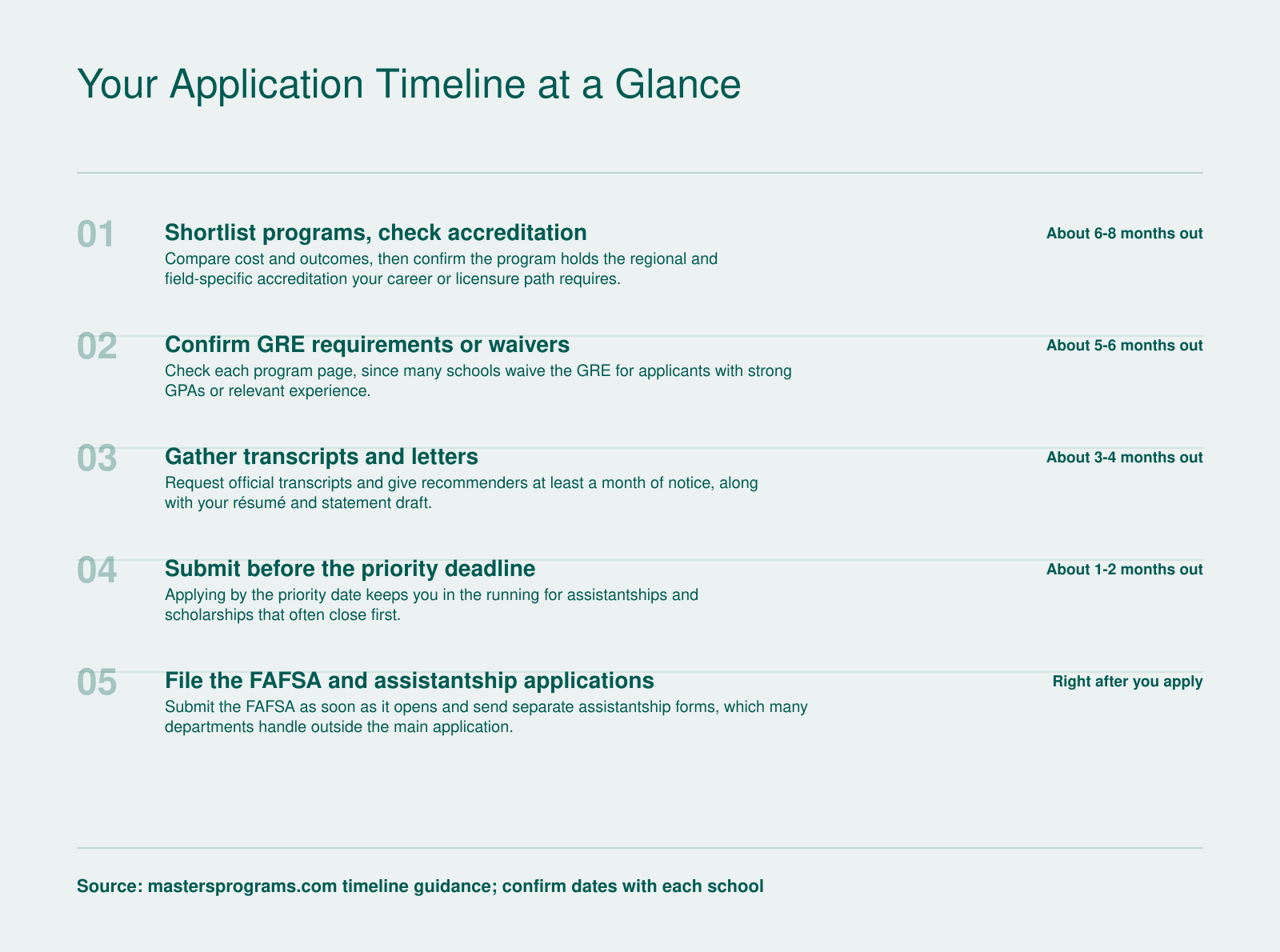
Your Application Timeline at a Glance
Work backward from the priority deadline for your shortlisted programs. These lead times are rough guides, so adjust them to each school's published dates.
Funding Your Kentucky Graduate Degree
Very few Kentucky graduate students pay full sticker price, and the discounts that matter most come from three places: an assistantship, an employer tuition benefit, or federal loan forgiveness tied to the job you take after graduation.
Assistantships Reward Being On Campus
Graduate assistantships at Kentucky's public universities typically bundle a tuition waiver with a stipend for teaching, research, or administrative work, and some appointments add health insurance. They are awarded by departments rather than a central office, so terms, hours, and stipend levels differ from one program to the next, and current amounts are not published in any single statewide place. Ask the graduate coordinator directly. One pattern holds across the state: assistantships overwhelmingly go to full-time, campus-based students, since the work is on site. Fully online students who are also working should build a budget without one and should compare several affordable online master's programs before choosing.
School-level scholarships and fellowships follow the same logic. Most are administered by the college or department, not advertised centrally, so the practical move is to ask whether your admission application also puts you in the pool for funding or whether a separate form is required.
Employer Tuition Benefits Are the Quiet Bargain
If you work for a Kentucky public university, the employee waiver can cover most of a master's. The University of Kentucky waives tuition and mandatory fees for regular employees at 0.75 FTE or higher, up to 8 credit hours per semester and 18 per year, with graduate coursework included for eligible staff and only one UK tuition benefit allowed per semester.1 Western Kentucky covers 6 credits a semester for full-time employees (18 per year, counting winter and summer), 3 per semester for part-timers after a service period, plus a 50% discount for spouses and dependents. Eastern Kentucky waives tuition for up to 6 credits a semester and lets employees transfer the benefit so a spouse or dependent can take up to 12. Read the fine print: EKU's waiver excludes course fees and books, benefits above $5,250 in a year can become taxable,2 and leaving within a year can trigger full repayment (75% within two).3 WKU's reciprocal benefit with other state institutions carries an enrollment-date eligibility limit worth verifying before you count on it. Outside higher education, ask your HR office whether tuition assistance exists before assuming it doesn't.
Loans and Forgiveness
Federal Direct Unsubsidized loans cover most graduate borrowing, with Grad PLUS available for the remainder. If you head into public school teaching (a field where many pursue Best M.Ed. Programs), a public or nonprofit health system, or a public social services agency, Public Service Loan Forgiveness can erase the balance after 120 qualifying payments. Factor that in before comparing loan totals across programs.
Counselor Licensure in Kentucky
Career Outcomes and Earnings for Kentucky Master's Graduates
The University of Kentucky's business and commerce master's graduates show a median salary of $110,670 five years after completion, based on 116 graduates in federal College Scorecard field-of-study data.1 That is the strongest verified figure available for a Kentucky master's program. A separate 2026 listing shows about $111,8682, and the sources don't explain whether the gap comes from release year, cohort or method, so treat the number as roughly $110,000 to $112,000.
What the Field-Level Numbers Show
- UK business/commerce master's: about $110,670, five years after completion.1
- WKU business administration master's: $103,485 on a later measure, up from $69,436 on an earlier one. The listings don't label the exact years, so the two figures can't be compared cleanly.
- WKU teacher education master's: $59,916 later, $49,133 earlier, with the same labeling caveat.
Nursing and UK teacher education are thin. UK reports 57 graduate-level nursing completers and WKU 47, but no master's median is published for either group. UK's graduate teacher education group has only 10 completers. UofL and EKU have no master's earnings median we could verify.
A Simple Value Check
Take the total program cost from the tuition comparison above and set it against these medians. A business master's costing less than a year of median pay at roughly $103,000 to $110,000 is an easy call. A teaching master's with a median near $60,000 deserves a harder look at total price, especially if the degree brings a pay-scale increase you can confirm with your district. Note also that WKU's institution-wide median four years out is $56,528, compared with $33,352 for Kentucky high school graduates aged 25 to 34. That comparison covers all WKU levels, not just master's holders, so it shows a general premium, not a graduate-degree one.
Limits Worth Knowing
I found no published Kentucky Center for Statistics figures on in-state employment or wages for graduate-degree completers, so there is no verified state-level master's premium to cite. Check that office directly if you need one.
Scorecard earnings also cover only former students who received federal aid, and they are cohort medians, not offers or guarantees. Labels can combine several programs, so a business median may not map neatly to one MBA track. Pay also differs by location: Louisville and Lexington employers typically pay differently than rural Kentucky employers, so weigh where you plan to work.
Research University, Regional University or Online-First: Which Fits You?
Is a Kentucky master's from UK or UofL worth more than one from WKU, EKU or an online-first program? The evidence does not support a clean answer. Available data mostly compares online and in-person delivery, not institutional category, so treat the points below as general patterns to verify with each program.
How the Three Types Compare
- Research universities (UK, UofL): Tuition is typically the highest of the three, though it varies by program. Assistantships and funded research roles are most common here, admissions tend to be more selective, and faculty research networks are strongest. Schedules lean toward full-time study, with some part-time and evening options.
- Regional comprehensive universities (WKU, EKU, Murray State, NKU, Morehead State): Costs are generally lower, admissions are usually more accessible, and many programs are built for working adults, with evening, hybrid or online options. Assistantships exist but are often fewer and smaller. Ties to regional employers, schools and health systems can be a real advantage for local careers.
- Online-first programs: Flexibility is the main draw, and no relocation is required. Cost varies widely, and assistantships are rare. Networking and research access depend on how deliberately the program builds them.
What the Outcome Data Suggests
Online study is mainstream: federal data shows 40.5% of U.S. graduate students study exclusively online.1 One same-program comparison found online median wages trailing traditional ones by roughly 1% to 4% in most fields, and 8.3% in engineering, though it does not say what "traditional" means. Hiring-manager surveys vary: a 2025 survey found 91% would not reject a candidate over an online degree, yet 42% preferred traditional degrees for leadership roles. Online completion for master's programs (52.3%) sits close to on-campus (54.1%).2
A Simple Decision Rule
Start with licensure and accreditation. If you need clinical mental health counseling, nursing or teaching credentials, confirm the program meets Kentucky board requirements and holds the right accreditation, since that can eliminate options outright. Next, compare net cost and likely debt using each school's published figures. Last, choose the format your job and family can sustain through completion, because a finished degree beats an ideal one you abandon.
Graduate schools in Kentucky with the most master's programs
| School | City | Type | Master's programs | Online | Grad tuition / yr |
|---|---|---|---|---|---|
| University of Kentucky | Lexington | Public | 58 | 24 | $14,644 |
| Western Kentucky University | Bowling Green | Public | 53 | 32 | $12,140 |
| University of Louisville | Louisville | Public | 52 | 28 | $15,128 |
| Northern Kentucky University | Highland Heights | Public | 50 | 43 | $10,788 |
| Eastern Kentucky University | Richmond | Public | 49 | 35 | $10,794 |
| Murray State University | Murray | Public | 36 | 25 | $10,683 |
| Campbellsville University | Campbellsville | Private nonprofit | 34 | 33 | $9,920 |
| University of the Cumberlands | Williamsburg | Private nonprofit | 34 | 29 | $3,195 |
| Morehead State University | Morehead | Public | 24 | 22 | $10,512 |
| Spalding University | Louisville | Private nonprofit | 23 | 14 | $12,530 |
| Midway University | Midway | Private nonprofit | 19 | 16 | $5,650 |
| Bellarmine University | Louisville | Private nonprofit | 16 | 12 | $14,760 |
| Sullivan University | Louisville | Private for-profit | 14 | 14 | $15,840 |
| Lindsey Wilson University | Columbia | Private nonprofit | 11 | 10 | $10,163 |
| Union Commonwealth University | Barbourville | Private nonprofit | 11 | 10 | $8,930 |
Program counts are the verified master's listings in our directory; tuition is the school-wide average for a full-time graduate student (IPEDS).
Kentucky Master's Programs: Quick Answers
These short answers cover the questions applicants ask most often. Policies differ by school and by program, so confirm details with the program you are considering.
Are online master's programs in Kentucky as respected as on-campus degrees?
Do Kentucky master's programs require the GRE?
Can I transfer graduate credits into a Kentucky master's program?
Can I start a Kentucky master's in spring or summer?
Compare programs nationwide
Many Kentucky residents study online. Every ranked list above has an online lens, or browse every field.
Online master's programs Browse all fields