Master's Programs in Massachusetts
Every master's program reported by a school in Massachusetts: 1,400+ programs at 60+ graduate schools, with the online options, costs and outcomes behind each one.

Massachusetts pairs some of the most respected graduate schools in the country with some of its steepest costs, and the gap between sticker price and real return keeps widening. A full-time year at UMass Amherst budgets near $50,000 for an in-state student, and Greater Boston rents push that figure higher at private campuses.
The practical questions are what a degree actually costs, which routes run cheapest, how far online options go, which programs have dropped the GRE, and which fields repay the borrowing. Licensure, funding, and international enrollment rules shape those answers as much as tuition does.
In this state, the better-known name is not always the better value, and program-level earnings data is where that shows up.
Key Points
- UMass Amherst's 2026-27 in-state graduate budget totals $49,969, with housing nearly matching tuition.
- Check programmatic accreditation, since LMHC licensure requires at least 48 semester credits.
- International students need on-campus F-1 study and a program on the DHS STEM list.
Popular degrees in Massachusetts
Master's programs in Massachusetts by field
Business & Management
- Management46 programs
- Analytics45 programs
- Finance42 programs
- Accounting36 programs
- Marketing36 programs
- General Business28 programs
- Public Administration28 programs
- Healthcare Administration24 programs
Education & Teaching
- Special Education44 programs
- Teaching39 programs
- Secondary Education36 programs
- Elementary Education30 programs
- Early Childhood Education29 programs
- STEM Education or Science Education or Mathematics Education23 programs
- Educational Leadership18 programs
- Reading & Literacy18 programs
Nursing
- Family Nurse Practitioner (FNP)16 programs
- Nursing Education or Nurse Educator16 programs
- Psychiatric Mental Health Nurse Practitioner14 programs
- Direct Entry MSN (MENP) or (DEMSN)13 programs
- Nurse Administrator11 programs
- Adult Gerontology Primary Care Nurse Practitioner8 programs
- Public Health6 programs
- Pediatric Nurse Practitioner5 programs
Psychology
- Applied Behavior Analysis20 programs
- Educational Psychology or School Psychology17 programs
- Counseling Psychology12 programs
- School Psychology10 programs
- General Psychology7 programs
- Clinical Psychology6 programs
- Applied Psychology6 programs
- Industrial Organizational Psychology5 programs
Healthcare
- Nutrition18 programs
- Public Health15 programs
- Health Informatics15 programs
- Health Administration14 programs
- Speech Pathology11 programs
- Health Education9 programs
- Exercise Science4 programs
- Clinical Research Management2 programs
Communications & Media
- Communication18 programs
- Communication Disorders10 programs
- Public Relations9 programs
- Speech Pathology9 programs
- Journalism5 programs
- Media Communication4 programs
- Organizational Communication4 programs
- Advertising4 programs
Social Work & Social Sciences
- Social Work24 programs
- Social Work Advanced Standing17 programs
- Sociology7 programs
- Political Science, Government7 programs
- Human Services2 programs
Counseling
- School Counseling24 programs
- Clinical Mental Health Counseling20 programs
- Marriage and Family Therapy or Marriage and Family Counseling5 programs
- Addiction Counseling4 programs
- Christian Counseling1 program
Science & Engineering
- Sustainability or Environmental Management25 programs
- Environmental Science22 programs
- Geography4 programs
Computers & IT
- Data Analytics19 programs
- Cybersecurity16 programs
- Machine Learning9 programs
- Information Security & Assurance7 programs
Criminal Justice & Law
- Public Policy14 programs
- Master of Laws8 programs
- Homeland Security6 programs
- Legal Studies3 programs
- Cybercrime2 programs
- Business Law2 programs
- Fire Science or Fire Administration or Fire Leadership1 program
Arts & Design
- Creative Writing18 programs
- Fine Arts6 programs
Religion & Theology
- Divinity8 programs
- Theology8 programs
- Christian Ministry3 programs
- Christian Leadership1 program
- Urban Ministry1 program
What You'll Pay: Public vs. Private Master's Tuition in Massachusetts
Each figure below is labeled with its academic year, and rates change often, so confirm current numbers on the school's bursar page before budgeting. Public universities generally anchor the low-cost tier (in-state UMass rates and the Massachusetts state universities), while private schools charge one rate regardless of residency. Base tuition is only part of the bill: mandatory fees and differential tuition for programs such as MBA, nursing, and engineering can push totals well above the per-credit rate, and the Tufts rows show how much rates vary even within one university.
| School | Sector | In-State Tuition (per credit) | Out-of-State Tuition (per credit) | Est. Program Total | Notes |
|---|---|---|---|---|---|
| UMass Amherst | Public research university | $2,401 (2026-2027) | $2,401 plus a nonresident differential (amount not confirmed) | N/A | At 1 credit, service fee is $254 and senate tax is $86, for $2,741 total before program-specific charges. One-time entering fee is $507; continuous enrollment fee is $295. |
| Bridgewater State University | Public state university | N/A (resident rate not confirmed in sources reviewed; FY2026) | $7,050 (FY2026 nonresident graduate rate as listed by the Board of Higher Education; confirm billing unit) | N/A | Mandatory fees not confirmed. Check the bursar page for resident rates and fees. |
| Framingham State University | Public state university | N/A (resident rate not confirmed in sources reviewed; FY2026) | $7,050 (FY2026 nonresident graduate rate as listed by the Board of Higher Education; confirm billing unit) | N/A | Mandatory fees not confirmed. Check the bursar page for resident rates and fees. |
| Harvard Extension School | Private continuing-education school | $895 (2026-2027) | $895 (2026-2027) | N/A | No supplemental tuition. $100 degree-program application fee, $40 per-term payment-plan fee, and a possible $150 fee for on-campus lab courses. |
| Boston University | Private research university | $3,043 (2026) | $3,043 (2026) | N/A | $75 student services fee and $75 technology fee per semester. Rates vary by program. |
| Tufts University: Fletcher Executive MIB (online) | Private research university | $2,664 (2026-2027) | $2,664 (2026-2027) | About $95,904 for 36 credits (2026-2027) | Flat rate for all students. Example of a professional program priced well above general graduate rates. |
| Tufts University: Friedman School online M.S. | Private research university | $2,224 (2026-2027) | $2,224 (2026-2027) | $66,720 for 30 credits (2026-2027) | $250 technology fee, $250 health administration fee, and $250 activity fee. |
| Tufts University: School of Engineering Fifth-Year M.S. | Private research university | $1,855 (2026-2027) | $1,855 (2026-2027) | N/A | Flat rate for all students. Fifth-year format is aimed at Tufts undergraduates; confirm eligibility and fees. |
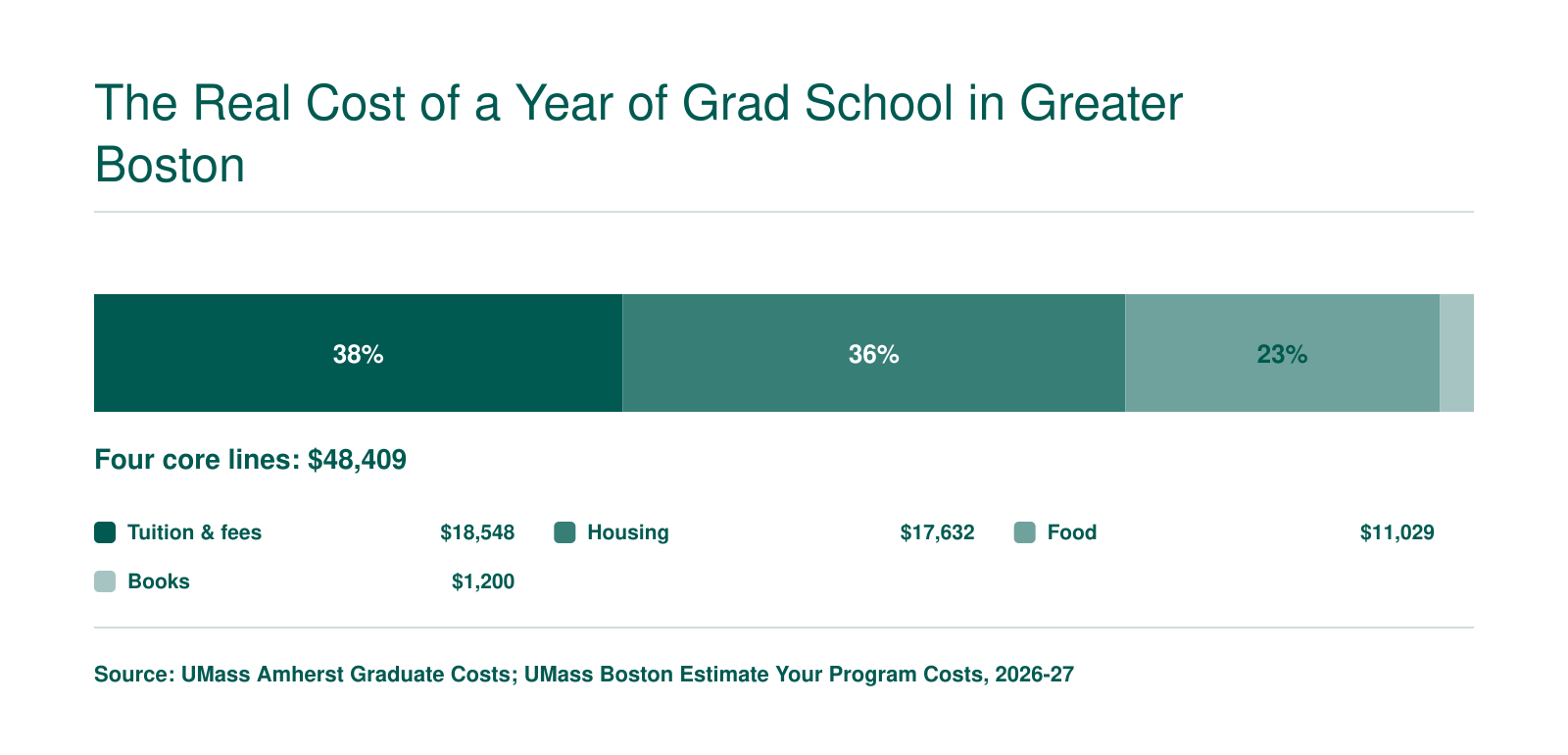
The Real Cost of a Year of Grad School in Greater Boston
UMass Amherst's published 2026-27 graduate budget for an in-state, full-time student totals $49,969, and four of its lines are shown below. Housing nearly matches tuition and fees, and at UMass Boston it runs $1,110-$2,200 a month depending on occupancy, so over 12 months it can top tuition. Massachusetts also requires health insurance for students taking 5 or more credits, which adds a line many out-of-state applicants miss: UMass Amherst lists $2,444 for the Fall 2026 plan plus a $470 health fee, and UMass Boston estimates $3,241 a year.
Online, Hybrid, and Evening Master's Formats in Massachusetts
A master's program's format is simply where and when you take classes. In Massachusetts, that usually means one of three setups: fully online coursework, hybrid or low-residency programs that blend online study with short campus visits, and evening or part-time classes held on campus for people who work during the day.
Which Format Fits You
- Fully online: Best for working professionals who need to study around a job, family, or a location outside Massachusetts. Many programs are asynchronous, so there is no fixed class time.
- Hybrid or low-residency: Suits students who want online flexibility but value some face-to-face networking. Plan for travel and lodging costs.
- Evening or part-time on campus: A good match if you live within commuting distance of Boston or another campus and learn better in a classroom.
Where to Look
UMass Online serves as the public system's front door to online graduate study, but tuition and policies are set by each campus and program. UMass Amherst publishes online course rates of $680 per credit for 2026, plus fees such as a $507 matriculation fee and an $85 per-semester registration fee, and notes that costs vary by course. Northeastern runs a large catalog of 100% online master's degrees; its online MS in Management, for example, is 30 credits over about 12 months at $820 per credit1, and its online MS in Information Systems is estimated at $24,6002. Those totals are based on 2026-2027 rates and exclude fees. Harvard Extension School's master's degrees are primarily online but each requires an on-campus component lasting anywhere from two weekends to three weeks, with courses priced at $3,580 each for 2026-20273.
The Residency Question
This is where out-of-state students can find real savings. UMass Lowell's Graduate, Online and Professional Studies division charges the same tuition whether you live in Massachusetts, another state, or abroad, and lists $750 per credit for Fall 2026 (selected online nursing courses carry separate rates expected to rise). Private schools like Northeastern don't distinguish by residency at all, though pricing still varies by program. Don't assume every online program at a public campus uses a flat rate; confirm with the specific department.
A Warning for Licensure Tracks
Online coursework rarely covers everything for licensed fields. Counseling, MSN programs, and M.Ed. programs typically require in-person practicums, clinical hours, or student teaching, often at approved Massachusetts sites. If you live out of state, ask how placements work before you enroll. International students should also note that some fully online programs are not eligible for an F-1 visa.
Admissions: GRE Policies, Deadlines, and Application Essentials
Choosing No-GRE master's programs saves you time and money, but it doesn't mean every program has dropped its quantitative expectations. Massachusetts has no single policy, and the program page controls wherever it differs from the university's general rules.
Do Massachusetts master's programs require the GRE?
Often not, though it depends on the program. UMass Amherst's Graduate School requires GRE or GMAT scores only where a program specifies them, and it automatically waives them for applicants with a U.S. JD, PhD, or MD from a regionally accredited institution. Communication, for example, lists the GRE as optional with no minimum score. Mathematics and Statistics requires the Mathematics Subject GRE only for the Mathematics PhD, not for the Applied Math or Statistics master's, and recommends the general test without requiring it.
Quantitative fields are less relaxed. Economics asks all applicants for the GRE General Test, and entering students usually score 151 or higher on the quantitative section. The Isenberg MS in Business Analytics waives the GMAT or GRE for applicants with a 3.0 GPA or above, and applicants below that can still be considered on professional experience. UMass Boston says some programs require official GRE or GMAT scores and offers waivers to Massachusetts residents with documented developmental disabilities. Current test policies for Northeastern and Boston University are not available in the sources reviewed, so check each program page directly.
Deadlines: priority versus rolling
Funding-heavy, research-oriented programs tend to set priority deadlines between December and February for fall entry. Economics lists January 10 for the fall 2027 cycle. Professional and online programs often run later or on a rolling basis. Isenberg's Business Analytics program has a June 1 priority date and an August 1 final date. Its Master of Finance has four fall dates, from November 1 through August 1. Public Policy lists April 15 for on-campus and July 31 for online, a rhythm common to many MPA programs. Dates change each cycle, so confirm the one for your entry term.
The core application package
- Transcripts: Official records from every undergraduate institution.
- GPA: UMass Amherst and UMass Boston both use a 2.75 minimum, and some programs set higher or lower thresholds (Communication states 2.7). Many programs review applications holistically, so a lower GPA is not automatically disqualifying.
- Statement of purpose: Tie your goals to specific faculty, concentrations, or labs.
- Recommendations: Usually two or three, ideally from professors or supervisors.
- Résumé: Especially important for professional programs and for test waivers based on work experience.
- Prerequisites: Fields such as nursing and data science may require specific coursework, so complete gaps before you apply.
Apply by the priority date
Assistantship and scholarship consideration is often tied to the priority deadline. A late application can still be admitted without funding, which changes the cost picture considerably. If money matters, treat the priority date as the real deadline.
Funding a Massachusetts Master's: Assistantships, Scholarships, and Loans
Paying for a master's in Massachusetts usually means stitching together four sources: an assistantship that pays you to work for the university, an employer that covers part of your tuition, merit money from the department, and federal loans for whatever is left. How much of each you can get depends far more on the type of program you pick than on the school's name.
Assistantships pay the most, but not everyone gets one
A graduate assistantship is a formal work contract with your department: you teach, grade, or support a research lab, and in return you receive a stipend and, usually, a tuition credit. At UMass Amherst, the published minimum hourly rate is $41.24 as of September 6, 2026, which translates to a minimum nine-month stipend of $31,342.40 for a half-time appointment, with some departments paying more. Appointments of at least 10 hours a week across a full 19-week semester generally qualify for a tuition credit under the graduate employee union contract, along with health benefits. One important exclusion: the tuition benefit typically does not cover University+ courses, and many online offerings fall in that category, so an online student may still be billed.
UMass Boston posts similar tiers for Fall 2026. A full assistantship runs 18 contractual hours with a biweekly stipend of $1,293.25, totaling $12,932.50 for the term, and carries a 100% tuition waiver.1 Three-quarter and half appointments scale down to 75% and 50% waivers.1 The number of appointments is limited by departmental budget. In practice, assistantships cluster in research and academic programs, such as sociology master's programs with assistantships; professional master's degrees and online formats, including the best online MBA programs, rarely offer them.
Employer help and the loan gap
Tuition assistance is common among Boston-area hospitals, biotech firms, and technology employers. Federal tax law lets an employer provide up to $5,250 per employee per calendar year in educational assistance tax-free; anything above that is generally taxable as wages. Read the fine print on grade minimums and service commitments before you enroll.
Federal graduate borrowing rules are in flux in 2026, with reported changes to Grad PLUS eligibility and new annual and lifetime caps on graduate loans. Confirm the borrowing rules that apply to you through the financial aid office rather than assuming you can borrow up to full cost, and budget for a gap on expensive private programs. Finally, ask admissions directly what share of students in your specific track receive funding. A vague answer is itself informative.
Accreditation and Licensure: What to Verify Before You Enroll
Institutional accreditation tells you a school meets baseline quality standards; programmatic accreditation tells you a specific degree will qualify you for the license or certification your career requires. For licensed fields, you need both, and the second one is the one people overlook.
Confirm the Institution First
Most Massachusetts colleges and universities are accredited by the New England Commission of Higher Education (NECHE), the regional institutional accreditor. NECHE evaluates the institution as a whole, including its programs, locations, and online offerings, through a continuing relationship that includes a comprehensive review with a peer site visit at least every ten years.1 It does not accredit individual programs. You can verify any school's status in the U.S. Department of Education's accreditation database, and NECHE advises contacting a school's registrar to confirm standing and obtain proof of a degree awarded.
Programmatic Accreditation for Licensed Fields
For regulated careers, the program's own accreditation matters more than the school's name:
- Counseling: CACREP accreditation is effectively expected for the LMHC path and smooths licensure review.
- Nursing: CCNE or ACEN accreditation is required; Massachusetts APRN authorization depends on completing a graduate program recognized by the Board.3
- Public health: CEPH accreditation is the standard signal for MPH programs.
- Business: AACSB is a strong quality marker but is not legally required to work in the field.
If a field does not lead to a state license, programmatic accreditation is a quality indicator rather than a gatekeeper.
Nursing and Educator Pathways
Massachusetts APRN applicants must hold current RN licensure2 (earned by passing the NCLEX after an approved program)5 and show graduate-level coursework in advanced pathophysiology, advanced physical assessment, and pharmacotherapeutics.3 The Board requires primary-source verification of your education and certification, so your transcript and credentials are checked at the source.4
For teachers, a master's degree is commonly part of advancing from an Initial to a Professional educator license through DESE, but exact requirements vary by license category and current regulations. Verify the rule for your specific field before enrolling.
A Note for Psychology Applicants
A master's in psychology in Massachusetts leads to counseling-style licensure such as the LMHC, not to "psychologist" licensure, which requires a doctorate. Confirm that the program's coursework and supervised practicum hours match the licensing board's requirements before you commit.
Becoming a Licensed Mental Health Counselor in Massachusetts
Which Massachusetts Master's Degrees Pay Off
The fields that pay best in Massachusetts are not always the ones the state needs most, and that gap is where borrowing decisions get risky. College Scorecard program-level figures show it clearly.
Higher-Earning Fields
Computing, nursing, and business lead the public campuses. UMass Lowell computer science graduates report median earnings of $151,603. UMass Lowell nursing graduates report $125,044 against median debt of $34,093. UMass Boston nursing shows $111,431 on $35,661 in debt, though some sources list higher earnings for the same program.1 At UMass Amherst, computer science reports $100,518 (debt $30,322) and the MBA $99,741 (debt $32,030).2
MIT sits far above that range: business at $258,152 and systems engineering at $227,052, with debt of $41,000 and $44,052. Treat those as a selective-institution ceiling, not a typical outcome.
Lower-Paying, In-Demand Fields
Counseling, MSW programs, and education matter to the state but pay less. For Salem State's 2017-2019 graduates:
- Social work: $69,819 in earnings, $40,594 in debt.3
- Clinical and counseling psychology: $69,495 in earnings, $32,512 in debt.3
- Teacher education: $60,928 to $72,560 in earnings, with debt of only $15,041 to $16,500.3
- Educational administration: $62,341 in earnings, $20,658 in debt.3
UMass Boston student counseling reports $60,385 in earnings against $39,825 in debt.1 There, debt equals about two-thirds of annual earnings, versus roughly a quarter for Salem State teacher education. That ratio, not the salary alone, is what to compare.
A Simple ROI Rule
Limit total borrowing to no more than your expected first-year salary. Every median above clears that bar, but the cushion differs. Borrowing $30,000 for a $150,000 career is far easier to carry than $40,000 for a $60,000 one. If a program's debt approaches your likely starting pay, look for a cheaper option, an assistantship, or a part-time format that keeps you employed.
Read the Numbers With Care
Scorecard figures cover graduates who received federal aid, and earnings are measured years after completion. The MIT and Salem State figures come from 2017-2019 graduates, not 2026 completers. Statewide, median federal debt among master's completers is $21,882, and four-year earnings are $94,656. Massachusetts wages are high partly because Greater Boston rent and living costs are high, so a strong salary stretches less than it would elsewhere. Use these figures to compare programs, not to predict your own paycheck.
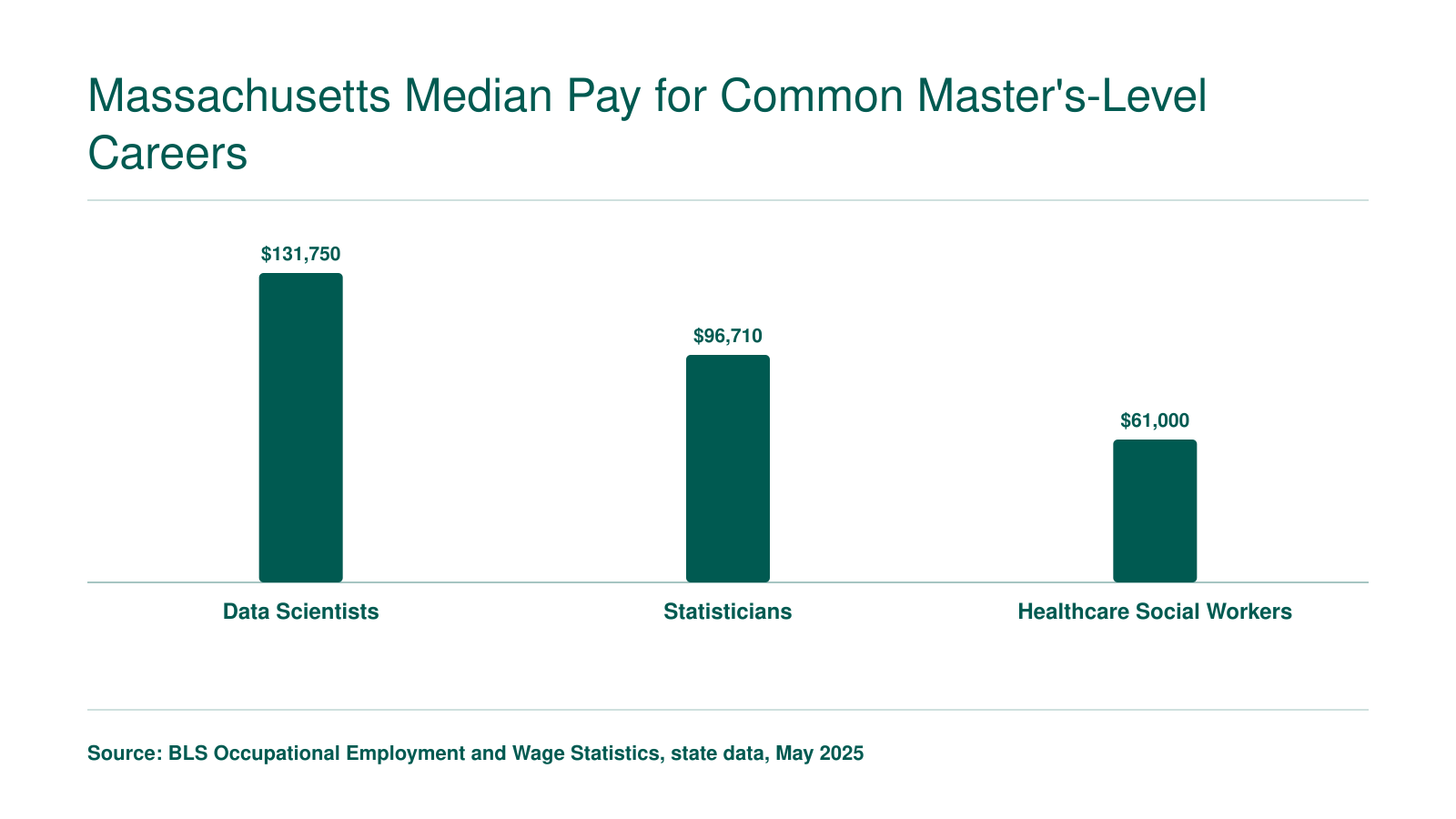
Massachusetts Median Pay for Common Master's-Level Careers
These are Bureau of Labor Statistics occupational wages for everyone working in each job in Massachusetts. They are not what graduates of any particular master's program earn, and many workers in these fields hold different degrees or experience levels. For nurse practitioners, physician assistants, K-12 education administrators, and mental health counselors, check the current BLS state tables before comparing, because the national mental health counselor median of $64,440 is not a Massachusetts figure.
International Students: Visas, English Tests, and Enrollment Rules
For international applicants, the choice between an on-campus master's and a fully online one is not really a choice at all. Online study generally cannot support F-1 status: UMass Amherst states plainly that F-1 and J-1 students cannot pursue an entirely online degree in the United States, and its Isenberg online MBA is closed to those visa categories for that reason. Immigration rules also cap how much online coursework counts toward full-time enrollment, typically a single distance class or up to three credits per term, so the rest of your load has to meet in person.
The F-1 sequence
The order rarely varies. You are admitted, you document funding for the first year against the school's estimated cost of attendance, and the international student office issues your Form I-20. You then pay the SEVIS I-901 fee (confirm the current amount on the official federal site before paying), complete the DS-160, and schedule a visa interview at your local consulate. Build in months, not weeks, since interview wait times swing widely by post.
English proficiency minimums
Massachusetts universities set these by program, not centrally. At UMass Boston, most graduate programs look for roughly TOEFL 79 and IELTS 6.0, while a listed group of programs requires about 90 and 6.5, and listed doctoral programs 100 and 7.0. The UMass Amherst Graduate School floor is near TOEFL 80 and IELTS 6.5, with many departments expecting more. Boston University's College of Arts & Sciences asks around TOEFL 100 and IELTS 7.0 for PhD and MFA applicants; Computing & Data Sciences and Fine Arts sit lower on TOEFL. Note that TOEFL is shifting to a 1 to 6 reporting scale for tests taken on or after January 21, 2026, which is why Northeastern's College of Professional Studies and CSSH publish figures like 4, 4.5, and 5.5.12 Applicants holding a prior degree taught in English are often waived, but confirm with the department.
Why STEM designation matters
Post-completion OPT normally runs 12 months. A qualifying STEM degree can add a 24-month extension, up to 36 months total, which is a powerful draw in Boston's biotech and software employers.
Graduate schools in Massachusetts with the most master's programs
| School | City | Type | Master's programs | Online | Grad tuition / yr |
|---|---|---|---|---|---|
| Boston University | Boston | Private nonprofit | 92 | 32 | $67,626 |
| Northeastern University | Boston | Private nonprofit | 79 | 41 | $26,020 |
| Northeastern University | Boston | Private nonprofit | 79 | 33 | $29,174 |
| University of Massachusetts-Amherst | Amherst | Public | 71 | 23 | $17,410 |
| University of Massachusetts-Lowell | Lowell | Public | 55 | 41 | $16,434 |
| Boston College | Chestnut Hill | Private nonprofit | 52 | 19 | $37,520 |
| Merrimack College | North Andover | Private nonprofit | 43 | 32 | $36,800 |
| University of Massachusetts-Boston | Boston | Public | 40 | 14 | $20,456 |
| Regis College | Weston | Private nonprofit | 37 | 24 | $17,910 |
| Simmons University | Boston | Private nonprofit | 37 | 19 | $28,561 |
| Harvard University | Cambridge | Private nonprofit | 37 | 12 | $57,248 |
| Endicott College | Beverly | Private nonprofit | 36 | 33 | $15,534 |
| University of Massachusetts-Dartmouth | North Dartmouth | Public | 34 | 16 | $17,269 |
| Bay Path University | Longmeadow | Private nonprofit | 33 | 33 | $15,162 |
| Worcester State University | Worcester | Public | 33 | 18 | $6,813 |
Program counts are the verified master's listings in our directory; tuition is the school-wide average for a full-time graduate student (IPEDS).
Common Questions About Master's Programs in Massachusetts
These answers condense the cost, admissions, regional discount, and scheduling details covered above. Policies vary by program, so confirm specifics with the department you are considering.
What are the cheapest master's programs in Massachusetts?
Do Massachusetts master's programs require the GRE?
Can residents of other New England states get reduced tuition for a Massachusetts graduate program?
Can I work full time while earning a master's in Massachusetts?
Compare programs nationwide
Many Massachusetts residents study online. Every ranked list above has an online lens, or browse every field.
Online master's programs Browse all fields