Best Master's in Information Security and Assurance Programs in Massachusetts
Compare 7 accredited Information Security & Assurance programs in Massachusetts, with graduate earnings, cost, debt, and completion data from IPEDS and the U.S. College Scorecard.

Which Massachusetts information security master's actually pays for itself? The state's hiring base makes that a fair question: defense contractors, hospital systems, financial firms, and the Route 128 software corridor all keep security staff on payroll year-round.
Campus, hybrid, and fully online programs sit side by side here, and the price spread is wide. Boston University lists $27,920, $29,700 in total program cost for its security concentration; Northeastern publishes $61,504 for its MS in Cybersecurity. Both carry National Security Agency designations, which means the credential gap between them is narrower than the cost gap.
Key Points
- Boston University holds NSA cyber defense and research designations, both currently valid through 2028.
- Northeastern University is the only school here reporting program-level earnings one year after graduation.
- Check each school's admissions page for GRE rules, since policies can change before 2027 deadlines.
Best Master's in Information Security and Assurance Programs in Massachusetts, Ranked
These six Massachusetts programs mix campus, hybrid, and fully online formats. Graduation rates cited below are institution-wide, not program completion rates, and net price figures are approximate institution-wide averages rather than quotes for graduate students. No Massachusetts master's in this field is confirmed as ABET accredited, so the designations noted are federal cybersecurity designations (CAE), which may apply to the institution or a broader portfolio rather than the exact degree.
Harvard University
#1Cambridge, MA · $55,000 – $60,000/yr (est.)
Best for: Working professionals building stackable credentials
Harvard Extension School offers a hybrid Master of Liberal Arts (ALM) in Cybersecurity: 11 online courses plus a three-week summer course on campus, at $3,580 per course. Standouts include stackable graduate certificates and an industry-partnered capstone. Harvard's institution-wide graduation rate is about 98 percent, and its approximate average net price is near $19,100. It holds NECHE institutional accreditation, but no ABET accreditation for this master's is established.
- Hybrid: 11 online courses plus a 3-week summer course on campus
- 12 courses total, tuition $3,580 per course
- Completion takes 2 to 5 years
- Four start dates per year
- Capstone with industry partners
- Three stackable graduate certificates
- Prior C++, Python or Java programming expected
Boston University
#2Boston, MA · $65,000 – $70,000/yr (est.)
Best for: Fully online students avoiding a thesis
Boston University's online M.S. in Computer Information Systems with a security concentration runs 32 credits over 16 months, with total program tuition of $27,920 and no thesis or capstone. The school holds NECHE accreditation and an NSA Center of Academic Excellence designation (CAE-CD and CAE-R), though the designation may not attach to this exact degree. Institution-wide graduation rate is about 89 percent, and approximate average net price is about $24,400.
- Fully online, part-time available
- 32 credits, 16-month program
- Total program tuition $27,920
- No thesis or capstone required
- Eight concentration options
- Covers cryptography, digital forensics, secure software development
- Scholarships and financial aid available
University of Massachusetts-Lowell
#3Lowell, MA · ~$16,000/yr (est.)
Best for: Students targeting government cybersecurity roles
UMass Lowell's cybersecurity concentration sits inside a 30-credit M.S. in Security Studies, offered online and run by Criminology and Justice faculty. Annual graduate tuition is about $15,700 in-state and $28,400 out-of-state. It is NECHE accredited with a CAE-R designation, and its regional ties include a student-staffed security operations center. Institution-wide graduation rate is about 65 percent, and approximate average net price is about $17,200.
- Online delivery, 30 credits
- Test optional, rolling admissions
- Starts fall, spring or summer
- 3.0 GPA minimum
- Transfer up to 12 graduate credits
- Certificate pathway stacks toward the M.S.
- Focus on network security and cyber forensics
University of Massachusetts-Amherst
#4Amherst, MA · $15,000 – $20,000/yr (est.)
UMass Amherst treats security as an engineering problem, with a five-course Computer Security concentration inside the M.S. in Electrical and Computer Engineering, offered on campus. Annual graduate tuition is about $15,100 in-state and $33,400 out-of-state. The UMass Cybersecurity Institute partners with MITRE and the Massachusetts Attorney General's office. Institution-wide graduation rate is about 83 percent, and approximate average net price is about $22,400. Confirm current NECHE and programmatic status with the school.
- On campus, inside the M.S. in Electrical and Computer Engineering
- Five-course concentration
- Courses in cryptography and computer architecture
- Projects in embedded and networking systems
- Covers social, legal and economic issues
University of Massachusetts-Boston
#5Boston, MA · ~$20,000/yr (est.)
UMass Boston's hybrid M.S. in Information Technology offers a cybersecurity elective area within a 30-credit, ten-course degree housed in the College of Management. GRE and GMAT scores are not required. Annual graduate tuition is about $19,900 in-state and $38,700 out-of-state. Institution-wide graduation rate is about 49 percent, and approximate average net price is about $17,700. Confirm current NECHE and programmatic status with the school.
- Hybrid format, 30 credits across ten courses
- No entrance exam required
- Rolling admissions, two recommendation letters
- Capstone with a written paper
- Electives in network forensics and cloud security
- Courses waivable through prior coursework
Northeastern University
#6Boston, MA · ~$26,000/yr (est.)
Northeastern's M.S. in Cybersecurity at the Boston campus blends technical, legal, and policy training, with an optional paid co-op. Total program tuition is about $61,504 over roughly two years, and the GRE is optional. It is NECHE accredited with a CAE-R designation for cyber operations, which may not attach to this exact degree. An Align track is designed for non-majors. Institution-wide graduation rate and net price are not reported.
- Boston campus, full-time or part-time
- About two years, total tuition $61,504
- Capstone required, optional paid co-op
- Test optional, rolling admissions
- Fall and spring starts
- 3.0 GPA minimum, two recommendation letters
- Align track designed for non-majors
Cost & outcomes by school
Federal data for the highest-earning Information Security & Assurance programs, independent of the ranking above. Earnings are this field's master's graduates four years after completing, where the Scorecard reports them.
| School | Earnings | Tuition / yr | Debt | Grads/yr | Format |
|---|---|---|---|---|---|
| University of Massachusetts-Lowell MA | — | $16,434 | — | — | Online |
| University of Massachusetts-Amherst MA | — | $17,410 | — | — | Campus |
| University of Massachusetts-Boston MA | — | $20,456 | — | — | Hybrid |
| Northeastern University MA | — | $26,020 | — | — | Campus |
| Northeastern University MA | — | $29,174 | — | 82 | Online |
| Harvard University MA | — | $57,248 | — | 1 | Hybrid |
| Boston University MA | — | $67,626 | — | 3 | Online |
Sources: U.S. Department of Education. Tuition and graduates: IPEDS. Earnings and debt: College Scorecard, this field's master's graduates; a dash means no figure is reported.
Cybersecurity vs. Information Assurance Master's: Technical, Policy, and Management Tracks
Boston University's National Security Agency designations stretch back to 2004 for cyber defense and 2008 for research, both valid through 2028, a longevity the degree titles alone don't reveal.
What the labels actually mean
Cybersecurity master's programs focus on defending systems: network defense, cryptography, penetration testing, secure architecture. Information security leans toward protecting data itself. Information assurance master's programs sit closest to governance, risk, and compliance, where the work is building programs against frameworks like NIST, running audits, and briefing executives. The split shows up clearly in the Massachusetts options. UMass Amherst's computer security concentration takes an engineering approach, with cryptography, architecture, and projects in embedded and networking systems, feeding security engineer and research roles. UMass Lowell's security studies degree, run by criminology and justice faculty, points toward government and defense policy work instead.
Why CAE status matters
NSA Centers of Academic Excellence designations carry weight in federal and defense hiring and in CyberCorps scholarship eligibility. Boston University and Northeastern both carry NSA-linked recognition tied to their cybersecurity offerings. If you want hands-on engineering, favor programs with technical concentrations: Boston University's security track within its computer information systems master's, or UMass Amherst's computer security concentration.
Top First-Year Earnings for Massachusetts Graduates
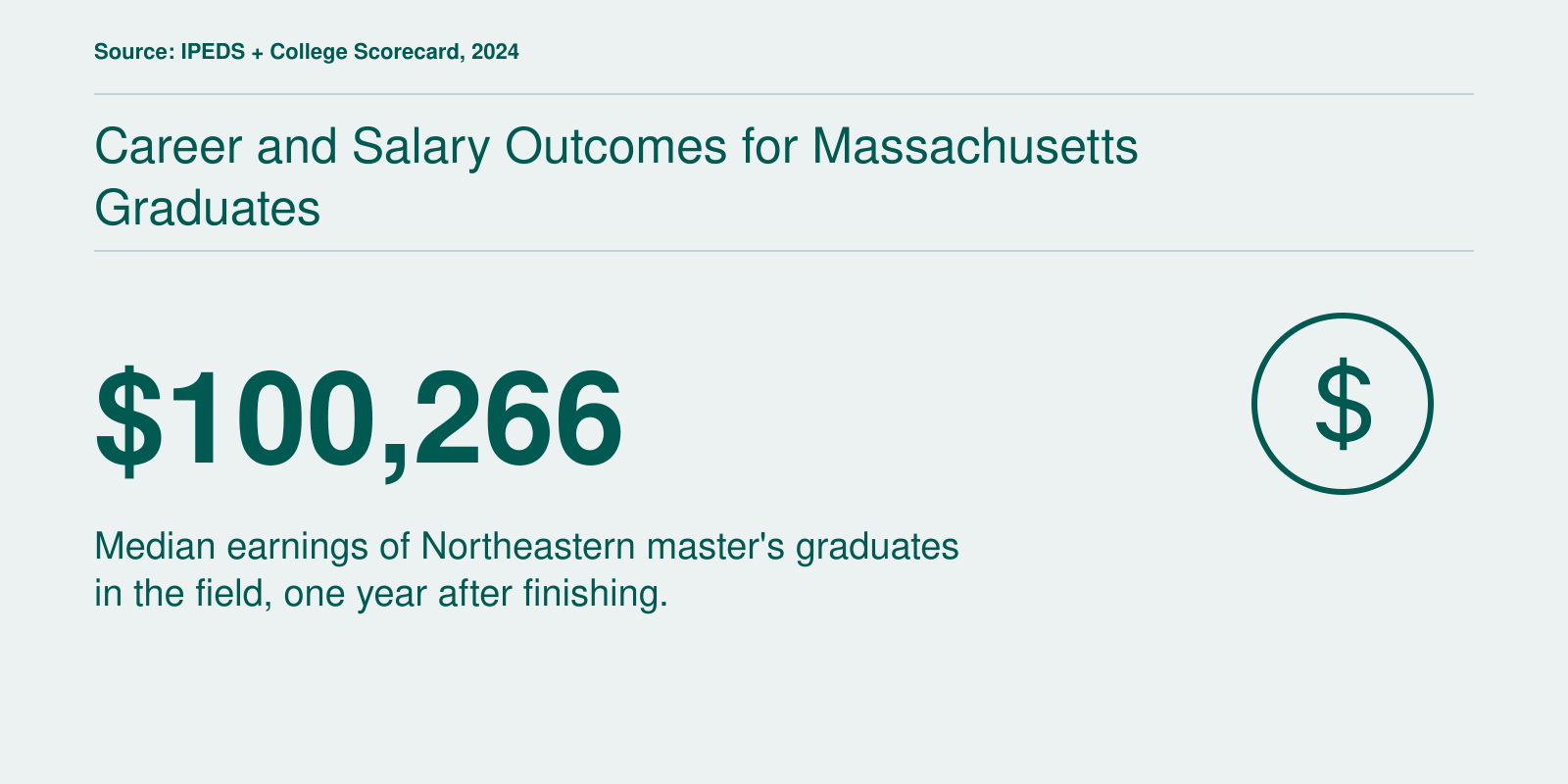
Among the schools here, Northeastern University shows the highest program-level graduate earnings one year out.
Online and Hybrid Information Security Master's Programs in Massachusetts
Working professionals comparing Master's Programs in Massachusetts can finish a Massachusetts information security master's while employed, but the delivery details matter more than the university name. Boston University's MS in Computer Information Systems with a security concentration can be fully online, on campus, or blended. Campus classes run in the evening, online courses are asynchronous, part-time enrollment is available, and no thesis or capstone is required. Northeastern's MS in Cybersecurity is offered in person or online, with full-time and part-time options and an optional paid co-op.1 Harvard's hybrid cybersecurity master's requires a capstone and includes a three-week on-campus summer course.
For hands-on learning, Boston University provides free online preparatory labs. Harvard's capstone is required; Northeastern requires a capstone and lists optional co-ops and internships with partners such as Rapid7 and MITRE.1
Practical takeaways: choose BU for flexible asynchronous evenings, Northeastern for co-op access, and Harvard for a structured hybrid with on-campus immersion. Verify start terms and any thesis, capstone, internship, or co-op requirements before applying.
Which Massachusetts Information Security Master's Programs Waive or Make the GRE Optional?
Several of the schools here do not require the GRE for their security-related master's programs, but the details vary by program. The table shows each school's published policy and any related criteria. Policies can change from term to term, so confirm the current requirement with the admissions office before you apply. Harvard and Boston University are not listed because we have no verified test policy for them, so check their admissions pages directly.
| School | GRE/GMAT Policy | Waiver or Exemption Criteria |
|---|---|---|
| University of Massachusetts Boston, MS in Information Technology | GRE/GMAT not required | None needed, since the test is not required |
| University of Massachusetts Boston, general graduate admissions | Some programs require GRE or GMAT scores; applicants must check each program's requirements | Massachusetts residents with a documented developmental disability (including dyslexia, but not blindness as the sole disability) may request a waiver; some programs may require an alternative assessment |
| University of Massachusetts Lowell, MS in Security Studies | GRE optional | No separate test waiver published. A 3.000 minimum GPA applies to science, technology, or engineering majors, and it can be waived with suitable professional experience or a relevant science or technology graduate degree |
| Northeastern University, MS in Cybersecurity (Boston) | GRE optional | No separate test waiver published. Minimum GPA of 3.0 on a 4.0 scale (or 8.0 on a 10.0 scale, or 80 on a 100 scale) |
| University of Massachusetts Amherst, Isenberg School of Management programs | GMAT required, with GRE accepted as an alternative | No waiver criteria published in the sources reviewed |
Related Articles
Career and Salary Outcomes for Massachusetts Graduates
Northeastern University is the only school here with a published program-level median earnings figure for its information security and assurance master's. It is measured one year after finishing. The other schools do not report program-level earnings or debt, so they are left out rather than filled in with institution-wide numbers. Against Northeastern's listed total program tuition of $61,504, first-year earnings cover the full cost of the degree with room to spare. Program-level debt is not reported, so a true earnings-to-debt ratio cannot be calculated.
Common Questions About Information Security Master's Programs in Massachusetts
How long does a cybersecurity master's program take in Massachusetts?
Can I get a master's in cybersecurity with no experience?
Is an MS in cybersecurity and information assurance worth it for federal jobs?
Compare Information Security & Assurance programs on the data that matters
Explore more Computers & IT specializations or browse every graduate field.
All Computers & IT programs