Best Master's in Machine Learning Programs
Compare 150+ accredited Machine Learning programs at 140+ schools, with graduate earnings, cost, debt, and completion data from IPEDS and the U.S. College Scorecard.

A machine learning master's can list for under $8,000 in tuition or more than $71,000, and the higher price does not reliably buy a better outcome. The decision that matters is which program pays off for you, not which name carries the most prestige.
The rankings here rest on federal IPEDS and College Scorecard data: tuition, net price, graduate debt, and earnings. Pacific States University sits at the low-cost end, while Columbia, Carnegie Mellon, and USC price well above $50,000.
Public flagships such as Wisconsin-Madison, Maryland, and Washington list tuition between roughly $12,000 and $19,000, and that gap is where the real value comparisons begin.
Key Points
- Listed tuition runs from under $8,000 to more than $70,000 across the programs here.
- BLS projects data scientist employment to grow 35% from 2025 to 2035.
- Federal earnings and debt data compare programs more fairly than prestige or advertising does.
10 Master's in Machine Learning Programs: 2027 Rankings
The strongest entries in this ranking combine high institution-wide graduation rates, a track record of placing graduates into well-paid technical roles, and delivery formats that range from fully online to evening and hybrid options. Several top-ranked programs also report median early-career earnings above $120,000, though not every program publishes that figure. What separates the top of the list is a clear fit between program structure and a student's schedule, budget, and career goal.
Pacific States University
#1Los Angeles, CA · ~$8,000/yr (est.)
Best for: Working professionals balancing jobs and study
Pacific States University offers a STEM-designated master's track in computer science with an emphasis in artificial intelligence and machine learning, blending research orientation with practice-oriented coursework. The 56-quarter-unit program includes a required thesis and can be completed through evening, online, or hybrid formats to accommodate working students. Effective September 15, 2026, the university no longer offers Curricular Practical Training, a change F-1 students should weigh carefully.
- 56 quarter units required for completion
- 3.0 GPA minimum to graduate
- Thesis required
- STEM OPT extension eligible
- Evening, online, and hybrid class formats
- F-1 international students eligible
- Practice-oriented coursework and applied research
- Covers intelligent systems and data analytics
Columbia University in the City of New York
#2New York, NY · ~$58,000/yr (est.)
Best for: Online learners needing flexible pacing
Columbia University delivers a fully online master's in computer science with a machine learning concentration through its Columbia Video Network, taught by Columbia Engineering faculty. The program builds advanced skills in algorithms, data analysis, and model building with applications in bioinformatics, finance, and intelligent systems. Graduates are prepared for roles such as machine learning engineer, data scientist, or AI specialist.
- Focus on bioinformatics, finance, intelligent systems
- Hands-on algorithms, data analysis, model building
- Prepares for ML engineer, data scientist, AI specialist roles
- Delivered entirely online through Columbia Video Network
- Taught by Columbia Engineering faculty
- Covers core machine learning concepts
Carnegie Mellon University
#3Pittsburgh, PA · ~$51,000/yr (est.)
Best for: Students targeting AI research careers
Carnegie Mellon University is a top-ranked research institution with a dedicated School of Computer Science, offering both a 16-month Master of Science in Machine Learning and a one-year fifth-year master's for current CMU undergraduates. The main MS program is STEM-designated, includes a practicum, and is competitive, with accepted students averaging a 3.9 GPA. The fifth-year option allows CMU majors to complete the degree in one year with no GRE requirement.
- No entrance exam required
- Test optional
- 16-month program
- 9 total courses
- STEM-designated program
- Practicum includes internship or research
- Average GPA of accepted students: 3.9
- Part-time available for domestic students
- 1-year program
- Open to any CMU major
- No thesis or capstone required
- No GRE scores required
- Summer practicum (internship or research)
- Three courses double-count
- Starts fall or spring
Boston College
#4Chestnut Hill, MA · ~$38,000/yr (est.)
Boston College offers a STEM-designated master's in applied analytics with a focus on machine learning, artificial intelligence, and data analysis. The 30-credit program can be completed in 12 months and is available in a hybrid format with full-time or part-time options. Students complete a hands-on capstone, and a dual degree with applied economics is available.
- $1,550 per credit
- 12-month program
- 30 total credit hours
- 10 total courses
- Capstone required
- STEM-designated program
- Dual degree with Applied Economics available
- Flexible online and on-campus options
Santa Clara University
#5Santa Clara, CA · ~$32,000/yr (est.)
Santa Clara University, located in Silicon Valley, offers an electrical and computer engineering master's with a concentration in signal processing and machine learning. The 46-unit program requires a 3.0 GPA and offers optional thesis research, with strong industry connections in the tech sector. Students may transfer up to 9 quarter units and complete the degree over a six-year limit.
- 6 concentration options
- 46 total credit hours
- 3.0 GPA minimum
- No thesis or capstone required
- Optional thesis up to 9 units
- Transfer up to 9 quarter units
- Residence: 37 units at SCU
- Six-year completion limit
University of Southern California
#6Los Angeles, CA · ~$72,000/yr (est.)
The University of Southern California offers an on-campus master's in electrical and computer engineering with a machine learning and data science concentration. The 32-unit program is test-optional, includes thesis and directed research options, and reports median earnings of $136,400 with top employers such as Amazon, Google, and Meta. International students are eligible for OPT STEM extension, and scholarships are available for fall applicants.
- 32 total credit hours
- Complete in 2-3 semesters
- No entrance exam required
- Test optional
- Median earnings $136,400
- Top employers: Amazon, Google, Meta
- Eligible for OPT STEM extension
- Scholarship consideration deadline December 15
University of Wisconsin-Madison
#7Madison, WI · ~$12,000/yr (est.)
The University of Wisconsin-Madison offers an accelerated 16-month master's in electrical and computer engineering with a named option in machine learning and signal processing. The 30-credit, course-only curriculum emphasizes practical problem-solving and quantitative thinking, with no thesis requirement. Students complete a hands-on project or internship, and the program is test-optional with a 3.0 GPA minimum.
- Test optional
- 16-month program
- 30 total credit hours
- 3.0 GPA minimum
- No thesis or capstone required
- Course-only curriculum
- Hands-on project or internship
- Accelerated 16-month completion
University of Maryland-College Park
#8College Park, MD · ~$18,000/yr (est.)
The University of Maryland-College Park offers a 30-credit, non-thesis master's in applied machine learning designed for working professionals. Classes meet on campus in the evenings, and the curriculum includes electives in deep learning, natural language processing, and computer vision. Graduates pursue roles such as data scientist or information engineer in fields like marketing, finance, and medicine.
- Face-to-face instructional delivery
- Evening classes for professionals
- Designed for working professionals
- Electives in Deep Learning, NLP, Computer Vision
- Advanced topics in deep learning and optimization
- Careers in data science and information engineering
- Co-directed by Amol Deshpande and Sennur Ulukus
Northwestern University
#9Evanston, IL · ~$55,000/yr (est.)
Northwestern University's master's in machine learning and data science is a 15-month, full-time campus program with a cohort of 55-60 students. The curriculum covers predictive, descriptive, and prescriptive analytics, and includes a summer internship and capstone. The program reports a 100% job placement rate within three months of graduation, with graduates hired by companies such as Spotify, Deloitte, and Qualtrics.
- 15-month program
- Cohort-based structure
- 100% job placement rate
- Capstone required
- Cohort of 55-60 students
- Covers predictive, descriptive, prescriptive analytics
- Quarterly seminar series and data conference
- Located on Evanston campus near Chicago
University of Washington-Seattle Campus
#10Seattle, WA · ~$19,000/yr (est.)
The University of Washington-Seattle offers a flexible, stackable master's in artificial intelligence and machine learning for engineering, designed for practicing engineers. The program requires an initial AI/ML certificate and a discipline-specific certificate before a capstone, with part-time and online options available. No GRE is required, and the program was developed with support from The Boeing Company.
- 5 concentration options
- Test optional
- Apply by June 1, 2027
- Full-time and part-time options
- 3.0 GPA minimum
- Capstone required
- Designed for working engineers
- Stackable degree pathway
Cost & outcomes by school
Federal data for the highest-earning Machine Learning programs, independent of the ranking above. Earnings are this field's master's graduates four years after completing, where the Scorecard reports them.
| School | Earnings | Tuition / yr | Debt | Grads/yr | Format |
|---|---|---|---|---|---|
| University of Wisconsin-Madison WI | $196,985 | $12,325 | — | 142 | Campus |
| Georgia Institute of Technology GA | $195,622 | $15,962 | $20,500 | 3,014 | Online |
| Carnegie Mellon University PA | $193,154 | $50,975 | $61,305 | 825 | Campus |
| Johns Hopkins University MD | $176,945 | $64,730 | $26,126 | 397 | Campus |
| University of Washington-Seattle Campus WA | $170,194 | $18,792 | $36,600 | 289 | Hybrid |
| Pennsylvania State University PA | $166,387 | $24,650 | $41,000 | 13 | Online |
| Northeastern University MA | $145,909 | $29,174 | $41,000 | 1,133 | Campus |
| George Mason University VA | $142,690 | $17,964 | $26,262 | 515 | Campus |
| Georgia State University GA | $136,876 | $8,664 | $30,750 | 198 | Campus |
| The University of Texas at Dallas TX | $130,924 | $15,168 | $22,374 | 515 | Campus |
| University of Central Florida FL | $123,587 | $8,872 | $29,403 | 202 | Campus |
| Northern Illinois University IL | — | $9,176 | $24,300 | 144 | Campus |
Sources: U.S. Department of Education. Tuition and graduates: IPEDS. Earnings and debt: College Scorecard, this field's master's graduates; a dash means no figure is reported.
Cost, debt & payoff
Median earnings of this field's master's graduates (4 yrs after completing) vs. their median federal loan debt · U.S. College Scorecard
Across these programs the median graduate earns about $138,766 and finishes with roughly $37,072 in debt — a ratio that clears a common rule of thumb (keep debt below first-year salary). Tuition and debt vary widely school to school, so check the per-school figures in the table above before you shortlist.
How We Rank Machine Learning Master's Programs
Where the Numbers Come From
Program offerings and tuition come from IPEDS, the federal postsecondary data system. Earnings, debt, and completions come from College Scorecard, which reports many of them at the level of the individual program rather than the whole university.
Program Outcomes Versus Institution-Wide Context
The two kinds of data answer different questions. Program-level outcomes show what graduates of a specific credential earn one to five years after finishing. Institution-wide figures, such as 10-year earnings and admission rate, describe the entire university, including its undergraduates and other graduate fields such as data analytics master's programs or cybersecurity master's programs. They are useful context, but they say little about a particular ML degree. When program-level earnings exist, we weight them more heavily. When they don't, institution-wide figures fill in as background only.
Accreditation Requirement
Every school ranked here must hold institutional accreditation from a recognized accreditor. In the U.S. that means one of HLC, MSCHE, NECHE, NWCCU, SACSCOC, or WSCUC.3 You can confirm a school's status in the CHEA directory (more than 8,200 institutions)1 and in the Department of Education's DAPIP database.2 Check the specific campus that delivers the degree, since a university-wide statement may not cover a branch or an online unit. The Department recognizes accreditors but does not accredit schools itself, and DAPIP is not audited, so reconcile any mismatch with the accreditor's own directory.2
No single specialized accreditor covers ML master's degrees. ABET accredits particular computing programs, mostly at the bachelor's level4, and its AI/ML criteria for 2026-2027 are still proposed.5 An ABET-accredited bachelor's does not make a school's master's ABET-accredited, so we don't treat the absence of ABET as a mark against a program.4
Limits You Should Know
Net price is an average for the whole institution, so your cost in a specific ML program may be higher or lower. Some programs are too new or too small to have published earnings; in those cases we leave the figure blank instead of estimating. Treat the figures as a starting point, then confirm current costs and outcomes with each program.
The Ranked ML Master's Programs at a Glance
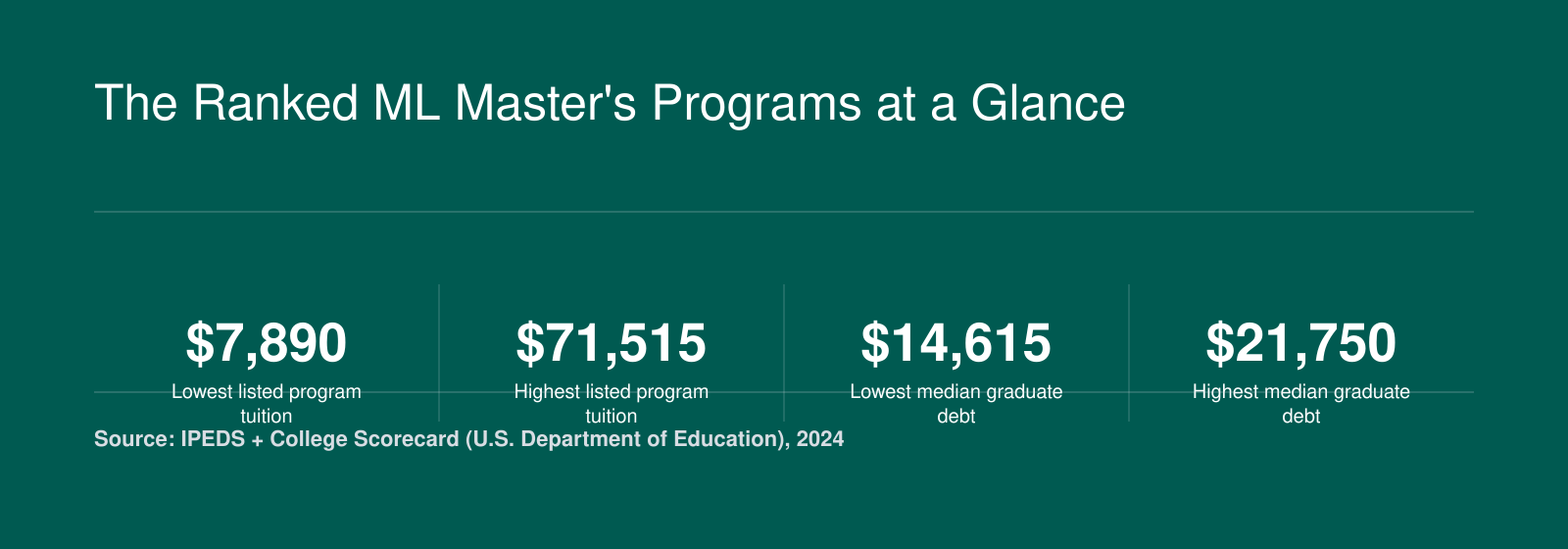
The programs here span formats, with online, hybrid, and on-campus options all represented. Listed tuition runs from under $8,000 to more than $70,000, so price varies far more than most applicants expect. Earnings and debt figures below describe each university overall rather than the ML program alone, so use them as context and not as a promise.
What a Machine Learning Master's Really Costs: Tuition, Fees, and Living Expenses
The price of a machine learning master's now depends less on the school's reputation than on where you live and how many months you stay enrolled.
Tuition Is the Visible Number
Among the public and online Computers & IT master's programs here, listed tuition runs from about $11,800 (Indiana University-Bloomington, in-state) to about $38,200 (University of Maryland-College Park, out-of-state). The in-state discount is real at flagship publics, while Colorado State University Global charges one flat rate for everyone. Private sticker prices sit in a different tier: MIT lists $66,720 for nine months1, Stanford roughly $66,300 to $69,700 depending on plan2, and Carnegie Mellon $62,2003.
What Tuition Leaves Out
Mandatory fees and insurance add up. Carnegie Mellon lists an $864 fee and $3,352 for health insurance.3 MIT's insurance is $5,148 if you choose its plan,1 and Stanford charges a $1,124 health services fee.2 Outside a school plan, a 2026 graduate cost of living comparison puts graduate health coverage at $250 to $400 a month. Furnishing a first apartment costs another $800 to $3,000 once. Also set aside money for laptop upgrades, cloud credits, and software, since published estimates rarely itemize them.
Housing is the biggest swing. The same comparison, which excludes insurance and personal extras, estimates monthly living costs for a graduate student sharing a two-bedroom at:
- Palo Alto: $3,329
- New York City (Morningside Heights): $3,062
- Cambridge: $2,760
- Seattle (U-District): $2,549
- Pittsburgh (Squirrel Hill): $1,969
That is about $1,360 a month between Palo Alto and Pittsburgh, or roughly $16,300 over a year. Rent alone is $2,000 versus $850.
Length Matters More Than the Rate
A second year costs far more than a cheaper per-year rate saves. MIT's published estimate is $109,017 for nine months and $144,315 for twelve.1 Carnegie Mellon's tuition plus non-tuition costs come to roughly $99,600 for a year.3 Add a second year and you roughly double the bill, while the Palo Alto-to-Pittsburgh housing gap is only a fraction of that. These published totals are built differently, so compare their components rather than the bottom lines.
A Note on Net Price
The net price figures attached to each school are institution-wide averages after aid. They are not a quote for an individual graduate student, whose funding depends on assistantships, scholarships, and employer support.
Lowest-Debt Machine Learning Master's Programs
The lowest-debt machine learning master's programs below compare median federal debt at completion with tuition and format. Each debt figure is a program-level median federal debt at completion, and the payment column shows the median 10-year federal loan payment for the same borrower group.
| School | Format | In-state tuition | Out-of-state tuition | Median debt at completion | Median 10-year monthly payment | Debt basis |
|---|---|---|---|---|---|---|
| The University of Texas at Dallas | Campus | $15,168 | $29,548 | $22,374 | $255 | Program-level median federal debt at completion |
| University of Washington-Seattle Campus | Hybrid | $18,792 | $32,811 | $36,600 | $416 | Program-level median federal debt at completion |
| Northeastern University | Campus | $29,174 | $29,174 | $41,000 | $466 | Program-level median federal debt at completion |
Related Articles
Online, Hybrid, and On-Campus ML Master's: Time to Degree and Flexibility
Format shapes how long the degree takes, whether you can keep working, and what kind of culminating project you finish with. In our rankings, "Both" means a school offers the program online and on campus.
Online: Built for Working Professionals
Georgia Tech's online M.S. in Computer Science (ML specialization) is 30 credits1, typically finished in about three years2, with credits valid for six years. The ML specialization takes five or six courses, and the rest are free electives.1 The 2026 materials describe a coursework-based degree and do not list a required thesis or capstone.1
UT Austin's online MSAI and MSCS are also 30 credits3, with completion generally running 18 to 36 months, according to the UT Austin CDSO online programs FAQ. The MSAI is coursework-based, though a thesis option exists with faculty sponsorship.3 The MSCS offers an optional thesis, usually completed in the final two semesters.4 Neither publishes a separate full-time or part-time schedule, so you set your own pace within those windows.
On-Campus: Faster, Immersive, Full-Time
Carnegie Mellon's MSML runs 20 months (four semesters plus a summer) and is full-time only, according to the Carnegie Mellon ML Master's Handbook. It requires 111 units, including a practicum, and has no thesis option. The Advanced Study version also runs 20 months but requires 147 units, including a thesis of at least 36 units of research and an internship.5 Campus formats generally give you easier access to internships and faculty research, which matters if you want a research or PhD-track path.
Which Fit Is Right for You?
- Working professionals: Online programs let you keep your salary while you study, at the cost of a longer timeline.
- Career changers who want speed and recruiting access: A full-time campus program compresses the degree and puts internships within reach.
- Research-minded students: Look for a required or optional thesis, as in CMU's Advanced Study track or the UT Austin MSCS.
Columbia's ML track is a well-known on-campus option, but confirm its current credit and thesis requirements directly with the department before you plan around it.
Admissions Requirements and Prerequisites for ML Master's Programs
Requirements vary by school, and published figures are often profiles or preferences rather than hard cutoffs. Confirm current details with each program before you apply. Stanford's MS CS AI track is not covered below because we could not verify its current requirements.
- Bachelor's degreeMost programs expect a degree in computer science, mathematics, statistics, engineering, or a related quantitative field. Georgia Tech OMSCS prefers computer science or a related field such as math, computer engineering, or electrical engineering. UT Austin's MSAI lists computer science, engineering, statistics, data science, or mathematics. Carnegie Mellon does not require a CS degree but expects strong CS preparation.
- Math prerequisitesCarnegie Mellon's MSML assumes a year of college-level probability and statistics, matrix algebra, and multivariable calculus. UT Austin's MSAI points to discrete mathematics and linear algebra coursework. Georgia Tech's official sources do not publish a full list of required math courses.
- Programming proficiencyExpect Python plus data structures and algorithms coursework. Carnegie Mellon says Java or Python is more useful than C, and that Matlab, R, or NumPy/SciPy experience helps. Georgia Tech expects programming fundamentals and recommends knowing multiple languages.
- GPA and GRECarnegie Mellon's published average GPA of 3.9 describes admitted students and is not a formal minimum. Its GRE is optional for Fall 2025 entry, and the GRE Subject Test is not required. Georgia Tech prefers a 3.0 and reviews other applicants case by case. It does not require the GRE. UT Austin's MSAI does not require the GRE either, though a score may help applicants without a relevant degree.
- Letters, statement, and English testsPlan on recommendation letters and a statement of purpose that explains your goals. International applicants generally submit TOEFL or IELTS scores. Carnegie Mellon lists a TOEFL of 111. Georgia Tech lists IELTS Academic 7.5 overall, and its TOEFL thresholds changed with the January 2026 scoring update. UT Austin's reported TOEFL 100 and IELTS 7.0 come from a secondary source, so verify them before relying on them.
The Bureau of Labor Statistics projects data scientist employment will grow 35% from 2025 to 2035, far faster than the average occupation, with median pay of $120,230 in May 2025. Computer and information research scientists, a related field, are projected to grow 22% over the same decade.
Machine Learning programs by state
Frequently Asked Questions About Machine Learning Master's Programs
These answers draw on the earnings, cost, and format data behind the rankings above. Figures describe typical outcomes, not guaranteed results for any one graduate.
Is a master's in machine learning worth it?
Can you get a master's in machine learning online?
Can I get into an ML master's without a computer science bachelor's degree?
Do I need a PhD instead of a master's for ML research roles?
Compare Machine Learning programs on the data that matters
Explore more Computers & IT specializations or browse every graduate field.
All Computers & IT programs