Best Master's in Machine Learning Programs in Michigan
Compare 6 accredited Machine Learning programs in Michigan, with graduate earnings, cost, debt, and completion data from IPEDS and the U.S. College Scorecard.

Is a Michigan "machine learning" master's really a machine learning degree? Usually not. Oakland University offers an artificial intelligence MS with a machine learning concentration, Northern Michigan University a computer science MS, and Northwood University a Master's in Business Analytics in Michigan.
That matters because credits, GRE rules, and earnings differ by program. Campus and online options sit side by side here, and the University of Michigan-Dearborn question gets a direct answer.
Key Points
- Walsh College offers the closest match to a dedicated machine learning master's in Michigan.
- Northern Michigan University is cheapest for residents at $12,196, per the tuition comparison.
- University of Michigan-Dearborn shows the widest residency gap, about $13,224 a year.
Top Master's in Machine Learning Programs in Michigan, Ranked
This list weighs program outcomes, cost, and institution-wide graduation rates. Most Michigan options are adjacent degrees, meaning an AI, analytics, or computer science master's with a machine learning concentration, rather than a dedicated machine learning degree. Walsh College comes closest, since its degree title names machine learning directly. Check each official degree title and curriculum before you apply.
University of Michigan-Dearborn
#1Dearborn, MI · ~$17,000/yr (est.)
Best for: Working professionals needing evening or online classes
The University of Michigan-Dearborn offers a Master of Science in Artificial Intelligence, an adjacent degree with a Machine Learning concentration rather than a dedicated ML degree. Graduate tuition is $16,726 in-state and $29,950 out-of-state. Schools offering this program graduate 58% of students. The university describes it as Michigan's first master's specifically in AI, and its computer vision work connects to the state's autonomous-vehicle industry.
- 30 credits; adjacent AI degree with a Machine Learning concentration
- Four concentrations: Machine Learning, Computer Vision, Intelligent Interaction, Knowledge Management and Reasoning
- Concentration is three courses (9 credits)
- Finish on campus, fully online, or hybrid
- Late-afternoon and evening classes
- Coursework, project, or thesis option
- 3.0 GPA and STEM bachelor's; GRE not required
- Rolling admission; 4+1 pathway for eligible UM-Dearborn undergraduates
Northwood University
#2Midland, MI · ~$38,000/yr (est.)
Best for: Business analysts applying ML to decisions
Northwood University's Global Master of Science in Business Analytics is an adjacent analytics degree, not a dedicated ML degree. It concentrates on machine learning, artificial intelligence, and predictive analytics. Graduate tuition is $37,980 for in-state and out-of-state students alike, the highest of the five schools here. Schools offering this program graduate 63% of students. It suits students who want ML applied to business problems.
- Adjacent business analytics degree with ML, AI, and predictive analytics focus
- 12-month program with a required problem-based capstone
- Start online or on campus (hybrid delivery)
- Courses include Solving Business Problems with Machine Learning
- Hands-on tools: SAS, Python, R
- STEM-designated, with OPT eligibility for 36 months
- Rolling admissions; scholarships up to $6,000
Oakland University
#3Rochester Hills, MI · ~$22,000/yr (est.)
Best for: Engineers wanting a broad AI concentration menu
Oakland University's Master of Science in Artificial Intelligence sits in its School of Engineering and Computer Science and offers a Machine Learning concentration. It is an adjacent AI degree, not a dedicated ML degree. Graduate tuition is $21,960 in-state and $24,648 out-of-state, so the out-of-state premium is small. Schools offering this program graduate 58% of students. Nine concentrations make it a good fit for engineers who want to compare ML with other AI specialties.
- Adjacent AI degree with a Machine Learning concentration
- Nine concentrations, including Edge AI and IoT, Trustworthy AI, and AI for Cyber Security
- Core AI foundation plus specialized electives
- On-campus delivery
- Offered through the School of Engineering and Computer Science
- Pathway to a Ph.D. in computer science
Walsh College
#4Troy, MI · ~$17,000/yr (est.)
Walsh College offers a Master of Science in Artificial Intelligence and Machine Learning. This is the only degree title on this list that names machine learning directly. Graduate tuition is $16,632 for in-state and out-of-state students alike. Classes run online without set meeting times, live on Zoom, or in person. Federal data show median earnings of $80,535 one year after completion for this program.
- Degree title names AI and machine learning directly
- Can be completed in as little as one year
- Online asynchronous, live Zoom, or in-person classes
- Capstone course or three one-credit practicum courses
- Foundation courses may be waived based on prior degree or credits
- Fast Track lets master's students take doctoral-level courses
- Transfer credits accepted; personalized credit evaluation
- Free no-credit Moodle orientation required
Northern Michigan University
#5Marquette, MI · $12,000 – $16,000/yr (est.)
Northern Michigan University's Master of Science in Computer Science offers a concentration in Artificial Intelligence, Machine Learning, and Evolutionary Computation. It is an adjacent CS degree rather than a dedicated ML degree. At $11,248 in-state and $14,704 out-of-state, graduate tuition is the lowest of the five schools. Schools offering this program graduate 52% of students. The degree suits students who want a research-leaning, lower-cost campus option in Marquette.
- Adjacent CS degree with an AI, Machine Learning, and Evolutionary Computation concentration
- 32 credit hours
- Choose three of five areas, including Artificial Intelligence
- Courses include Machine Learning and Evolutionary Computation
- Thesis (suited to PhD paths) or project (industry-focused)
- On-campus delivery
Cost & outcomes by school
Federal data for the highest-earning Machine Learning programs, independent of the ranking above. Earnings are this field's master's graduates four years after completing, where the Scorecard reports them.
| School | Earnings | Tuition / yr | Debt | Grads/yr | Format |
|---|---|---|---|---|---|
| Walsh College MI | $106,055 | $17,157 | $33,080 | 15 | Hybrid |
| Northwood University MI | — | $37,980 | — | — | Hybrid |
| Northern Michigan University MI | — | $12,196 | — | 1 | Campus |
| University of Michigan-Dearborn MI | — | $17,126 | — | 142 | Hybrid |
| Oakland University MI | — | $21,960 | — | 56 | Campus |
| University of Michigan MI | — | $28,886 | — | 220 | Online or campus |
Sources: U.S. Department of Education. Tuition and graduates: IPEDS. Earnings and debt: College Scorecard, this field's master's graduates; a dash means no figure is reported.
How Much Does a Master's in Machine Learning Cost in Michigan?
Resident vs. nonresident tuition
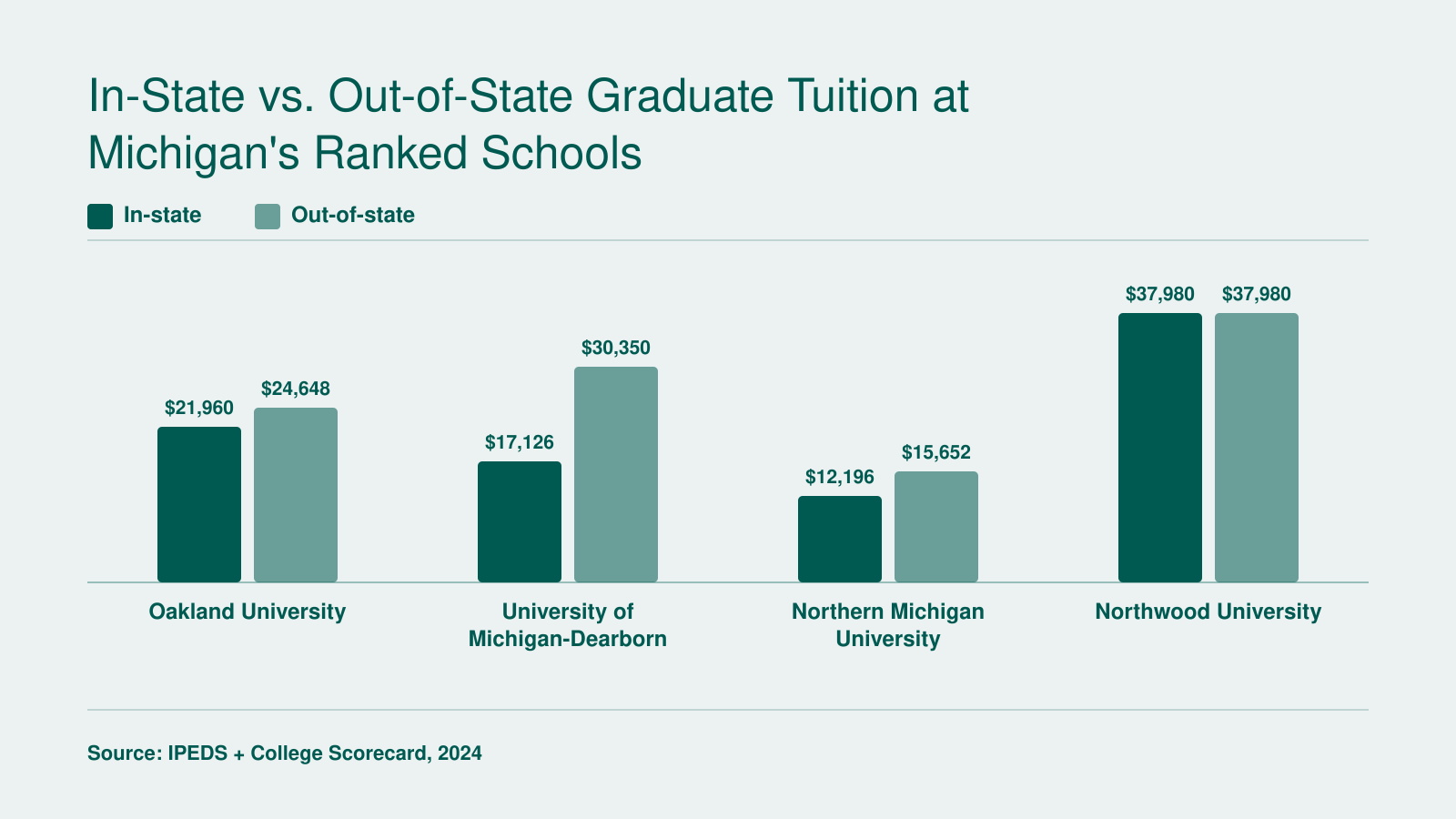
University of Michigan-Dearborn carries the widest residency gap among the best master's in machine learning schools here: about $17,126 a year for Michigan residents against $30,350 for nonresidents, a spread of roughly $13,224. Northern Michigan University is the lowest-priced option on both sides of the line, near $12,196 in-state and $15,652 out-of-state. Oakland University's gap is unusually narrow, about $21,960 versus $24,648. Northwood University, as a private institution, charges a single rate near $37,980 regardless of residency.
Per-credit rates and fees
Annual figures rarely match the bill. Michigan universities typically charge graduate work by the credit hour and layer on per-term registration and student-services fees, as Wayne State's graduate tuition and fee schedule shows,1 and engineering or computing programs often carry differential tuition above the general graduate rate. Some best online master's in machine learning programs add a per-credit distance fee. Confirm the current per-credit rate and the full fee schedule on each school's official tuition page before you budget.
Aid, assistantships, and credentials
Institution-wide net price averages (roughly $9,120 at Oakland and $9,492 at Dearborn) reflect aid across the whole student body, not a quote for graduate students. Realistic cost reducers across master's programs in Michigan are graduate assistantships, employer tuition assistance, and in-state online rates where a school publishes them.
Verify Higher Learning Commission accreditation directly with the institution. Michigan licenses no machine learning practitioners, so accreditation and a demonstrable project portfolio matter far more than any state credential.
In-State vs. Out-of-State Graduate Tuition at Michigan's Ranked Schools
Northern Michigan University is the cheapest option for Michigan residents at $12,196, and Northwood University has the smallest nonresident premium because it charges every student the same $37,980. University of Michigan-Dearborn has the widest gap, at about $13,224. Figures are published graduate tuition and fees before any aid.
Related Articles
Online and Hybrid Machine Learning Master's Options in Michigan
Delivery format has become as important as curriculum for working professionals choosing a machine learning degree, and Michigan schools now let students mix settings rather than pick one. University of Michigan-Dearborn is the clearest example.
University of Michigan-Dearborn
- MS in Artificial Intelligence: 30 credits. Students can take courses all on campus, all online, or a mix of the two. The project option is structured so a full-time student could finish in 24 months after coursework. That is a conditional schedule, not a typical part-time timeline.
- MS in Data Science: 30 credits. It is offered fully online, in person, or in a mixed format. A typical completion time is not stated.
What to confirm before you apply
Both Dearborn programs publish format and credit totals, but a typical completion time for part-time students is not listed. Ask the department whether evening or asynchronous sections are offered, since that determines whether you can keep a full-time job. Also confirm on the university's graduate tuition page whether online students pay the same rate as Michigan residents.
For Northwood University, Oakland University, Walsh College, and Northern Michigan University, check each school's official program page for current format, credit count, and scheduling before relying on any third-party listing.
Which Michigan Machine Learning Master's Programs Waive or Make the GRE Optional?
Prerequisites to expect
Most machine learning and AI master's programs expect a bachelor's degree in a quantitative field such as computer science, engineering, mathematics, or statistics. Admissions committees usually look for coursework in calculus, linear algebra, and probability, plus programming experience, most often in Python. Applicants from other backgrounds can sometimes close gaps with bridge or prerequisite courses, so ask each department before assuming you are ineligible.
GRE policies at the schools here
Michigan State University's M.S. in Data Science does not require the GRE.1 Wayne State University's M.S. in Artificial Intelligence and its online M.S. in Computer Science: Artificial Intelligence also do not require it.23 Wayne State's M.S. in Data Science and Business Analytics waives the GRE for applicants with a 3.0+ GPA.4 We could not confirm a current, published GRE policy for University of Michigan-Dearborn, Northwood University, Oakland University, Walsh College, or Northern Michigan University. Treat each as unconfirmed rather than assuming a waiver. The same goes for minimum GPA and fall application deadlines: we have no verified dates to report for these schools, and deadlines can change from one admissions cycle to the next.
Before you apply, check the Master's in Machine Learning Programs With No GRE Required list and each program's graduate admissions page for the exact test requirement, any GPA-based waiver, and the fall deadline. If a page is silent or unclear, email the graduate admissions office and ask for the policy in writing. Also ask whether work experience or a strong quantitative record can substitute for test scores at No-GRE master's programs.
Top Program-Level Earnings in Michigan
Walsh College's Master of Science in Artificial Intelligence and Machine Learning has the highest program-level earnings figure among the schools here.
Michigan Machine Learning Master's FAQ
Michigan degree titles vary, and many programs fold machine learning into broader artificial intelligence or data science curricula. These answers focus on what published program information supports, so confirm current details with each school before you apply.
How does the University of Michigan-Dearborn machine learning master's work?
Which Michigan universities offer a dedicated master's in machine learning rather than an AI or data science degree?
Can I enter a machine learning master's in Michigan without a computer science bachelor's degree?
Compare Machine Learning programs on the data that matters
Explore more Computers & IT specializations or browse every graduate field.
All Computers & IT programs